Archive for category Quotes

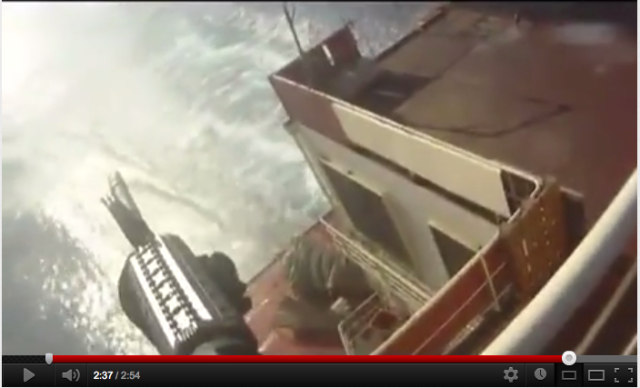
Quotes: Up To 80% Of Ship Owners Are In Favour Of Arming Their Vessels

“We took the decision three to four months ago that we could not defend our ships without contracting-in armed guards with light machine guns and who will shoot back,” said Per Gullestrup, CEO & Partner of Clipper Ferries/Ro-Ro.
“I hear that 60% to 80% of owners are in favour of arming their ships, which is a lot, and if you figure out that every time you do, it costs an owner between $30K and $50K to put armed guards on each passage then you are talking about a lot of money,” he said.

I had to post this, just because it is such a startling quote. And if the figures of $50,000 per passage is true, then anyone with any business sense will know that this is going to be one heck of a market.  I have mentioned this in the past, and will continue to say that the maritime security market is seeing some rapid growth right now and will only go up.

Of course this will only snowball on itself, just because no shipping company will want to be the ‘undefended low hanging fruit’ that could be easily taken by pirates. And believe me, there are plenty of ways for pirates to figure out what shipping companies are using armed security, and which ones are not. Pirate investment companies have elaborate intelligence collection operations going on, and they will find you if you are ‘easy money’.

The other thing I was wondering is that if PNC’s are making $50,000 per voyage, then how come we are not seeing salaries reflect this rate? These companies that are making this much money per trip, should definitely ensure that their contractors are getting paid well to put their lives on the line. For that fee, contractors should have the best equipment, weapons, and leadership on those voyages. We should also see health coverage as a mandatory benefit, just because there is no DBA out on the high seas. So if you get your leg blown off by an RPG round, I certainly hope that your company covers that? And if contractors are not able to receive these benefits because the rate is too low, then that $50,000 per voyage fee needs to go up.

I would also hope that companies are investing in good legal help, and offer their contractors full coverage if they happen to get caught up in some legal issues. There is so much that could happen out there, and there are no legal protections whatsoever. Please do not throw your contractors under the bus, and you have a responsibility to take care of them out there if they get into trouble. Especially if they are in ports of countries that have really shady laws.  There is no SOFA to protect or give guidance to these contractors out there, so a company really needs to be on the ball with this stuff.

Let’s talk about salaries. I believe salaries for maritime security should reflect the danger that those crews are up against. If pirates are using wolfpack tactics and heavy weaponry, then that ups the danger level tremendously. Not to mention that if pirates manage to sink a vessel, that the crew is now in danger of drowning. I make this point, because it is a requirement for most of these contractors to have STCW certifications. So contractors are expected to get this certification (on their own dime usually), so that if the vessel catches fire or sinks, that they will know how to survive. Why then are the salaries not reflecting this reality of sea life in pirate infested waters?

Not to mention that the value of the ship and it’s goods, and it’s safe delivery, is extremely important and vital to the world markets. Those armed guards are crucial to the safe delivery of those goods, and yet pay structures do not reflect this great responsibility? Stuff to think about, and I certainly hope that the companies remember who their most important asset is out there, and that is their contractors. -Matt


Up to 80% of owners want their ships armed

As many as 60% to 80% of ship owners are in favour of arming their vessels even though the cost can be as high as $50,000 per passage, a leading Danish ship owner has claimed.
“We took the decision three to four months ago that we could not defend our ships without contracting-in armed guards with light machine guns and who will shoot back,” said Per Gullestrup, CEO & Partner of Clipper Ferries/Ro-Ro.
“I hear that 60% to 80% of owners are in favour of arming their ships, which is a lot, and if you figure out that every time you do, it costs an owner between $30K and $50K to put armed guards on each passage then you are talking about a lot of money,” he said.

Read the rest of this entry »

Tags: , , ,

Quotes: Pratap Chatterjee On The Number Of Contractors Needed For Afghanistan During Drawdown

I just found this and thought I would share.  The two quotes in the article were the ones I thought were the most interesting, and if you would like to read the whole thing, by all means follow the link below.

What is cool here is Pratap has estimated a ratio of contractors to troops for this drawdown, based on the surges in Afghanistan and Iraq, and the drawdown in Iraq.  Or basically the numbers needed for the buildup or drawdown of a conflict. It would be interesting to see how well these figures hold up after all is said and done? Either way, I thought the numbers were pretty impressive.

In the article, he also mentioned how much private security has grown in Afghanistan, and I have talked about that in the past as well. He has predicted, and I agree, that DoS will have a pretty sizable requirement for security contractors there, much like for Iraq.

The other quote that I put up that was interesting, was the possible factors that could impact these numbers. That Karzai could implement the ban on private security companies under Decree 62, and install his own police force wherever. Or there could be a dramatic decrease in reconstruction.

The reconstruction stuff I do not see, because folks want a return on investment for projects they have already invested millions into.  If not, what a waste of money? Better to finish the project and then leave.

As to Karzai banning private security companies?  Well, as Pratap brought up, I think the latest attack at the Intercontinental Hotel in Kabul should change that mindset. I mean Karzai is responsible for shutting down and limiting PSC’s already. According to my readership, the MOI is sitting on approximately 45 licenses that have yet to be issued to companies so they can do their job.

So let’s think about that?  That is 45 companies that are wanting to provide security in a country where the enemy is purposely targeting civilians, and the MOI is just sitting on these licenses? The enemy is attacking hotels, supermarkets, hospitals, reconstruction sites, etc., and yet these private security assets are just wasting away….  I say let these private companies contract with private security, and let the Afghan police and military fight crime and wars. -Matt

afghanistan contractorsQuotes: Pratap Chatterjee On The Number Of Contractors Needed For Afghanistan During Drawdown

…Using a range of 1.3 to 1.4 (based on what Afghanistan needed before the surge and Iraq needed after the drawdown), I would project that if the Obama administration draws down to 68,000 troops in Afghanistan by September 2012, they will need 88,400 contractors at the very least, but potentially as many as 95,880.

….But the one group that has seen demand explode since Obama became president is the number of private security contractors (men or women with guns), which spiked from a flat line of about 4,000 to almost 19,000 today. Given the attack on the Intercontinental in Kabul yesterday, that number seems very unlikely to drop.To be sure, there are two reasons that might change — a dramatic slowdown in reconstruction activity or if President Karzai decides to disband the private security contractors in the country as he has threatened to do in the past. -Pratap Chatterjee.

Tags: , , , , , ,

History: A Closer Look At The Life Of Sir John Hawkwood

“God take away your alms. For as you live by charity, so do I by war, and to me it is as genuine a vocation as yours.”
- Sir John Hawkwood,
upon being greeted by two friars with the words, “God give you peace.”

So with this post, I wanted to highlight a quote from The Prince below that is of significance. Machiavelli used John Hawkwood as an example of ‘one who did not conquer’ or desired to conquer Florence. To me, this pointed out a key element to Hawkwood’s success. That he identified a niche in the market of force back then that made his services and company stand out.

Hawkwood was an extremely successful captain back then, and his services were highly sought after. But what is most interesting to me is this guy was a foreigner in Italy at the time. And yet he was so successful and so respected that he had the name of Giovanni Acuto given to him, awarded land, made commander of forces, citizenship offered, a pension– and get this, he was buried with state honors in the Duomo! Not bad for a foreigner and the son of an Essex tanner?

His last days as a commander of forces in Florence, are what the people remembered, just because he was so crucial to the defense of that city against Milanese expansion. But the war that impressed me, that was supposedly one of the most famous wars of that time period, was the Battle of Castagnaro. Here is a snippet from wikipedia:

Battle of Castagnaro
The Battle of Castagnaro was fought on March 11, 1387 at Castagnaro (today’s Veneto, northern Italy) between Verona and Padua. It is one of the most famous battles of the Italian condottieri age.
The army of Verona was led by Giovanni Ordelaffi and Ostasio II da Polenta, while the victorious Paduans were commanded by John Hawkwood (Giovanni Acuto) and Francesco Novello da Carrara, the son of Francesco I, lord of Padua.
Castagnaro is hailed as Sir John Hawkwood’s greatest victory. Following a Fabian-like strategy, Hawkwood goaded the Veronese into attacking him on a field of his own choosing, by laying waste to the Veronese lands nearby.
Drawing his forces up on the far side of a canal, and anchoring his right flank on a patch of woods, Hawkwood waited until the Veronese had committed to attacking across a ford of fascines piled up in the canal. Once so occupied, Hawkwood sprang his trap.
Hawkwood had left a copy of his standard behind his forces, then had led his cavalry into the woods to his right. At a given signal – supposedly, a flaming arrow – the copy of his standard dropped, and Hawkwood’s cavalry burst from the woods on the Veronese left, with his real standard in front. At the point of impact, Hawkwood is said to have cast his commander’s baton into the Veronese ranks and ordered his men to retrieve it for him.
Per Trease, it is said that Hawkwoods battle cry that day was a grim play on the Paduan war-cry of Carro! – in Hawkwood’s rendition, it became Carne! (“Flesh!”).

It is also important to point out Hawkwood’s secrets to success.  He certainly was acute or a student of warfare, and he identified the niche he needed to not only be marketable, but dominate. He also had a sense of humor, as stated with that last sentence in the quote.  Here is another quote from wikipedia:

However part of the White Company’s reputation was built upon the fact that Sir John’s men were far less likely to desert dangerous situations than other mercenaries and Hawkwood soon grew much richer than many other condottiere.

This quote tells me a lot. It says that he focused on taking care of his people.  The only way you can keep guys from deserting like this, is that they must have trusted Hawkwood and that he paid well. He had the top company to work for back then, and when you have a good company, you gain loyalty and develop unit cohesion. Success breeds success, as they say. I would compare it to a company like Apple or Google, and how these companies attract the best of the best, and keep them around because they pay well and the leadership/culture is awesome. Not to mention that these folks also believe in the product or service being sold.

Finally, I wanted to end this with the quote up top that also sheds some light into the mindset of Hawkwood. I do not classify this as an indication of Hawkwood’s religious beliefs or intentions, but more an indication as to his life’s focus. That he was a student of warfare, and a student of the market of force he worked in.  That he understood the Italian way of the condottiere, and mastered it.-Matt


Duomo Condottieri Oct03 D09History: A Closer Look At The Life Of Sir John Hawkwood

Sir John Hawkwood is on the right side.

The Prince
by Nicolo Machiavelli
CHAPTER XII
How Many Kinds Of Soldiery There Are, And Concerning Mercenaries
…And if the Venetians and Florentines formerly extended their dominions by these arms, and yet their captains did not make themselves princes, but have defended them, I reply that the Florentines in this case have been favoured by chance, for of the able captains, of whom they might have stood in fear, some have not conquered, some have been opposed, and others have turned their ambitions elsewhere. One who did not conquer was Giovanni Acuto, and since he did not conquer his fidelity cannot be proved; but every one will acknowledge that, had he conquered, the Florentines would have stood at his discretion.

—————————————————————-

The Condottiere

“A condottiere (plural condottieri) was the holder of a military condotta (plural condotte), or contract, for the raising and leadership of troops.  While condotte were being issued by Italian cities and states as early as the second half of the twelve hundreds as a means of recruiting a part of their armies, it was only in the later years of the thirteen hundreds that such contracts became the main method of raising armies in Italy.  The companies, often made up largely of foreigners (many of whom had been left “unemployed” by the temporary cessation of the Hundred Years War around the time of the Black Death in 1348), which dominated Italian warfare for much of the thirteen hundreds, were normally employed under contract, but they were surprisingly democratic in their organization, and the contracts with employing states were signed by representative groups of leaders.  By about 1370 individual military commanders had largely gained control of the companies and had become the sole contractors for their services.  From this moment onwards the vast majority of condottieri were Italians and they dominated the military scene in Italy throughout the fourteen hundreds.
The nuclei of the companies which condottieri contracted to provide were normally kept permanently in being and augmented for specific contracts and campaigns by recruitment of additional rank and file. The condottiere, therefore, was invariably a man of substance possessing estates and permanent income which enabled him to maintain his principal followers between contracts and recruit rapidly from amongst his own tenants and dependants. These socio-economic conditions were of more importance than military reputation in dictating the size of the contract which a condottiere could obtain, and hence his prestige and reputation. Many of the leading condottieri were either independent princes like the Gonzaga lords of Mantua or the Este lords of Ferrara, or were members of extensive landowning families like the Orsini or Dal Verme.
The main strength of the condottiere company lay in its ‘lances’, a term which describes not only the main weapon of heavily armed cavalrymen but also the group of attendants who supported them.  However, during the fourteen hundreds, condottieri began to take an increasing interest in infantry as an essential support to their cavalry, and a number of leading captains also possessed some artillery.  While it would be wrong to see a willingness to experiment and innovate as an outstanding characteristic of the condottieri, there were among them some major military personalities.  Men like Francesco Sforza, Bartolomeo Colleoni and Federico da Montefeltro had European reputations in the mid-fourteen hundreds, and in the Wars of Italy many of the most successful leaders of the French and Spanish armies in Italy were Italian condottieri.
Undoubtedly the contract system of service tended to breed a sort of military individualism which weakened the cohesion of a large army, but in fact by the fourteen hundreds the system did not mean that condottieri changed their employment with every contract.  The Italian states were among the first in Europe to develop permanent armies, and most Italian condottieri settled into a pattern of routine renewals of increasingly long-term contracts with one or other of the states.  There remained the exceptional figures whose reputations, and whose control of what amounted to large private armies, prompted political ambitions and made them targets of increasingly tempting offers from potential employers.  But at this level the condotta took on some of the characteristics of a diplomatic alliance, and a switch of allegiance has to be seen in terms of international politics rather than individual infidelity.  In formal terms the condotta system and the role of the condottiere as a leader of cavalry survived throughout the fifteen hundreds.  But the declining importance of cavalry in war and the growing political domination of France and Spain in Italy meant an end to their political role and a decline in social prestige.”
Source:  The Thames and Hudson Dictionary of the Italian Renaissance

Tags: , , ,

Strategy: If The Rule You Followed Brought You To This….Of What Use Was The Rule?

Sometimes, the best example of strategy can be found in the simplest and most interesting places. I believe this scene in the movie called No Country For Old Men, is a fantastic example of the importance of picking the right strategy. These two men in the scene were involved in a game of hunting one another, and the character played by Woody Harrelson named Carson Wells lost. The hitman played by Javier Bardem is named Anton Chigurh, and he obviously had a better strategy for this game. Anton also summed up the very essence of winning, be it business or war. He says: ‘If the rule you followed brought you to this…..of what use was the rule?’. Words to live by…-Matt


Tags: , , ,

Quotes: PSC Usage In Afghanistan Is Highest Recorded Number In US History

What I wanted to do here is to highlight some very important and historical statistics of this CRS report I posted a couple of weeks back. This gives a very clear picture as to how significant private security contractors are to the war effort in Afghanistan, and the sacrifice of PSC’s. Especially the sacrifice of local national PSC’s, which account for most of the deaths of this group.

Although I must emphasize ‘recorded’ here, because no one recorded the amount of US PSC use during our very early wars.  I personally think that privateer usage was one of the highest number of PSC’s used by the US during times of war. Although a strong argument could also be made that the expansion of the west in the US would be the most impressive number of PSC’s used during time of war.

Pioneers, investors, the military, the railroads, cattle companies, shipping companies, banks, law enforcement etc. were all highly dependent upon on private security in all of it’s forms to protect lives and investments against Indian combatants and criminals. During this time period, there were 8 contractors awarded the Medal of Honor as well.

And of course this expansion of the west and resulting Indian Wars and land wars covered a very long time period of conflict in the US. For that reason, I would estimate that this time period would be the highest use of PSC’s by the US. It just wasn’t recorded by any government accounting office. Although Buffalo Bill did a pretty good job of bringing some attention to the matter with his Wild West Show. (which ran from 1883- 1913, a 30 year long show!)-Matt

Number of Private Security Contractors in Afghanistan
Since December 2009, the number of PSC personnel in Afghanistan has exceeded the number of PSC personnel in Iraq. According to DOD, as of March 2011, there were 18,971 private security contractor personnel in Afghanistan. This represents the highest recorded number of private security contractor personnel used by DOD in any conflict in the history of the United States. Local nationals made up 95% of all security personnel.
According to DOD, for the 15-month period of September 2007 to December 2008, the number of security contractors in Afghanistan increased by 16%, from 3,152 to 3,689. However, from December 2008 to March 2011, the number of security contractors increased from 3,689 to 18,971, an increase of over 400%. DOD has attributed the increase in contractors to increased operational tempo and efforts to stabilize and develop new and existing forward operating bases.
Security Contractors Compared to Total Contractor and Troop Levels
From December 2008 to March 2011, the number of U.S. troops and DOD contractor personnel in Afghanistan increased. However, the number of security contractors increased at a much faster rate (414%) than total contractors (26%) or troop levels (207%). As of March 2011, security contractor personnel made up 21% of all DOD contractors and was equal to 19% of the size of total U.S. troop presence in Afghanistan.
Casualty Rates of PSC Personnel vs. Uniformed Personnel
According to DOD, from June 2009 to November 2010, 319 private security contractor personnel working for DOD have been killed in action in Afghanistan, compared to 626 U.S. troops killed in action over the same period.28 Adjusting for the difference in the number of PSC personnel compared to troops, a PSC employee working for DOD in Afghanistan is 2.75 times more likely to be killed in action than uniformed personnel.  More contractor security personnel were killed in action providing mobile security (233 people or 73% of fatalities) than static security, even though those providing mobile security are only 25%- 30% of the total PSC workforce.
Nationality of Contractors
According to DOD, since September 2007, local nationals have made up 90% or more of all security contractors in Afghanistan.
Link to report here.

Tags: , , , , , , ,

Letter Of Marque: Thomas Jefferson On Privateering, July 4, 1812

Today is the birthday of Thomas Jefferson, and I thought it would be cool to post his original paper on the concept of privateering, and why it should be used during the War of 1812.  I plan to link to this page often in the future, when ever I talk about the history of the concept and how important it was to the US strategy back then.

The other thing I wanted to point out is the article written in 1882 about the paper that Thomas Jefferson wrote, and the statistics the author presented. I have not seen these statistics before, and they are pretty interesting.  Of course the author of the article was certainly impressed with the concept of privateering and it’s effects on an enemy. The author made this point in the article, that really stuck out for me. That the British were certainly concerned about American privateers:

One at least of the London journals, the Statesman, foresaw the danger from privateers in 1812. When war was threatened, it said: “America cannot certainly pretend to wage a maritime war with us.  She has no navy to do it with.  But America has nearly a hundred thousand as good seamen as any in the world, all of whom would be actively employed against our trade on every part of the ocean, in their fast-sailing ships of war, many of which will be able to cope with our small cruisers; and they will be found to be sweeping the West India seas, and even carrying desolation into the chops of the Channel.”
All this, and more, the two hundred and fifty privateers accomplished.  They cruised in every sea, and wrought such havoc with British commerce as had never been known before.  Coggeshall’s history of the service enumerates about fifteen hundred prizes taken by them in the two and a half years of war, and these were not all of the captures by privateers alone; while the government war-vessels, in their cruises, added considerably to the number.  The fortunes of the privateers were of the most varied kind.  Some of them made long cruises without falling in with a single British merchantman of which they could make a prize.  Others took enough to enrich every man of the crew.

Very cool stuff and there is way more in this old, but extremely informative article. Check it out. -Matt

t jefferson2 iconLetter Of Marque: Thomas Jefferson On Privateering, July 4, 1812
Thomas Jefferson On Privateering
July 4, 1812
“What is war?  It is simply a contest between nations of trying which can do the other the most harm.  Who carries on the war?  Armies are formed and navies manned by individuals.  How is a battle gained?  By the death of individuals.  What produces peace?  The distress of individuals.  What difference to the sufferer is it that his property is taken by a national or private armed vessel?  Did our merchants, who have lost nine hundred and seventeen vessels by British captures, feel any gratification that the most of them were taken by his Majesty’s men-of-war?  Were the spoils less rigidly exacted by a seventy-four-gun ship than by a privateer of four guns?  And were not all equally condemned? Read the rest of this entry »

Tags: , , , , , ,

Quotes: Libyan Rebels ‘Considering Hiring Security Experts’, Says Reporter

A hat tip to Wired’s Danger Room for finding this little nugget of information.  As far as I have heard, the only involvement of PSC’s in Libya was the initial stages of rescuing clients caught in the chaos.  Although it would not surprise me if there are already a few freelancers running around doing their thing–but that is not confirmed.?As to involvement of PMC’s in the actual offensive operations or advising the rebels?

Boy, whatever company that takes that on will need some serious blessings from the highest levels of government.  I am talking a license from the US government or from the UN, or both.  Preferably both, and that license should cover everything.  The US already has such a thing that they issue through ITAR.  But that is for other than offensive operations.

For offensive operations or actual authorization to kill Qaddafi and his troops, it will take something with a little bit more legal teeth.?What I am talking about is somewhere along the lines of a death warrant, bill of attainder or Letter of Marque and Reprisal.  Something that gives the acting party the ultimate in legal protections to do what it has to do out there.  That document must also have all the right signatures and blessings.?Of course the other way to contribute is via the outlaw way, or just do it without official legal blessing.

Good luck getting any of the serious players in this game with that kind of set up.  They would much rather stick to the safe and ‘legal’ PSC work in Iraq and Afghanistan.?I am also reminded of what happened in Rwanda and the world’s reaction back then.  At that time everyone sat and watched as a genocide played out before our eyes.  There were also calls to do something, and no one sent troops to stop it.  The UN was so desperate at the time that they reached out to Executive Outcomes and asked for a quote for their services. Of course the UN was not hip on contracting the services of a capable PMC. They also thought EO’s price was too expensive, and yet ended up spending even more money for a UN only mission that responded way too late to the massacre and failed at saving lives. I often wonder how many people could have been saved if EO was contracted and tasked to saved the day there? -Matt

They do know that.  And it‘s an emotional thing.  They don‘t want to see Gadhafi thrown out by the 82nd American Airborne Division, or the 101st or anything like that.?But if there were groups of 12 Team Alphas, the Special Forces here, hidden away someplace, giving them advice and communicating with aircraft, I know they would accept that.  I spoke with some rebel leaders who definitely want that.?They‘re even considering hiring security experts on their own—and there are a lot of I guess you could call them mercenaries that are available on the open market, British, SAS, people who retired and are now working more or less freelance.  They‘re looking actively to hire people like that, and it would certainly be more effective and cheaper and less chaotic than having all of the wannabe Rambos flowing in if they had some sort of direct communication with the people who are giving them military cover.-Richard Engel, Reporter In Libya.

Quotes: The Interior Ministry In Kabul Depends On 282 Foreign Advisors, And 120 Are Contractors!

     The Interior Ministry in Kabul has 282 foreign advisers working there, according to the NATO Training Mission Afghanistan, which placed them in the ministry. Of the 282 advisers, 120 are contractors, costing $36 million a year, paid for by the U.S. government. The rest are made up of 119 U.S. military and U.S. government civilians, and 43 from other coalition countries…..

     …..Several Interior Ministry officials, serving and retired, were complimentary about the work of the foreign advisers. One mid-ranking security official, who didn’t want to be named because he wasn’t authorized to speak to reporters, said that corruption would be “many times” greater if the foreigners weren’t present. 

paragraph dividerQuotes: The Interior Ministry In Kabul Depends On 282 Foreign Advisors, And 120 Are Contractors!

     That last part of the quote up top is what I was focused on.  If you read through the article below, you hear all sorts of negative comments about the services of this foreign advisory group, to include bashing the contractor element. Of course those corrupt souls in the Afghan government would bash these pesky foreign advisors that would report on their greedy activities…. To me, this advisor crew is vital to the war effort, by helping to minimize the amount of corruption in this government.  Imagine if there was no adult supervision?

    Also, DynCorp and MPRI were listed as some of the top contractor advisors, which is interesting.  MPRI is like a retirement home for retired military officers. So it would make sense that this collection of military mind power and experience would be directed towards a very crucial part of the war.  And that is getting the Afghan government on it’s feet, and trying to make it look good in the eyes of the people.  A tall order if you ask me.

     This also indicates to me the strategic importance of contractors.  The US and NATO could have insisted on having an all federal or military group of advisors.  But they do not have that capability, and they have had close to ten years to try and develop an all government force.  As you can see, private industry has been able to answer the call just fine, and a majority of this group is composed of smart and very capable contractors, doing a very important job.

     It is also an example of the ‘blended workforce’ concept. This advisory corps has 162 government and military advisors in it, so they too can contribute in building the Afghan government, as well as keep track of and manage the advisory corps and it’s efforts. A federal/public partnership, or blended workforce is what you call this. You see this arrangement with other areas of war zone contracting, like with the WPS program–a federal handler, overseeing a contractor security team. Hopefully this blended workforce concept does not impede the advantages of private enterprise, or decrease the strength of government oversight. It should complement both, and the end result should be something everyone can support.-Matt

rule dividerQuotes: The Interior Ministry In Kabul Depends On 282 Foreign Advisors, And 120 Are Contractors!  

Afghans rely heavily on foreign advisers as transition looms

By Saeed Shah

Nearly 300 foreign advisers, most of them Americans, work at Afghanistan’s Interior Ministry, and hundreds more work in other government departments, a reliance on foreign expertise that raises doubts about the viability of the West’s exit strategy.

Afghan President Hamid Karzai will announce later this month his plans for “transition” from heavy international involvement in Afghanistan’s governance and security to local control. But the number of civilian advisers in the ministries suggests that either Afghans lack the ability to govern themselves or that the international community is trying to run the administration itself, more than nine years after the U.S.-led invasion of the country.

There’s no clear plan to reduce that number.

Foreign advisers in the Interior Ministry, for example, appear to outnumber the senior Afghan officials they serve.

The Afghan government’s capacity to execute plans is so lacking it will spend only half of its $1.5 billion budget for economic development projects this fiscal year, according to the Ministry of Finance — despite the desperate need for investment in education, health and other basic services.

Read the rest of this entry »

Tags: , , , , , , , , , , , , ,

Quotes: “Nation States No Longer Have A Monopoly On Military Force….”

    This article just rehashes everything that I have posted previously about the Saracen International contract in Somalia.  What is quote worthy though is this gem below. The last sentence really cracked me up.

     Pass this one around folks, and I put this up on the Facebook Page for FJ as well. Hell, I would even say that this is the quote of the year. lol -Matt

rule dividerQuotes: Nation States No Longer Have A Monopoly On Military Force....

     “Nation states no longer have a monopoly on military force, intelligence, diplomacy or anything else,” Mr. Clarridge said. “What’s going on in Somalia, where you have skilled contractors training a counter-piracy force, is an example of where the future of the military is going. No government or group of governments can get their act together to do it, but someone has to do it, and they are doing it.”- Duane Clarridge, From The Article “Private Firm Trains Somalis To Scuttle Pirates“, December 28, 2010

Tags: , , , , , , , ,

Quotes: Michael Thibault On Karzai’s PSC Decree And It’s Threat To The US Mission

    At least someone with some sense is stating the obvious.  Of  course this decree is a threat to the mission and strategy in Afghanistan, and it is also a threat to President Obama’s plan and future election. He, along with his party in the US depend upon a strategy in Afghanistan that will help them politically in the near future.  The economy and war will be front and center for election season, and progress must be shown in Afghanistan for there to be any political capital to be won. That could be why you don’t hear too much about this issue in the media.

    Another thing that is interesting politically, is right now PSC’s or PMC’s are a hot potato issue.  Republicans don’t want to come to the aid of this industry either, just because the Democrats would bash them for it. I do not see support from any independent groups either, and probably for the same reason. Which is all pretty typical for this industry, but in reality, we have been vital for both Republicans and Democrats over the years.

    The way I see it right now, politically we are very important to whomever is in office. Our deaths in war do not mean the same as when troops die. Our usage allows politicians the ability to increase a security presence very quickly both at home or overseas, and without a draft or congressional mandate. All we require is financing, and you have an instant army for whatever you need done.

     We are the ones that will be protecting the diplomatic mission in Iraq and filling any of the security gaps that cannot be filled by the congressionally mandated troop presence there now. We are also important in Afghanistan, because yet again, we fill a security need that would otherwise be filled by troops that are already tasked with important combat missions. There are close to a quarter million contractors of all types in this war, with 1700 thousand plus contractors that have been killed, and yet we are all marginalized as if we don’t matter? The fact is, we do matter. But hey, that will be our own little secret I guess. lol -Matt

—————————————————————–

thibaultQuotes: Michael Thibault On Karzais PSC Decree And Its Threat To The US Mission

Michael J. Thibault

Majority Co-Chair, Appointed by Senate Majority Leader Reid and Speaker of the House Pelosi

*****

Michael Thibault, the co-chair of the congressionally appointed Wartime Contracting Commission, which was brought together for the sole purpose of looking at how the U.S. can better manage its contracted workforce, sees a disconnect between what the Afghan government wants and what the U.S. government needs.

“If President Karzai sticks with this timeline, the U.S. mission and objectives will suffer,” Thibault says. “The U.S. military would have to take over those roles, and the mission we have laid out never allowed for this.”

Link to Quote here.

Tags: , , , , , , , , ,