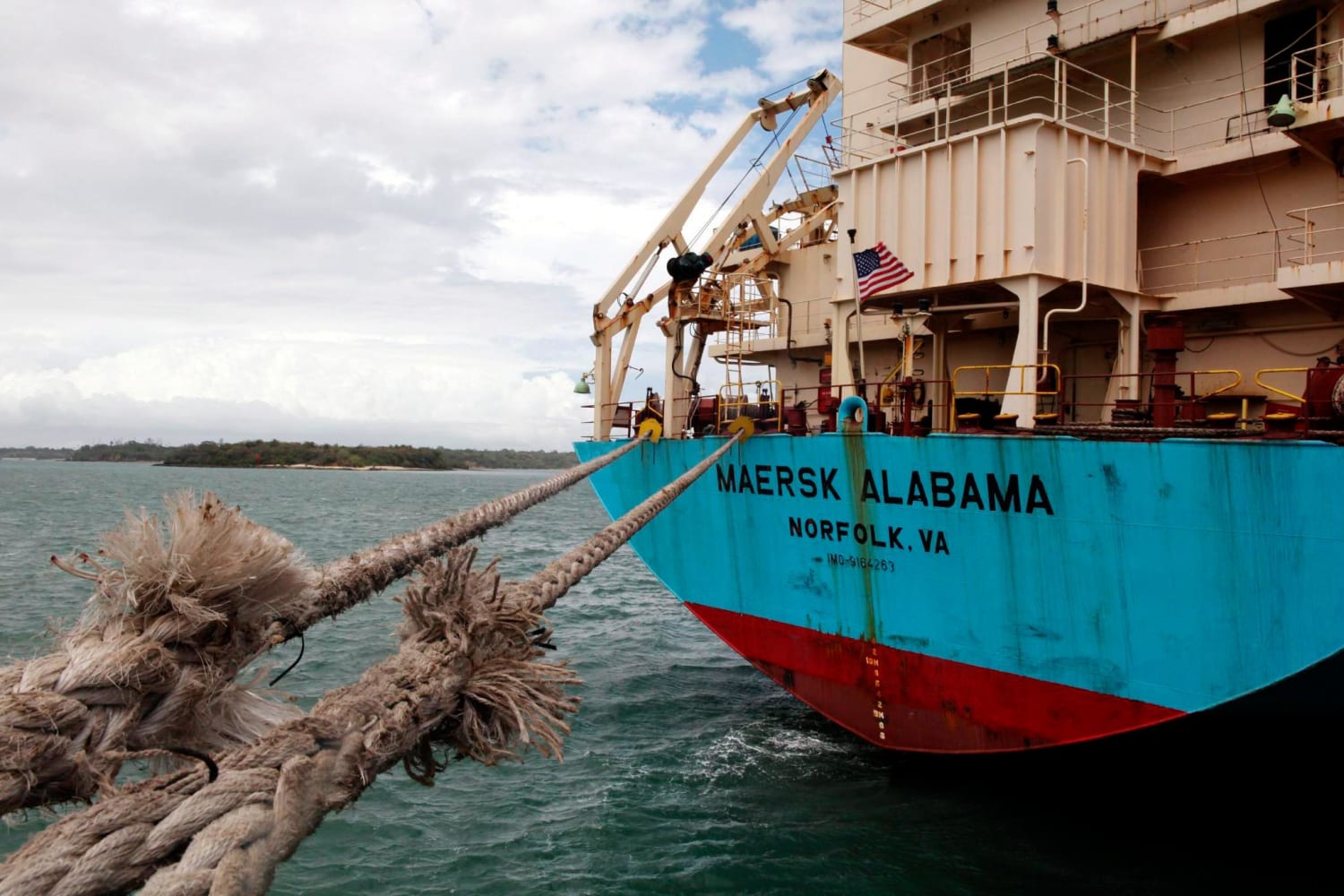
Archive for the 'Maritime Security' Category

Maritime Security: To the Shores of Tripoli..

     A great little article about how we used to do things, when it came to pirates. Send the Marines and some Mercenaries, and attack the land bases of these pirates.  That and stop paying these ransoms, because it only encourages these guys.

     Now do I see an Obama administration sending troops to the shores of Somalia, just like we did in 1804? Or will the memory of our efforts in Somalia in the early nineties kick in, and prevent us from  doing what we need to do?  

     I don’t see us doing anything on land because of the bitter memory of our last venture there, but you never know.  If piracy becomes a money making tactic of the mufsid dorks, then we might see more of an effort to combat it as part of the overall war strategy.  More than likely, it will continue to be treated as a criminal thing, and ships will be on their own and the various navies involved will only have a partial impact on protecting them all.        

     Although, if we are to learn anything from history, we must deal with the land component of piracy as part of an overall strategy, if we are truly serious about combating it.  -Head Jundi

—————————————————————— 

Shores of Tripoli 

To the Shores of Tripoli . . .

The place to stop pirates is on the beaches.

by Seth Cropsey

12/08/2008, Volume 014, Issue 12

The November 15 hijacking 450 miles east of Mombasa, Kenya, of a thousand-plus foot oil tanker carrying more than two million barrels of crude oil forced international recognition that the seas have been dramatically added to the world’s list of outlaw space. According to the International Maritime Bureau, recorded attacks by pirates in the Gulf of Aden area have more than tripled–to 92–in the past year. The million square mile swath of the Indian Ocean off, and south of, the Somali coast through which approximately 20,000 ships a year pass between Asia, Europe, and the Western Hemisphere is within hailing distance of smaller, but no less significant, portions of the Middle East and South/Central Asia whose lawlessness has produced important consequences around the world. The prospect of a large-scale meeting of lawless land and lawless sea would be especially troubling even if the possible failed state in the middle–Pakistan–didn’t possess nuclear weaponry.

But for now, the problem is that Somali pirates who use global positioning devices to help identify potential targets, who deploy “mother” ships that can venture out to sea to launch and recover small fast boats, and who have mastered simple but effective tactics for capturing ships have transformed one of the world’s strategic choke points into a watery version of the Cyclops’ island home, a place without law. The consequences transcend what is already happening: spiking maritime insurance rates, significantly increased costs to international consumers as shipping lines reroute around the Cape of Good Hope, and a growing problem of captured ships’ crews held hostage in Somali pirate havens–330 crew members from 25 nations at last count.


Maritime Security: Live Piracy Map 2008

Piracy Map

Live Piracy Map 2008

     This map shows all the piracy and armed robbery incidents reported to the IMB Piracy Reporting Centre during 2008. If exact coordinates are not provided, estimated positions are shown based on information provided. Zoom-in and click on the pointers to view more information of an individual attack. Pointers may be superimposed on each other.

Check Out Map Here


Maritime Security: Somali Pirates Hijack Ship, British Guards Escape

    Boy, on the surface, the story does not sound good.  Why are the guards jumping ship, and leaving their client to the mercy of pirates?  And how did these guards miss this one?  Most of all, were they even armed to defend the ship?  Lots of questions about this incident, and I will not judge before I hear everything.  

   Like I have said before, sooner or later these pirates will catch on to the fact that most of these security companies that are posting guards on these ships are lightly armed, or worse yet, just outfitting them with less than lethal stuff like the LRAD.  These guys are smart, and they will do all they can to sneak up on these ships.  They will pose as coast guards, or a distressed ship in need of help, and as soon as they can get up on the craft, they will board. It is a tactic as old as the sea, and in my opinion, we need to start learning some of these ancient lessons on how to deal with pirates. -Head Jundi 

——————————————————————- 

Somali pirates hijack ship, British guards escape

By KATHARINE HOURELD 

November 28, 2008

NAIROBI, Kenya (AP) — Somali pirates hijacked a chemical tanker with dozens of Indian crew members on board Friday, and three British security guards were rescued by helicopter after jumping into the sea, officials said.

A warship on patrol nearby had sent helicopters to intervene in the attack, but they arrived after pirates had taken control of the Liberian-flagged ship, diplomatic officials said on condition of anonymity, as they were not authorized to speak with media.


Jobs: Maritime Security Positions, Africa

Maritime Security Managers to work offshore in West Africa

Check it out at Minimal Risk

—————————————————————— 

Maritime Special Interdiction Teams (SF types only)-Horn of Africa and Middle East

Check it out at the Secure Aspects Job Board

Company Link


Maritime Security: Somali Piracy Offers Huge New Market for Private Security

Somali piracy offers huge new market for private security

Agence France-Presse | 11/21/2008 10:08 PM

NAIROBI - Protecting ships in Somalia’s pirate-infested waters could be the

next big thing for the world’s ever-growing private security industry but

the legalities are complex, experts said Friday.

Last week’s hijacking of a Saudi super-tanker worth a quarter of a billion

dollars has raised the issue of onboard security for the world’s merchant

fleet, which carries an estimated 90 percent of the planet’s traded goods.


Maritime Security: How to Deal With Pirates

“Steer the hostile prow to Barb’ry’s shores,” wrote an anonymous poet, a veteran of the Battle of

Bunker Hill, “release thy sons, and humble Africa’s power.”


      Finally, some voice of reason out there.  The only way Somali pirates will stop doing what they are doing, is to fight them.  If we keep paying them off, and continue this policy of not fighting them, then they will only continue to do it.  And what do you know, piracy has only gotten worse in that region.  So whom ever these so-called experts are, that continue to give shipping companies this advice of not fighting back and just paying them off, have done more to increase piracy in that region than anything else. And it seems we have learned this lesson before in the past. -Head Jundi  

——————————————————————- 

NOVEMBER 22, 2008

How to Deal With Pirates

By MICHAEL B. OREN

The rise of piracy is threatening international trade and raising complex questions. The only way to end the scourge is to respond aggressively, says Michael B. Oren.

The attack began when an unidentified vessel drew alongside a merchant ship in the open sea and heavily armed brigands stormed aboard. “They made signs for us all to go forward,” one of the frightened crewmen remembered, “assuring us in several languages that if we did not obey their commands they would massacre us all.” The sailors were then stripped of all valuables and most of their clothing and locked in the hull of their own captured ship. They would be held in unspeakable conditions, subsisting on eight ounces of bread a day and threatened with beating and even beheading should they resist. “Death would be a great relief and more welcome than the continuance of our present situation,” one of the prisoners lamented.


Weapons: The MK 38 Mod 2 Machine Gun System

     I thought in light of the recent piracy buzz, I would review an excellent weapon system that could be used to combat these thugs.  There are plenty of weapons out there that could do the job of fighting off these guys. I think the MK 38 Mod 2 would be a good start for that search.  It has reach, and it could mess up the hull of a boat really well.  Plus if an electronic aiming system is used, precision fire could be directed at engines.  Not to mention using night vision equipment, like FLIR to own the night as well.  Most of all, a shot across the bow with this thing, and these guys would think twice about messing with your boat.  

    The other thing I like about this gun, is the ability to remove the weapon system with a special mount(Mk 88 mount).  That would be good for a company that wants to move this gun from boat to boat.  That and you can set this up to fire manually, in case the electronics break down.(please note photo)  I also like the idea that it is based off a weapon system that is being used all over the place(Mk 242) and parts should be available for it.   Like I said, it is not the only weapon out there, and there are plenty to choose from in order to get the job done, but this is a great start.  

    So why would I talk about such things on a security industry blog?  Well for one, I don’t think a couple of M-4’s would suffice as adequate protection for 100 million dollar super tankers cruising around in pirate country.  You must have a weapon that can effectively keep pirates away, so they will not be able to use their weapons–our weapons range must beat their weapons range.  So stand off distance is essential in this game.  But you don’t want to overkill these guys with a main gun, that is slow.  You need a gun that is light and quick, yet very effective at stopping a vessel if you have to.  

    Now would security contractors on a vessel be able to secure a weapon like this for operations?  Sure, they could get anything they want.  But money, licenses, and the various laws and regulations out there that dictate the use of such weaponry would be the obstacles.  And if Iraq and Afghanistan is any indicator of what we can or cannot use as security contractors, then I might have to suggest something else.  The largest caliber weapon system I have seen contractors use is a DShK, or a .50 caliber M-2 Machine Gun.

Then there is the automatic grenade launchers like the Mk 19 or the AGS 17 , but that is another story.

     Or I guess we could tone it down a little and use a M-107 or something? But honestly, if I was defending a big ship from a well organized gang of thugs attacking from fast moving vessels, I want the right tool for the job.  And trust me, if the pirates have been making millions of dollars off of these operations, they now have the resources to buy big guns. Even the DShK was being used by Somalis on land–what’s to say they won’t convert their boats into a maritime versions of a ‘Technical‘?  

     Also, the other nice thing about showing some ‘cannons on deck’ is the intimidation factor.  Right now, pirates are operating on the idea that these boats are not armed and do not want to fight, hence making them easy targets.  All they have to worry about is avoiding the large and cumbersome Navies floating around, and board a boat.  Once on the boat, they know the company will roll over and pay them the ransom.  We must stop this cycle, and we must have the tools to send the right message ‘of don’t mess with this boat’. 

    Another idea, is to do what was mentioned on one of the blogs I highlighted, and that was to place an Abrams or Bradley on top of tanker.  Or something smaller, with the idea of having a gun that can move around on the deck.  The US Navy or Marines could put small detachments of guys on merchant ships and tankers, and actually protect these vessels. Or the UN could provide these troops, or that ship’s country of origin could provide the troops.  But yet again, this becomes a man power issue, and a law of the sea issue that is way beyond my pay grade.  That is the idea though, and protecting these vessels is of the utmost importance to our national security.  When the cost of oil goes up, because of some pirates taking down a tanker, then that is when we should take notice.  

    Finally, the reason I am more focused on protecting the vessels with an onboard security team, is because we do not have enough navies to actually protect each individual boat.  The area to patrol is too big, and there are too many ships to coordinate and protect.  It would be like herding cats over thousands of square miles.  And what is really crazy, is trying to identify these pirates.  They do not fly the Jolly Roger, they act like fishing vessels in distress or pretend to be a friendly vessel of some sort.  They will do all they can to blend in and to deceive, to accomplish their mission of taking down multi-million dollar boats. They are smarter than we give them credit for, and they have a method that is working.  -Head Jundi 

——————————————————————- 

MK 38

The Mk38 Naval Weapons System. Image is official U. S. Navy photograph, taken aboard the USS Ingraham (FFG-61) in June 2003.  

History

The MK 38 machine gun system (MGS) was employed aboard various combatant and auxiliary ships in the Mid-East Force escort operations and during Operations Desert Shield and Desert Storm. The weapons are maintained in a rotatable pool, available for temporary installation on various deploying ships and permanent installation on certain amphibious and auxiliary ships, patrol craft and Coast Guard cutters.


History: How the Royal Navy Dealt with the Pirate Blackbeard

Royal Navy


How the Royal Navy Dealt with the Pirate Blackbeard..

In the 19th century, British warships largely eradicated piracy when they policed the oceans. The death penalty for piracy on the high seas remained on the statute books until 1998. Modern piracy ranges from maritime mugging to stealing from merchant ships with the crew held at gunpoint. 

Wiki for Blackbeard 


Maritime Security: Major Shipping Company to Sail Around Africa to Avoid Gulf of Aden

    I caught this little chunk of story, at the end of another story I was reading and thought it was interesting.  So will other parts of Africa catch on, and just hijack these vessels on the other side of the block?  Pirates operate off the West Coast of Africa too.  We’ll see how it goes for them.  -Head Jundi

—————————————————————— 

November 19,2008

By Sam Dolnick

……….On Tuesday, a major Norwegian shipping group, Odfjell SE, ordered its more than 90 tankers to sail around Africa rather than use the Suez Canal after the seizure of the Saudi tanker Saturday.

“We will no longer expose our crew to the risk of being hijacked and held for ransom by pirates in the Gulf of Aden,” said Terje Storeng, Odfjell’s president and chief executive. 

Story Link Here 


Maritime Security: Pirates Take Down a Super Tanker, Somalia


     Thanks to Jeff for sending me this article.  This is significant.  These pirates took down a ’super tanker’, at 450 nautical miles off the coast of Somalia!  Those are two records–the biggest ever ship taken, and the furthest out to sea hijacking.  They must be using a mother ship out there in order to do an operation like this.  

     The other interesting angle to this, is the shift of attacks further out to sea, mean a larger patrol area.  A herculean task, and I think this will change the thinking about the way piracy will be dealt with.  That security forces will have to escort each ship, or post a robust force on the ship itself in order to properly protect it.  To just post a security ship in the general area is not going to work, if pirates are willing to go so far out to sea.

   And with this subject, if you have been watching the show on History Channel called Shadow Force, the first two episodes have dealt with maritime operations.  Although what they are doing is busting illegal fishing operations off the coast of Liberia.  The cool thing about the operation, are the obstacles and challenges that they had to over come just to get up and running over there. They used a RIB, with a FLIR camera and an LRAD non-lethal sound weapon system. Cool show. -Head Jundi

—————————————————————— 


super tanker

The MV Sirius Star super tanker. 

Tanker taken to Somali pirate stronghold

U.S. and other naval forces decide — for now — against intervention

The Associated Press

updated 6:16 a.m. PT, Tues., Nov. 18, 2008

MOGADISHU, Somalia - Pirates who seized a Saudi supertanker loaded with $100 million in crude oil anchored the ship within sight of impoverished Somali fishing villages Tuesday, while the U.S. and other naval forces decided — for now — against intervention.