Thursday, January 7, 2010
Cool Stuff: UAV Or Toy? The iPhone Controlled Parrot AR.Drone
Wednesday, January 6, 2010
Industry Talk: Privatizing Airport Security
“Again, it’s because you can fire a bad contractor, but you can’t fire the government. I think TSA stands for Thousands Standing Around.” -John Stossel
*****
This is a no brainer coming from our side of the house, and I salute John Stossel for calling it the way he sees it. I brought up three interesting informational pieces on airport security, and the reasoning behind going the private route. For one, it works, and number two, it is what the Israelis do.
I know, I know, we have a much larger airport system in America than the Israelis do. But we must look hard at what we are doing, versus what others are doing, and ‘build a snowmobile’ out of the thing. Privatizing airport security is just one component of the strategy, and using what we can from the Israeli and European models is essential. By the way, I love the quote that Stossel put together up top. lol-Matt
—————————————————————–
O’Reilly Tonight: Privatize the TSA
By John Stossel
January 5, 2010
I’ll go on O’Reilly tonight to talk about the ridiculous new flight rules from the TSA .
Before my last flight, right after Christmas, security officials patted me down. I was wearing shorts. But they patted down my bare legs. There is a lot of “security” that seems pointless. Jet Blue told us that TSA had ordered them to keep all TV’s off for the whole flight. Everyone had to stay seated for an hour before takeoff — without blankets, pillows or personal belongings on their laps. And so on—you’ve heard about the new rules.
Those rules might help stop a terrorist if he did the exact same thing that Abdulmutallab attempted on Christmas. In reality, I suspect the rules will do nothing but inconvenience millions.
TSA should not exist. Before 9/11, screening was private — private companies, working for government, did the screening. They weren’t very sophisticated, but they did the job. The small knives the hijackers used were not violations of government rules. Neither were unlocked cockpit doors.
Military News: Million-Dollar Man
This is a quick run down as to the cost per soldier over in Afghanistan. My thoughts on this, is why not just give every soldier a horse? They can run around all over the country with a horse, and even lay a kevlar blanket under the saddle for a little extra protection. The horse eats grass or hay or whatever, and drinks water where ever you can find it. A patrol could cover a lot of ground on horseback, and best of all, there is tons of experience to learn from when it comes to horses and warfare. Especially for Afghanistan.
You could also eat the horse if it is killed, or use it as cover during a fire fight. The horse is pretty quite, compared to the running engine of a HMMV or MRAP. The horse could be traded and given to the locals when the mission is done or as gifts, and the coalition could take advantage of an industry in Afghanistan that is already in place. Something to think about, and we have fooled around with horses a little bit in this war in the beginning. Let’s put the cavalry back on the things and reduce our costs? –Matt
——————————————————————
By Jesse Ellison
Jan 2, 2010
The current cost to station 68,000 U.S. troops in Afghanistan: just over $65 billion—or, to quote a figure politicians have extrapolated, about $1 million a soldier. (Obama’s budget director has cited this ratio in estimating surge costs.) Why so much? A breakdown, using 2010 Defense numbers:
OPERATIONS: The biggest expense—transporting soldiers and equipment to, and around, Afghanistan.49%*$473,371
WORN-OUT GEAR: When units leave, their damaged stuff gets a complete overhaul or is replaced altogether.12.5%$120,339
PROTECTIVE MATERIALS: Armor and equipment, including 1,080 Òmine-resistant, ambush-protected vehicles.11.9%$114,956
TRAINING AFGHANS: Providing Afghan National Security Forces with infrastructure and arms.11.4%$109,747
INTELLIGENCE: Includes airborne sensors and surveillance of high-value targets.5.75%$55,275
CONSTRUCTION:
Flexible funds for small-scale civil and humanitarian projects and miscellaneous building costs.
3.98%
$38,212
COALITION SUPPORT: Reimbursement for operational and logistical support by cooperating nations.2.87%$27,574
RESEARCH: Development of technology to combat IEDs (improvised explosive devices).1.2%$11,287
TRAINING PAKISTANIS: Financial support for Pakistani Security Forces to secure borders and fight insurgents.1.1%$10,294
*numbers do not add up to 100% due to rounding.
Story here.
Maritime Security: Xe Pulls Plug On It’s Counter-piracy Venture, Ship Up For Sale
That’s too bad, and I was actually hoping that they could make this fly. This could be a matter of just timing, because I do think an escort ship is the way to go for the really sensitive shipping like weapons or natural gas. Xe should also try to sell it through Aprodex or something like that. –Matt
——————————————————————
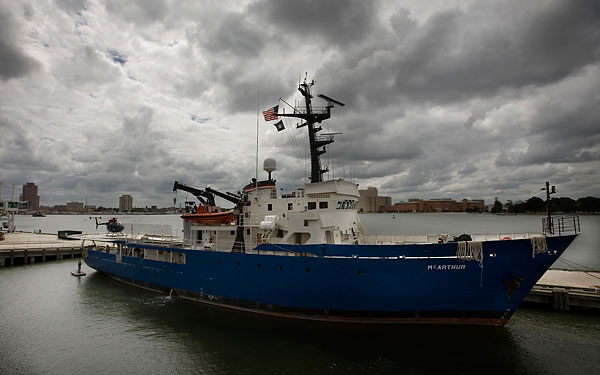
Xe pulls plug on its counterpiracy venture; ship up for sale
January 5, 2010
Apparently unsuccessful in marketing it for anti-piracy operations, Xe has put its 183-foot ship McArthur up for sale.
In an online advertisement on the Web site Yachtworld.com, the McArthur is listed at a reduced price of $3.7 million. The vessel is docked in Alicante, Spain.
Xe, the Moyock, N.C.-based private military company formerly known as Blackwater, acquired and refurbished the 40-year-old ship three years ago and declared itself ready to begin patrolling the Gulf of Aden to protect merchant vessels against pirates.
In an interview with The Virginian-Pilot in 2008, Bill Mathews, then Blackwater’s executive vice president, placed the value of the overhauled vessel at $15 million.
Based in Norfolk, the McArthur was built in 1966 by Norfolk Shipbuilding & Drydock Co., now BAE Systems Norfolk Ship Repair. For most of its life, it was used as a research vessel by the National Oceanic and Atmospheric Administration. It contains a helicopter pad and two-bed hospital.
The impending sale was first reported Monday on the blog of the U. S. Naval Institute, a nonprofit forum on global security issues. Xe had no immediate comment on the report.
Tuesday, January 5, 2010
Training: University Of North Dakota Offers Degree Program In UAV Piloting
How cool would that be, to get a degree in UAV piloting? Although I do think that a four year degree is a little excessive for the task. I do think UAV’s will become easier to fly and will be more intelligent as time goes by. I could see maybe a two year degree or something like that, just to give some kind of a foundation for this stuff.
What is interesting about the future of our industry, is that UAVs will become more common on jobs, and knowing how to use them, will definitely give you a leg up for that contract. It is much like how many guys end up operating CCTV or XRay Machines on gigs, along with all the other duties of security operations. There might even come a day where this skill will be a requirement of a company, along with managing other robotics and fancy devices. I am sure security specialist felt the same way about GPS or high tech radios some thirty or forty years ago, when they were told that they might have to use that stuff on a job. All I know is keep playing those video games guys and gals. lol –Matt
——————————————————————
A first: UND offers degree program in UAV piloting
5 January 2010
The number of unmanned aircraft systems has jumped from a fleet of about 50 vehicles nine years ago to more than 2,400 in use today; these UAVs need trained operators to operate them, and the University of North Dakota offers the first-in-the-U.S. degree program in UAV piloting.
The UAV market is exhibiting all the characteristics of a maturing market. There are four steps to this maturation process: first, innovative start-ups and entrepreneurs dominate the sector; in the second phase, the big guys move in, buying up smaller companies; in the third phase there is litigation over intellectual property infringement; in the fourth phase, colleges and universities begin to offer degrees in the field.
In evidence: The University of North Dakota is offering the world’s first bachelor’s degree for pilots who will never leave the ground. Discovery news’s Irene klotz reports that these pilots are not afraid of flying. There is just less of a need to be airborne with the rapid growth of so-called unmanned aerial vehicles, or UAVs. “College students like to be employable when they graduate,” said Jeffrey Kappenman, director of the school’s Unmanned Aircraft Center. “This market is a growing market.”