A EU NAVFOR spokesman was unable to provide Sky News with a figure for how many suspected pirates had been returned to Somalia without charge.
“I don’t have the number for those returned to Somalia – a number of reasons but largely because it was not initially considered important to maintain the number,” the spokesman told Sky News. -Link to quote here.
This is the part of our global anti-piracy campaign that absolutely kills me. It’s as if these navies are sport fishermen, and they are releasing their catch so it can grow bigger, and spawn more fish, so they have more fish to ‘catch and release’ in the future.
Now of course we are dealing with the legal mechanisms, or lack there of, of each country that has laws that deal with piracy. So when a navy captures a pirate or suspected pirate, those navies are operating under the guidelines of those laws. Because these countries have not implemented sound anti-piracy laws, we unfortunately see pirates captured and then release because of some legal mistake or loophole. Or, those that did the arresting of the pirates did not capture and detain properly, or properly document or obtain witnesses, etc.
So who are the worst offenders of ‘catch and release’? That is a good question and I tried to do a little search for any comprehensive reports on this problem. Below, I have found a few recent articles on Canada and the UK, and their deficient legal mechanisms in place for prosecuting pirates. Here is a sample for the UK.
Fewer than one in every five suspects picked up around the Horn of Africa over the past four years have been prosecuted for piracy-related offences, the Ministry of Defence has admitted. The figures will fuel growing criticism of Britain’s involvement in the anti-piracy operation.
Official MoD figures obtained by The Independent on Sunday show the Royal Navy has boarded 34 vessels suspected of piracy in the Indian Ocean since volunteering to lead Operation Atalanta, the EU’s first naval mission, in 2008. However, on all but six occasions, the gangs rounded up were taken to the nearest beach and released – despite often being caught with equipment including guns and ladders. A list of boardings since November 2008 shows that the navy has detained a total of 279 likely pirates but allowed 229 of them to go free, some in groups of up to 17 at a time. Fifty more were sent on for prosecution in Kenya, the Seychelles or Italy.
Amazing. This is just insane, and this practice of catch and release must end. Also, I wanted to mention that all the nations involved have had similar catch and release stories, so the UK or Canada are not the only ones. I have been documenting this for awhile now, and it is very frustrating.
I also wanted to mention that we are missing opportunities of detention by not allowing private security companies to detain and arrest these pirates. Every engagement could turn into an arrest and a removal of these criminals off of the high seas. By issuing Letters of Marque to PSC’s or the captain on these boats, nations could give them the same arresting powers that their navies currently have.
Within the terms of the LoM, you can define exactly how arrests are to be done and the specific rules for detention and transportation of prisoners. A country can also offer bounties for each pirate that was legally detained and prosecuted. We have GPS and video filming capability, and these can all be tools required under the terms of the LoM in these modern times.
As it stands now, security companies are executing the ultimate in extreme justice on the high seas. That would be actually killing pirates during the defense. So the question I have is why is killing pirates more appropriate than detaining them? If anything, a security company should have the option of capturing those pirates instead of just killing them. It would also take a load off of the larger navies who are tasked with anti-piracy.
So why capture them alive? Well, for intelligence purposes, a pirate that is alive and talking, is far better than a dead one. Also, by capturing them, we take them out of the game. Of course killing them takes them out of the game permanently, but sometimes killing these pirates is not feasible within the course of current rules of engagement.
In one scenario, what if the pirates attacking the ship decided to stop their attack and just give up for whatever reason? Or during their attack, their engine fails and they get within killing range–so they raise their white flag right there. Does an armed guard execute these pirates who are trying to give up, or do they detain them? Or do we just let them go? And also, if that pirate vessel is no longer sea worthy because armed guards made it so, and now pirates are sinking, is there any obligation at all to save and detain those pirates? These are all questions that could be answered with an effective Letter of Marque regime and bounty program, that makes capturing pirates something of interest to security companies on these vessels.
I mention bounty, because even with a LoM, security companies will not be entirely motivated to detain. An effective bounty or reimbursement program would be necessary to make up for the costs of such an offense industry. You must also incentivize the process in order to create a vibrant offense industry. A company would be risking life and limb to go that extra mile to capture a pirate crew, so companies must have some mechanism in place for compensation.
So those are my thoughts on the whole thing. The laws dealing with piracy need to catch up, and we also must look at legal mechanisms that will help to make the elimination of piracy more efficient and effective. –Matt
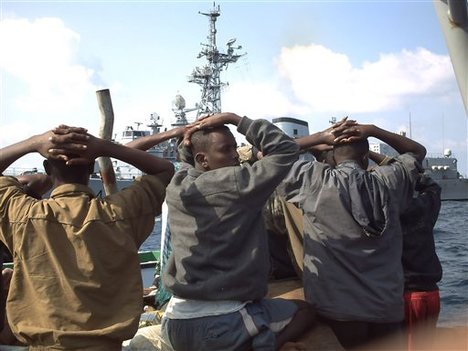
Navy frees four out of five suspected Somali pirates
Britain criticised for ‘particularly poor record’ in international crackdown on Indian Ocean piracy
Brian Brady
Sunday, 8 April 2012
Hundreds of suspected pirates arrested by the Royal Navy off the coast of East Africa have been immediately set free – to continue threatening merchant vessels in one of the world’s busiest shipping lanes. Fewer than one in every five suspects picked up around the Horn of Africa over the past four years have been prosecuted for piracy-related offences, the Ministry of Defence has admitted. The figures will fuel growing criticism of Britain’s involvement in the anti-piracy operation.
Official MoD figures obtained by The Independent on Sunday show the Royal Navy has boarded 34 vessels suspected of piracy in the Indian Ocean since volunteering to lead Operation Atalanta, the EU’s first naval mission, in 2008. However, on all but six occasions, the gangs rounded up were taken to the nearest beach and released – despite often being caught with equipment including guns and ladders. A list of boardings since November 2008 shows that the navy has detained a total of 279 likely pirates but allowed 229 of them to go free, some in groups of up to 17 at a time. Fifty more were sent on for prosecution in Kenya, the Seychelles or Italy.
The Government has acknowledged the “catch and release” strategy is often an “unsatisfactory outcome”, although ministers also maintain it helps to disrupt pirate networks.
(more…)

