Feral Jundi

Tuesday, December 29, 2009

PMC 2.0: Armchair Deputies Patrol U.S. Border

   I posted a deal about this awhile back, and it is cool to finally get some statistics about the program.  I thought it was an awesome idea back then, and I still think it is good idea and deserves further study and use.

   Now some of you are probably wondering why this isn’t under law enforcement or technology?  I put it under PMC 2.0 because I think the lessons learned with this virtual border watch program, could easily be applied to other countries and border security contracts.  Especially countries where border control is a matter of life and death, where terrorists are looking to import their hate.

   Look at the Afghanistan and Pakistan border, or the Iraq borders, or the Saudi Arabia and Yemen border?  Crowd sourcing a border watch program could very well be the trend of future border security operations.  It also involves that Grandma in Michigan, if in fact she wanted to make  a difference in the war effort or with border enforcement here in the US. It is like a modern day version of the coastal lookouts that civilians participated in back during World War Two.

   By the way, these guys should turn this into a mobile application for smart phones, and make this something people can do while waiting in the doctor’s office before an appointment.  That would really increase the numbers if you know what I mean.-Matt

—————————————————————–

Armchair deputies patrol US border

December 26, 2009

By Claire Prentice

When John Spears gets home from his sales job in New York, he sits down at his computer with a bottle of beer and starts patrolling the US border.

And to do it, he does not need to stir from his sofa.

He is one of tens of thousands of people around the world who are volunteering to patrol the 1250-mile long (2000 km) stretch between Texas and Mexico via the web.

The controversial $4m (£2.5m) Texas Virtual Border Watch Programme invites civilians to log on to Blueservo.net.

There they can monitor live feeds 24/7 from 21 hidden surveillance cameras placed at intervals along the border.

Supporters see the initiative as a step forward in US efforts to curb illegal immigration, drug smuggling and border violence.

Critics say it is encouraging vigilantism and stoking anti-immigrant feeling.

Value for money?

(more…)

Strategy: The Failure Of Today’s Counter Piracy Strategy

   I don’t care what any of the experts think on this one.  It doesn’t take a defense analyst or a counter piracy expert to look at these two stories, and the one I posted about the chemical tanker and fertilizer ship being taken, and deduct that the current strategy is not working.

   Look at this first story I posted below. The Dutch capture 13 pirates, and they had to release them because no one wanted to deal with them?  And then they had to give them food and fuel so they could ‘make it home alright’? How sweet of us. Pfffft. This is lunacy.  No wonder this whole piracy thing is increasing, because it is the ultimate criminal venture to be in.

   The next story really spells out the failure of the strategy.  We have a massive flotilla of navies from all over the world, that costs millions of dollars to operate every day, and this is what we get out of that investment? An increase in successful pirate operations?  Who the hell is in charge of this mess?

   The strategy I propose is pretty simple. Make it mandatory that all ships have armed security, and they all have the means to contact a Naval quick reaction force via protected communications. Put the cost of security and proper communications on the shipping industry, and only use a few key Naval vessels for back up.  If a ship gets into a fight with pirates, then they put out the distress call to the closest strategically placed Naval QRF, and do the best they can to hang on until they get there. Hell, we could just have armed drones flying around all day to act as back up. But just as long as there is competent and well armed security on these boats, then this will give the boats enough time to out maneuver the pirates or hang on until help gets on station.

   We could also hunt them down at sea, but good luck with that.  It would take thousands of boats, canvasing the sea, all with the right to search and seize vessels.  Even then, these pirates will just hide on a fishing vessel and pretend to be safe, until the hunting vessels are gone.  I say if we are going to hunt them, then you use really good bait, which is why it is so important to have armed ships with a Naval QRF to back them up. That QRF should also be in the form of aviation, and not some slow cruising boat that would take an hour to get where it needs to be. That is my idea of a a QRF on the ocean.

   The second part of my strategy is all about dealing with the land problem, and that requires eradicating any threats to the government, and giving the government the time and support necessary in order to establish a solid governance over the land. But it all requires a professional army to do a proper job of cleaning up that resistance, and establishing control over key corridors and areas. Anything is possible, just as long as you have the manpower and resources to contribute to the effort.  You could either use a competent PMC (something similar to Executive Outcomes) or try to get an organized and well trained Army that is not busy with the current wars we are in.  Good luck with that last one.

   The point being, is that we really cannot be effective at sea, if we do not have a land based component of our strategy. Until we do what we have to do, these pirates will only continue to get more wealthier, more bold, more greedier, and probably more dangerous because now they can afford the good stuff. –Matt

Edit: 12/31/2009 – Further proof of the failure.  Look at these numbers. (I posted the rest in the comments section)

Mr. PHAM: Unfortunately, and I hate to rain on the parades of the world’s navies, but they haven’t sent an unambiguous message. Since August of 2008 to mid December 2009, the combined navies of the world have stopped 706 pirates. Of these 706, 11 were killed in the altercations with the navies. Four hundred and eleven, however, were simply catch and release because the various countries of the world can’t agree on rules for prosecution.

And so the pirates look at this and say the chances of actually being caught and actually having to suffer some legal penalty, 46 convicted out of 706 stopped, your chances are pretty slim.

——————————————————————

Captured Somali pirates get away scot-free

December 18 2009

The Dutch navy frigate HNLMS Evertsen has released 13 Somali pirates who were captured earlier this month. The European Union failed to find a country willing to put them on trial on suspicion of piracy and ordered their release on Thursday.The pirates were kept in detention on the ship’s aft deck, which was “an unpleasant situation” according to the Dutch Defence Ministry. They were released near Djibouti and transferred to their own ship, which had been towed all the way by HNLMS Evertsen.

HNLMS Evertsen was part of an EU mission off the Somali coast. The men were arrested when they attempted to hijack a merchant ship.

(more…)
Maritime Security: Somali Pirates Hijack A Chemical Tanker And Ship Hauling Fertilizer

   Does anyone else see how scary this really is?  We freak out about one Nigerian dude on a plane with explosive underwear, yet pirates have just hijacked two of the largest floating potential bombs you could ever get.  So what happens when AQ contracts out the services of these pirates? The Gulf of Aden is smack dab in the middle of Somalia and Yemen, two countries ravaged by war and Islamic extremism, and now pirates have just captured a chemical tanker and ship carrying fertilizer. Am I the only one seeing the potential here?

   The other one that gets me about this is how much are we spending on all of these navies floating around out there, and what is the return on investment?  In my view, there should be ‘no hijacked vessels’ for the amount being spent.  Which leads me to my next point.  Put armed guards on the boats for crying out loud, and put the cost of security on the shipping companies.  Use the navies as QRF’s or coast guards to help assist vessels that get into gun battles.  And for all the ultra sensitive chemical and petrol tankers, assign one escort ship to them, either private or government, and call it good. That way, they can draw any fire of the pirates, away from the big vessel and on to the escort vessel for a fight.  That’s just for the defense.

   For the offense, we have to fix things on the land, so that there is nothing safe for pirates to go home too.  Until we do fix things on land, we will continue to deal with these dorks on the open seas for a long long time. The Barbary Pirates are a prime historical example for what is going on right now, and these guys have a business model that works.

   Now if we continue to depend upon large lumbering navies to defend hundreds of ships from little tiny boats with pirates on them, who are spread out amongst thousands of square miles of ocean, we will continue to have problems.  To me, taking the gloves off and getting down to business, is basically creating a business out of eradicating pirates. The pirates have a business model that drives them, we need a business model that drives our goal of stopping them.  That means Letters of Marque and Reprisal being issued to competent modern day privateers.  If you create a bounty system, as well as allow privateers to keep a percentage of whatever that pirate company had in terms of assets, then you could definitely spark the interest of private industry for something like this. –Matt

——————————————————————

Somali Pirates Hijack Two Vessels

December 29, 2009

NAIROBI, Kenya — Somali pirates seized a ship carrying fertilizer from the U.S. in the Indian Ocean and a British-flagged chemical tanker in the heavily patrolled Gulf of Aden — the first merchant vessel to be hijacked in the gulf in nearly six months, officials said Tuesday.

The hijackings late Monday showed that pirates are relentless in their pursuit of quick money from ransoms and that ship owners need to take extra precaution when sailing in the Horn of Africa, said Noel Choong, who heads the International Maritime Bureau’s piracy reporting center in Kuala Lumpur, Malaysia.

The waters off Somalia are teeming with pirates, who have hijacked dozens of ships for multimillion-dollar ransoms in the past two years. An international naval force now patrols the Gulf of Aden, one of the world’s busiest shipping lanes.

After the latest hijackings, pirates now hold 12 vessels and 263 crew members, Mr. Choong said. Pirates anchor their captured crafts near Somalia’s shore in the pirate strongholds of Haradhere and Hobyo. International forces can’t rescue the vessels without risking the lives of the crew, leaving negotiated ransoms as the only safe means of resolution.

The latest incidents brought the number of attacks in the Gulf of Aden and off Somalia to 214 this year, with 47 vessels hijacked, Mr. Choong said. That compares to 42 successful attacks out of 111 attempts in 2008, before the EU Naval Force deployed in the Gulf of Aden in December 2008.

(more…)

Vietnam: Securitas Enters The Security Services Market In Vietnam

Filed under: Industry Talk,Vietnam — Tags: , , , — Matt @ 6:30 AM

   You never hear any security related news coming out of Vietnam, so when this came across my screen, I thought this would be cool to add to the archive.  Long Hai Security sounds like a pretty big group in Vietnam and hopefully the transition is smooth.

   Most of the time, these companies really don’t change much in the transition, unless there are blatant deficiencies. Stuff that needs to be addressed in order to make the newly purchased company profitable and sound.  Other than that, I really don’t have much more to add, and hopefully some readers can chime in about the market there. –Matt

—————————————————————–

Securitas enters the security services market in Vietnam

December 29, 2009

Following the strategy to expand in Asia, Securitas has agreed to acquire 49 percent of the Vietnamese security services company Long Hai Security. Purchase price is approximately MSEK 35 (MVND 88,000).

Long Hai Security has annual sales of approximately MSEK 53 (MVND 134,000) and approximately 2,500 employees. The company is the market leader in the Vietnamese security services market and operates throughout Vietnam, with its largest branches being in Ho Chi Minh City and Hanoi.

Long Hai Security provides mainly guarding services, but has also operations protecting its customers’ property in secure cash transportation, executive protection and alarm monitoring services.

Long Hai Security is consolidated in Securitas AB as of January 1, 2010.

(more…)

Sunday, December 27, 2009

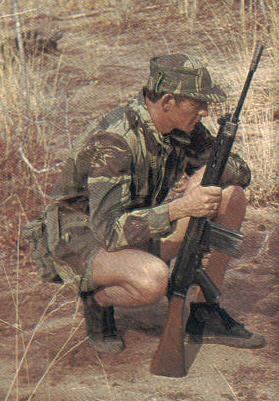
History: Tracker Combat Units–Zambezi Valley Manhunt, by David Scott-Donelan

This is some old school Soldier of Fortune material, but still really good.  The Tracker Combat Units in Rhodesia were impressive, and as you can see below, this unit produce some interesting folks for their war.  In particular, Andre Rabie and Allan Franklen, both founding members of the Selous Scouts.

And just so we don’t forget, I talked about David Scott-Donelan’s school awhile back and how important these combat tracking skills are.

The one point that really struck me, was this quote ‘troop strength was low and resources to patrol a 1,000-mile border and 150,000 square miles of hinterland were severely limited’. Boy that sounds like the US/Mexico border, the Saudi/Yemen border, the Afghanistan/Pakistan border, the Iraq borders, etc., etc., etc…..

In a world where manpower and resources are hard to come by and terrorists and criminals exploit miles of borderland to accomplish their deeds, the solutions that the Rhodesians came to are more relevant today than they ever were before. They were forced to do border stuff on the cheap, and developing a combat tracking capability was the outcome of that.

I also got a kick out of the similarities between the old west, and Rhodesia’s war.  We used Indian Scouts and Mountain Men to do just what these guys were doing, and that is tracking humans.  Why we are not emphasizing the use of more of these tracker teams in places like Afghanistan, is beyond me.  As long as this war has been going on, there should have been entire schools in place over in Afghanistan, whom have produced hundreds of competent man trackers and scouts for that war.  Where are the Jezailchis Scouts and why are we not learning from the lessons of others in this current war? –Matt

Edit: David Scott-Donelan is no longer associated with TTOS, and his new school is called The Scott-Donelan Tracking School. His website is located here.

——————————————————————

Tracker Combat Unit

ZAMBEZI VALLEY MANHUNT

Tracker Combat Unit (TCU) Trails Terrs

Soldier of Fortune Magazine

March 1985

By David Scott-Donelan

Rhodesia was hardly a nurturing environment for an experimental military unit. Most soldiers were concerned with simple survival, particularly in the earlier days of the country’s no-holds-barred bush war against communist guerrillas. In those times, the government’s troop strength was low and resources to patrol a 1,000-mile border and 150,000 square miles of hinterland were severely limited.

But history demonstrates some of the toughest life forms spring from harsh environments. In Rhodesia, when you talked tough, you talked about the Army’s Tracker Combat Unit.

From TCU’s small nucleus of original members came an impressive roster of military leaders including Andre Rabie and Allan Franklin, founding members of another innovative and deadly organization, the Selous Scouts. Other original TCU members included Brian Robinson, who later commanded Rhodesia’s Tracking School and Special Air Services at the height of battlefield commitment of that unit. TCU plankowner Joe Conway was decorated for tackling four terrorists while armed only with a bayonet. And ‘T.C.” Woods survived an underwater battle with a crocodile, even after the man-eater chewed off one of his balls. The original members of the Tracker Combat Unit were veterans and genuine hard-cases. They had to be.

(more…)

« Newer PostsOlder Posts »

Powered by WordPress