Feral Jundi

Wednesday, January 14, 2009

Industry Talk: Contracting in Combat, by James Carafano Ph.D.

Filed under: Industry Talk — Tags: , , — Matt @ 4:02 PM

    An excellent article that collects all the interesting data of many of the big reports on contracting, and tries to refine the problems into some key points to focus on.  I also have his book in the Jundi Gear store.  The key suggestions he makes are these:

    * An experienced and capable contracting officer at all deployed locations.    

   * Contracting officers armed with all the support tools and authorities they need to do their job.   

    * A government workforce with sufficient authority to do a job well and that will be held accountable for its areas of responsibility. Contracting officers will work closely with all military forces and other interagency representatives in their areas of responsibility. They will supervise contracts under a contingency contracting process capable of matching the needs of the force with contractors qualified and equipped to do the job.   

     * The contracting officer and the contractors themselves will be overseen by an integrated, qualified team of auditors and inspectors who provide real oversight and accountability, but who do not interfere with the ability of the contractors to do their jobs. All their work will be part of a system that provides visibility and transparency so that everyone who needs to understand the process and why will have access to the relevant information. 


    The main theme is quality control on the part of the government, and that is a major theme that I hit upon here on FJ.  The last point of this grouping hinted at an important concept as well.  Quality control does not mean micromanaging or interfering with contractor operations.  It means just observing, and ensuring that the contracts are being carried out properly.  And if a contracting company violates the terms of that contract, then it is absolutely vital that those companies are dealt with properly and fairly by the client. Deal with it now, not later.  That takes sound leadership with the appropriate authority, sufficient manpower, and support and guidance from upper level leadership.  –Matt

——————————————————————- 

Contracting in Combat: Advice for the Commission on Wartime Contracting

by James Jay Carafano, Ph.D.

January 13, 2009

In the wake of controversy over private military contracting, the National Defense Authorization Act of 2008 established the Commission on Wartime Contracting to investigate the issue. The commission is expected to issue an interim report in 2009 and a final report in 2010. The commission should pro­mote recommendations to improve the government’s capacity to make and oversee contracts in an “expedi­tionary” wartime environment, advocate a more robust and capable contracting force, and propose better doctrine and management processes for decid­ing when hiring contractors to support military oper­ations is most useful.

A New Kind of War

Contractors have become ubiquitous on the battle­field in Iraq and Afghanistan. Contract employees washed dishes, drove trucks, built facilities, and even guarded Jerry Bremer, the appointed head of the Iraq Coalition Provisional Authority who led the first year of the occupation. By 2007, there were more than 100,000 civilians working under U.S. government contracts in Iraq and Afghanistan–and about 160,000 U.S. combat troops. According to some esti­mates, contractors account for roughly 40 percent of the costs of running operations.[1]
(more…)

Tuesday, January 13, 2009

Industry Talk: Feral Jundi on Combat Operator Radio!

Filed under: Industry Talk,Podcasts — Tags: , , — Matt @ 12:07 PM

     Hey, here is the latest Feral Jundi news.  I just did a podcast with Jake over at Combat Operator Radio, and it was fun.  It was my first time doing that kind of thing, and we covered a lot of topics about the industry.

     Some of the topics covered are 2009 predictions for the industry, salary issues, and thoughts on leadership in the industry.  

     You can go to COR and click on the play button of the Talk Shoe widget. Also, you can grab this interview between me and Jake over at iTunes.  Enjoy, and let me know what you guys think. –Matt

Combat Operator Radio Talk Shoe Page

Combat Operator Radio


Sunday, January 11, 2009

Industry Talk: In Defense of Security Contractors

Filed under: Industry Talk — Tags: , , — Matt @ 12:45 PM

   This story popped up on a few of my radars, and Scott sent me a copy as well.  As you might guess, I am always interested in hearing the critiques of this industry and the support of this industry.  So this article in the magazine Foreign Policy was a good little support piece.  

   One thing I want to add to this, that I think the author was kind of lacking on though, was the amount of security contractors in this war, and the numerous companies doing all sorts of interesting things out there.  Here on FJ, I have mentioned a few.  Like the CMD(CMC) program, where security contractors protect an entire camp and munitions dump, while UXO workers demolish old munitions.  Security contractors do everything from guarding UXO to convoy operations between all of the bases to supply camps and transport people.  These camps were completely run and operated by civilians, and they worked.  The only military management, if you could call it that, were Army Corps of Engineer guys.  These camps would usually have one or two of these folk to watch everything.  But other than that, these camps were completely civilian operated and protected. I brought up this example with other authors out there, and it continues to be ignored.  This mission helped to remove thousands of tons of old explosives in Iraq, and at a cost to contractor lives.  It deserves a mention at the least.

    The GRD program in Iraq was another massive program that involved convoy protection services, and DOD contractors(guys got killed doing this as well).  And currently there are solicitations for the same kind of convoy protection services contracts in Afghanistan, as there were in Iraq.  The programs that this author spoke of, are the TWISS(DoD) and the WPPS(DoS) program.  He gives only a partial picture, and the New America Foundation put the number of security contractors at over 12,000 if we are to look at the entire war effort.  230,000 plus was the figure for civilian contractors in total(that is KBR type folk, as well as the meat eater types).

   Overall, I enjoyed the article because at least it was someone willing to challenge this mindset that we are ‘a bad thing’ for this country.  I also believe that with a little effort on the part of the DoD and DoS, the quality of these contracts could be monitored and managed effectively.  That would require leadership and actually putting in the necessary manpower to manage all the thousands of contractors out there.

   The author also mentioned a key component of why it is so important to keep tabs on contractors:  

Finally, the bodyguard mentality won’t go away with the security company contracts; it must be changed from the top. Behind the highly publicized incidents were not “rogue mercenaries” but professionals dedicated to the mission — protecting the principal at all costs. “At all costs” means just that; costs to the locals, to the broader counterinsurgency effort, and to relations with the host government are irrelevant. For a bodyguard, this is the only measure of effectiveness, and it won’t go away just because the bodyguard works for the government. 

    DoS and DoD need to remember to include us when they talk about Strategic Communications and Unity of Effort. Of course our actions impact the overall counterinsurgency effort, and none of us in the industry want to hurt that effort.  So going back to leadership and effectively managing contractors, you can see that it is not only an important thing for accounting purposes, but it is also important for the war effort.  We can get there, it’s just the client needs to start talking more about how to effectively manage the ‘elephant in the room’ called contractors.  And like the author pointed out, just getting rid of us is not the most practical or even reasonable answer to these issues.  I say do like Pete Blaber said for solving complex problems.  Saturate, incubate, and illuminate and accomplish that mission.-Matt

——————————————————————- 

In defense of security contractors

By Col. Mark Cancian (USMCR Ret.)

01/08/2009

Like them or hate them, we still need private security contractors

In criticizing the use of contractors in Iraq, some observers cite Blackwater as the tip of the contractor iceberg. It’s a fair analogy, but it deserves to be taken a step further. As with an iceberg, you may be able to shave some off the tip, but hacking away at the body is pointless.

(more…)

Saturday, January 3, 2009

Iraq: Quick Response By Armor Group in Iraq Helps Stranded Marines

Filed under: Industry Talk,Iraq — Tags: , , , , — Matt @ 1:02 PM

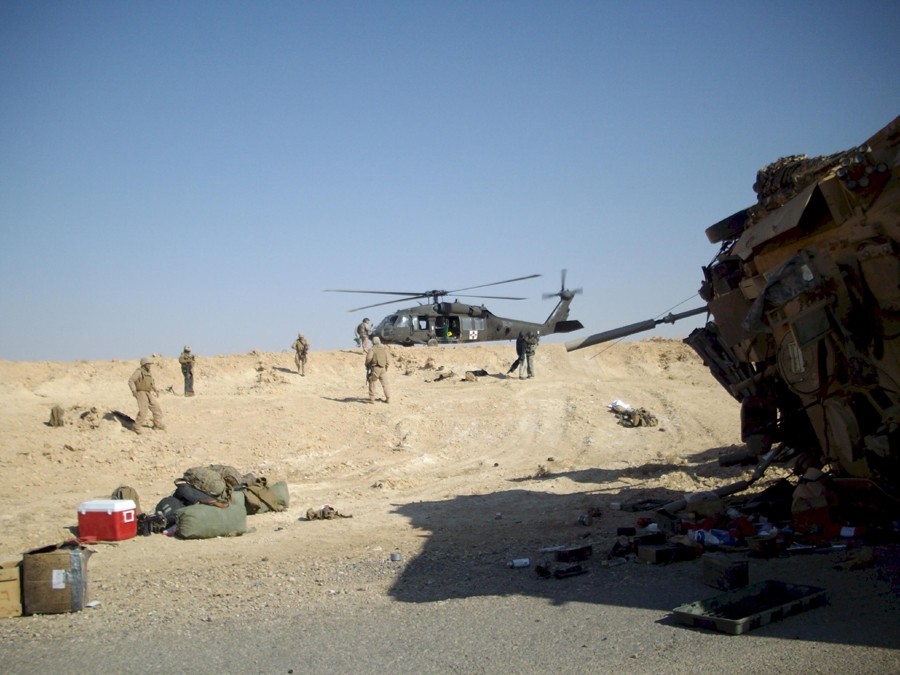
    This story is about a year old, and came out before I started this blog.  I want to thank Scott for sending me this, so I could post it here for everyone to check out.  Most would be surprised how often contractors have come to the aid of the military in the war, and vice versa.  It comes from a mutual respect and a sense of helping out one another as best we can.  The military has saved numerous contractor lives through medevac operations in this war or coming to our defense during some bad deals, and contractors always remember how important that relationship with the military is.  The military are the ones with the big guns and air support as well, and there is no competition with them–they are king in this war.  So this myth that some how contractors and military don’t get along out there, or we are a threat to the military, is just stupid.  Besides that, most of us are all prior military anyways, and we understand the military mindset and culture very well.  Semper Fi.  –Matt

——————————————————————- 

Marines

Somewhere out in western Anbar. 

Quick response by munitions clearance team in Iraq helps stranded Marines

Jan 24, 2008

BY Kim Gillespie, USACE

Huntsville Center’s Coalition Munitions Clearance program personnel assist at the scene of a Marine Corps tank accident in Western Iraq. The accident left the Marines’ communication equipment and main guns inoperative. CMC personnel secured the area and called a Medical Evacuation helicopter for one seriously injured Marine. Photo by Tim Bohannon (USACE)

The Soldier’s Creed states, “I will never leave a fallen comrade.” Army Civilian and contractor employees feel the same way.

(more…)

Thursday, December 18, 2008

Industry Talk: FedBiz Opps, Iraq and Afghanistan

Filed under: Afghanistan,Industry Talk,Iraq — Tags: , , — Matt @ 10:54 AM

Afghanistan

12/17/08

Armed Contractor Oversight Directorate

W91B4N-09-T-5006

R — Professional, administrative, and management support services 

12/17/08

Convoy Security Services

W91B4N-09-R-5001

V — Transportation, travel, & relocation services 

——————————————————————

Iraq

12/17/08

Security Services

W91B4M-09-R-0004

S — Utilities and housekeeping services 


« Newer PostsOlder Posts »

Powered by WordPress