Feral Jundi

Friday, September 14, 2012

Industry Talk: Live Tracking Protests In The Middle East And North Africa

Ever since this stupid movie came out, protests against western interest and embassies all over the Middle East and North Africa have been attacked. It is happening very fast and it is very difficult to keep up with–much like a large forest fire. In the smokejumpers, we called these fast, dangerous and large forest fires –‘gobblers’, or fires that gobbled up everything in their path. These protests are acting like a gobblers.

With that said, any sites that track it’s movement and can help to predict new protests will be very helpful to western interests and businesses overseas. It will also help out those who are just traveling over there so they can apply some OODA to their personal situation.

Analysis Intelligence is one such group that is live tracking the protests right now. They are also attempting to predict upcoming protests. Check it out. –Matt

Link to live tracking here.


Libya: Americans Killed Defending Consulate Were On Contract To Hunt Down MANPADS

One of the Americans killed alongside Ambassador Christopher Stevens in an attack on a U.S. diplomatic mission in Libya Tuesday told ABC News before his death that he was working with the State Department on an intelligence mission to round up dangerous weapons in the war-torn nation.
In an interview with ABC News last month, Glen Doherty, a 42-year-old former Navy SEAL who worked as a contractor with the State Department, said he personally went into the field to track down so-called MANPADS, shoulder-fired surface-to-air missiles, and destroy them. After the fall of dictator Moammar Gadhafi, the State Department launched a mission to round up thousands of MANPADS that may have been looted from military installations across the country. U.S. officials previously told ABC News they were concerned the MANPADS could fall into the hands of terrorists, creating a threat to commercial airliners.

Rest in peace to the fallen. These men fought with every measure of their lives and paid the ultimate sacrifice. They were also contractors, tasked with hunting down MANPADS in Libya, which is of vital national interest…and world wide interest.

Also, my condolences go to Brandon and SOFREP for losing a friend and fellow SOFREP team member. He was the ‘resident Naval Special Warfare’ editor there. Go to this link to read more.

As to the company these men worked for and the specific details of the contract, I haven’t a clue. The three articles I posted below give a background of these two men and a background of the MANPADS task force. Supposedly this same task force which was established in 2006, is looking at Syria to do the same thing. –Matt


Two ex-SEALs from SD killed in Libya
By Debbi Baker, Gretel C. Kovach, Nathan Max
September 13, 2012?
Two of the four Americans killed Tuesday after an attack on the U.S. consulate in Libya were former Navy SEALs from San Diego County.
Glen Doherty, 42, of Encinitas, and Tyrone Woods, 41, of Imperial Beach, were working at the diplomatic compound in Benghazi as security and intelligence contractors. Also killed were the U.S. ambassador to Libya, Chris Stevens, and information officer Sean Smith. Three others were wounded.
Secretary of State Hillary Clinton said Thursday that Doherty and Woods “died helping protect their colleagues.
“Our thoughts, prayers, and deepest gratitude are with their families and friends. Our embassies could not carry on our critical work around the world without the service and sacrifice of brave people like Tyrone and Glen,” she said in a statement.
The two former SEALs settled in San Diego County after initial training in Coronado, where all the elite naval special operators must pass a grueling 21-week test of mental and physical endurance.
Doherty, who grew up in the Boston suburb of Winchester, Mass., was a gregarious outdoorsman and high-octane adventurer, a self-proclaimed “high priest” of “The Cult of Recreationalism,” friends and family said.
The pilot, former ski instructor, surfer and trainer at the CrossFit/SEALFIT gym in Encinitas served nine years as a SEAL before getting out in 2005.

(more…)

Wednesday, September 12, 2012

Industry Talk: Private Security In Bolivia Is Booming

Filed under: Bolivia,Industry Talk,Law Enforcement — Tags: , , , — Matt @ 9:51 AM

At least 563 private security guards, aged between 18 and 50 years, serving in the 39 companies legally established in La Paz to provide physical protection and electronics particular persons, property, and institutions.”They are registered 563 (officials) that offer some of these services in La Paz. All are old, “said Lt. Col. Miguel Angel Rivera, head of the Chief Control of Private Security Companies (Jedecoes).

Insight Crime did a great post on the alarming increase in the use of private security in Bolivia. According to IC, one of the main reasons why it has exploded is the lack of trust the population has in it’s law enforcement.

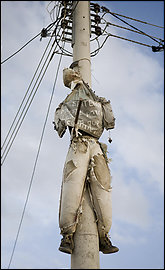
You know it is bad when 85 % of the people who live in four large cities in Bolivia, do not report crimes. There is also a lot of vigilantism going on, as reported by the Economist (and raising scarecrows to warn criminals). Not to mention the cartels and organized crime there.

What is interesting to me is that these guards are not allowed to be armed. My thoughts about this is that perhaps because of this restriction on guards, that the illegal security outfits are popping up to fill that void? IC made this comment.

In 2010, it was found that only around 15 percent of private companies in the eastern city of Santa Cruz, an organized crime hotbed, were legal.

If cartels are operating there, then it is possible that most of these illegal companies are criminally related. Or, they could be companies actually trying to provide an effective service in a dangerous world.

Also, if the demand is that high for security and the government is not moving fast enough to certify or regulate, then supply versus demand economics will apply. Someone will fill the need as they say, and it looks like PMSC’s in Bolivia are very much in demand… –Matt


563 private guards watched in La Paz
September 9, 2012
At least 563 private security guards, aged between 18 and 50 years, serving in the 39 companies legally established in La Paz to provide physical protection and electronics particular persons, property, and institutions.”They are registered 563 (officials) that offer some of these services in La Paz. All are old, “said Lt. Col. Miguel Angel Rivera, head of the Chief Control of Private Security Companies (Jedecoes).
A licensed private security company, according to the National System of Public Safety, develops preventive surveillance and early warning under custody and in close collaboration with the Police. For his actions, trains its employees on issues of emergency, first aid, environment, customer service and more.
“We do not act violently. Is not permitted. Our main objective is to develop an efficient system of prevention, only if there is imminent risk, if we intervene, “said Raul Moreno, CEO of Radar.

(more…)

Thursday, September 6, 2012

Cool Stuff: The Private Security Monitor–One Stop Shopping For Laws And Regulations For PMSC’s

This is a great resource for those that own PMSC’s, or are looking to start one up. If you want to operate internationally, you need to know the laws and regulations pertaining to running your business in these parts of the world.

For a great interview with the founders of the Private Security Monitor, go to Maritime Security Review’s post. Here is a snippet.

1) What was the driving force for developing the Private Security Monitor web portal and what are the Centre’s principal objectives?

The idea for the Private Security Monitor grew out of a 2011 workshop I hosted at University of California Irvine, part of an on-going collaboration with the Geneva Centre for the Democratic Control of Armed Forces (DCAF). At this workshop, participants from governments, international organizations, civil society groups, and industry focused enhancing transparency around private military and security services. Participants seized upon the idea of building a centralized, online information portal specific to these services and agreed that academic institutions were well-poised to undertake this project. When I was offered a position directing the Sié Chéou-Kang Center for International Security and Diplomacy at University of Denver’s Korbel School, this became our first major project.

We launched the “Private Security Monitor” publicly in August. The web portal, located at psm.du.edu, provides an annotated guide to regulation, data and analysis of private military and security services. It is a one-stop source for public information on the worldwide use of these services and thus a resource for governments, policy-makers, activists, journalists, and researchers.

And this portion tells what is available to readers.

6) What are the principal benefits for MSR readers and how would you suggest that they use the portal?

There are many useful documents for maritime security providers on the Private Security Monitor site. There is a dedicated IMO section with links to all IMO guidance; a list of leading industry associations and links to industry association reports on the use of privately armed guards aboard ships; organized by country, regulations relevant to the use of private armed guards and carriage of armaments aboard ships; and standards related to the hiring, vetting and training of private security service providers.

Users can scroll through the site to learn about the variety of regulations and regulatory efforts contained therein. They could also search documents according to issue area, document type, geographical area, year or keyword. There is a quick search tab on each substantive page and a more comprehensive search page that can be accessed from the top navigation bar.

Pretty cool and I will keep a link to the PSM over in the links to the right of this blog. –Matt


About the Private Security Monitor Project

The Private Security Monitor is an independent research project dedicated to promoting knowledge of and transparency in global private military and security services. The Private Security Monitor’s web portal provides an annotated guide to regulation, data and analysis of private military and security services. It is a one-stop source for public information on the worldwide use of these services and thus a resource for governments, policy-makers, activists, journalists, and researchers.
Housed and maintained at the Sié Chéou-Kang Center for International Security and Diplomacy at the University of Denver’s Josef Korbel School of International Studies, the Private Security Monitor operates in partnership with the Geneva-based Center for the Democratic Control of Armed Forces (DCAF).
BACKGROUND and FUTURE DEVELOPMENTS
The idea for the Private Security Monitor grew out of a 2011 workshop at the University of California, Irvine co-sponsored by UCI’s International Studies Program, DCAF, and the Center for Security, Economics and Technology (CSET) at the University of St. Gallen. At this workshop, participants from governments, international organizations, civil society groups, and industry agreed that lack of transparency was an important problem for the governance of private military and security services and that academic institutions could best contribute to information sharing, research and analysis. Thus the workshop’s first recommendation was for an academic-based project to serve as a one-stop source for information about private military and security services.

(more…)

Tuesday, September 4, 2012

Afghanistan: Insider Attacks And Contractors

In a recent interview, Lockheed’s chief executive, Robert Stevens, said defense contractors were assessing the costs and the risks of keeping personnel in Afghanistan as the uniformed military presence shrinks.
“If there’s an expectation that says companies are going to be there, then we’re going to ask, are we going to get enough security?” he said. “Who’s going to support this, from where? What would the logistics footprint look like, what would the personnel requirement look like, what would the security environment look like? Those are all reasonable questions.”

This is a conversation I have been contemplating for awhile now, and I have been trying to figure out the best way to approach this problem. Bottom line is that the discussion on insider attacks or green on blue attacks on contractors is not happening out there. We are absolutely being left out of the conversation in regards to these incidents, and yet contractors are a vital to the training and logistics initiatives all throughout Afghanistan.

It is also well known that training of Afghan police/military is a major element of the exit strategy from Afghanistan. Contractors are right there in the action with their military counterparts, and they are also being killed and wounded by insiders–like the military. I have blogged about our strategic value to the war effort before, and it is amazing to me how little is being said about this industry’s contribution…and sacrifice.

Most of all, what are the directives to companies on how best to deal with this problem?  Are all of the companies on the same sheet of music when it comes to countering this problem, or are they all doing their own thing? What is the best way of countering this?….  So that is what I would like to talk about in this post.

First of all, let’s discuss some of the statistics or lack there of. Meaning, no one is tracking contractor deaths specifically and I am only able to draw from assembled military related statistics. The Long War Journal has done a good job of this.

Most of the insider attacks are happening in the south, with the Helmand Province being the top spot. Most of the attacks had to be stopped by killing the individual(s). Here is a break down of how many folks have been killed or wounded due to insider attacks since January 1, 2008.

Numbers of Coalition troops and affiliates killed and wounded by green-on-blue attacks:

The total number of Coalition casualties from green-on-blue attacks for the period Jan. 1, 2008 to the present is 109. The total number of Coalition wounded is 89.

Green-on-blue casualties per year, and percentage of Coalition deaths caused by such attacks:

2012 – 45 – 14%

2011 – 31 – 6%

2010 – 21 – 3%

2009 – 10 – 2%

2008 – 2 – less than 1%

Green-on-blue wounded per year:

2012 – 45

2011 – 23

2010 – 7

2009 – 11

2008 – 3

As you can see, this is a trend that is increasing, but we are also training a bunch of police and military. So with that increase in personnel being trained comes an increase of trainers and their exposure to this sea of questionable folks.

The other thing to look at is who are these guys?  Well, according to the latest reportage, General Allen has given a quick look at the ratio.

Previously, NATO military officials had said that only about 10 percent of the insider attacks could be attributed to Taliban infiltration or impersonation of Afghan security units. But on Thursday, General Allen said that in addition to that infiltration figure, another roughly 15 percent of the attacks could be caused by Taliban coercion of soldiers or police officers, either directly or through family members.
Because most of the attackers had been killed or had escaped, and not captured alive for interrogation, it was difficult to provide firm statistics, he said. He also noted that more Afghans than Western troops had been killed by such insider attacks.

Man, those are some pretty sobering statistics, and I shudder to think how many of these deaths and injuries were contractors? I would think that contractor statistics tend to match military statistics, because we are doing the same job and working in the same environment. But I can’t say for sure, and it is only assumed. I have covered contractor deaths resulting from insider attacks before–in Afghanistan and elsewhere.

Ok, so now that is covered, what is the military doing to counter this? Time magazine wrote a great article that listed what we are doing based on a briefing that Secretary of Defense Panetta and General Dempsey put out last month. Here they are.

– “First, to increase the intelligence presence, so that we can try to get better information with regards to these kinds of potential attacks.

– “Also, to increase counterintelligence, to have people trained in counterintelligence to be part of these units so that they can, as well, identify those threats.

– “We have a thorough vetting process. It’s an eight-step process. We’re doing forensics on the particular instances that occur in order to make sure, you know, how that process.

— that vetting process operated and what we can do to improve it.

– “Implementing a notification process, so that when we get information we can alert people to the threats.

– “Training requirements — we’re not only implementing training requirements with regards to our forces, but the Afghans are doing the same to try to identify these people.

– “We have a guardian angel program which involves identifying one individual who stands to the side so that he can watch people’s backs and hopefully identify people that would be involved in those attacks.”

I also understand that pamphlets are being handed out to military personnel at the various FOBs and outposts in regards to countering this stuff. If you are a contractor in these areas, try to grab one of these to figure out your strategy for dealing with this threat. Especially if you are looking for ideas of souping up your own SOP’s and policies. Or if you are just looking for personal strategies on how to counter this stuff because your company has not given sufficient guidance.

Now to comment on some of these ideas and initiatives, and how this applies to contractors. My view is to find what works and copy it. To learn from others whom have dealt with this in the past, and in other parts of the world and in other wars, and borrow some brilliance as they say.  Analyze and synthesize.

First is the personal strategy. Petition your company to allow you to be armed and carry loaded on FOBs and outposts, and seriously consider using a retention holster.  I use the Safariland ALS, just so I can have some form of retention for my pistol. An insider attack can be as simple as someone taking your pistol or rifle and using it against you and your group. Something to think about there, and it looks like the military is finally waking up to the idea of making sure everyone on FOBs and outposts that have weapons, carry them loaded. Contractors who have weapons issued, should be allowed to do so as well.

Wearing body armor is a no brainer when it comes to training or working around questionable type folks. Having some medical items on you as well as a flashlight is crucial to survival as well. Insider attacks could happen night or day, or the attacker might go into a bunker or dark hiding place in order to escape when being hunted. A flashlight is a life saving tool if you want to search for persons and destroy them in that kind of situation.

Positioning yourself in your environment for optimum survival is a good one. Kind of think of yourself as the ‘principal’, and you are a close protection officer for your person.  Where would you position yourself for the highest chance of survival in any given situation and position?  What is your escape route and what would you do if an insider attacked, happened right then and there, day or night?  Constantly ask this question wherever you are at, and apply some OODA.

Another solution is to use a similar guardian angel program for contractors. Some guys I have talked with actually set up a guard with a machine gun to overlook the training of folks. It sends a pretty loud message and keeps everyone ‘civil’ at ranges. But it can also create mistrust and division–which is not good for that essential unit cohesion that we all need in the war in order to operate as a unified team. Yet again, security for training needs to be evaluated and it must be determined what is best for that specific contract and set of circumstances.

The final one is intelligence. Or better yet, know yourself and know your enemy (Sun Tzu). You must have someone on the ‘inside’ to find these insiders and to determine the general mood and demeanor of those you are training and working with. This insider can also be used to fine tune your management and trainers working with these guys to ensure they are not making folks angry enough to go on a shooting spree.

Why is this important? Well remember that post I did about how damaging bad bosses really are? Well if you have a trainer(s) that are abusing Afghan trainees, or running their programs poorly, or doing something to aggravate these guys, then that is something you can find with an insider. Especially from a cultural point of view, because a trainer might be doing something incredibly offensive and not even know it. An insider within the trainee group could help fine tune the contract. I liken these insiders as more ‘mystery shoppers’ than moles, and companies can use these guys to optimize the contract/mission, evaluate the management, and find the bad apples.

But of course this is a fine line to walk, and companies should not abuse this concept of operation. They should also work hard to ensure that whom they put into that role is briefed on how to do this properly. The end goal is you want to see your company and client in their most natural states and get a true feel for what is happening so that solutions are ‘real solutions’ to ‘real problems’. Or companies can throw darts at the solution board and use hope as a means for success or for finding these insiders.

Well, that is about all I have on this. This will at least get the conversation going and get everyone talking within their organizations on how best to counter this threat. –Matt


Hoping to foil infiltrators, Afghans will spy on recruits
August 21, 2012
Afghan officials say they have launched an expanded effort to spy on their own police and army recruits, an acknowledgment that previous measures designed to reduce insurgent infiltration in the country’s security services have failed.
The steps come amid a spate of “insider’’ attacks that have shaken the US-Afghan military partnership during a stage of the war that hinges on close partnership between the two forces.
Nine US troops have been killed by their Afghan counterparts in the past 12 days, and 40 coalition service members have died in insider attacks so far this year.
President Obama, in his most extensive comments to date on the issue, said Monday that his administration is ‘‘deeply concerned about this, from top to bottom.’’
The Afghan measures include the deployment of dozens of undercover intelligence officers to Afghan security units nationwide, increased surveillance of phone calls between Afghan troops and their families, and a ban on cellphone use among new recruits to give them fewer opportunities to contact the insurgency, Afghan officials say.
The initiatives appear aimed at addressing US criticism that the Afghan security forces are not doing enough to ferret out insurgents within their ranks. The chairman of the Joint Chiefs of Staff, Army General Martin Dempsey, was in Kabul on Monday for consultations on the matter, and Obama said he would soon be ‘‘reaching out’’ to President Hamid Karzai of Afghanistan.

(more…)

« Newer PostsOlder Posts »

Powered by WordPress