Feral Jundi

Tuesday, September 4, 2012

Industry Talk: US Boosts Security For Afghan Contractors

Finally, a discussion about contractor safety in Afghanistan. Although I have yet to hear any talk about it in the contracting community, as to these specific measures. A big hat tip to Nathan Hodge for writing this and getting it out there. –Matt


U.S. Boosts Security For Afghan Contractors
By Nathan Hodge
August 29th, 2012
The U.S. military has added previously undisclosed security measures for contractors in Afghanistan, amid a wave of insider attacks by Afghan soldiers and police and the continuing withdrawal of coalition troops.
Separately, the top U.S. general’s plane was hit by insurgent fire early Tuesday as it sat on a runway at Bagram Airfield in Afghanistan. Indirect rounds fired shortly after midnight damaged the C-17 transport plane of Gen. Martin Dempsey, the chairman of the Joint Chiefs of Staff, and another helicopter, according to the U.S.-led coalition.
The general and his entourage weren’t on the plane at the time and weren’t injured, the coalition said, adding the entourage took another military aircraft to leave Afghanistan. The attack came just months after an Afghan civilian tried to drive a stolen vehicle into the U.S. defense secretary’s plane during a similar visit.
In scheduled meetings with U.S. commanders in Afghanistan and Afghan military officials, Gen. Dempsey had focused on the rise in attacks on U.S. military forces by Afghan police and army personnel.
The U.S.-led coalition has also ordered tighter “force protection” measures for contract personnel who are involved in military training, according to Royal Canadian Air Force Maj. Steve Neta, a spokesman for the North Atlantic Treaty Organization training mission in Afghanistan.
A NATO document viewed by The Wall Street Journal outlines a number of extra precautions for contractors, including requiring personnel to travel in more heavily armored convoys with military-compatible communications, GPS trackers and specific weaponry.
Maj. Neta said the coalition, as a matter of policy, doesn’t discuss specific protection measures.
“We did make revisions to a policy relating to our contractors, although this wasn’t precipitated by any one event,” he said. “Force protection is a fundamental element to our operations here and we feel that our personnel understand that measures are implemented in the interest of providing as safe an environment as possible.”
The increased security for contractors was put in place in recent months alongside efforts to increase security for coalition troops. Contractors and coalition troops alike have been increasingly targeted recently by uniformed Afghan soldiers and policemen, in so called “green-on-blue” attacks. Over the past two weeks, at least 10 U.S. troops have been killed in attacks by Afghan troops on their international colleagues.

(more…)

Tuesday, August 28, 2012

Industry Talk: A Closer Look At The Aid Industry And Their Current And Future Use Of PMSC’s

According to the report, incomplete U.N. data shows a steady rise in the number of security contracts from 2006-2007, with the value increasing from $44 million in 2009 to $76 million in 2010, the latest data available.
The majority of contracts in 2010 – $30 million worth – were for activities by the U.N. Development Program followed by $18.5 million for U.N. peacekeeping operations and $12.2 million for U.N. refugee activities, it said.
The report said the overall value of contracts is likely to be considerably higher because data from some U.N. bodies, like the U.N. children’s agency UNICEF, is not included or incomplete.

In this post I wanted to post some statistics of interest to our industry that will help companies looking for an entry into this market. Or at least it will help companies in their research, and identifying possible niches.

Awhile back I posted a publication that discussed the UN’s increasing reliance on private security. I wanted to expand on that post a little more and identify some key statistics that report did not have, that I was able to grab elsewhere, that will further help to educate companies out there wanting to get into this sector of security.

The first statistic is this one. It came from the report called ‘Aid Worker Security Report: Spotlight on security for national aid workers: Issues and perspectives (August 2011)‘ This report gives a quick run down as to the types of attacks and how many deaths there have been over the years. 2008 was the peak of deaths and was certainly a wake up call for this industry.
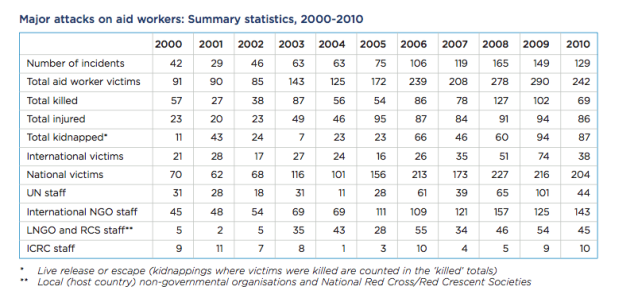
 

But these deaths also show the drive and incentive that these aid groups have when it comes to getting into these troubled spots of the world. That despite these deaths and incidents, they are still getting in there. They are driven by their donors, and if they do not produce results, then they will see a decrease in donations. Competitors in this market will get more donations if they are perceived as being ‘more effective’ in helping people.

We are also talking about millions of dollars worth of donations, and large aid organizations that have tons of folks and facilities to support with those donations. So showing worth and an ability to follow through with aid is vital if they want to continue getting donations.

Plus, groups like Aid Watchers or or Charity Watch help to further gauge the effectiveness of organizations, which help to further guide donations. These donations are also highly dependent on people having the disposable income to actually give to these causes. You can see how finicky this process can be during a downward trend in the economies of countries world wide.

There is also a lot of competition from smaller aid groups or individuals, seeking to fund their projects. In this type of competitive market for your donation, it is easy to understand why they would take the risk of sending folks into harms way to show they are more capable than the other guy.

What is also at issue is the perception of aid groups in these countries. As this applies to our industry, there is the perception that using armed security sends a negative image to the local populations. In the eyes of these clients, the security industry has an image problem.

Which brings up the next statistic that I thought was interesting. What types of security services are these aid groups willing to contract, and who are they contracting with? Well, here is one graph I found from Providing Aid in Insecure Environments: Trends in violence against aid workers and the operational response (2009 Update) HPG Policy Briefs 34, April 2009.
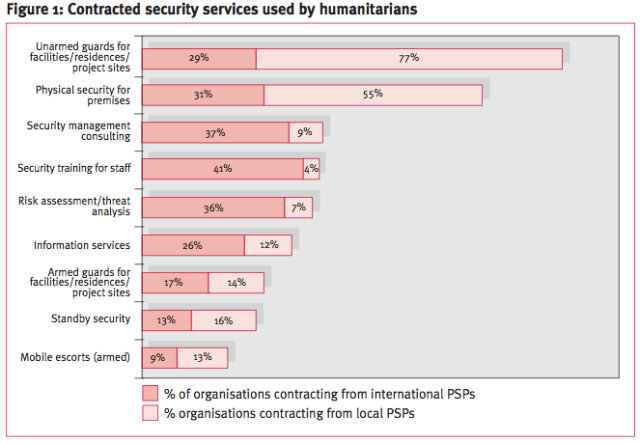
 

With this graph you can see this high dependency on ‘unarmed local guards’.  Which is a nice idea, but realistically in a war zone or troubled spot, unarmed guards is a horrible idea. And yet aid groups continue to depend upon this type of protection.

But for training/consulting/managing/risk assessment, international PMSC’s are still king. Which is not surprising, and I only think this will increase as aid groups continue to look at entering or holding their position in these hot zones.

Finally, I wanted to go back to the UN’s use of private security and it’s significance. The UN is a business of sorts as well. They have to show to the member countries that they are effective. If they are not able to operate in these countries and keep the peace, then they will not be able justify it’s cost and existence. So for operations that are not direct peace keeping missions, but still place staff in war zones or troubled spots, they must do all they can to hold in place and not be chased out because of incidents.

There has also been a change in philosophy at the UN, which was mentioned in this report I posted.

Change of Security Philosophy (at the UN)
During the past decade, the UN has redefined its security strategy, recognizing that the organization could no lon- ger rely on its own reputation to secure it from harm. As one high official put it, the UN can no longer count on the “strong assumption that the UN flag would protect people, protect the mission.” At the same time, the UN decided to keep a presence in dangerous conflict situations where it previously would have withdrawn. This new dual posture led the organization to rely increasingly on forceful protection measures.
The Secretary General spoke of this new approach in his 2010 report on the Safety and Security of UN Personnel. He noted that the UN was going through a “fundamental shift in mindset.” Henceforth, the organization would not be thinking about “when to leave,” but rather about “how to stay.” The UN now proposes to stay in the field even when insecurity reaches a very dangerous threshold. The Secretary General’s report, reflecting the UN’s general posture, focuses on how to “mitigate” risk, rather than considering the broader context, such as why the UN flag no longer protects and whether the UN should be present in a politically controversial role in high-risk conflict zones.
Risk outsourcing is a rarely acknowledged aspect of this security philosophy. Private contractors reduce the profile of UN-related casualties and limit the legal responsibility for damages that security operations may cause. This is similar to the posture of governments, which lessen wartime casualties among their own forces through the use of PMSCs, and thus avoid critical public pressure on the waging of war. UN officials have acknowledged in private that in situations where casualties cannot be avoided, it is better to hire contractors than to put UN staff in danger. As is the case for governments, UN use of PMSCs serves as a means to prevent public criticism of larger security policies.

Hiring the services of a PMSC can be easier as well, and can have better results than depending upon poorly trained local forces and security markets. This industry has gained experience and capability, and especially after ten plus years of war time contracting.

I also believe that the UN’s use of PMSC’s will only help private aid groups to ‘see the light’ when it comes to using security to accomplish their goals. Much like with the whole ‘armed guards on boats’ theme that I keep pounding away at in maritime security posts, I think a similar theme could be promoted for aid groups. Especially if you can associate armed security with a reduction in deaths and kidnappings, and an increase in effectiveness for all aid groups. Or if the perception of the security industry can be changed, and the image of this industry better fits into what these aid groups need.

Also, you could compare this to a ‘dance’ between our two industries. This is like a dance between two new partners with two different ideas of what good dancing is all about. As we work together in these dangerous troubled spots in the world, I believe the partnerships will only improve and get synchronized. But that only happens if our group and their groups strive to understand one another, and apply kaizen to that relationship. So hopefully this post has contributed to that understanding.

It’s a dangerous world out there, and the security industry is ready and willing to meet those challenges. –Matt


Private funding in humanitarian aid: is this trend here to stay?
By Velina Stoianova

13 April 2012.
Major humanitarian crises in the past decade have prompted unprecedented amounts of private donations: the tsunami that caused widespread devastation across the Indian Ocean in December 2004 saw US$3.9 billion raised in private aid; the response to the January 2010 earthquake in Haiti generated at least US$1.2 billion in contributions from the general public; US$450 million was channelled in response to the 2010 floods in Pakistan; and at least US$578 million went to Japan following the March 2011 earthquake and tsunami. While global private support to specific large-scale emergencies is relatively easy to gauge, it remains unclear how much private money overall is out there in any given year.

(more…)

Industry Talk: Turkey’s Private Security Officers Outnumber Armies Of Six Countries In Europe

Filed under: Industry Talk,Turkey — Tags: , , , , , — Matt @ 9:13 AM

Turkey has roughly 217,000 private security guards who are employed in public offices and private companies, a figure that outnumbers the soldiers in the armies of six countries in Europe — Austria, Belgium, Portugal, the Netherlands, Norway and the Czech Republic…Currently there are 1,430 security firms in Turkey, and 737 training centers for private security officers, according to the Security Headquarters’ Private Security Department’s figures.
Candidates receive non-armed certifications after 90 hours of training, but an armed certification requires a further 30 hours…

Every now and then I will come across statistics from other countries about their PMSC industry. These two stories below go into the statistics of Turkey’s market and I thought it would be cool to archive them here.

One statement below brought up an interesting point about loans. Getting a loan in some countries is not as difficult as it is in others, and it looks like Turkey has an industry that is yearning for more capital to expand and grow. From building training facilities to buying all the equipment and weapons necessary to maintain a growing security business, they need it.

“We want the government to support our sector. In a country that is capable of providing loans to the IMF, we want to be able to receive long-term low-interest loans from state banks, as well as support from the Social Security Institution and the Finance Ministry. With this support, our sector will be able to develop even more,” he said.

The other point to bring up is that 9/11 has had a world wide impact on this sector, and not just in the west.  Security services are in high demand all over because of the threat of terrorism or crime, and this industry is in high demand in countries where police forces have been cut. In countries where austerity measures have reduced the number of police, you will see this market of force expand and private security is filling that vacuum.

Of course the final big picture comment is summed up in this statement.

Perut also added that the private security services sector is valued at up to $6 billion for the entire world.

I guess Perut did not have access to the Small Arms Survey done last year that actually put the value of this market much higher. Although he could be referring to just one aspect of PMSC’s, so who knows where he got it from. Here is the quote:

The private security sector has been booming since the mid-1980s and continues to grow steadily (van Dijk, 2008,
p. 217). Recent estimates show that the security market is worth about USD 100–165 billion per year, and that it has
been growing at an annual rate of 7–8 per cent. –2011 Small Arms Survey, Ch. 4

Interesting stuff and if you guys have anything add to this data, let me know. This post will also be filed under Turkey in the categories below if you need it. –Matt


Private security officers in Turkey now their own ‘army’
08/28/2012
The 217,000 private security guards in Turkey outnumber armies of many many nations, according to Bülent Perut, chairman of a sector organization. Rapid urbanization is increasing the number, he says.
The number of Turkish private security officers has reached 217,000, greater than the combined military forces of Austria, Belgium, Portugal, Holland, Norway and the Czech Republic, according to data from a sector organization.
“Even though there aren’t specific figures as to the size of the sector’s economy, we believe that in general it ranges between $3-6 billion,” Private Security Associations Federation President Bülent Perut told Anatolia news agency in an interview published Aug. 28.
In Turkey, 886,000 people hold private security certificates, confirming that one has received appropriate education and training in the field. Some 604,000 of these people also hold a security ID, the state authorization to work as a guard.
Perut told Hürriyet Daily News in a phone interview yesterday that many security guards preferred other jobs when they are available, because of the low wages and
poor level of social rights in the security sector.

(more…)

Monday, August 20, 2012

Games: Army Of Two– The Devil’s Cartel

This is a great concept for a game. Take these two security contractors and veterans of the middle east, and put them up against the cartels down south. Here is a quick description about the game.

You’ll face off against the world’s most vicious drug cartel in Army of TWO The Devil’s Cartel. Take part in a private military operation against The Scythe, a wide-spread criminal operation that has brought murderous terror to the besieged nation of Mexico. Lead your own insurrection as you battle tenacious foot soldiers and ruthless drug lords in a story that’s ripped from today’s headlines. Do whatever it takes to end the corrupt cartel’s stranglehold over the country, and bring the head of The Scythe to swift and bloody justice. The Army of TWO may be vastly outnumbered by the villainous Devil’s Cartel, but they certainly will not be outgunned.

Man, it almost seems like the guys at EA are reading this blog. lol I have been talking about private industry, armed with letters of marque, operating within a well constructed offense industry, and used against the cartels for awhile now.

What is cool here is that this game further demonizes the cartels and allows the gaming public to participate in their destruction.  It also brings up the concept of using private industry to take care of a problem. Even if the reality of doing such a thing is remote, or that private industry would probably approach it in a less dramatic and violent fashion, it is the idea of such an action that is significant. Very cool and we will see how it sells. –Matt

Facebook page for game here.

Website for game here.


Industry Talk: Shell Spent Close To $1 Billion On Worldwide Security Between 2007-2009!

Filed under: Africa,Industry Talk,Nigeria — Tags: , , , , — Matt @ 11:35 AM

But the scale of Shell’s spending, revealed by the data for the first time, raises questions about the effectiveness of its security policies. “What is striking about the amount being spent in Nigeria is its ineffectiveness,” said Amunwa. “Shell spent many millions of dollars each year on government forces who failed to provide the company with adequate security.”
Nkabari said: “Shell cannot call this spending ‘security’. If it was really providing security, then why do we continue to have vandalisation, why do we have bunkering [theft of oil], why do we have the security mess that we have in the Niger delta? They give protection to the oil workers but they are not providing the region with ‘security’.”

It does raise the question as to how effective this has been in actually creating security? Either way, this is a stunning amount of money that Shell has dished out for security, and especially in Nigeria.

One thing about Nigeria is that it is filled with corrupt leaders in the military and government. Leaders that played both sides in the conflict there for economic gain. Meaning, they can get money by attacking the pipelines and stealing oil, and they can make money by protecting the pipelines. So they can just keep the money machine going by attacking through proxies, and protecting with the military. And meanwhile, Shell throws millions of dollars into that machine.

On the other hand, Shell is doing the numbers and doing the cost benefit analysis of all actions. So even if they are feeding this corrupt machine, at the end of the day, they are able to make a profit. Not only that, but the people have a say in this stuff too, and if they do not support the effort because of whatever reason, then they will lend their support to forces like MEND (or ideas like MEND, because everyone acted under it’s banner to steal from Shell)

This stuff is extremely interesting to me because companies like Shell or Exxon Mobil are going into war zones or non-permissive environments throughout the world, and setting up operations. And in one year, they could go from working with a somewhat stable government to being in the middle of political turmoil, rebellion (arab spring), war, or some insurgency. They have to make incredibly tough decisions at all levels of involvement, and they have to be good at predicting what’s next.

So like a small country, they need a security/defense apparatus, and they need an intelligence apparatus in order to create and implement strategies wherever they are at. When Shell had the third highest security budget in Africa, that is pretty significant. I wonder how the other companies compare?

Interesting stuff, and our industry and it’s lessons learned over the last ten years of war will be absolutely crucial to the resource extraction world–now and into the future… –Matt


Wearing an orange vest with camouflage?…


Shell spending millions of dollars on security in Nigeria, leaked data shows
Internal documents reveal oil company spent $383m over three years protecting staff and installations in Niger delta region
By Afua Hirsch and John Vidal
Sunday 19 August 2012
If it were a country Shell would have the third highest security budget in Africa.
Shell is paying Nigerian security forces tens of millions of dollars a year to guard their installations and staff in the Niger delta, according to leaked internal financial data seen by the Guardian. The oil giant also maintains a 1,200-strong internal police force in Nigeria, plus a network of plainclothes informants.
According to the data, the world’s largest company by revenue spent nearly $1bn on worldwide security between 2007-09: if it were a country Shell would have the third highest security budget in Africa, after South Africa and Nigeria itself.
The documents show that nearly 40% of Shell’s total security expenditure over the three year period – $383m (£244m) – was spent on protecting its staff and installations in Nigeria’s volatile Niger delta region. In 2009, $65m was spent on Nigerian government forces and $75m on “other” security costs – believed to be a mixture of private security firms and payments to individuals.
Activists expressed concern that the escalating cost of Shell’s security operation in the delta was further destabilising the oil rich region and helping to fuel rampant corruption and criminality. “The scale of Shell’s global security expenditure is colossal,” said Ben Amunwa of London-based oil watchdog Platform. “It is staggering that Shell transferred $65m of company funds and resources into the hands of soldiers and police known for routine human rights abuses.”

(more…)

« Newer PostsOlder Posts »

Powered by WordPress