Feral Jundi

Wednesday, May 23, 2012

Iraq: Exxon Mobil Leads The Charge North, As The Shine Of The South Wears Off

Filed under: Industry Talk,Iraq — Tags: , , , , , — Matt @ 1:49 PM

Iraq has ambitious plans to develop its huge southern oilfields – potentially the world’s biggest source of new oil over the next few years – and few oil firms dare risk being barred from such a bonanza by angering Baghdad.
But increasingly, some executives say, Kurdistan’s potential is also coming up in boardroom discussions, as sluggish output, red tape and infrastructure bottlenecks in the south take some of the shine off the central government’s oil program.
Oil majors are now waiting on the sidelines, watching the outcome of Exxon’s balancing act between Baghdad and Arbil, the northern capital. France’s Total is the latest company to provoke Baghdad’s ire by acknowledging interest in Kurdistan.
“What companies are trying to do is get to the point where they are investing in the north and the south,” said one industry source working in Iraq……Firms have experienced problems getting visas for contractors and security staff, delays in bringing in armored vehicles and holdups securing operating licenses. Such hassles make Kurdistan’s offerings look more tempting by comparison.

“Every delay we face cuts off a significant part of the internal rate of return,” said one oil company source. “Sometimes I wonder if we picked the wrong region.”

This is some interesting business going on in Iraq. Oil companies are playing a risky game in Iraq, and yet they are the actors that will more than likely drive Iraq to ‘pull it together’. It also looks like Exxon Mobil is leading the charge in this game as well.

I say this, because the divisions in Iraqi parliament/central government, along with corruption, is causing oil companies to seek safer and more stable leadership/relationships to do business with in order to keep extracting and shipping oil. For example, Exxon has signed contracts both in the North and the South, and it looks like they are starting to lean more towards moving north with the hopes that this will send a message to parliament. Of course parliament reacted by saying they cannot bid on any more contracts in the south.

The other area of interest with this, are the contracts signed in the disputed areas. Specifically the area near Mosul, which is the second largest city in Iraq.  I could see Exxon having all sorts of problems in that region unless some serious deals were made, and I was curious as to what the motivation was?  Perhaps the clues are in the state of affairs within the city itself. Check this quote from an interview with Mosul’s governor?

Mosul is an agricultural and oil region. However, it cannot properly and sufficiently use Iraq’s oil revenues. Mosul is also uncomfortable with the recent agreements between foreign oil companies and Arbil to extract oil from Mosul’s soil. For instance, Exxon-Mobil signed a contract with the KRG despite the fact that the site it will explore for oil is in Mosul. Nujaifi is holding talks with Exxon-Mobil and the KRG to resolve this problem. In addition, under the Iraqi constitution, Mosul should get 11 percent of Iraq’s oil revenue. However, it receives only 2 percent. According to Nujaifi, if the oil bill is not adopted and the oil revenues are not distributed evenly by the provinces, a political crisis will erupt. The poverty rate in Mosul is 23 percent, whereas it is 3 percent in the KRG. Nujaifi notes that the rising tension along the borders of Mosul is creating tension for them as well. As the KRG becomes more popular, it is impossible to explain the recent state of backwardness in Mosul.

I highlighted the key parts in this quote, and I think that is most significant. With poverty as high as it is, and a neighbor like KRG enjoying the good life, who do you think Mosul will want to do business with?  Especially if Iraq is only giving Mosul 2 % of Iraq’s oil revenue.  They are definitely getting the short end stick in this deal, and either the South pays up, or Mosul will probably join the Exxon party.

Also, the news of Kurdistan signing a deal with Turkey for a new pipeline that would completely shut out Baghdad is definitely some news to talk about here. That would mean they would have a way to capitalize on oil extraction without paying Baghdad. They could possibly bring cities like Mosul into the mix with this pipeline, and especially if Mosul can capture a better deal.

On Sunday, Iraqi Kurdistan unveiled an agreement to sell oil through Turkey into the international markets, thereby leaving Baghdad completely out of the loop. The Kurdish oil minister Ashti Hawrami said Iraqi Kurdistan will construct a huge 1 million barrel per day pipeline over the next 12 months through which oil and gas will be carried through Turkey.
“We envisage the building of a new pipeline taking Kurdistan’s oil, particularly the heavier component part to Cihan,” Hawrami said at a conference with Taner Yildez, the Turkish energy minister.
Baghdad believes such an arrangement contravenes Iraqi laws, while Kurds assert they can sign any contract regarding their natural resources according to the terms of the constitution.

Oil fields like this also provide jobs to the locals and infuse money into the local economy. Security will be crucial–which means local security companies will be a huge player in this. (although if you look at how MEND operates in Nigeria, you could see the same thing happening in Mosul with insurgents) The question here is would Baghdad send the troops to protect these oil fields? lol Probably not, unless they are included in the oil deal. That is where this get’s interesting, and I am sure criminal groups and insurgents are looking at how they could use this to their advantage.

The other thing to look at is if Exxon and other oil companies have another pipeline they can use, that is being managed by a government that knows what it is doing and is stable, then I could totally see how this would be a better bet for those companies.  This is also another signal to Baghdad that ‘hey guys, if you come together and square away your house, then you too can enjoy the same prosperity as the Kurds’.

Or, the Iraqi government can try to exert influence or pull some military moves up north, but good luck there. lol The Peshmerga and terrain will dictate otherwise.

So we will see how it goes. My guess is that Exxon and others will continue to play the North against South in order to keep extracting. They will keep these two players of the country competing for these companies and their capability. That back and forth interaction, might be the kind of business that will force the country to square itself away in order to finally realize their oil extraction goals. The alternative is to be driven apart.

There is a lot of money in the ground, and if Iraq wants it, it will have to do business with the companies that know how to get it out and into the market. That takes compromise and leadership, and a divided parliament and corrupt government in the south will only force companies to take the path of least resistance. –Matt
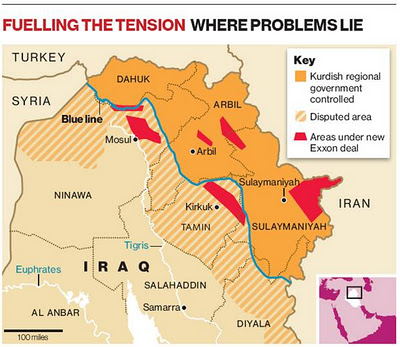


Analysis: In Iraq, oil majors play north versus south
By Patrick Markey and Peg Mackey
Thu Apr 5, 2012
In the weeks before Iraqi Kurdistan revealed that Exxon Mobil had signed up to explore for oil there, executives at rival Shell faced a dilemma over whether or not to join the U.S. oil major in its foray north and risk angering Baghdad.
The fields in the autonomous region offered rich potential, an easier working environment, better security and attractive contracts. That seemed a winning combination for smaller oil companies already working there, such as Norway’s DNO, even though they struggled to collect profits.
But at the 11th hour, industry sources say, Royal Dutch Shell backed out and decided to focus on a $17 billion gas deal in the south rather than sign exploration contracts with the Kurdish Regional Government, which the central government could dismiss as illegal and could prompt reprisals.
Shell’s caution, Exxon’s silence on its deals and this week’s renewed dispute between Baghdad and Kurdistan over export payments reveal how delicate is the balance companies must manage between a central government and a Kurdish authority locked in a struggle over who controls Iraq’s vast oil wealth.
The dispute over oil is at the heart of a wider disagreement between Iraq’s central government in Baghdad and the Kurdish region, which are also increasingly at odds over regional autonomy, land and political influence.
Iraq has ambitious plans to develop its huge southern oilfields – potentially the world’s biggest source of new oil over the next few years – and few oil firms dare risk being barred from such a bonanza by angering Baghdad.

(more…)

Thursday, May 17, 2012

Iraq: Foreign Military Contractors Spearhead Effort To Train Iraqi Forces

“This is the model that Iraq is very comfortable with –low .U.S presence in uniform, a lotta contractors, and they’re getting the quality instruction, the quality training that they really need,” Lieutenant General Robert Caslen

Here is a quick story and update on some more contractor training programs in Iraq. But in this case, this is training that the Iraqis want and need.  Perhaps the Police Development Program that DoS is running should take some notes?

What is interesting is that the article listed some numbers.  Check it out.

But they left behind the Office of Security Cooperation-Iraq (OSC-I), a group of about 157 military personnel under U.S. embassy authority, and some 600 civilian contractors, mostly retired soldiers.?They are working with the Iraqis on everything from training on new equipment, such as U.S. M113 armored personnel carriers and M1 Abrams tanks, to military education.

600 hundred contractors training the Iraqis? I imagine that figure includes support contractors as well, because for every trainer or soldier, there is the logistical support in the background that keeps them going. That is still impressive. But what is equally important is the public private partnership that is going on to make that happen. 157 military personnel are there, helping to implement this training and advising as well. –Matt


Foreign military contractors spearhead effort to train Iraqi forces
Thursday, 10 May 2012
Explosions throw up clouds of smoke near Iraqi soldiers with armored vehicles, who check for casualties, spot enemy forces in the desert ahead of them and then open fire.?But the blasts are only simulated artillery fire and the “enemy forces” are pop-up silhouette targets, not gunmen and vehicles.
That is just as well for these soldiers on a training exercise, as the puffs of dust kicked up by bullets downrange indicate that their aim is often off the mark.?An Iraqi company commander led his soldiers in the exercise at the massive Besmaya military base southeast of Baghdad, but it was a foreign contractor who controlled the scenario.?It was the contractor who ordered the targets raised and lowered amid the sounds made by .50 caliber machine guns on the armored vehicles and the chatter of M-16 rifles.?Contractors, who also assist soldiers in preparing for drills and with after-action reviews, are at the forefront of U.S. efforts to train Iraqi forces.?Negotiations on a post-2011 U.S. military training mission broke down last year over Iraqi reluctance to offer the trainers immunity from prosecution, and almost all American soldiers left the country last December.

(more…)

Wednesday, May 16, 2012

Cool Stuff: The Men That Ended The Draft, And What That Means For Today’s Wars And Contractors

In his recent coauthored book, Two Lucky People, Mr. Friedman writes that 5 of the 15 commissioners — including himself, Mr. Greenspan, and Mr. Wallis — were against the draft to begin with. Five members were undecided, and 5 were prodraft. Yet when the commission’s report came out less than a year later and became a paperback book, all 15 members favored ending the draft. What happened in between? That’s where Bill Meckling comes in.

This is cool because thanks to the work and ideas of these men, they were able to radically change the way the US was doing business. They ended the idea of a ‘slave army’ or compulsory draft.

Of course there were a lot of things in alignment in order to make that happen back then, namely the Vietnam war, but as you can see with the interview and the story below, it still took some convincing to get folks to change their mind.

I also think it is interesting that the generals of the day, tried to use the ‘mercenary’ concept in the derogatory.  That General Westmoreland did not want to command an ‘army of mercenaries’. lol Wow, he went there.

But what is equally interesting is how Milton Friedman shut down and tore apart the General’s argument in a rather Boydian kind of way.  (it would have been cool to see Boyd and Friedman debate?)

In his testimony before the commission, Mr. Westmoreland said he did not want to command an army of mercenaries. Mr. Friedman interrupted, “General, would you rather command an army of slaves?” Mr. Westmoreland replied, “I don’t like to hear our patriotic draftees referred to as slaves.” Mr. Friedman then retorted, “I don’t like to hear our patriotic volunteers referred to as mercenaries. If they are mercenaries, then I, sir, am a mercenary professor, and you, sir, are a mercenary general; we are served by mercenary physicians, we use a mercenary lawyer, and we get our meat from a mercenary butcher.

The other reason why I bring this up, is because I believe this is a crucial part of US warfighting history as to why this industry is so strong and relevant in today’s wars. The ending of the draft, along with a society demanding a peace dividend at the end of wars, are two factors which really drive the necessity of contingency contracting. Meaning, a society that does not have the draft, must have a means of raising an army quickly by other means in order to meet the demands of a war or wars.

At the end of the Cold War and the First Gulf War, we saw large cut backs in the US military. This was the peace dividend that society demanded, and politicians gave them. But what happens when that peace is shattered and a reduced military must be activated?  Well everyone knows the story of 9/11 and the last ten years of war that has been fought in Iraq and Afghanistan, and around the world. The requirement for manpower, and the ability to sustain sufficient levels of manpower under an All Volunteer Military regime has been tested. And in my view, the AVM was a success, but with a caveat.

The AVM did have problems raising sufficient manpower during the tough periods of this war. The peek of the Iraq war comes to mind. I mean the military was using stop loss and recalling soldiers in order to get enough bodies out in the field. The news and political debates really showed the violence of that war, and it was a hard sell to a young person to want to be a part of that. In that kind of environment, along with having a ‘military we went to war with, and not the one we wished we had’, we had problems. So how did we make up the difference for manpower? Enter contractors….

You see, contractors are a necessary industry to have, if a Democracy like ours wants to wage war using the AVM concept. And the numbers speak for themselves (please see all of the prior publications on the blog that listed those numbers). What is more important is that private industry did answer the call, and did it ‘willingly’. Contingency contractors did everything from cooking to cleaning, to building and fixing, to training and mentoring, to PSD/Convoy/Static security.  And this industry that answered the call, had ‘legions’ of willing participants from all over the world lining up to join the effort. Especially during the peek of the Iraq war.  They did it for pay, much like a soldier in the All Volunteer Military gets paid, and they did it for patriotic or idealistic reasons, much like a soldier in an AVM.

I only see this industry becoming more relevant and legitimate as time goes by. I think Milton Friedman would be pretty impressed by how private industry reacted to this need for contingency contracting/manpower in today’s wars. Private industry also reacted in the same way to the equipping and arming of war machines of wars past. What private industry did during WW 2 was beyond belief, and all of those companies that re-tooled and focused for that effort helped the allies win. Private industry is quite the thing when it has direction and incentive.

I also think that the concept called the All Volunteer Military is a misnomer. There is nothing volunteer about it. lol I mean when I hear the term volunteer, I think of it’s definition–‘a person who performs a service willingly and without pay’. Today’s military service requires a contract, and the soldier get’s paid and they receive benefits. So I just have a problem when people say that the military is a ‘volunteer’ force. It may not be a ‘slave army’, but it certainly is not an army of volunteers.

I guess under that logic, I am a volunteer as well? Matter of fact, contractors should be tied in directly within the concept of an All Volunteer Military. It’s just we volunteer for a privately run service, and not a publicly run service. But both groups of force, do so out of free will and because of the pay and benefits. So what differentiates both of us?

Well, one way to look at this is to apply my Offense and Defense Industry models to what is going on right now. The military has the monopoly on all Offense Industry.  Meaning they are the ones that profit from killing or capturing the enemy. By profit, meaning if they are successful in winning wars and destroying the enemy, then congress blesses the military with more funding. They also get the glory and praise for victory. Those leaders responsible for doing well, also profit by getting promotions and taking those successes with them further on in their careers or life. Winning wars, certainly ups the value of the victors responsible for that.

For Defense Industry, the military does not hold a monopoly. And that is significant. It is private industry that competes with the military when it comes to the defense, in war zones. Everything from cyber security, to standing posts, to training, to PSD, to static security, to convoy operations. Private industry is certainly competing with the military, and they have market share. And like I mentioned up top, the numbers speak for themselves. This blog also lists numerous examples of how private industry operates and flourishes in today’s Defense Industry realm.

I also think the example of Fedex/UPS versus the Postal Service, is a good one to look at when looking at today’s Defense Industry. Both the public and private organizations share the same space, much like how military and contingency contractors share the same space called Defense Industry. But it is in that space, where folks on both sides will fight it out as to how much market share they will get.

It is also funny that there are literally no ‘contractor think tanks’ to promote private industry in war. Nothing. There are blogs like mine, and a few trade associations that promote private industry, but that is it. Not to mention lobbyists, but that goes without saying. Now compare that to what the military has in order to promote what they do? From think tanks to academies to war colleges to numerous military leaders working side by side with politicians–the military is in a far better position to exert influence. Hell, congress gives them money to promote what they do. lol

And yet, with all of that in place….contractors still exist on the battlefield after ten plus years of war. I mean when was the last time you saw a Dyncorp recruitment commercial during the Super Bowl? How about a college or university paid for by private military companies, all with the idea of producing tommorrow’s private military leaders? How about a Letter of Marque Institute, purely dedicated to the promotion of that legal instrument of war?

Yet our industry flourishes, self organizes, learns, continuously improves and competes with others to make a better product or service. It’s either that, or we fail and get left in the dust by our competitors. I am also thankful that this country does not have the draft, and that only in extreme situations would they ever fire up the selective service or draft–to probably save the country. But for today’s wars, an All Volunteer Military (and Contractor Force) works for me. –Matt


Thank You, William H. Meckling
We owe a debt of gratitude to the man who killed the draft.
January 1999
By David Henderson
If you are an American male under age 44, take a moment of silence to thank William H. Meckling, who died last year at age 76. Even though you probably haven’t heard of him, he has had a profound effect on your life. What he did was help to end military conscription in the United States.
Between 1948 and 1973, here’s what you knew if you were a healthy male born in the U.S.A.: the government could pluck you out of almost any activity you were pursuing, cut your hair, and send you anywhere in the world. If the United States was at war, you might have to kill people, and you might return home in a body bag.

COLD DRAFT

Bill Meckling didn’t think that was right, and not just because the Vietnam War was so reckless. He had been drafted into the army in World War II and witnessed the government’s incredibly wasteful use of manpower when it could pay below-market wages. He tucked that lesson away and would use it 25 years later. ?Meckling went on to become an economist. In 1962 he was named the first dean of the University of Rochester’s new business school, where he continued until 1983. ?Meanwhile, a 31-year-old economist named Martin Anderson joined Richard Nixon’s campaign for president in 1967. One of Mr. Anderson’s main goals was to persuade Nixon to end the draft, and he wrote the antidraft campaign speech that Nixon gave in 1968. Mr. Anderson then worked, as one of the new president’s advisers, to end the draft.

(more…)

Monday, May 14, 2012

Somalia: MPRI In The News–US Trains African Soldiers For Somalia Mission

This is a cool little article that mentioned the work that MPRI is doing currently in Africa as part of the ACOTA program. It just shows how important companies like this, or Bancroft Global, Dyncorp, Halliday Finch or Sterling Corporate Services are to the task of trying to stabilize Somalia. –Matt


U.S. trains African soldiers for Somalia mission
By Craig Whitlock
May 13, 2012
The heart of the Obama administration’s strategy for fighting al-Qaeda militants in Somalia can be found next to a cow pasture here, a thousand miles from the front lines.
Under the gaze of American instructors, gangly Ugandan recruits are taught to carry rifles, dodge roadside bombs and avoid shooting each other by accident. In one obstacle course dubbed “Little Mogadishu,” the Ugandans learn the basics of urban warfare as they patrol a mock city block of tumble-down buildings and rusty shipping containers designed to resemble the battered and dangerous Somali capital.
“Death is Here! No One Leaves,” warns the fake graffiti, which, a little oddly, is spray-painted in English instead of Somali. “GUNS $ BOOMS,” reads another menacing tag.
Despite the warnings, the number of recruits graduating from this boot camp — built with U.S. taxpayer money and staffed by State Department contractors — has increased in recent months. The current class of 3,500 Ugandan soldiers, the biggest since the camp opened five years ago, is preparing to deploy to Somalia to join a growing international force composed entirely of African troops but largely financed by Washington.

(more…)

Iraq: Iraq Police Development Program–Will It Be Scrapped Or Just Reduced In Size?

The trainers are mostly retired state troopers and other law enforcement personnel on leave from their jobs back home, and a number of officials who criticized the program questioned what those trainers have to offer Iraqi police officials who have been operating in a war zone for years.
Mr. Perito said that the State Department never developed a suitable curriculum and that instead, advisers often “end up talking about their own experiences or tell war stories and it’s not relevant.”
Retired Lt. Gen. James M. Dubik, now a senior fellow at the Institute for the Study of War, who oversaw the training of Iraqi security forces from 2007 to 2008, said, “The evidence suggests that the State Department never really engaged the Iraqis to find out what they need and what they want.”

In an effort to ‘right size’ the US mission in Iraq, and adjust to Iraq’s desire to enforce their sovereignty, we are seeing an adjustment happening.  Which makes sense and is totally reasonable. It is the Iraqi’s show now, and it will be very difficult to sell them on a massive program that they think they do not need or even want.

Or, like the quote up top and what SIGIR identified in the report, that DoS should work a little harder at creating a curriculum or program that the Iraqis actually like and want more of. And that would take talking with them, and using some kind of metrics to determine what is working with the course, and what is not.(as SIGIR recommends)

Also, more work needs to be done to convince the police commanders and leaders of Iraq that courses like this actually do increase the effectiveness of their police. But that takes action, not words, and the service out in the field must be evaluated and surveys taken in order to get a feel for what is effective. That old Jundism of ‘get feedback’ comes to mind.

Another point was brought up in the article below that was interesting. And that is security for these police advisers in Iraq. With the military gone, the security these days for operations are contractors.

The Iraqis have also insisted that the training sessions be held at their own facilities, rather than American ones. But reflecting the mistrust that remains between Iraqi and American officials, the State Department’s security guards will not allow the trainers to establish set meeting times at Iraqi facilities, so as not to set a pattern for insurgents, who still sometimes infiltrate Iraq’s military and police.

So as Iraq hassles contractors, or as the Iraqis do a terrible job of securing places that these advisers might visit or the people they might train, that operations in this environment becomes very complex and dangerous. But it isn’t impossible, and security contractor will make it happen–just as long as DoS is working hard about the issue of how Iraqis treat security contractors.

If you are on this program and disagree with what was said in this NYT’s article or what was said in the SIGIR, definitely come up in the comments section and speak up. Also, if anyone at DoS wants to come up and speak about the program on this blog, by all means feel free to do so. Although DoS did make a public statement in regards to this article, and I posted that below along with the SIGIR report done last year about this program. –Matt 


U.S. May Scrap Costly Efforts to Train Iraqi Police
By TIM ARANGO
May 13, 2012
In the face of spiraling costs and Iraqi officials who say they never wanted it in the first place, the State Department has slashed — and may jettison entirely by the end of the year — a multibillion-dollar police training program that was to have been the centerpiece of a hugely expanded civilian mission here.
What was originally envisioned as a training cadre of about 350 American law enforcement officers was quickly scaled back to 190 and then to 100. The latest restructuring calls for 50 advisers, but most experts and even some State Department officials say even they may be withdrawn by the end of this year.
The training effort, which began in October and has already cost $500 million, was conceived of as the largest component of a mission billed as the most ambitious American aid effort since the Marshall Plan. Instead, it has emerged as the latest high-profile example of the waning American influence here following the military withdrawal, and it reflects a costly miscalculation on the part of American officials, who did not count on the Iraqi government to assert its sovereignty so aggressively.
“I think that with the departure of the military, the Iraqis decided to say, ‘O.K., how large is the American presence here?’ ” said James F. Jeffrey, the American ambassador to Iraq, in an interview. “How large should it be? How does this equate with our sovereignty? In various areas they obviously expressed some concerns.”

(more…)

« Newer PostsOlder Posts »

Powered by WordPress