Feral Jundi

Thursday, March 29, 2012

Company Spotlight: CEO Stephan Crétier Talks About Garda And Role In Middle East

This is cool. The CEO of Garda was interviewed recently and it is neat to hear about some of the inner workings of Garda and their strategy in the market.

From what he said, they are trying to become the Walmart of private security. Interesting, but I think G4S has them beat there. lol But still, I think what is really cool here is that Garda became successful despite being in a hard place to do business.  It sounds like Quebec is a tough town in that regard, and for a private security company to excel is really unique.

I also perked up on his comment about their entry into Iraq. Here is the quote:

Q: Why the Middle East, given that it’s so fraught with danger and potential PR disasters?
A: You’re right, but at the same time you can have a PR disaster at Toronto Pearson, you can have a PR disaster in the shooting of armoured trucks. We’ve been extremely selective. People say, well, you’re just another Blackwater. But companies like Blackwater and Triple Canopy work as subcontractors to the U.S. government and army. We don’t. We work for NGOs in dangerous areas—oil and gas companies, reconstruction companies. We don’t work in war zones. When Iraq was at war, we weren’t there. We were in Kurdistan. We came in with the reconstruction of Iraq. In Afghanistan we are working almost exclusively with NGOs. We’re very specific about the type of business we want to do. We could do the same business as Blackwater, but it’s not the kind of culture we are looking at.

Interesting comment, but I do not agree. There are just as many complexities and issues working the oil/gas/NGO/reconstruction angle, as there are with working for a government like the US. I think the reason why Garda is not getting into that arena is because the market is filled with US PSC/PMC providers that are ‘preferred’ by the US Government and army, and not because of the culture. So for that market, they simply cannot compete.

I see this comment as more of the same when it comes to bashing US companies in order to differentiate and ‘elevate’ their company.  To say we are not like them, when in fact you are exactly like them, is telling. You provide a protective service to clients, and your culture is no different than a US company culture. (do a search on Garda or GardaWorld and they have had their fair share of issues–so their ‘culture’ is not immune despite the clients they choose)

Also, working for an NGO in Afghanistan, is working in a war zone. I think that comment was a misstatement. And if they are doing any convoy work or motorcades from Kurdistan to the southern Iraq or central Iraq, then they are operating in a war zone. And of course, Kurdistan has not separated from Iraq…yet, so working in Iraq is still working in Iraq. lol

Cool interview regardless, and check it out below. –Matt


In conversation: Stephan Crétier of Garda
On becoming the Wal-mart of security, and what exactly Garda is doing in the middle east
by Martin Patriquin
Wednesday, March 21, 2012
Stephan Crétier stumbled into the security industry in 1994. Five years later, with a $25,000 second mortgage on his home, he bought and radically revamped the Montreal-based security firm Garda, best known for its armoured trucks and pistol-packing guards. Today, the company is one of the largest of its kind in the world with revenues last year of over $1.1 billion. Roughly a year after moving into the fraught security industry in the Middle East, four employees of GardaWorld, Garda’s global security wing, and Peter Moore, the man they were protecting, were kidnapped in Baghdad. Only Moore survived.
Q: You were actually on track to become a baseball umpire. Why the career change?
A: I was doing some minor league baseball in the U.S. It was really a question of looking down the road and asking, “Am I going to make it?” It’s a long road, and at the same time your friends are out of university and getting real jobs. One day, I decided it was enough, and I went back to Montreal. I worked for a small mom-and-pop [security] operation, and after five years I decided to start my own. The rest is history.
Q: You acquired Garda in 1999. What were the dynamics of the security services industry at the time that led you to believe you could make a serious go of this thing?
A: When I started the business—I don’t want to insult anyone, but it was security people in business instead of business people in security. We had security people trying to build a police-type model. We tried to replicate a model that existed in Europe in the early ’70s. Those companies really accelerated their growth when Europe discovered terrorism; [Europe] needed the help of a more modern and professional private sector to help take care of national security.

(more…)

Wednesday, March 28, 2012

Iraq: The Oil Ministry Wants To Ban Security Firms On Oil Fields

How I read this is that the Oil Ministry wants to pull what Afghanistan is wanting to do, and get paid for Oil Police to protect these oil companies. So what they do is demonize these private security firms so they can justify this action.

Which is fine except Iraq is going to run into the same problems as Afghanistan with their APPF farce. The Oil Police are probably still corrupt, and honestly I could see them dropping the ball on quality of service or even allowing an infiltrator or two to make their way onto these oil drilling sites or arranging for kidnap type deals. Until Iraq is free and clear of this insurgency and Al Qaeda, or free of Quds forces/Iranian influence, I would have to say that trust of the Oil Police would be pretty low.

And speaking to that trust, usually a company has a buffer between it’s employees out in the field and a local guard force. A protective detail that provides some comfort to these companies so they can operate and know they have a trusted force watching their back. Most companies already operate like that now–with a local guard force running the perimeter and a PSD force watching over and managing the local guard force.  It works well, but to take that buffer out of the picture is a big mistake. Especially in an active war zone.

I am also wary of cost. How much more will companies have to pay for this Oil Police protection? What will these companies have in the way of checks and balances if this force steals from them or does something in violation of a contract? In other words, you can fire a private security company, but how can you fire a government force–and especially if it is criminal/corrupt or provides poor service?

Personally, Iraq should do all it can to accommodate these oil companies. Let them have their private security, but also encourage them to contract local guard forces–which they already do.  Focus the Oil Police on actual police duties that would further protect these oil assets. Believe me, they have plenty to do when it comes to preventing attacks and crime against oil infrastructure. Private security also does not patrol out in the towns and cities, nor do they have arresting authority.  So why use the police as body guards, when they would be far more useful just being police?

We will see how this turns out. I am sure Iraq will do whatever they want, and this is more of the same when it comes to hassling PSC’s there. I am also wondering if they are treating all PSC’s like this, or just the western PSC’s?  I say this because if you look at the graphic below, there are oil companies from all over the world operating in Iraq. If there is any discrimination here, I would like to hear about it and please feel free to post that in the comments below. I would also be curious if this new statement violates any prior contracts or memorandums signed between Iraq and these companies? –Matt


Iraq bans security firms on oil fields
March. 19, 2012
With U.S. forces gone from Iraq, Baghdad has banned foreign security contractors, long abhorred by Iraqis, from the 12 major oil fields being developed by international companies, mainly in the south.
But the government may find that hard to enforce.
Iraq’s military and security forces, still being trained by Americans, have shown themselves incapable of maintaining stability and protecting these vital and vulnerable facilities amid a surge in political violence since the U.S. withdrawal was completed Dec. 18.
The order by Iraq’s Oil Ministry was issued Feb. 29 and signed by Director General Faisal Walid. The contractors, the ministry declared, will be replaced by Iraq’s Oil Police who “will provide the necessary protection.”
Whether the 31,000-strong U.S.-trained force is capable of shielding Iraq’s vast oil and gas infrastructure, that includes 4,500 miles of pipelines which Baghdad is expanding under a $50 billion upgrade program, remains to be seen.
The ban reflects a wider drive by Prime Minister Nouri al-Maliki’s Shiite-dominated government to impose tough restrictions on the tens of thousands of private security personnel who remain in Iraq, and eventually to throw them all out.

(more…)

Monday, March 26, 2012

Industry Talk: 2011 Private Security Officer Deaths–CONUS

Filed under: Industry Talk — Tags: , , , — Matt @ 1:29 PM

Thanks to Matt for sending me this link. This is the first time I have ever come across a compilation of PSC deaths for the US. This website has been keeping a record of such a thing for several years now, and their memorial wall is filled with security officers that have lost their lives in the line of duty. Also pay notice to the one statistic that caught my attention– that 11 security officers committed suicide while on duty in 2011. That is certainly disheartening. Check it out. –Matt


2011 PRIVATE SECURITY OFFICER DEATHS
ATLANTA GA JANUARY 4 2012
In 2011, Private Officer International, a security-police organization worked with numerous state and federal reporting agencies, private companies and media entities to track, record and calculate the injuries and assaults on and the deaths of, private security officers in the U.S.
In 2011, more than 37,000 assaults against contract and proprietary security officers, loss prevention agents and private police were reported.
Those assaults resulted in more than 13,700 injuries.
There were also 114 “confirmed” security officer “on-duty” deaths as a result of a combiniiton of homicide, accidential, industrial and “unclassified” incidents. But actual death totals are believed to be 12%-20% higher and misreported in other worker classifications.
11 Security officers also committed suicide while on-duty.
The breakdown of the deaths were:
54 Gunshots
11 Stabbing
19 Trauma/Assault
10 Car Accidents
6 Industrial Accidents
14 Unclassified
The average age of the security officer killed in the line of duty was 38.
The states with the most incidents of security officer injuries, assaults and deaths included New York, California, Illinois, Texas, Florida, Alabama, Georgia, Ohio, Pennsyvania, New Jersey, Tennessee, Louisiana, Virginia, Indiana, and Nevada.
Link to Private Officer International here.

Friday, March 23, 2012

Publications: Structuring A Sustainable Letters Of Marque Regime, By Lieutenant Todd Hutchins

A big hat tip to David Isenberg for finding this paper and writing an excellent article about it. Also bravo to the California Law Review for publishing this paper and hopefully between this site and David’s, we can really promote this thing. I am always on the lookout for modern legal interpretations of, and the possible uses for the LoM.

It is also cool that the author of this paper is an officer in the US Navy and a current JAG student. Maybe he can come up and talk a little about any feedback he has received for this paper, and the reason why he chose this particular topic.

Now for a couple of points of interest. Lt. Hutchins is more focused on an international LoM system, as opposed to countries issuing LoM’s. You know, I don’t think this approach would work, just because personally speaking, I would rather answer to the laws and customs of my own country versus answering to an international court. What is to prohibit any biases towards me and my nationality in such a international court?  So personally, I would much rather have a LoM issued by a country whose legal system I trust and would give me the best odds in a trial of my peers–from my country.

I still think companies would seek an internationally issued LoM. Especially if the profit margin was there. If it is not, then the risk will definitely not equal the reward and this industry will not thrive. You really need to make the enemy into the ‘Blufin Tuna’ or ‘Buffalo’ of prizes.

Which brings me to my next point. Offense Industry requires a strong profit motive for the destruction or capture of a declared enemy. The reward must equal or be greater than the risk in this case. I tend to lean towards greater than the risk, just because we want extreme competition for this highly valuable enemy.

So the question with this is if the enemy has enough assets that can be seized and decided upon in a prize court. The guys with the money are on land or hiding out in Dubai or wherever. How will a company be able to seize their assets on the international stage?

Now privateers like Captain Morgan did do land raids to capture enemies and their assets. He was quite successful at it, and if we were to target Somali pirates, then allowing companies to raid wealthy Somali investors in Somalia or elsewhere would be key. But then that would require special agreements with those countries that these investors are hiding in. The LoM would have to be very specific and comprehensive in this regard.

Or, the issuing party could throw in bounties and create a false market out of the whole thing. To artificially attach value to these targets, as well as allow companies to seize assets. That to me would be optimum, just because you really have to sweeten the pot for companies to get involved with this thing. Perhaps the 10 percent that governments would receive via prize courts, would go back into the pot for bounties and costs of running prize courts?  Raising money for bounties is a factor when creating artificial values of targets.

I also applaud the author for identifying how expensive the current Defense Industry is for maritime security. I have mentioned in the past that DI’s are costly, and they do nothing to eliminate the problem. If anything, DI’s profit from the continuation of war or piracy, and it is against the best interest of these participants to remove the very thing that gives them their reason for existence. But DI’s have their place, and I believe that in order to reduce the costs of DI, you need to also implement an offensive capability. You will always need guards to protect that in which you love, but you must also have a force tasked with hunting the bad guys–to keep them off balance and put them on the defense. And ultimately, you would like to make piracy into a very unprofitable game for all parties thinking about getting into that business.

Finally, I would like to add one more deal to this review, just to emphasize the significance of profit and reward in warfare. This quote comes from Sun Tzu.

Now in order to kill the enemy, our men must be roused to anger; that there may be advantage from defeating the enemy, they must have their rewards…Therefore in chariot fighting, when ten or more chariots have been taken, those should be rewarded who took the first. Our own flags should be substituted for those of the enemy, and the chariots mingled and used in conjunction with ours. The captured soldiers should be kindly treated and kept….This is called, using the conquered foe to augment one’s own strength.- Paragraphs 16, 17, 18, Chapter 2, ‘Waging War’.

Even Sun Tzu understood the value of reward in war.  Might I add that the interpretation of ‘rewards’ refers to spoils, and not some ideological reward of just ‘winning’. Although that has it’s place for incentive, but feeling good about a win does not pay the bills as they say. lol

I should also note that Sun Tzu also delved into the concept of the cost of protracted war. It is expensive, and if there is no element of a strategy focused on eliminating an enemy, and industry is only used for defense, then the costs will continue to drain the treasures of those nations and companies with interest in the matter.

There is no instance of a country having benefited from prolonged warfare…It is only one who is thoroughly acquainted with the evils of war that can thoroughly understand the profitable way of carrying it on. –Paragraphs 6,7, Chapter 2, ‘Waging War’.

That pretty much sums up why wars should be fought as quickly as possible, and why there should be thought about creating an industry that profits from ending it, and not ‘carrying it on’. Something to give balance or even counter strong DI’s that come about from prolonged warfare. –Matt


Structuring A Sustainable Letters Of Marque Regime: How Commissioning Privateers Can Defeat the Somali Pira…

Thursday, March 22, 2012

Afghanistan: Government Extends Deadline For APPF Transition

Filed under: Afghanistan,Industry Talk — Tags: , , , , , — Matt @ 11:24 AM

Go figure? The APPF needs more time…. lol I imagine they will need a lot of things in the near future. Like more money, more training, more drugs, more guns and bullets to sell, and more sleep time on post, etc. For those companies signing contracts with them, enjoy your overpriced government security force/Karzai money machine.

The other hypocrisy about this is that it was foreign PSC’s that protected Karzai in his beginning years. So for him to criticize this industry and at the same time basically create another government raised army, is certainly telling. Karzai is purely focused on money, and the APPF is just another money making scheme that he can use to juice these western companies and agencies. Might I add that the APPF is more expensive and with the current arrangement, a western company will have no real buffer force to protect it’s people from any rogue guards or enemy infiltrators. How could any company trust this arrangement?

Of course this is also about money for these western companies as well. They know the situation, and the contractors that work for them know the situation. These companies and contractors are making their bets, and banking on the hope that nothing bad will come out of the arrangement. That the money is more important than their personal safety and security.

I guess you can tell that I am not that impressed by this force and arrangement? lol Yes, I am vocal against it, because you can just look at the arrangement and know how this will turn out. It’s like watching a car heading into a rioting crowd. You know that car is getting damaged or destroyed, and the driver might be killed or hurt in the process, and doom on that driver for making such a poor decision.

My other view on this is that I am a champion of private industry.  I am absolutely biased against government run programs like this, and especially governments that are corrupt and poorly run. And when lives are in the hands of such government programs….look out. This isn’t cutting grass (which government would probably suck at as well), this is the profession of arms and providing security in a war zone. This is not a matter that should be taken lightly. –Matt


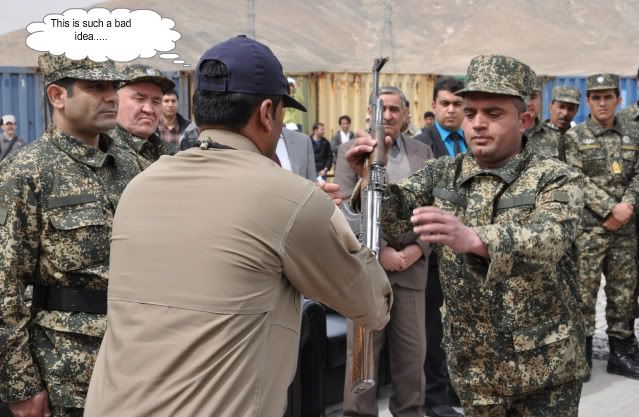
A Blue Hackle security contractor handing over his weapon to an APPF guard during a ceremony.


Afghan government extends deadline for abolishing private security guards
March 18, 2012
The Afghan government is giving companies extensions ranging from a few weeks to 90 days to change from private security guards to a government-run force, officials said Sunday.
The reprieve comes just three days before the March 21 deadline that the Afghan government had set for the majority of companies to start using government-provided security.
Private development companies have said the move is threatening billions in U.S. aid to the country because companies would delay projects or leave altogether because they didn’t feel safe using strictly local security over whose training and procedures they have little control.
President Hamid Karzai has railed for years against the large number of guns-for-hire in Afghanistan, saying private security companies skirt the law and risk becoming militias.
It’s been part of Karzai’s larger push for more control over the way his international allies operate in Afghanistan, as seen most recently in his call for NATO troops to pull back from village outposts and to hand over security responsibilities to Afghans more quickly.

(more…)

« Newer PostsOlder Posts »

Powered by WordPress