Feral Jundi

Wednesday, February 22, 2012

China: Enter The ‘Private Security’ Dragon

During the recent Sudan hostage crisis, The Wall Street Journal reported that the Sudanese troops who engaged in the rescue effort were joined by a dozen armed Chinese private security contractors. While that article and coverage of the issue in the Chinese media didn’t identify where the contractors came from, there’s a strong likelihood they were drawn from the same pool of former security forces personnel that Shandong Huawei recruits from and perhaps even came from the company. Chinese sources say it was the Sudanese military that told news outlets armed Chinese contractors were participating, so it appears that Beijing wants to keep its use of private security contractors out of the public eye.

Lately I have noticed an upward trend in reporting about China and it’s private security. These three articles below help to paint that picture of what I am talking about. We have a situation where China has interests all over the world, their people are getting killed and kidnapped all over the world in higher numbers, and security situations are changing for the worse in some of these places they have set up shop in.

Not only that, but now Chinese businesses are demanding more protection and they have the money to buy it. Especially if Chinese PSC’s charge less than western companies.

This first article below talks about the company Shandong Huawei Security Group. I have never heard of them before, and I could not find a link to their website. Although I doubt I would put a link up to their site for fear of getting some virus or whatever. lol Either way, Shandong Huawei is supposed to be one of their top PSC’s.

The article also described an interesting situation going on in Iraq. As the security situation degrades and there is now a lack of western forces to keep things in check, companies like Shandong Huawei are stepping in to fill that security vacuum in order to protect companies like the China National Petroleum Corporation. Oil is of national interest to China, as it is to many countries, and PSC’s are a part of their strategy to protect those national interests.

In the quote up top it mentioned Sudan and the involvement of security contractors in the rescue of kidnapped Chinese workers. There is oil in the Sudan and China definitely has interest there. And if PSC’s are actively involved in rescue operations like this, then it is not far fetched to imagine PSC’s entering other areas of security which would border more military-like operations. Will we see a company like Shandong Huawei evolve into more of a private military company?

The other thing mentioned in this article is the strategic implications of Chinese PSC’s. Here is the quote:

There are a number of strategic implications of this rise of armed private security providers by Chinese firms. For a start, if a project is in an area unstable enough to require armed private guards, there’s a significant probability of armed encounters between security providers and potentially hostile locals. Coupled with this is the fact that given their police and military backgrounds, the contractors are likely to look and comport themselves like soldiers, and would probably be armed with similar types of weapons. There’s real potential, then, for confusion on the ground in a place like Sudan when a private contractor who looks like a soldier engages rebels or others who then mistake him for an actual member of Chinese government forces. A local whose relative was shot near a Chinese drilling site by a security guard who looks like a soldier is likely to blame Beijing, which could spark additional violence against Chinese interests in the area.

Yep. And if the local insurgency/gang/criminal elements are not getting their cut, then expect these groups to attack these Chinese ventures.

The second article below is very interesting to me because it is written by Chinese journalists and actually discusses the lack of experience that Chinese PSC’s have compared to American PSC’s. That they should ‘study’ American PSC’s….or steal trade secrets about such things. lol Either way, I thought this was cool that the Chinese have recognized the west’s expertise in this area. Check it out.

Calls for security guards from China to accompany workers posted in dangerous areas overseas have increased since kidnappings in Sudan and Egypt underscored the danger workers face as Chinese companies expand globally.
The abductions highlight the urgency to ensure the security of Chinese workers overseas, said Han Fangming, deputy director of the foreign affairs committee of the Chinese People’s Political Consultative Conference National Committee, on his micro blog.
Han said that there is a need to study how private security contractors in the United States, such as Academi, work and “when the time is right, the government might allow qualified companies” to establish such services…. Another factor to consider is how prepared the security services are to handle dangerous situations.
“I think security guards in China are far from the level of private security contractors like Academi in the US,” Fu said.

Yep. Private security contractors in the US, and our western partners, have all learned many hard lessons over ten years of warfare. If China plans on allowing PSC’s to do this kind of thing in war zones, then yes, they will be looking to all and any lessons learned in order to make that work. It is also a matter of Mimicry Strategy, and whatever works best, will be copied.

The final article discusses the enormity of the Chinese presence throughout the world. It also emphasizes the threat to these citizens and the upward trend of kidnappings. More kidnappings equals more ransoms. More ransoms paid equates to a creation of a kidnapping industry where individuals purposely target Chinese. That is the price China will pay if they plan on setting up shop in these dangerous parts of the world.

The dramatic rise in overseas travel and expatriate work by Chinese was punctuated by the recent kidnappings of Chinese workers in Sudan and Egypt. “Overseas Chinese protection” (haiwai gongmin baohu) has been a critical priority since deadly attacks killed 14 Chinese workers in Afghanistan and Pakistan in 2004. Between 2006 and 2010, 6,000 Chinese citizens were evacuated to China from upheavals in the Solomon Islands, East Timor, Lebanon, Tonga, Chad, Thailand, Haiti and Kyrgyzstan.
But a new urgency has arisen in the past year: in 2011, China evacuated 48,000 citizens from Egypt, Libya, and Japan; 13 Chinese merchant sailors were murdered on the Mekong River in northern Thailand in October 2011; and in late January 2012, some 50 Chinese workers were kidnapped in two incidents by Sudanese rebels in South Kordofan province and by Bedouin tribesmen in the north of Egypt’s Sinai Peninsula.
The worldwide presence of Chinese citizens – and the dependencies that generates – will only continue to grow: in 2012, more than 60 million Chinese people will travel abroad, a figure up sixfold from 2000, and likely to reach 100 million in 2020. More than five million Chinese nationals work abroad, a figure sure to increase significantly in the years ahead.

That is a lot of Chinese traveling and working throughout the world! As the word gets out amongst the thugs/terrorists/rebels of the world, we will continue to see this Chinese kidnap and ransom trend increase. That means more protection work, and more hostage rescue or negotiation work for this young Chinese PSC market. So yes, I would speculate that we are witnessing the rise of the Private Security Dragon and who knows where this will lead. –Matt
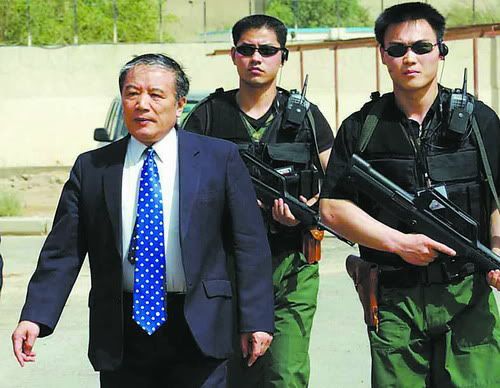
Enter China’s Security Firms
February 21, 2012
By Andrew Erickson & Gabe Collins
Chinese private security companies are seeing an opportunity as the U.S. withdraws troops from Iraq and Afghanistan. But plenty of complications await them.
A security vacuum is developing around Chinese workers overseas. The recent kidnapping of 29 Chinese workers in Sudan (where another worker was shot dead during the abduction) and 25 workers in Egypt has sparked a strong reaction in China. As a result, Beijing is looking to bolster consular services and protection for Chinese citizens working and travelling overseas. On the corporate side, private analysts are urging companies to do a better job of training employees before they are sent abroad. Yet with at least 847,000 Chinese citizen workers and 16,000 companies scattered around the globe, some of them in active conflict zones such as Sudan, Iraq, and Afghanistan, key projects and their workers are likely to require more than just an expanded consular staff to keep them safe.
It’s with an eye on this growing danger that new Chinese private security providers see a business opportunity. Shandong Huawei Security Group appears to be a leader among Chinese security providers, which thus far have predominantly focused on the country’s robust internal market for bodyguard and protective services. Huawei provides internal services, but in October 2010, opened an “Overseas Service Center” in Beijing. The company’s statement on the center’s opening explicitly cites the withdrawal of U.S. troops from Iraq, and the potential for a security vacuum to result, as key drivers of its decision to target the Iraq market.

(more…)

Wednesday, February 15, 2012

Industry Talk: Triple Canopy Awarded $159.9 Million For Afghanistan Security Services

Congrats to TC, but I have to say that I am not too interested in promoting their job for this. For the simple reason that the pay is too low and the leave schedule sucks. As it stands now, you have to work 344 days in order to get the bonus. That’s if the contract is still in place after a year. Who knows what will happen in Afghanistan a year out?

The other thing is burn out. Work is nice, but if you are working 12 hour days for 344 days out of the year, then that is a horrible schedule. For that reason, I think TC is going to have a tough time keeping this thing staffed. What I could see happening with this  is that guys use this contract as a ‘stepping stone’ contract in order to get into a better paying/better leave schedule job. Especially for those guys that have families.

In my opinion, I think this is a poorly constructed contract if these are the terms. The industry standard (in my opinion) for pay in a war zone like Afghanistan or Iraq should be more in the neighborhood $400 to $600 a day for static, to reflect the various management positions and seniority of contractors within the company. I should also note that such contracts like WPS is an excellent model for an ‘industry standard’ for pay. That is what this contract should have been modeled after, and DoS’s WPS program get’s it right in that department.

The industry standard for leave should be more around 2 to 3 months on, and about 1 month off. That is a great leave schedule, and the contract should allow some flexibility within that leave schedule to allow for emergencies and contractor personal choice. Requiring a contractor to work 344 days in a war zone is a recipe for disaster. Guys will burn out and their families will hate them for being away that long. I doubt that you will even see guys complete the contract to get the bonus, just because they will jump on the first gig that comes up with better pay and a better leave schedule. I know that is what I would do.

Even the hours worked is dumb. In my personal opinion, an 8 hour shift, working 6 days a week with one day ‘off’, is far better than a 12 hour shift 6 days a week. (especially if you are wearing kit all day long and working 344 days a year) I will also say that if this contract does lose guys because they burn out, that those left on the contract will be working a lot of hours without any days off. Just ask the AGNA guys what that is like when contractors bail ship because the company sucks or there are better gigs elsewhere. The guys that are left are the ones having to make up for a lack of manpower.

It is also a threat to the security readiness of a base, and could lead to a default on contract if there is a high attrition rate. Staffing a contract is serious business, and if folks are jumping ship because it sucks, then that has all sorts of consequence. Now imagine low staffing and low morale throughout a guard force because of being over worked, mixed with a high enemy threat or even enemy attacks?  We are not talking about security at some mall in Sandusky Ohio, we are talking about the protection of FOB’s filled with military and civilians in an active war zone, all depending upon that contracted guard force and it’s abilities.

In other words, this contract will have issues. That’s too bad, because I thought the Marines would have been smarter about this, and especially when they had more choice in the formation of this ‘best value’ contract. They should have asked this community what an appropriate contract would look like, and it just seems to me like they created another TWISS-like contract. Too bad…

The other thing I was curious about is if Triple Canopy gets paid for every guy they train?  Meaning when they train a contractor for this gig, they bill the government all the relevant costs. Why this matters is if the contract sucks and is set up to be a revolving door contract for guys, then TC will have to train up more contractors to keep it staffed. So what is TC’s incentive for training these guys and keeping them on the contract in Afghanistan? If anything, they benefit from a contract where contractors ‘don’t’ stick around so they can keep charging the government for training.

Which brings up another crucial point. When you set up a revolving door contract like this, then you lose something that is absolutely vital to organizations and security in war zones. Unit cohesion. Imagine being on a contract where no one sticks around? Where a new contractor shows up every week, or the management jumps ship every other week? Talk about instability. lol So basically you will have a contract where folks are constantly adjusting to new people, and all along you will have the security of a FOB to focus on. How can you trust the guy to the left and right of you, if A. you don’t know who they are and B.you don’t know if they will be there from week to week.

Unit cohesion is so hard to create in a company anyways, but if the contract itself does not lend itself towards making contractors happy and keeping them on the gig, then you can kiss any kind of unit cohesion good bye. And actually, that will be a cause of internal problems. I dare any military unit to try the same thing in a war zone, and see what the end result becomes. And this is what you want protecting these bases?

I sometimes wonder if the military should be setting up these contracts in the first place. How is it that the federal government understands how to set up these things (like WPS), but the military does not?  Could it be that the military purposely constructs poor contracts because contractors are the competition? What incentive do the Marines have in constructing a contract where a company that comes in to replace their Marine force, does a better job than that Marine force– because the contract lends itself to success?  Why would they want that company to be successful, and ‘show them up’?  Food for thought when it comes to the public versus private discussion about this industry, and when it comes to the principal-agent problem.

Finally, it is very simple to understand the game here. You find the industry standard within that war zone, and you stick to that standard. If you want to lose people and could care less about the quality of the contract/services, then by all means set up your contract below that industry standard. Go cheap, pay peanuts, and get your monkey’s.

On the other hand, if you want to attract the best of the best within an industry, then you need to offer incentives that are ‘better’ than the industry standard. And if you want a best value contract that has some degree of stability, then match what the industry standard is, choose a good reputable company, and manage it well. That is my thoughts on the matter. –Matt


Triple Canopy Awarded $159.9m for Afghanistan Security Services
By DOD
Tuesday, February 14, 2012
Triple Canopy, Reston, Va., was awarded a $159,972,048 firm-fixed-price contract. The award will provide for the security services in Afghanistan. Work will be performed in Afghanistan, with an estimated completion date of Jan. 26, 2017. The bid was solicited through the Internet, with eight bids received.  The U.S. Army Contracting Command, Rock Island, Ill., is the contracting activity (W560MY-12-C-0002).
Link to news here.
—————————————————————
From thread at SOCNET Forum
@camp leatherneck
$200 daily
6-12 hr days a week with the possibility for more hours
(1) 21 day leave period
12k bonus for contract completion
2 week train up on TC site followed by deployment @camp lejune
—————————————————————
From Triple Canopy’s Career section–Afghan Guard, Afghanistan
Position Responsibilities
-Act as armed security officer
-Responsible for internal security shift
-Perform unarmed screener duties by searching visitors, their vehicles and their belongings. Screeners will be proficient utilizing hand-held metal detectors, walk-through metal detectors and High throughput personnel inspection systems.
-Possess the capacity to acquire a good working knowledge of all aspects of contract security
-Must satisfactorily complete all Government required (and supplied) training and certifications prior to employment
Essential Skills and Experience
-US Citizen
-Must have a valid US Driver’s License and US Tourist Passport
-Honorable discharge from the military (if applicable)
-Able and willing to DEPLOY for one (1) year with one (1) 21-day R&R rotation
-Posses or be able to obtain a DOD Secret Level Clearance.
-Be at least 25 years of age
-Posses one (1) year of Military/ Police experience to include the use of personnel and vehicle security screening devices.
-Preferred security experience in the Middle East region.
-Possess a certificate of successful completion of a basic or advanced security guard training and certification program administered or recognized by the Government or professional organizations
-Must have no felony or domestic violence conviction. Record of recent recurring misdemeanors may adversely impact candidate’s suitability rating
-Employment with Triple Canopy is contingent upon a favorable background check to Include no serious financial problems in the past seven (7) years
Physical Demands and Work Environment
Able to perform internal security guard services, at any potential internal security posting, for 12 hours, while donning all required personal protective gear.

Tuesday, February 14, 2012

Kenya: The Government Teams Up With PSC’s For Counter-Terrorism Efforts

Kenya’s private security industry is undergoing radical changes triggered by numerous threats arising from terrorism activities in the country. The firms are struggling to meet new demands that seek to align their operations with those of government security agencies. Police Spokesman Eric Kiraithe said the idea is to ensure that security guards complement police and other agencies like the National Security Intelligence Service and the military in the war against terrorism.
Kenya has been on high security alert since October last year when the military entered Somalia in Operation Linda Nchi, to fight Al-Shabaab. “We need these people (private guards) because some of them are very well-trained and professional. But in the end we need an Act to inculcate professionalism across the board,” said Mr Kiraithe.

Below I have posted two articles that discuss the latest efforts that the Kenyan government is taking in order to work with and regulate their PSC industry in order to better prepare them for counter-terror efforts. The reason why this is important to Kenya is that terrorism has increased in their country and it is a threat to their tourism industry. It is also a threat to the population itself, and thanks to their neighbor called Somalia, they have plenty of pirates and jihadists to deal with.

The company mentioned in this first article is called XFOR Security Solutions. It is a UK company and they are teaming up with police officers from Kenya to train other PSC’s in the country.

He said the Security firms can play a big role in bringing security services closer to members of the public.
“We have carried out training in Nairobi where we meet various security heads from different sectors to educate them on various ways to identify and counter terrorism and we hope to extend the training to North Eastern,” said Mr Lincon-Hope.
The training comes a few months after a French woman and a British Couple were kidnapped while on holiday in Kiwayu, a few kilometres north of Lamu.

Tourism is also a big component of Kenya’s economy, and with so many other threats to their economy, it would make sense that they would try to shore up their security services there. From high oil prices to droughts, Kenya is having to take measures to better their economic prospects. So enter the private security market and the current requirements for protecting the resorts and game reserves.

The second article below talks about the government’s regulatory efforts. Notice how there is more of an emphasis on how to create a system of rules and laws that will make PSC’s more of an asset in Kenya’s efforts to counter terror and crime. That is great, and this is how a government should view their PSC’s–as strategic national security assets, and not as a liabilities.

National Private Security Workers Union secretary-general Thomas Alloyce said:
“Once the law is passed, requirements for one to offer private security will be expanded. Guards will undergo training in bomb detection and disposal, VIP protection and counter- terrorism strategies.”
In the draft stage, the Bill faced hurdles over some proposed sections.
For instance, the issuance of firearms to security guards.
“We are safer when we have as many people out there each with qualifications in certain security areas.”

I wish Kenya well with their efforts and we will see how things go. If any readers have anything to add, feel free to comment below. –Matt


Coast police officer Aggrey Adoli with security staff from various hotels along the coastline after they attended an anti-terrorism training organised by XFOR security Solutions-Kenya on February 13, 2012. Photo/LABAN WALLOGA

Police train private security firms’ staff on explosives in war against terrorism
By ANTHONY KITIMO
February 13  2012
The fight against terrorism continued to gather momentum after the government teamed up with private security firms to seek a joint solution to the crime.
It is seen as a decisive step by the government to restore confidence to tourists following last year’s two abduction cases in Lamu by Somali bandits.
On Monday, the police department promised to work closely with private security firms in Coast Province, particularly along the 600 kilometre coastline to prevent any further terrorists attacks.
A joint training is being conducted in Mombasa, organised by a British based security private firm, XFOR Security Solution and top police officers.
They are gathered at the Nyali Reef Hotel to coach more than 100 participants from different security firms.
Detecting explosives
The trainees will learn various ways of detecting explosives and how to collect intelligence in their respective work places, especially in hotels and other business premises, such as supermarkets.
The merger comes days after a security firm, Brinks Security based in Mombasa aided in the arrest of a British who was taking pictures near the Central Bank, Mombasa branch and various sensitive premises in Mombasa town.
Speaking while opening the training, Coast Provincial Police boss Aggrey Adoli and provincial Anti-Terrorism department head Elijah Rop said the knowledge will ensure private security firms’ employees are conversant with various explosives which might be a threat to the business they offer security services to.

(more…)

Friday, February 10, 2012

Afghanistan: Private Security Transition To The APPF Looking Messy…. And Dangerous

Filed under: Afghanistan,Industry Talk — Tags: , , , , , , — Matt @ 6:22 AM

Companies have long hired private guards precisely because they don’t trust the Afghan police to protect them in a crisis. The United Nations used Afghan police to guard its staff housing until an 2009 attack on a residential hotel in which Taliban assailants quickly made it past police guards and killed five U.N. staffers. The U.N. has since increased its security to include foreign guards.
Afghans working with APPF have gone so far as to urge the business licensing agency to “stop stalling the process,” according to a letter sent to U.S. government officials by a development company and obtained by the AP.

I posted two relevant stories below about Afghanistan and contractors. The first is this joke of a plan about replacing all PSC’s with the government force called the APPF.  Although according to the article below, it doesn’t look like it will happen on time, that the forces are not being properly trained and prepared, that the various clients they serve will have very little to say about the quality or conduct, and the best part, it will be more expensive. So some deal this APPF will be for those clients in Afghanistan that have to use them. lol

And as budgets for aid projects are decreasing, the APPF program is likely to increase security costs substantially.
An APPF guard will cost at least $770 a month, according to an AP analysis of official government figures, while private security providers contacted for this story say they usually charge $510-$630 a month per guard.
To avoid pay cuts for guards, individual companies will have to supplement salaries. And any costs for RMC managers will be on top of this. Once these expenses are figured in, security costs could easily double under the APPF.

The second article below is about all of the incidents over the years of Afghan troops, police or PSC’s that were either mentally insane or the enemy, and killed their western partners. The quote up top is from the first article, and the proof of how many incidents is in the second article.

Supposedly friendly Afghan security forces have attacked U.S. and coalition troops 45 times since May 2007, U.S. officials say, for the first time laying out details and analysis of attacks that have killed 70 and wounded 110.

Oh yeah, that is an assuring statistic. And this second article really didn’t get into all the attacks against contractors, but hey, I guess we don’t count?

All I know is that the APPF is going to be one hell of a money making machine for Karzai, and one hell of a headache for those clients being forced to use them. –Matt


Afghan private security handover looking messy
By HEIDI VOGT
February 10, 2012
The push by Afghanistan’s president to nationalize legions of private security guards before the end of March is encouraging corruption and jeopardizing multibillion-dollar aid projects, according to companies trying to make the switch.
President Hamid Karzai has railed for years against the large number of guns-for-hire in Afghanistan, saying private security companies skirt the law and risk becoming militias. He ordered them abolished in 2009 and eventually set March 20 of this year as the deadline for everyone except NATO and diplomatic missions to switch to government-provided security.
Afghan officials are rushing to meet the cutoff with the help of NATO advisers. But with fewer than six weeks to go, it’s likely that many components will still be missing on March 20. And even once everything falls into place, higher costs and issues of authority over the government guards will remain.
The change imperils billions of dollars of aid flowing into Afghanistan, particularly from the United States. In a country beset by insurgent attacks and suicide bombings, the private development companies that implement most of the U.S. aid agency’s programs employ private guards to protect compounds, serve as armed escorts and guard construction sites.
On March 21, approximately 11,000 guards now working for private security firms will become government employees as members of the Afghan Public Protection Force, or APPF. They will still be working in the same place with the same job. Except now they’ll answer to the Interior Ministry.
“We don’t want to have security gaps. This is really important to our customers and to us,” said the head of the APPF, Deputy Minister Jamal Abdul Naser Sidiqi. It will happen, he says, because the presidential order says it has to.

(more…)

Thursday, February 9, 2012

Publications: The Oil And Gas Infrastructure Security Market 2012-2022

Visiongain calculates the global oil and gas infrastructure security market will reach $29.16bn in 2012.

Boy, I would love to get my hands on this thing. But at $2,633, I will have to pass. lol As you can see, this type of information is extremely valuable to those companies that specialize and compete in this market. Oil and Gas security is a huge market for security contractors, and as the demand for energy increases and more instability threatens the oil producing regions of the world, then guys and gals like us who protect the infrastructure and the people building and supporting that infrastructure will become increasingly important and necessary. It’s nice to be wanted.

Just look at piracy and it’s impact on oil shipments? An entire tanker taken off the market because of a couple of hijackers, can send ripples in the market. Numerous tankers taken can send shock waves.

Look at the attacks on pipelines all throughout the world and try to calculate the impact on those markets that depend on that gas or oil. Especially during winter time. Energy security is big business, and until some ‘black swan’ type energy invention comes on to the scene that makes oil and gas obsolete, then I don’t see much change in the current direction of the market.

Interesting stuff and if any of the companies that bought this thing, or anyone that has actually looked at the report would like to give us some juicy tidbits, we are all ears. –Matt


The Oil & Gas Infrastructure Security Market 2012-2022
Report Details

Over the next decade, global demand for oil and gas is set to rapidly increase as rising populations and economic growth help to drive the industry. This will create a need for additional oil and gas infrastructure to be constructed. At the same time, many countries around the world are currently facing a number of security challenges stemming from civil unrest, terrorist activities, and a competitive global market. Together, these factors will create substantial opportunities for companies involved in the oil & gas infrastructure security market as a range of products and services will be needed to protect both existing and future assets. Visiongain calculates the global oil and gas infrastructure security market will reach $29.16bn in 2012.

This report offers an examination of the oil and gas infrastructure security market over the next decade, providing detailed market forecasts for each of the leading 15 national markets, as well as forecasts for the four sub-markets: perimeter security and surveillance, maritime security, access control, and cyber security. The various drivers and restraints of the market are evaluated in order to provide readers with specific insights into the future direction of the industry and where the greatest opportunities are likely to be found. How much are the leading national oil and gas infrastructure security markets planning to spend on acquiring new technologies and services between 2012 and 2022? How will each of the sub-markets perform over the next ten years? Who are the leading companies in the oil and gas infrastructure security industry? What factors will drive growth opportunities over the next decade?

(more…)

« Newer PostsOlder Posts »

Powered by WordPress