Feral Jundi

Thursday, June 2, 2011

Industry Talk: STRATFOR–Protective Intelligence Lessons From An Ambush In Mexico

This is a fantastic post from STRATFOR, and I wanted to get it out there to the readership. Of course this post is in accordance with their republication policy, with two links at the beginning and at the end of this excellent article. Thanks to David for giving me the heads up about the article as well.

When this ambush originally happened, Borderland Beat put it out there and that is where I heard about it.  It is a shocking incident, because it brings up a lot of  points on the realities of the war south of the border. This was not some gang shooting a couple rounds at a rival gang in a drive by–this was a complex attack, complete with military grade weapons and a well planned and disciplined execution. This ambush was also between two drug cartels, and this ambush resulted in the decimation of the target, which happened to be the Los Zetas cartel. (the irony is that the Zetas were the guys that came from Mexican SF forces)

What this article below emphasizes is that size or weaponry is not everything in the world of convoy or psd operations. The Zetas had plenty of guns, plenty of manpower, and even armored vehicles. They lost this fight, because the attacking force knew their routes and were able to prepare an effective ambush. The Zetas also had poor immediate action drills or plans to deal with this kind of thing. Although a well executed ambush is pretty effective, no matter what IA you have.  The lesson here is how important the ‘advance’ or route planning and reconnaissance  is to the protective detail, convoy operation, or any movements through enemy territory. The Zetas got caught with their pants down in this deal, and paid a heavy price….

It also emphasized the importance of OPSEC and PERSEC.  Obviously the attacking force was able to find out when and where this Zetas movement was going to commence. The Zetas felt they had plenty of manpower and firepower to deal with any threats, and probably did not care too much about OPSEC or PERSEC.  The Zetas in this case, remind me of Poncho Villa in the Battle of Celaya, where intelligent strategy and tactics by General Alvaro Obregon defeated the frontal assault and idiotic bravado of Villa.

The other thing I wanted to add to this article that wasn’t mentioned, was the use of drugs by these combatants. After following these fights down there for awhile, I have actually come across some video that showed combatants of a cartel using cocaine before a raid. (at minute .53 in this video) This was a common act with insurgents in Iraq or even in Afghanistan, and using drugs to enhance performance or steady the nerves before an attack, is a factor to keep in mind. This simple act of using drugs, actually makes a combatant tougher to kill and more erratic or unpredictable to fight. But it also impacts their decision making, which is a huge detriment. It might explain why the Zetas were so careless in this scenario.

Stuff to think about, and for those of you operating down in Mexico, I wish you well.  You have a tough job in a very intense and complex operational environment. I also wanted to point out another source for information that has grabbed my attention. The guys at Small Wars Journal have been posting a series called the Mexican Cartel Tactical Note, by Dr. Robert Bunker and I highly recommend reading and commenting there if you can. Know your enemy…. –Matt


Protective Intelligence Lessons from an Ambush in Mexico
Jun 2 2011
By Scott Stewart
On the afternoon of May 27, a convoy transporting a large number of heavily armed gunmen was  ambushed on Mexican Highway 15 near Ruiz, Nayarit state, on Mexico’s Pacific coast. When authorities responded they found 28 dead gunmen and another four wounded, one of whom would later die, bringing the death toll to 29. This is a significant number of dead for one incident, even in Mexico.
According to Nayarit state Attorney General Oscar Herrera Lopez, the gunmen ambushed were members of Los Zetas, a Mexican drug cartel. Herrera noted that most of the victims were from Mexico’s Gulf coast, but there were also some Guatemalans mixed into the group, including one of the wounded survivors. While Los Zetas are predominately based on the Gulf coast, they have been working to provide armed support to allied groups, such as the Cartel Pacifico Sur (CPS), a faction of the former Beltran Leyva Organization that is currently battling the Sinaloa Federation and other cartels for control of the lucrative smuggling routes along the Pacific coast. In much the same way, Sinaloa is working with the Gulf cartel to go after Los Zetas in Mexico’s northeast while protecting and expanding its home turf. If the victims in the Ruiz ambush were Zetas, then the Sinaloa Federation was likely the organization that planned and executed this very successful ambush.
(more…)

Wednesday, June 1, 2011

Industry Talk: Xe Gets A New CEO And Some New Blood

Xe is starting to infuse some new blood into their game. Red McCombs, John Ashcroft and Bobby Ray Inman all make the list and here is a quick run down of each.

The Texas oil executive (Red McCombs) is a co-founder of Clear Channel Communications and a former owner of the Minnesota Vikings, Denver Nuggets and San Antonio Spurs.
In addition, former Attorney General John Ashcroft and retired Adm. Bobby Ray Inman, a former director of the National Security Agency, have been brought on board as independent directors.

Not to mention the new CEO Ted Wright who came from KBR. It will be interesting to see where the company goes from here. –Matt

Xe Services, successor to Blackwater, names new CEO
By Bill Sizemore
June 1, 2011
Xe Services, the security and training company formerly known as Blackwater, has named a new chief executive officer. He is one of several new faces joining the company as it tries to distance itself from a history of legal troubles and international controversy.
USTC Holdings, Xe’s parent company, announced Wednesday that Ted Wright will join the company as CEO effective June 13. Wright comes to Xe from Houston-based KBR, a global engineering, construction and services company, where he had been president for North American government and defense. He spent 30 years on active and reserve duty in the Air Force.

(more…)

Tuesday, May 31, 2011

Building Snowmobiles: The Cyber Lance

I want to thank Matt from Facebook for bringing up this quote from Starship Troopers. I found the movie clip of the quote and it clearly shows the weakness of cyber warfare. It shows why you must have a direct action/physical security component mixed with your cyber warfare/information operations unit.

The simple reason why is that all it takes for your enemies to ruin your ‘hacking’ ventures, is for them to kill your hacker and physically destroy his equipment. To ‘throw a knife into the hand of the guy that pushes the buttons’, to paraphrase the quote up top.

Or worse, that hacker could be tortured and key information could be extracted in order to conduct a larger attack. The value of what that hacker knows (a nation or company’s secrets), or what they know how to do (hacking a nation or company), makes them a high value target.

In other words, today’s freelance hacker or even government/military hacker, is a highly valuable asset to a nation or a company. That highly valuable asset must be defended, and have a highly evolved physical and cyber offensive capability in order to compete and survive in today’s world.

So in order to deal with this new reality I have developed and defined a new term that I wanted to share with the readership. Enter the ‘cyber lance’.

Basically, a cyber lance is a combined arms team within a privateer company or military unit. Or it could be an outsourced team. The lance part comes from the french term Lances fournies, or ‘lances fournished’. Here is the definition from wikipedia.

The Lances fournies (French: “lances furnished”) was a medieval army squad that would have surrounded a knight in battle, consisting of a four to ten man team built of squires, men-at-arms (usually mounted swordsmen), archers, attendants (pages) and the knight himself. These units formed companies under a captain either as mercenary bands or in the retinue of wealthy nobles and royalty.
A Lance was usually led and raised by a knight in the service of his liege, yet it is not uncommon in certain periods to have a less privileged man, such as a sergeants-at-arms, lead a lance. More powerful knights, also known as a knight bannerets, could field multiple lances.

And of course the cyber is used to refer to anything to do with the internet or computing. I particularly like this etymology of cyber from wikipedia:

By the 1970s, the Control Data Corporation (CDC) sold the “Cyber” range of supercomputers, establishing the word cyber- as synonymous with computing. Robert Trappl credits William Gibson and his novel Neuromancer with triggering a “cyber- prefix flood” in the 1980s.

What’s cool about a cyber lance, is that a company can actually define it’s size to a client. They can say ‘we have 20 cyber lances’ or ‘cyber lancers’ (whatever sounds better to the user)
The other reason why I like the cyber lance concept, is that it mixes physical security with cyber security. It also mixes physical offense, with the cyber offense.  You must have one with the other as the world of cyber warfare continues to evolve. The cyber lance defines that combined arms group of hackers and shooters. The way I envision it, it could be as simple as a protective detail assigned to a hacker, or as involved as a special forces type team that does both the protection of a hacker, and conducts offensive operations based upon the information gained by that hacker. It is a fusion of the cyber and the physical, and all the potential actions that can come out of that combination.
I also like the etymology of lance corporal.  If you have ever served in the Marines, you more than likely were a ‘Lance Corporal”. Although the lance part refers to lancepesade.

From the Italian lanzia spezzata, which literally means “broken lance” or “broken spear”, but which was used to denote a seasoned soldier (the broken spear being a metaphor for combat experience, where such an occurrence was likely).

Or if you have ever heard of the term ‘free-lance photographer’ or ‘free-lancer‘ (etymology- medieval mercenary warrior) , then now you know the origins of the term. I think it works pretty nicely for cyber lance. So to me, cyber lance makes perfect sense in the context of what I am talking about here.
The cyber lance is also flexible in it’s usage. They could be all military units, or a  private cyber lance contracted out to the government or companies. A cyber privateer or cyber pirate company would have several groups of cyber lances as an organizational idea. Each cyber lance is just a unit or term to describe this hardened ‘hacker team with teeth’. It also goes back to the idea of combined arms, or mutually supporting groups within a unit. This concept is very much a part of the building snowmobiles mindset.

Combined arms is an approach to warfare which seeks to integrate different branches of a military to achieve mutually complementary effects (for example, using infantry and armor in an urban environment, where one supports the other, or both support each other). Combined arms doctrine contrasts with segregated arms where each military unit is composed of only one type of soldier or weapon system. Segregated arms is the traditional method of unit/force organisation, employed to provide maximum unit cohesion and concentration of force in a given weapon or unit type.

A cyber lance also promotes the idea of ‘team’, as opposed to an individual.  I believe cells or teams are far more capable for the attack and defense, as opposed to just an individual. The security of a nation or company, or the prosecution of that nation or company’s best interest would best be placed into the hands of a team, as opposed to just one individual.  Primarily because teams would actually have the ‘teeth’ necessary to capture or kill ‘individuals’, or defend against an attacking force. A cyber lance could also be attacked by a cyber lance, or a group of cyber lances that would make up a cyber privateer company.

Another key component of the cyber lance is it’s ability to work within the borders of another country or navigate the complexities of the commons called cyber space. A small team can be surgical and have a light foot print.  It also falls in line with the concepts of netwar, and offense industry which was a past building snowmobiles post.
Finally, as hackers become more valuable and more capable, it will be of national interest to protect these assets. The cyber lance could very well be the next chapter or paragraph in the world of combined arms and cyber warfare. It will also take the combination of the hacker’s mind and the tactical and strategic thinking of a special operations team to think of all the ways a cyber lance could be used for the defense or offense. The end result could lead to the destruction of a nation’s key national security assets, or the preservation of a nation’s vital national security assets. That is what makes a cyber lance a very important and lethal building snowmobiles concept. –Matt

Monday, May 30, 2011

Industry Talk: Memorial Day…

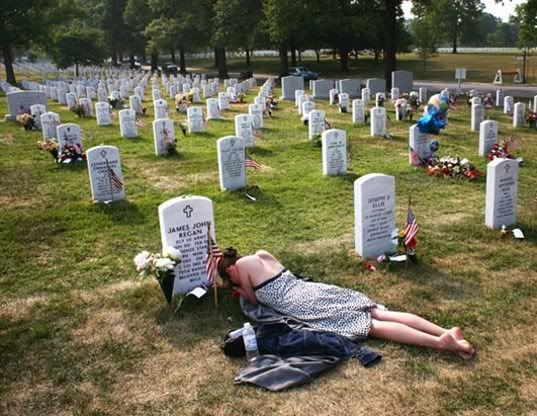
This year I wanted to find an image that said more than anything I could ever say about what Memorial Day means. I do not know who the young lady is in the photo, but I do empathize and sympathize. I think everyone here recognizes what this photo says and what her loss means to her.

No matter what country you are from, no matter if you are a soldier or contractor, a man or woman, husband or wife, boyfriend or girlfriend, son or daughter, or friend and comrade–the loss and this woman’s personal and private remembrance of her loved one  is universally understood. It is one reminder of many, that sacrifice in war is profound and painful to endure for everyone. Te numquam obliviscar…. –Matt

Edit: 06/01/2011- One of my readers sent me a link to the obituary of the lost soldier that this women is mourning. He was a Ranger and rest in peace.

Sunday, May 29, 2011

Quotes: PSC Usage In Afghanistan Is Highest Recorded Number In US History

What I wanted to do here is to highlight some very important and historical statistics of this CRS report I posted a couple of weeks back. This gives a very clear picture as to how significant private security contractors are to the war effort in Afghanistan, and the sacrifice of PSC’s. Especially the sacrifice of local national PSC’s, which account for most of the deaths of this group.

Although I must emphasize ‘recorded’ here, because no one recorded the amount of US PSC use during our very early wars.  I personally think that privateer usage was one of the highest number of PSC’s used by the US during times of war. Although a strong argument could also be made that the expansion of the west in the US would be the most impressive number of PSC’s used during time of war.

Pioneers, investors, the military, the railroads, cattle companies, shipping companies, banks, law enforcement etc. were all highly dependent upon on private security in all of it’s forms to protect lives and investments against Indian combatants and criminals. During this time period, there were 8 contractors awarded the Medal of Honor as well.

And of course this expansion of the west and resulting Indian Wars and land wars covered a very long time period of conflict in the US. For that reason, I would estimate that this time period would be the highest use of PSC’s by the US. It just wasn’t recorded by any government accounting office. Although Buffalo Bill did a pretty good job of bringing some attention to the matter with his Wild West Show. (which ran from 1883- 1913, a 30 year long show!)-Matt

Number of Private Security Contractors in Afghanistan
Since December 2009, the number of PSC personnel in Afghanistan has exceeded the number of PSC personnel in Iraq. According to DOD, as of March 2011, there were 18,971 private security contractor personnel in Afghanistan. This represents the highest recorded number of private security contractor personnel used by DOD in any conflict in the history of the United States. Local nationals made up 95% of all security personnel.
According to DOD, for the 15-month period of September 2007 to December 2008, the number of security contractors in Afghanistan increased by 16%, from 3,152 to 3,689. However, from December 2008 to March 2011, the number of security contractors increased from 3,689 to 18,971, an increase of over 400%. DOD has attributed the increase in contractors to increased operational tempo and efforts to stabilize and develop new and existing forward operating bases.
Security Contractors Compared to Total Contractor and Troop Levels
From December 2008 to March 2011, the number of U.S. troops and DOD contractor personnel in Afghanistan increased. However, the number of security contractors increased at a much faster rate (414%) than total contractors (26%) or troop levels (207%). As of March 2011, security contractor personnel made up 21% of all DOD contractors and was equal to 19% of the size of total U.S. troop presence in Afghanistan.
Casualty Rates of PSC Personnel vs. Uniformed Personnel
According to DOD, from June 2009 to November 2010, 319 private security contractor personnel working for DOD have been killed in action in Afghanistan, compared to 626 U.S. troops killed in action over the same period.28 Adjusting for the difference in the number of PSC personnel compared to troops, a PSC employee working for DOD in Afghanistan is 2.75 times more likely to be killed in action than uniformed personnel.  More contractor security personnel were killed in action providing mobile security (233 people or 73% of fatalities) than static security, even though those providing mobile security are only 25%- 30% of the total PSC workforce.
Nationality of Contractors
According to DOD, since September 2007, local nationals have made up 90% or more of all security contractors in Afghanistan.
Link to report here.

« Newer PostsOlder Posts »

Powered by WordPress