Feral Jundi

Friday, September 9, 2011

Leadership: A Command Culture And Philosophy Called ‘Auftragstaktik’

A command and control procedure within which the subordinate is given extensive latitude, within the framework of the intention of the individual giving the order, in carrying out his mission. The missions are to include only those restraints which are indispensable for being able to interact with others, and it must be possible to accomplish them by making use of the subordinate’s forces, resources, and the authority delegated to him. Mission-oriented command and control requires uniformity in the way of thinking, sound judgment and initiative, as well as responsible actions at all levels.- German army regulations describe Auftragstaktik, from Parameters.

Part of what makes this blog so fun and interesting is the hunt for the great idea. I don’t care where it comes from, or who came up with it–to me, it is all about logic and reason. Either the idea is sound, or it is not. It should also be able to withstand the furnace of debate and scrutiny. Hence why I post such things.

But this is a simple concept to wrap your brain around, and yet so difficult to implement in institutions like the US military or various companies. To put this much freedom of operations into the hands of a leader is pretty tough for some CEO’s or Generals to handle. And as the author presented below, the German Army during WW 2 was the victim of a officer corps that was poorly constructed. But at the tactical level, the German Army was amazing, and this concept of Auftragstaktik is a big part of that.

Anyways, I will let the reader make their own determinations based on the articles below. The first is the most modern article on the concept and a big hat tip to Jorg Muth and Thomas Ricks for getting it out there. The second article is an old one, written by a German soldier and veteran of WW 2 named Gerhard Muhm. He went into detail on how Auftragstaktik was used in the German Army at the time. The final article is a snippet from Wikipedia, which will help to simplify and focus the reader on the core concepts.

It is also important to note that Intent is a very important theme in today’s military’s. It is the idea that everyone in the unit knows the intent or the mission and what must be accomplished. Commander’s intent is another way of putting that. There is a whole study on intent at wikipedia, and it is definitely worth your while to go through it to get a feel on how important it is to the various military units of the world.

Intent is a key capability in 21st century military operations and is a vital element to facilitate subordinates initiative (U.S Army 2003, para.1-69), self-synchronisation (Alberts et al. 1999, pp.175-180) and collaboration and cooperation (Alberts and Hayes 2007,pp.109-114) amongst team members in joint operations.

Now how does this apply to private industry or even offense industry?  Well interestingly enough, there is a a lot of auftragstaktik going on already with private industry. No one tells companies how they are supposed to perform static security, convoy operations, or PSD. Even within companies, you see differences in mission accomplishment between the various contracts. So that is a very positive aspect of today’s PMC’s and PSC’s. Personally, I have seen the same missions accomplished differently in a multitude of companies that I have worked for. It is what makes the industry interesting to observe and be a part of. But as a result of these variations, private industry is able to evolve and develop SOP’s that are unique and effective. We also have some cross breeding going on with SOP’s/ideas, just because contractors are taking what they learned from prior contracts and bringing that with them to the next job for mission accomplishment.

On the flip side, our Defense Industry is purely focused on the ‘defense’. Which is fine, but it does not eliminate the enemy or reduce their numbers. For that, you need to create a Offense Industry, and concepts like Auftragstaktik or company intent will be very important to the accomplishment of a contract in this type of industry. It is also important to set up an offense industry that supports the intent of the principal or the country firing up such a machine. In other words, a country that constructs a offense industry should not be involved in telling companies ‘how’ they are to accomplish the task.

A great example is Executive Outcome’s contract in Sierra Leone. Would they have been successful if SL told the company how they were to accomplish the task?  I don’t think so, and that would defeat the reason for hiring such a company in the first place. You give them the intent, and let them figure out the ‘how’.

Now of course this concept is not a strategic concept as the articles have mentioned below. Which is very important to remember if a offense industry is to be created. Countries must first have a sound strategy in place, and the offense industry must be assembled in such a way to support that strategy.  That is a whole different post, but I guess where I am going with this is that what makes offense industry such a powerful concept is the idea of allowing companies the freedom to innovate and figure out how to accomplish the task.

Not only that, but they also have ‘incentive’ to do well. The goal should be to give them the intent, establish rules and boundaries that insure they do not hinder the overall strategy or harm other friendly units, provide adequate incentive, and set the industry free to accomplish the task. Then adjust and modify as necessary–all based on Kaizen and having a sound learning organization. –Matt


Jörg Muth on Command Culture and Auftragstaktik In The German Military
(posted at Best Defense)
Friday, September 9, 2011
By Jörg Muth
Auftragstaktik. The word sounds cool even when mangled by an American tongue. What it means, however, has always been elusive to Americans. The problematic translation of that core German military word into “mission type orders” completely distorts its meaning. Auftragstaktik does not denote a certain style of giving orders or a certain way of phrasing them; it is a whole command philosophy.
The idea originates with Frederick the Great, who complained after more than one battle that his highly experienced regimental commanders would not dare take action on their own but too often ask back for orders and thus waste precious time.
Nearly one hundred years later the military genius Helmuth Karl Bernhard Graf von Moltke was the first to formulate the concept of Auftragstaktik. Moltke was a diligent student of Frederick’s campaigns, of military history in general and philosophy. At a time when he was not yet famous and, not yet the victor of three wars, he observed the annual General Staff war games in 1858. The paperwork and the detailed orders appalled him because he knew that in war there was no time for such nonsense. During the war game critique he decreed that “as a rule an order should contain only what the subordinate for the achievement of his goals cannot determine on his own.” Everything else was to be left to the commander on the spot.
(more…)

Thursday, September 8, 2011

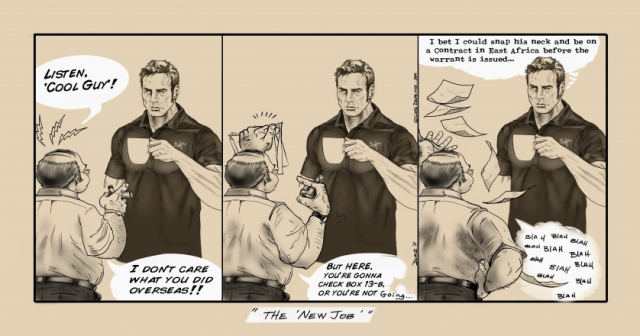
War Art: ‘New Job’, By LMS Defense–The Comics

Filed under: War Art — Tags: , , , — Matt @ 3:27 PM

Another great comic strip from LMS Defense and Righteous Duke Designs! Follow the LMS link or click on the image if you want a bigger picture of the comic. –Matt

LMS Defense link here.

Righteous Duke Designs here.


Mexico: Nuevo Leon To Implement A Citizen-defense Program To Counter The Cartels

Filed under: Libya,Mexico,Training — Tags: , , , , , , , — Matt @ 2:08 PM

The training for people with weapons permits in Garcia is part of a phase of Rodriguez’s security program aimed at “involving the citizens in defense of the region.”
“Many of them want the training and knowledge … to defend their families and their heritage,” he said.
In addition to the weapons course, the project also includes broader training in its “urban defense” goals.
“Imagine if there is someone wounded and no one in the neighborhood knows what to do. It’s happened to us that in the street there is someone who’s been shot and the (paramedics) don’t come,” Rodriguez said.
So far, about 3,000 people from Garcia and nearby cities have signed up for the course, including engineers, teachers, housewives and retired military.

Ok, this is awesome. This is what I have been hoping and praying for in Mexico. The citizenry there needs to realize that they cannot entirely depend upon the police or military to protect them. And the government needs to realize that the citizenry can certainly be an effective tool to counter the cartels. So programs like this are a great start, but they also need to do this right in order to increase their odds of success.

It is also important to note that if you look at the rebels of Libya, that they were once civilians, yet were able to transform into a force that defeated a standing army. With a little motivation and some training/experience, a citizen force can certainly do some damage. The war against the cartels is a righteous war that must be fought and won, and I really think the citizens of Mexico can rally around defeating these scumbags. The people interested in such a program just needs to be empowered by the approval of it’s leaders, and given a little training to be effective.

It would really be cool to take this a step further and send some SF teams down to Mexico and help train these 3,000 folks that have signed up for this program. Or for this town to receive the funding necessary to get a training company down there to help out. If any contractors are looking for a way to contribute to the fight down there, you could probably get in your car and drive to this town and offer your services pro bono?

One thing though that needs to be mentioned about such a program. This is a declaration of war against the cartels. So this program needs to be conducted in an intelligent and secure manner. Training sites or gun ranges will be targets of the cartels. Folks who participate will be targets as well. The cartels will also do their best to infiltrate the program and subvert it, much like what they have done with government or police. So it will be up to the participants of this program to ‘cleanse’ itself of all cartel scum.

It also reminds me a lot of the Soviet Partisan warfare against the Nazis during WW 2. The Soviet’s at the time realized that if citizens are going to fight, that they need a basic ‘how to’ manual to fight and survive in their occupied homeland. These manuals also discussed how to defeat the Nazi anti-partisan forces intending on destroying this civilian threat. But the partisans kicked ass and certainly helped in the overall war effort. The point of all of this is that these partisan forces certainly did a number on the Nazis, and civilians can certainly play an effective role in a war.

Another example of the power of partisan guerrillas is the story of Wendell Fertig in the Philippines during WW 2. This guy was a stud, but he was also just a regular guy and engineer who was caught behind enemy lines when we pulled out of the Philippines. Wendell decided to lead a guerrilla war against the Japanese as a result of his predicament, and he was able to organize and build an effective force with very little. He was highly motivated and a smart problem solver, and his force was able to do some serious damage upon the Japanese.

Mexico needs the same type of innovative and dedicated leaders in their towns and cities to lead a guerrilla war against the cartels. So bravo to Jaime Rodriguez Calderon for taking the initiative and ‘doing something’ about the problem. Hopefully Mexico and the US will support this town in it’s efforts, and identify and help other ‘real’ leaders with similar goals. –Matt

Edit: 08/13/2011- It looks like another town is taking up arms in Chihuahua. Very cool and I hope this spreads! Quote:

“One small northern Mexico community, surrounded by Cartel thugs, is taking matters into their own hands.
The people of Uruachi, Chihuahua have begun to arm themselves in a last attempt to protect themselves against a group of 12 armed men surrounding the community, Mayor Aldo Campos said.”


Mexican city plans to train citizens to fire guns
Javier Estrada
September 7, 2011
Officials in a northern Mexican city plagued by violence say a new course will take a fresh approach toward protecting citizens: Training people to handle and shoot guns.
The aim of the approach, says Garcia Mayor Jaime Rodriguez Calderon, is putting a stop to crime in the 40,000-person city in Nuevo Leon state.
“Many people call me because their son or their husband has been kidnapped, or some family member’s car has been stolen. I said to myself, ‘Wow, how can we, the citizens, defend ourselves,’ ” Rodriguez told CNNMexico.com.
Twice this year, gunmen have tried to assassinate Rodriguez, who has earned the nickname of Bronco for his strong personality.

(more…)

Wednesday, September 7, 2011

Iraq: US Says No Decision On Keeping Troops In Iraq

Filed under: Industry Talk,Iran,Iraq,Military News — Tags: , , , , , — Matt @ 3:03 PM

This is an interesting development. Many folks were speculating that a much higher number of troops would stick around, and then this rumor of 3,000 troops came out and all hell broke loose. lol The article below mentions politics as a driver for this type of decision making….go figure?

The concern here is that if there is too small of a footprint, that these troops will be sitting ducks in Iraq, or Iraq will not be able to deal with their security issues without sufficient troop presence. My concern though is that companies in Iraq that are dependent upon the security services of the current troops, will have to once again re-adjust to the politics of the matter. Planning might have included a certain amount of US troop presence in specific areas, and all of their war fighting tools and capabilities that come with that presence. So if they were planning on a 10,000 troop presence, and now it is 3,000, that can have an impact.

It also can impact the logistics. If contracting companies were planning for a set amount of troops based off the feedback war planners were giving them, then those companies have made their moves and planed for those contracts. So yet again, the back and forth on the troop presence in Iraq has an impact on this industry. Of course companies will flex and adapt, but I am sure this is causing a lot of headaches.

The other aspect of Iraq that needs to be mentioned is the Iranian influence there. As we speak, rockets and mortars continue to fall on the various FOBs and outposts in Iraq. These munitions come from all sorts of sources, but the biggest arms provider is Iran. Their goal is to help along the exit of US Troops and destabilize the region so their pet leaders can rise to the top (like Sadr). So the environment in Iraq is less troops, but tons of contractors, and lots of Iranian weapons and influence pouring into the country to help destabilize it and in the long run control it with puppet leaders.

Iraq is also in dire need of maintenance of weapons and equipment, foreign investment to include oil contracts, training and upkeep of security forces, etc. If Iraq cannot depend upon a US troop presence to help in these areas, then they will probably depend on contractors to fill these needs. Which our industry will fill the need, but yet again we have the wolf called Iran and Al Qaeda still doing their best to do harm.

I contend that private industry can deal with these sets of problems, but private industry does not have the same freedom of war fighting and weapons/hardware that US troops enjoyed. So in essence, private industry will have to accomplish what the military used to do, and yet with one hand tied behind it’s back. If Iraq sinks into Civil War again, or the pace of war and problems pick up, contractors will be right in the middle of that. –Matt


US says no decision on keeping troops in Iraq
By LARA JAKES
September 7, 2011
The Obama administration pushed back Wednesday on reports it has decided to keep a few thousand troops in Iraq next year — a number that will do little to ease security concerns but may be too big for White House advisers who are worried about the slumping U.S. economy and the president’s re-election chances.
In Washington, new Joint Chiefs chairman Army Gen. Martin Dempsey and Undersecretary of State nominee Wendy Sherman separately said there has been no decision on how many troops might stay.
U.S. Ambassador to Iraq James F. Jeffrey went a step further, soundly dismissing as false news reports that about 3,000 troops would remain in Iraq beyond the final Dec. 31 withdrawal deadline.
He said that figure has not been part of ongoing discussions in Baghdad, where both governments have been weighing whether as many as 10,000 U.S. forces should stay.

(more…)

Legal News: Corporate Whistle Blower Center Reaches Out To Contractors

I like it. Anything that gets the companies to do the right thing is a good thing. So if the Corporate Whistle Blower Center can help contractors that have identified waste, fraud, and abuse in their companies, then I dig that. Especially if they can help those contractors get the reward that comes with reporting such abuse.

What I believe this organization is referring to when talking about a reward is the provisions within the False Claims Act. I mentioned this law as a primary driver on why AGNA settled in the case with James Gordon. Here is a quick summary of the Lincoln Law.

The False Claims Act (31 U.S.C. §§ 3729–3733, also called the “Lincoln Law”) is an American federal law that imposes liability on persons and companies (typically federal contractors) who defraud governmental programs. The law includes a “qui tam” provision that allows people who are not affiliated with the government to file actions on behalf of the government (informally called “whistleblowing”). Persons filing under the Act stand to receive a portion (usually about 15–25 percent) of any recovered damages. Claims under the law have typically involved health care, military, or other government spending programs. The government has recovered nearly $22 billion under the False Claims Act between 1987 (after the significant 1986 amendments) and 2008.

The other reason why there is more interest in these kinds of cases is that companies will be hurt in any bidding process for government contracts, if they are charged with False Claims or in litigation. It is the primary reason why AGNA settled, so that it would not stop them from pursuing contracts. Here is a link to the FAR 52.207-1 that details what I am talking about.  I also put that section up below this article.

Now just for clarification, I am not affiliated with this group, nor can I vouch for their effectiveness. They are just another option for contractors to use, and of course do your own research and put together a good strategy before getting into this stuff. –Matt


Corporate Whistle Blower Center Urges U.S. Contractor Employees in Afghanistan and Iraq to Step Forward for Huge Rewards if They Can Prove Massive Fraud
Tuesday, September 6, 2011
The Corporate Whistle Blower Center is urging employees of major U.S. federal contractors, or subcontractors, that have been defrauding the US taxpayer in Afghanistan, or Iraq to step forward, for what could be enormous rewards, provided they can prove it. An independent panel investigating wartime spending estimates that as much as $60 billion has been lost to waste and fraud over the past decade in Iraq and Afghanistan. In its final report to Congress, the Commission on Wartime Contracting said the figure could grow larger as U.S. support for reconstruction projects and programs wanes and Iraq and Afghanistan are unable to sustain the schools, medical clinics, roads and power plants already built with American tax dollars. The Corporate Whistle Blower Center says, “In actuality we are pretty sure in many cases the schools, power plants, or medical clinics were never completed, and in other instances we know federal subcontractors gouged the U.S. government, and the taxpayers on everything from over inflated fuel, or food prices, to pretty much you name it. As long as you can prove it, and the amount exceeds two million dollars, there can be huge rewards for this type of information, as long as its substantial proof, and credible. If you possess this type of information please call us at 866-714-6466, because we would welcome the chance to explain the federal whistleblower reward programs to you.”
September 06, 2011
The Corporate Whistle Blower Center is strongly encouraging employees of federal contractors, or their subcontractors, that were providing any type of service in Afghanistan, or Iraq to step forward, if they possess significant proof of overbilling, or defrauding the U.S. federal government, because the rewards can be enormous. The group says, “If a government type panel says the fraud is sixty billion dollars in Iraq, or Afghanistan, its probably more like a hundred billions dollars plus, and provided you have substantial proof, and the proof is easy to understand, and black, and white, the rewards can be huge.” The Corporate Whistle Blower Center says, “When it comes U.S. contractors, or subcontractors defrauding the U.S. taxpayer we think in some instances it could be in the tens, or hundreds of millions of dollars, and it runs the gamete from construction, or infrastructure projects, that were not properly done, or not done at all, to food, fuel, engineering services, to you name it. And, we are pretty sure there are hundreds, or thousands of individuals, who possess the proof it happened. To us this type of solid proof is like having a winning lotto ticket, and we’d like to explain how the U.S. Federal Whistleblower programs work.” For more information please contact the Corporate Whistle Blower Center anytime at 866-714-6466, or contact the group via its web site at http://CorporateWhistleBlowerCenter.Com
Simple rules for a whistleblower from the Corporate Whistle Blower Center:
•    Do not go to the government first, if you are a major whistleblower. The Corporate Whistle Blower Center says, “Major whistleblowers frequently go to the federal government thinking they will help. Its a huge mistake. Frequently government officials could care less, or they are incompetent.”
•    Do not go to the news media with your whistleblower information. Public revelation of a whistleblower’s information could destroy any prospect for a reward.
•    Do not try to force a government contractor, or corporation to come clean to the government about their wrong doing. The Corporate Whistle Blower Center says, “Fraud is so rampant among federal contractors, that any suggestion of exposure might result in an instant job termination, or harassment of the whistleblower. We say, come to us first, tell us what type of information you have, and if we think its sufficient, we will help find the right law firms, to assist in advancing your information.”
Any type of insider, or employee, who possesses significant proof of their employer, or a government contractor fleecing the federal government is encouraged to contact to Corporate Whistle Blower Center anytime at 866-714-6466, or they can contact the group via their web site here.

—————————————————————

52.209-5  Certification Regarding Responsibility Matters.

As prescribed in 9.104-7(a), insert the following provision:

Certification Regarding Responsibility Matters (Apr 2010)

(a)(1) The Offeror certifies, to the best of its knowledge and belief, that—

(more…)

« Newer PostsOlder Posts »

Powered by WordPress