Feral Jundi

Friday, July 1, 2011

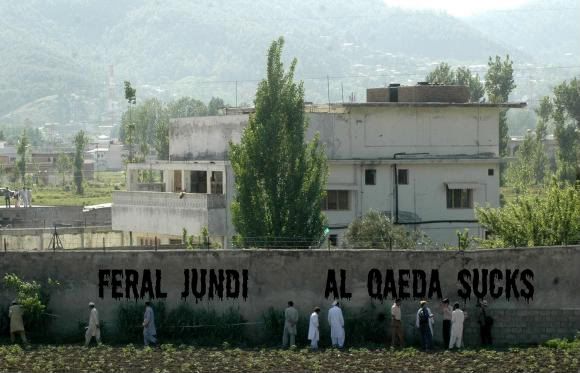
Funny Stuff: Advertising On Usama Bin Laden’s Compound Wall In Abbottabad?

Filed under: Funny Stuff,Pakistan — Tags: , , , , — Matt @ 11:50 AM

I read today that PETA has approached Pakistan to ask if they could advertise on the compound wall of Usama Bin Laden’s house in Abbottabad. Personally, I think they should deny it and bulldoze the compound.  But if Pakistan did sell advertising space on that wall?…… –Matt

Thursday, June 30, 2011

Jundism: In Praise Of Those Who ‘Do’….

Filed under: Jundism,Kaizen,Leadership — Tags: , , , , , — Matt @ 3:38 PM

‘Only accurate rifles are interesting.’ -Townsend Whelen

This is a quick post, but important. For Townsend, only accurate rifles are interesting. I like that quote, and I think it works well with what I believe in, and that is ‘only those that do are interesting’. Over the years, I have received numerous emails from readers who had the courage ‘to do’ what is right. To quote Col. John Boyd, they chose the route of ‘to do’ when they came to that great crossroads of life that everyone experiences, and they wanted to share that with me.

These men and women are my heroes, and they are what inspire me every time I work on this blog or think about how to improve this industry and war effort. They are the unsung heroes of every company, military unit or government, that had the courage to stand up and demand excellence or battle with those who are unjust.  They have also done these things at peril to self, all because being righteous sometimes equates to being unpopular or not advancing in an organization. But at least they did not compromise what they believed in, and this is what makes them more interesting and more of a leader than any of those that strive ‘to be’.

There are other moments of jundism that I hear about that motivates me. Those that came up with the better idea, and fought hard for that better idea and won, are also my heroes. They might have built a snowmobile, and created a new idea, which is really awesome. Or they might have lost the battle, all because of someone else’s ego or pride.  Either way, that individual get’s my respect for fighting the good fight.

The other thing I like to focus in on with my exchanges with the readership, either here or at Facebook, is to empower those individuals in their personal battles. To actually give them the means to win those battles through sound strategy and good intelligence. ‘Know yourself, know your enemy’, as Sun Tzu would say.  But most importantly, win without fighting.

That last part is very important.  I want my readership to win their battles, and not face casualty. That is very hard to do though, and even in my personal battles, I have lost. But I have also won some battles, and the key is to learn from those losses and continuously improve upon your ability to win future battles. And of course, the ultimate in war fighting, or the battle of wills and ideas, is to win without fighting at all.

To do this, you must know your adversaries well, and know yourself so you can figure out what ‘winning’ really means. Studying strategy, and borrowing brilliance is crucial. You must also avoid fights that end up in pyrrhic victories. Seek fights where your strength can defeat their weakness, and get that win. I want you to continue working in this industry and become a force of change, or to be the example.  That is winning.  To destroy yourself while destroying your opponent is losing in my book. Remember this when thinking of conducting legal battles, or battles with management and other individuals in your particular occupation.

Finally, it gives me great pleasure to know that jundism and this blog is bringing about a revolution in thought process. I have readers who are now students of good leadership, who are innovators, who are not afraid to do what is right, etc. They are also students of strategy and are continuously improving. These  readers and leaders have embraced these ideas, and have used them to their advantage.  It is a privilege and honor to be a part of that process and serve this family.

For those that fall under the category of ‘to be’, all I have to say is that you do not earn my respect. Although there is something I do like about this loathsome group…..  I like to study you, so I can empower those that aspire ‘to do’, to defeat you. –Matt

“Tiger, one day you will come to a fork in the road,” he said. “And you’re going to have to make a decision about which direction you want to go.” He raised his hand and pointed. “If you go that way you can be somebody. You will have to make compromises and you will have to turn your back on your friends. But you will be a member of the club and you will get promoted and you will get good assignments.”
Then Boyd raised his other hand and pointed another direction. “Or you can go that way and you can do something – something for your country and for your Air Force and for yourself. If you decide you want to do something, you may not get promoted and you may not get the good assignments and you certainly will not be a favorite of your superiors. But you won’t have to compromise yourself. You will be true to your friends and to yourself. And your work might make a difference.”
He paused and stared into the officer’s eyes and heart. “To be somebody or to do something.” In life there is often a roll call. That’s when you will have to make a decision. To be or to do. Which way will you go?”- Col. John Boyd

Wednesday, June 29, 2011

Quotes: Pratap Chatterjee On The Number Of Contractors Needed For Afghanistan During Drawdown

I just found this and thought I would share.  The two quotes in the article were the ones I thought were the most interesting, and if you would like to read the whole thing, by all means follow the link below.

What is cool here is Pratap has estimated a ratio of contractors to troops for this drawdown, based on the surges in Afghanistan and Iraq, and the drawdown in Iraq.  Or basically the numbers needed for the buildup or drawdown of a conflict. It would be interesting to see how well these figures hold up after all is said and done? Either way, I thought the numbers were pretty impressive.

In the article, he also mentioned how much private security has grown in Afghanistan, and I have talked about that in the past as well. He has predicted, and I agree, that DoS will have a pretty sizable requirement for security contractors there, much like for Iraq.

The other quote that I put up that was interesting, was the possible factors that could impact these numbers. That Karzai could implement the ban on private security companies under Decree 62, and install his own police force wherever. Or there could be a dramatic decrease in reconstruction.

The reconstruction stuff I do not see, because folks want a return on investment for projects they have already invested millions into.  If not, what a waste of money? Better to finish the project and then leave.

As to Karzai banning private security companies?  Well, as Pratap brought up, I think the latest attack at the Intercontinental Hotel in Kabul should change that mindset. I mean Karzai is responsible for shutting down and limiting PSC’s already. According to my readership, the MOI is sitting on approximately 45 licenses that have yet to be issued to companies so they can do their job.

So let’s think about that?  That is 45 companies that are wanting to provide security in a country where the enemy is purposely targeting civilians, and the MOI is just sitting on these licenses? The enemy is attacking hotels, supermarkets, hospitals, reconstruction sites, etc., and yet these private security assets are just wasting away….  I say let these private companies contract with private security, and let the Afghan police and military fight crime and wars. –Matt

…Using a range of 1.3 to 1.4 (based on what Afghanistan needed before the surge and Iraq needed after the drawdown), I would project that if the Obama administration draws down to 68,000 troops in Afghanistan by September 2012, they will need 88,400 contractors at the very least, but potentially as many as 95,880.

….But the one group that has seen demand explode since Obama became president is the number of private security contractors (men or women with guns), which spiked from a flat line of about 4,000 to almost 19,000 today. Given the attack on the Intercontinental in Kabul yesterday, that number seems very unlikely to drop.To be sure, there are two reasons that might change — a dramatic slowdown in reconstruction activity or if President Karzai decides to disband the private security contractors in the country as he has threatened to do in the past. –Pratap Chatterjee.

Publications: The Frequency Of Wars, By Mark Harrison And Nikolaus Wolf

“In other words, the very things that should make politicians less likely to want war – productivity growth, democracy, and trading opportunities – have also made war cheaper. We have more wars, not because we want them, but because we can. Finally, under present international arrangements this deep seated tendency is not something that any one country is going to be able to control.”

This paper was fascinating and I highly recommend reading it.  Some of the findings will be surprising to some folks, and especially the cause of increased war. Or even ‘whom’ is the cause of increased war…

I also wanted to tie this into my Opensource Military Hardware post, because this DIY concept meshes well with the conclusions of this paper. Opensource concepts, like DIY wireless nets that the Fablab is producing, or opensource software construction, are ideas that are spreading.  It is the ability to empower individuals or communities to create the kind of product or service that they want, based upon their needs and financial standing.

To not depend upon someone else to make it for you, but to have the means to design and create it yourself is a powerful thing. It is about choice and not being dependent on someone else. You can either buy the store bought, expensive cookies, or learn how to make those same cookies with a little work and some research. Or you make those cookies, because the store no longer has those cookies.  And if you can make that cookie cheaper, and even better than the store bought cookies, all because you were well informed, like with a recipe wiki or some forum, then now you can see the power of this concept as applied to other industries.

To piggyback the conclusion of this paper, opensource will probably be the next trend that will further empower states and non-state actors to wage war. And specifically poor countries and 4th generation war practitioners. Organizations at war, no matter what their wealth and size, will always have a military industrial base.  It could be a couple of guys in a garage, welding rocket pods to jeeps, or it could be a massive industrial complex that produces stealth bombers and tanks.

I think what is interesting to ponder though, is that with today’s wars, the small scale industrial bases of today’s enemies, have certainly been able to hold their own against the west’s massive industrial bases. It is as simple as some ‘maker’, creating an EFP at the cost of ten dollars, and using that device to destroy a multi-million dollar M-1 Abrams tank.  Of course there are other examples of competing industries during times of war, and we are witnessing such things in Libya or Mexico. All of these groups are trying to figure out how to exploit the weakness of the other side’s weapons and hardware.

With more collaboration and information sharing, the learning curve for how to exploit these weaknesses increases. Opensource concepts really speed things up, and I think organizations around the world will recognize the power of such a thing. Simply because they will see how it is applied to ‘productivity growth, democracy, and trading opportunities’ and come to the conclusion that this could also be used to make war ‘cheaper’. Cheaper gives politicians a choice and the ability to say ‘we can’ go to war.

As a sidebar, it is also interesting to note that contractors are a big part of today’s war fighting, because we too give politicians the ability to say ‘we can’ go to war. That whole adage that ‘you go to war with the army you have, not the one you wish you had’, has kind of been tweaked thanks to the concept of contracting. A country can go to war with the army ‘it was willing to pay for during times of peace’, and instantly supplement that force with a highly flexible support mechanism. A support mechanism that ‘you do not have to pay for during times of peace’, and one that gets absorbed back into other industries and society when war is over. Probably the biggest advantage of this support mechanism is that it ‘chooses’ to serve and work in a war.

Politically speaking, not having to implement a draft is incredibly attractive to a country’s leaders, and further gives them the ability to say ‘we can’ go to war.  Using an army of choice, equates to organized violence that is created out of passion/desire/commitment, and not created by forced labor. Might I also add that a well compensated contractor, still must make a commitment to exposing themselves to a war. Thus this choice is as much a patriotic choice, as it is a financial one for many that go. Because if it was all about the money, then all of society would rush the door called ‘contracting’ and compete in this industry. As it stands now, there is only a select segment of society that is willing to risk life and limb in a war and service in the military or as a contractor is something they have committed too.  And personally speaking, I would much rather participate in a venture of the willing, as opposed to being a slave in an army of slaves.

Of course then we go back to the discussion of just because we can, should we?  And that is a matter for politicians and the country they have sworn to protect to get into. All I am trying to do with this post, is to ponder this study and speculate on the future of warfare. –Matt

Wars steadily increase for over a century, fed by more borders and cheaper conflict
28th June 2011
New research by the University of Warwick and Humboldt University shows that the frequency of wars between states increased steadily from 1870 to 2001 by 2% a year on average. The research argues that conflict is being fed by economic growth and the proliferation of new borders.
We may think the world enjoyed periods of relative freedom from war between the Cold War and 9/11 but the new research by Professor Mark Harrison from at the University of Warwick’s the Centre for Competitive Advantage in the Global Economy, and Professor Nikolaus Wolf from Humboldt University, shows that the number of conflicts between pairs of states rose steadily from 6 per year on average between 1870 and 1913 to 17 per year in the period of the two World Wars, 31 per year in the Cold War, and 36 per year in the 1990s.
Professor Mark Harrison from the University of Warwick said:
“The number of conflicts has been rising on a stable trend. Because of two world wars, the pattern is obviously disturbed between 1914 and 1945 but remarkably, after 1945 the frequency of wars resumed its upward course on pretty much the same path as before 1913.”

(more…)
Tuesday, June 28, 2011

DIY: Opensource Military Hardware?

Filed under: DIY,PMC 2.0,Video — Tags: , , , , — Matt @ 9:50 PM

Ok, I have to say it. I watched this video at TED and instantly thought–Opensource Military Hardware wiki (OMH). The same concepts these guys applied to farm equipment and the basic tools of a society, can easily be applied to weapons and military equipment manufacture. And in fact, if you watch what is going on in Libya or even Mexico, it is already happening on the world stage.

Honestly speaking, mankind has been doing this since the time of spears. What makes this unique though, is the concept of open source and collaboration. That some engineer in Sweden combined his knowledge with some student in Ethiopia, to help some Peruvian maker shop put together a cost effective armored vehicle that works. And the whole world can access the same open source material via a wiki.

Of course the down side of this type of wiki would be ‘everyone’ could access it. That makes this a dangerous idea. But on the other hand, OMH is going to happen regardless. The internet already provides plenty of resources for folks to check out and use.

The other idea is that OMH could be a closed wiki, only available between partner nations. That way, one nation could give preferred poorer nations a means to protect themselves from neighbors. The thought here is ‘give a man a fish, you feed them for a day’….’but teach them how to fish, and you feed them for life’. To basically give countries a means to create their own defense industries, as opposed to giving them expensive weapons and hardware and expecting them to be able to maintain this costly equipment.

This is also a PMC 2.0 topic. Companies have built homemade armored vehicles in places like Iraq, and often these designs were based on whatever ideas those contractors in the field had come up with. Imagine if a company had access to an OMH, and could cheaply build the equipment they needed in whatever country they were operating in? You could either make an OHH ‘tank’, or go through the risk of open markets and hostile neighbors to purchase such hardware?

Or if your logistics sucks, and you need an armored vehicle yesterday, OMH could come in extremely handy. Lot’s of angles to go with this concept, and definitely check out the video below. –Matt

Edit: 11/29/2011- Check out this wiki. It is called Open Warfare.org. and it is pretty much doing what I was talking about in this post. Making public projects based on open source information and using the feedback of a the crowd. Check it out here.


« Newer PostsOlder Posts »

Powered by WordPress