Feral Jundi

Tuesday, June 21, 2011

Letter Of Marque: Inching Closer To A World Of Cyber Privateering

Lately, there has been an increased intensity of hacking attacks on government and business. Of course, government is doing all it can to keep up and stop these hackers. And like the piracy problem on the high seas, hackers in the commons called cyber space are operating with virtual impunity.

To me, there are several areas of weakness that today’s hackers are exploiting. One is the shear enormity of the internet and cyber space, and all the potential targets that a hacker can attack. Like with the pirates of Somalia, hackers have plenty of ocean and are constantly searching for new hunting grounds and weaknesses to exploit.

Their rewards can be immense. Hack into a bank, steal information from a technology firm, or hack a government website and exploit that information. Or they do it because of the ‘lulz’ or the hell of it, just to prove they are the best. Or worse, they attack individuals. (companies or the government has done nothing to protect the little guys– like this blog, from attacks)  And these hackers can do it all from a terminal at some random location in the world.

The other thing at play here is scale. Once folks see for themselves how successful one group or individual is, then others will copy them. They will borrow brilliance and follow a model of operation that works, all to achieve a goal. And like today’s example of piracy, hacking spreads because it is inspired by the success of others and by the rewards of the risk taking.

It also spreads when money or organizational influence comes into play. China or a cartel from Mexico can easily do things to add fire to the world of hacking and cyber warfare. All nations add to scale of such things. Just wait until ‘plomo o plata‘ comes to the world of hacking, and then that is when cyber lances will really become essential.

Which brings me to the point of this post. Because this problem is only growing, there must be measures that equal the size and scale of this global deluge. Legal tools like the LoM must be considered to even the scale between black hat and the company use of white hat hackers. Of course it would be nice if government and it’s law enforcement apparatus could be large enough enough to apply the rule of law to all corners of the cyber universe. But like with today’s modern day scourge of piracy, government cannot be everywhere and at all times.

So here is where I like to take the next step forward.  Companies need the legal authority to effectively combat black hat hackers. That legal authority can and should come in the form of a Letter of Marque and Reprisal.  Or maybe a government can come up with a different title for this license.  But either way, by giving companies the legal authority to do what they need to do to combat the problem, they in essence help to put ‘the armed guards on boats’. (another analogy with today’s piracy problem)

Here is some more food for thought. If the targets of hackers are companies, then is the government the best tool to use to protect all of these companies out there?  Who would have more interest and incentive to protect a company’s infrastructure–a government or the the company itself?  Of course a company would love for someone to do it for free, but the problem here is that there is too much at stake to put the security of a company simply in the hands of a burdensome, bureaucratic and highly inefficient  government organizations. Government does not have the resources to watch over every company, and it does not have the personal motivation to defend a company’s assets to the fullest degree.

Yet again, the piracy analogy works for this example. All of the navies in the world have not stopped piracy, and if anything, the problem has grown. Likewise, the US government was not able to protect Sony, Google or Lockheed Martin from vicious hacking attacks, even though the government has cyber warfare units and tons of agencies tasked with monitoring cyber related activities.

So what is the solution?  I say government should listen to what the companies have to say about how best to help them. The government would also have to re-evaluate what ‘help’ really means, in the context of this problem. If a company says it is legally constrained when trying to defend against black hat hackers, then what is the logical solution?  Do you put the government’s police forces in charge of a company’s security anti-hacking units, or do we license a company to combat this problem?  To me, issuing a license to companies so they can actually compete with these black hat hackers, is the equivalent of putting ‘armed guards on boats’ to defend against Somali Pirates. It makes sense, and it answers the problem of scale.

It also sounds like this is the natural progression anyways?  The new DIB Cyber Pilot program sounds like another step towards empowering companies. With companies like Lockheed Martin, it behooves the government to help them because this company is very much a part of our national security.  So will licensing companies be the next ‘natural progression’ as an answer to this world wide scourge? I know myself, and the Morgan Doctrine blog will be following this stuff, and we will see….-Matt


Monday, June 20, 2011

Books: The Profession, By Steven Pressfield

Thanks to Mark from Zenpundit for the heads up about this book. Steven Pressfield is an outstanding author and he even has a novel on the Commandant of the Marine Corp’s reading list called Gates of Fire. The book is also taught at West Point, Annapolis, the Marine Corps Basic School at Quantico, the Virginia Military Institute and at Brophy College Preparatory.(I am sure there are others) So when an author gets that much respect for his written word, I tend to perk up when he writes a novel about private military companies in the near future.

You might also remember his discussion about solutions for the Afghanistan war. Him and Jim Gant were definitely promoting some interesting solutions, and it was a pleasure back then to read and follow along. I am still following his blog and he does a fantastic job of going over the process of writing, as well as discussing history’s military lessons.

I have not read this book yet, but I definitely would like to hear what others think about it. On Amazon there are reviews to check out, and Mark had a few readers on his site that chimed in.  Here is a product description from Amazon.


Product Description
The “master storyteller” (Publishers Weekly) and bestselling author of Gates of Fire, The Afghan Campaign, and Killing Rommel returns with a stunning, chillingly plausible near-future thriller about the rise of a privately financed and global military industrial complex.? ?The year is 2032. The third Iran-Iraq war is over; the 11/11 dirty bomb attack on the port of Long Beach, California is receding into memory; Saudi Arabia has recently quelled a coup; Russians and Turks are clashing in the Caspian Basin; Iranian armored units, supported by the satellite and drone power of their Chinese allies, have emerged from their enclaves in Tehran and are sweeping south attempting to recapture the resource rich territory that had been stolen from them, in their view, by Lukoil, BP, and ExxonMobil and their privately-funded armies. Everywhere military force is for hire.  Oil companies, multi-national corporations and banks employ powerful, cutting-edge mercenary armies to control global chaos and protect their riches.  Even nation states enlist mercenary forces to suppress internal insurrections, hunt terrorists, and do the black bag jobs necessary to maintain the new New World Order. ? ?Force Insertion is the world’s merc monopoly. Its leader is the disgraced former United States Marine General James Salter, stripped of his command by the president for nuclear saber-rattling with the Chinese and banished to the Far East.  A grandmaster military and political strategist, Salter deftly seizes huge oil and gas fields, ultimately making himself the most powerful man in the world.  Salter’s endgame is to take vengeance on those responsible for his exile and then come home…as Commander in Chief. The only man who can stop him is the novel’s narrator, Gilbert “Gent” Gentilhomme, Salter’s most loyal foot soldier and as close to him as the son Salter lost. As this action-jammed, lightning fast, and brutally realistic novel builds to its heart-stopping climax Gent launches his personally and professionally most desperate mission: to take out his mentor and save the United States from self destruction.? ?Infused by a staggering breadth of research in military tactics and steeped in the timeless themes of the honor and valor of men at war that distinguish all of Pressfield’s fiction, The Profession is that rare novel that informs and challenges the reader almost as much as it entertains.

The only commentary I have on this, just based on the description, is that Gilbert “Gent” Gentilhomme sounds like a practitioner of Jundism. lol Or basically, he had the courage to do what is right, and stop this out of control General–that he used to idolize.

So if anyone is interested in purchasing this book, you can find it in the Jundi Gear store here. You can also check out all the reviews on Amazon while on that page, and so far the book is getting good reviews. To give you a taste, Steven has even published a chapter of this book on his site. Check it out and let me know what you think. –Matt


Friday, June 17, 2011

Iraq: In Rebuilding Iraq’s Oil Industry, US Subcontractors Hold Sway

“The strategic interest of the United States is in new oil supplies arriving on the world market, to lower prices,” Mr. Kuzyaev said.
“It is not important that we did not take part in the coalition,” he said, referring to the military operations in Iraq. “For America, the important thing is open access to reserves. And that is what is happening in Iraq.”

This is an area of Iraq reconstruction that everyone is watching. Because every drop of oil that can be extracted out of the ground in Iraq, will only help to feed a very hungry global oil market.

The article below also made a key point which is worth mentioning again. US companies will definitely play a crucial part in building and maintaining oil infrastructure and drilling in Iraq. Although it would have been nice for the US and it’s coalition partners to have even more of a share of oil contracts there, but politically speaking, it just wasn’t in the cards.

Probably the biggest point to mention here is how much money American companies stand to make with their oil services contracts:

“Iraq is a huge opportunity for contractors,” Alex Munton, a Middle East analyst for Wood Mackenzie, a research and consulting firm based in Edinburgh, said by telephone.
Mr. Munton estimated that about half of the $150 billion the international majors are expected to invest at Iraqi oil fields over the next decade would go to drilling subcontractors — most of it to the big four operators, which all have ties to the Texas oil industry.

And with that kind of money and company presence in Iraq, security will be very important in these post war years. Companies like Edinburgh International are already in the mix for energy security work in Iraq, and I expect to see more of that. –Matt


In Rebuilding Iraq’s Oil Industry, U.S. Subcontractors Hold Sway
By ANDREW E. KRAMER
June 16, 2011
When Iraq auctioned rights to rebuild and expand its oil industry two years ago, the Russian company Lukoil won a hefty portion — a field holding about 10 percent of Iraq’s known oil reserves.
It seemed a geopolitical victory for Lukoil. And because only one of the 11 fields that the Iraqis auctioned off  went to an American oil company — Exxon Mobil — it also seemed as if few petroleum benefits would flow to the country that took the lead role in the war, the United States.
The auction’s outcome helped defuse criticism in the Arab world that the United States had invaded Iraq for its oil. “No one, even the United States, can steal the oil,” the Iraqi government spokesman, Ali al-Dabbagh, said at the time.
But American companies can, apparently, drill for the oil.
In fact, American drilling companies stand to make tens of billions of dollars from the new petroleum activity in Iraq long before any of the oil producers start seeing any returns on their investments.
Lukoil and many of the other international oil companies that won fields in the auction are now subcontracting mostly with the four largely American oil services companies that are global leaders in their field: Halliburton, Baker Hughes, Weatherford International and Schlumberger. Those four have won the largest portion of the subcontracts to drill for oil, build wells and refurbish old equipment.

(more…)

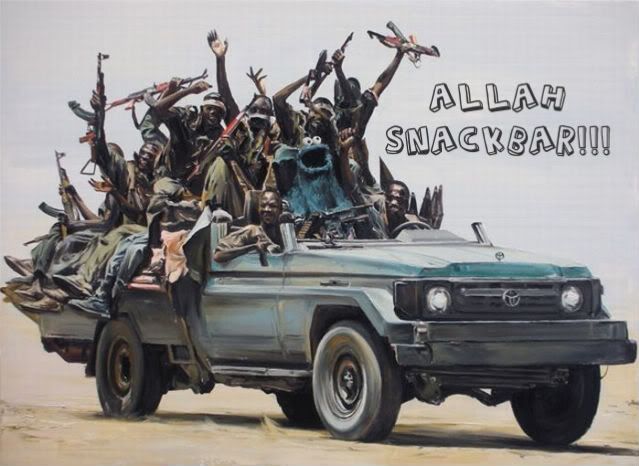
Funny Stuff: Allah Snackbar!!!

Filed under: Funny Stuff,War Art — Tags: , , , , — Matt @ 7:57 PM

Thursday, June 16, 2011

Mexico: The Market Of Force

Filed under: Law Enforcement,Mexico — Tags: , , , , , — Matt @ 3:06 PM

The purpose of this post is to present very clearly what the market of force is down in Mexico.  This is a country where millions of folks have risked life and limb to illegally cross over into the US to make a better life and earn more money. So with that said, the market of force is certainly a factor down in Mexico because jobs are so tight.  Not to mention the ‘plomo o plata‘ concept where the cartels use fear and intimidation to impose their will on the people.

These statistics also show why corruption is so bad.  The cartels are extremely intertwined with government, police, military, and society, and are expert at wielding their money to get what they want.  The may not have morality on their side, but they definitely have peer pressure and cash on their side. Meaning ‘if everyone else is doing it, to include my uncle and my cousins, then I might as well too–or get the wrath of the cartels’.  Who knows, but I do know that the cartels seem to have no problem with sicario recruitment. Especially if they can get these recruits addicted to drugs or threaten to kill their families.

So with that said, what I wanted to do is present the employment options for a hired gun down in Mexico. Or what I call the ‘Market of Force’.  As with most market of force analysis that I have seen in war zones, the side that pays the most, tends to have no problems with recruitment.

Worse yet, the one factoid that really stood out to me, was found in this quote:

However, instead of presenting himself as a victim of circumstances, the sicario describes his frustrations with powerlessness and his ambitions for a different path from the work-saturated lives of his parents. Despite being a bright student who earns scholarships and starts college, he begins to do drug runs at an early age. At 15, he meets the current head of the Juárez cartel, Vicente Carrillo Fuentes, and as a young man he decides to drop out of college and enter the police academy – under the sponsorship of the cartel.
The sicario describes police academies as training grounds for cartel operatives, where cadets on the cartel’s payroll would even go to special FBI-hosted training in the United States.
The penetration of drug organizations into government institutions goes even further, as the sicario describes his duties delivering money to state officials, using patrol cars to move drugs, the old pacts with local governments to not sell drugs within their cities, and the presence of top military officials at narco-parties. -From Borderland Beat’s Review of the book El Sicario

The cartels grab these kids when they are close to police academy age, and probably have no police record, and then they get them trained up in the methods of law enforcement, complements of the state. This particular sicario seems like he chose this more as a career move. This kind of thing happens with the military as well. Basically using state sponsored training in order to be proficient at defeating the state’s police or military, and most importantly, defeating competing cartels. Very smart. It also explains why the cartels are always stealing police uniforms or military uniforms, so they can conduct pseudo operations. This act also destroys the trust that the local populations have in their law enforcement or military units.

As to solutions?  The first step is always in the government. It must be purified of any cartel influence. The next step would be to purify law enforcement, and pay them an excellent salary. The military too.  Give them all the best training, the best salaries, and do everything you can to keep these groups funded and well led.  Mexico should definitely be front and center on the asset seizure game, and figure out ways of spreading the wealth amongst their police and military so that salaries are competitive with the sicarios. If not, they will continue to be negatively impacted by the market of force. You see the same thing happening in Afghanistan between government and the Taliban, you see the same thing in places like Iraq between the insurgency and the government, and you see the same thing in places like Somalia where fishermen and naval officers chose piracy because of the reward and poor economy. –Matt

As of 2010 entry level security guard salaries start at approximately $70 to $100 (840 pesos to 1200 pesos-rounded up) a week. People holding mid level positions can expect to make between $150 to $250 and high level security protection employees can expect salaries of $1000 to $2000 a month. –From eHow

The war has certainly exposed the weakness of Mexico’s criminal-justice institutions. Numbers are not the problem: with 366 officers per 100,000 people, Mexico is better supplied with police than the United States, Britain, Italy and France, among others. But it is badly organised and corrupt. Policemen earn an average of $350 a month, about the same as a builder’s labourer, meaning that wages are supplemented with bribes. Carlos Jáuregui, who was Nuevo León’s chief security official until March, reckons that more than half the officers in the state were being paid by organised crime. A policeman in Monterrey can be bought for about 5,000 pesos ($400) a fortnight, Mr Jáuregui reckons.
“Police are treated as second-class citizens,” says Ernesto López Portillo, head of Insyde, a Mexico City think-tank. They are kept that way by the constitution, which separates police officers from other public servants, meaning they do not qualify for the standard minimum wage and the 40-hour weekly work limit. Police forces are in theory overseen by internal investigation units, but their findings are secret and, in any case, Mr López Portillo estimates that fewer than 5% of forces have such a body. –From the Economist

A new video shows an interrogation of a man identified as Aldo Rivas Torres, who is believed to be a member of the criminal organization Los Zetas. The video is signed by The M’s.
The incident occurred in the municipality of Santiago Papasquiaro, located in Durango and it is believed that the video was recorded recently.
Four armed commandos dressed in military type uniforms point their weapons at the obvious distressed Rivas, while he details his work as a sicario where he confesses that he was receiving a monthly salary of about 15,000 and 20,000 pesos ($1,200 to $1,600 dollars).
He claims that he received direct orders from his brother Jesus Rivas Torres, who serves as an Captain in the Mexican Army, but is also involved with Los Zetas where he is the head of the organization in the village and receives a monthly salary of 500,000 pesos (about $40,000 dollars).-Borderland Beat

Most of the detainees wore military-style clothing, a woman of 16 years of age indicated that training had just started, that they had been sent to the training camp so they could learn how to fight in order to fight for a plaza soon. She also said that they were paid 8,000 pesos a month.- Borderland Beat

However, instead of presenting himself as a victim of circumstances, the sicario describes his frustrations with powerlessness and his ambitions for a different path from the work-saturated lives of his parents. Despite being a bright student who earns scholarships and starts college, he begins to do drug runs at an early age. At 15, he meets the current head of the Juárez cartel, Vicente Carrillo Fuentes, and as a young man he decides to drop out of college and enter the police academy – under the sponsorship of the cartel.
The sicario describes police academies as training grounds for cartel operatives, where cadets on the cartel’s payroll would even go to special FBI-hosted training in the United States.
The penetration of drug organizations into government institutions goes even further, as the sicario describes his duties delivering money to state officials, using patrol cars to move drugs, the old pacts with local governments to not sell drugs within their cities, and the presence of top military officials at narco-parties. -From Borderland Beat’s Review of the book El Sicario

The Army is under authority of the National Defense Secretariat or SEDENA. It has three components: a national headquarters, territorial commands, and independent units. The Minister of Defence commands the Army via a centralized command system and many general officers. The Army uses a modified continental staff system in its headquarters. The Mexican Air Force is a branch of the Mexican Army. As of 2009 starting salary for Mexican army recruits was $6,000 Mexian pesos, or about $500 US dollars per month, with an additional lifetime $10,000 peso monthly pension. -From Wikipedia

Colombian Sicarios
A more overt reference to Sicarii occurred in Colombia since the 1980s. Sicarios, professional hit men adept at assassinating, kidnapping, bombing, and theft, gradually became a class of their own in organized crime in Colombia. Described by Mark Bowden in his investigative work Killing Pablo, the sicarios played a key role in the wave of violence against police and authorities during the early 1990s campaign by the government to capture and extradite fugitive drug lord Pablo Escobar and other partners in the Medellin cocaine cartel. Unlike their ancient namesake, sicarios have never had an ideological underpinning. Perhaps the only cause that they were attributed to was the opposition to extradition of Colombian criminals. Though Escobar employed sicarios to eliminate his enemies, these assassins were active more as independent individuals or gangs than loyal followers of a leader, and there were plenty of sicarios willing to serve the rival Cali cartel. Nevertheless, many died in combat against police forces, indicating that they were not all inclined to bend to the wind. Indeed, long before Escobar’s time, Colombia in particular had a long legacy of professional kidnappers (secuestradores) and murderers, whom he emulated.
In Spanish the word ‘sicario’ is used to refer to both killers who have specific targets and underling hitmen. In Italian, it means “hired killer, hired assassin, cutthroat”.-From Wikipedia

« Newer PostsOlder Posts »

Powered by WordPress