Feral Jundi

Monday, May 9, 2011

Industry Talk: Global CST Doing ‘Too Good Of A Job’ In Latin America

If anyone remembers the raid that freed the American contractors and Ingrid Betancourt in Colombia, then you might have remembered me talking about Global CST’s supposed involvement.  Well, according to this article, this company was definitely kicking some butt and ruffling some feathers down in Latin America. lol It is an example of private industry competing with government forces in the war fighting department, and government getting all bent out of shape because the company is actually  good at what they are doing.

Which brings me to an interesting point here.  When the US shows some concern about a PMC, then there is a good chance that the company actually knows what they are doing.  And it makes sense, because the Israelis are very good at problem solving and war fighting.  Why wouldn’t a PMC like this not do well?  For more research into the company, I wrote about them awhile back and these guys will be the ones to watch down in Latin America and elsewhere. It would be a good one to contract with for the war against the cartels.

Also, it is interesting that the company has set up a Scribd and a Youtube Channel, but no Twitter or Facebook account?  They might as well go all out with the social networking effort if strategic communications is the intent? Just saying… –Matt

US saw Israeli firm’s rise in Latin America as a threat, cables show
By TIM JOHNSON
May 09, 2011
A security company led by the former head of operations for the Israeli military made such inroads into Latin America a few years ago that U.S. diplomats saw it as a security risk and moved to thwart the company’s expansion, U.S. diplomatic cables show.
The diplomats’ efforts were made easier when an interpreter for the Israeli firm, Global CST, was caught peddling classified Colombian Defense Ministry documents to Marxist guerrillas seeking to topple the state, one cable said.
Still, the ability of the Israeli security consultancy to obtain contracts in Colombia, Peru and Panama in rapid succession speaks to the prowess of retired Israeli military officers in peddling security know-how amid perceptions that they’d bring better results than official U.S. government assistance. (more…)

Sunday, May 8, 2011

Bounties: The Truth About Geronimo…And Usama Bin Laden, By Benjamin Runkle

The original Geronimo campaign and the hunt for bin Laden share plenty of similarities. On May 3, 1886, more than a century before a $25 million reward was offered for information on bin Laden’s whereabouts, and almost 125 years to the day before the al-Qaeda leader’s death, the U.S. House of Representatives introduced a joint resolution “Authorizing the President to offer a reward of twenty-five thousand dollars for the killing or capture of Geronimo.”

Excellent little article about the comparisons between these two manhunts. But what is really interesting to me is that back then the President was authorized by congress to issue a bounty for the killing or capturing of Geronimo.  So does that mean that a bounty was paid to the members of Lt. Charles Gatewood’s small five man party that sealed the deal on Geronimo?  Mind you that this party was composed of ‘two Apache scouts, an interpreter and a mule-packer’.  Not bad for such a small team, and it reminds me of the effectiveness of the small teams required for the capture of UBL.(on a side note here, no one has been awarded the millions in bounties that UBL had on his head)

Which brings me to my next point.  It is not the size of force or intelligence apparatus, but the quality and effectiveness of such a thing.  In both cases, it was not a large army that was able to find these guys and put them away.  It was small teams. And in both cases, these teams were tipped off to the location of their guy by a local or a detainee.  So what does that say?

Could this indicate that small companies or units are more capable of finding people, than large cumbersome armies? I think so.  I also think that bounties can work, if they actually support a vibrant ‘offense industry’.  The bounty for Bin Laden did not support the kill or capture by companies or individuals, and only depended upon an individual to come forward with a tip.  That’s if they would come forward.  If a company was tasked with finding and capturing/killing UBL or any of the other leaders, then they too could use a bounty system to get their information locally. Or use whatever means, based on the guidelines and laws of a issued license.

The other point I wanted to make is how long and how costly this manhunt has been.  According to this author in the Atlantic, the total time for the hunt of UBL was 15 years at a cost of 3 trillion dollars. I cannot even imagine what 3 trillion dollars looks like, but I do know what cost effective is.  This hunt for UBL was not cost effective, and I definitely think that there is another way to go about this task. Not to mention the lives lost in this long war.

Finally, there is the question of violating a country’s sovereignty in order to go after an individual(s). We definitely crossed Pakistan’s border with military force, landed on their territory, killed UBL and several others, and took materials from this compound.  All of these acts were done without the permission of Pakistan, and I am sure it will have it’s repercussions.(logistics for Afghanistan come to mind) But my point is that the US authorized this act at the highest levels.  So the US has now set a precedence and has deemed this a necessary act for national security.  I agree and applaud the President for making this move, but the US must also consider that Al Qaeda is still operating and still out there.

It will take many raids, and many small teams to reach all of these groups and violate the sovereignty of many countries out there in order to accomplish what we just did in Pakistan.  If such acts are this important to the national security of the US, then I do not see how issuing Letters of Marque and Reprisal to private industry to help in this endeavor would be considered that much more of a stretch? Or we can continue to spend trillions of dollars on large scale military deployments in places like Iraq or Afghanistan, violate those country’s sovereignty with large scale occupation, all to find these people? Something to think about when talking about waging war efficiently and using the right tool/strategy for the job.

On a side note, Benjamin Runkle has put together an excellent blog to coincide with the topic of his book called Wanted Dead or Alive: Manhunts from Geronimo to bid Laden. I have put his blog in my RSS reader, and this is an area of study that everyone should take a look at if they are interested in the method behind ‘finding’ bad guys.-Matt

The truth about Geronimo .. and Osama bin Laden
By Benjamin Runkle
May 6, 2011
“Geronimo!” That was the call that went over the command net on May 1, indicating that Navy SEALs had found their man. And that code name for Osama bin Laden has angered some Native Americans, who have demanded a formal apology from the Obama administration.
Their complaints are understandable, but misguided. The code name doesn’t denigrate the Apache war captain, a hero to some students of Native American history, through comparison to the Saudi terrorist leader. The similarities are not in the men themselves but in the military campaigns that targeted them.
In May 1885, Geronimo led the breakout of 120 Chiricahua Apache from the San Carlos Reservation in what is now Arizona, creating mass hysteria in the American Southwest. The Chiricahua had legitimate grievances: Civilian “Indian agents” were corrupt and consistently cheated the Apache on their rations, while the land the tribe had been given was almost worthless for farming but still encroached upon by miners. (more…)

Letter Of Marque: Jack Hunter Discusses The LoM With Judge Napolitano

Wednesday, May 4, 2011

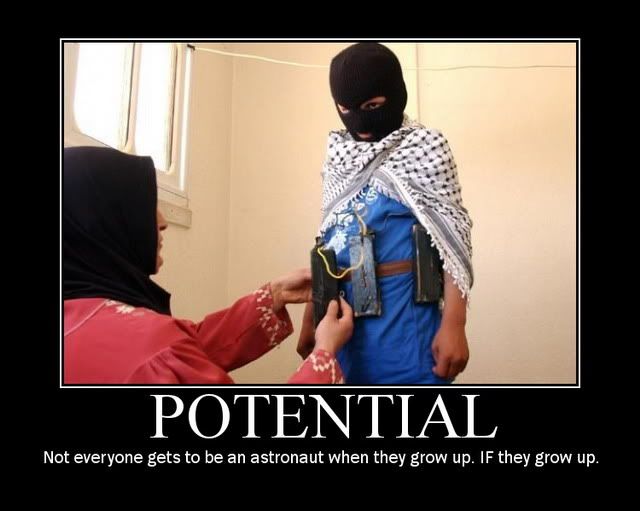
Funny Stuff: Feral Jundi Had Some ‘Potential’ Viewers In Abbottabad, Pakistan

Filed under: Al Qaeda,Funny Stuff,Pakistan — Tags: , , , — Matt @ 12:40 PM

This is funny.  Over the course of this blog’s history, I have had five visits from Abbottabad Pakistan according to my Google Analytics. They found the site through Google, and these are the dates they visited.

Sept 28, 2010
August 16, 2010
June 30, 2010
April 7, 2010
October 8, 2009

Now what I did was to go back to each of these dates and see what stories they were attracted to.  Well what I found out was that it wasn’t a story they clicked on, but a Funny Stuff poster I posted a long time ago called Potential.  I posted this poster to show how ridiculous our enemy was, and how little regard they had for human life.  So did Bin Laden or any of his clowns check out the poster?  It is a good possibility because on those dates, there wasn’t anything of significance interest to their efforts, and the Potential Poster had top viewing. lol

The reason for that is because it reached the first page of Google Images for the search ‘funny stuff’.  Thousands of people over the course of the image’s history have viewed the thing because of it’s placement in the image search.  And it looks like I was able to piss off five folks with that ultra-offensive poster.  Score!!!  The best part is that thing will continue to do it’s damage to the psyche of booger eaters world wide. hee hee –Matt

Edit: Just so folks know, I was not the original creator of this poster.  I just found it floating around out there on the internet and thought it was pretty funny. 

Industry Talk: Role Of Security Contractors Debated At Hearing

Bravo to Doug Brooks for standing up for the industry at this hearing.  The debate on what is ‘inherently governmental’ continues to rage, and there are those out there that continue to be very forgetful of the sacrifice of today’s private industry and of our contributions to this war and wars past.  Arguably, we are a strategic asset for the simple reason that without contractors, there would have to have been other means of raising an army to deal with the manning requirements of the war.

My message to all the elected officials on that wartime commission panel is that because you did not have the political courage to implement a draft and authorize the raising of a massive military force, that in effect you gave the war planners no other choice. And as long as we continue to have a military composed of individuals that ‘chose’ to serve, meaning they signed a contract and willfully serve the country, then we will always have manning issues. Simply because you either do a really good job of making the military and war fighting appealing to potential recruits, or you lose them to the private sector.  An all volunteer force concept works great during peace time or during the successful periods of a war campaign, but when there are multiple wars and a multitude of chances of dying or getting wounded on the battlefield, the whole military idea becomes less attractive–and especially when you ask a recruit to sign four years of their life away for the war effort.

It is the freedom of choice that we are talking about here. Our leaders do not have the courage to take away that freedom of choice and implement a draft. Because of the legacy of our war in Vietnam, that required a draft to raise an army, is what I am referring to here as the example. The draft is political suicide, and many politicians out there are not willing to implement that tool to raise an army.

They are also not willing to accept the costs of raising such an army.  With contracting, it is easier to bypass the political risk that goes along with increasing troop levels for wars that continue to drag on and on.  With contracting, it can be wrapped up in all sorts of budget deals, and companies can subcontract to get the mission accomplished.

Not to mention the political costs of when a soldier dies, versus when a contractor dies.  I have noted that over 2600 contractors have been killed in this war, and probably more if there was an accurate accounting of all private sacrifices.  That is 2600 less folks that politicians had to answer for with their constituents. Not to mention all the wounded, and all the folks from numerous countries from all around the world that have contributed to the contractor work force. It is a sacrifice that barely registers with the tax paying and voting public.

Then of course there are the politics of war fighting.  At the height of the Iraq war, when everyone was wanting to pull out and give up, it was contractors that were able to step up and fill in the necessary man power requirements while congress tried to figure out what they wanted to do. And also, that surge of military force could more focus on combat operations as opposed to kitchen duty or guard duty at some camp.  That is a huge strategic asset for a war planner, because if he could not depend on contractors for that support, then they would have had to go to congress and ask for even more troops.

Probably one of the most significant contributions in this war, is the legion of contracted interpreters. Without them, our US troops would be nowhere with this war in Iraq or Afghanistan. These contractors are also on the front lines, participating in the offense and defense by default. They are also dying and getting wounded right there with the US troops and coalition partners.  Oh, and without contracted interpreters, we would have never have gotten as far as we had with the hunt for Usama Bin Laden.  Someone had to interpret the Arabic or Pashtun materials and statements over the years, and yet no one mentioned in the hearings as to how important their contribution has been?

Even the surge in Afghanistan couldn’t happen with out the support of contractors, and war planners know it.  But just imagine if war planners had to go to congress and instead of asking for 50,000 extra troops, they had to ask for 100,000 or 200,000?  The sticker shock for 50,000 troops would freak out congress, and just imagine if they had to ask for twice or three times that? That is why contractors are a strategic asset. I also imagine that the war would have definitely turned out differently without this highly flexible and scalable work force and strategic asset called contractors.

Finally, there is the precedence that continues to be forgotten by all the experts that speak to congress about what is inherently governmental.  In the constitution there is proof positive of the US government’s use of a private offense industry during times of war in the form of Article 1, Section 8, Paragraph 11 (or the Letter of Marque and Reprisal). We used privateers for offensive operations against our enemies, and it wasn’t a one time deal either. We heavily used privateers in both the Revolutionary War and War of 1812, and back then they were a strategic asset of those wars. That is what we used to go up against the world’s best navy at the time called the British Royal Navy.  It was also the most cost effective use of private force for war time that I can think of.

Privateers were a part of the US government’s early use of ‘offense industry’ to not only destroy it’s enemies, but to also profit from the destruction of an enemy.  It was also a way of raising man power at sea in a very rapid and scalable way, and involving the innovations and enterprising ways of private industry during times of war. Did I mention that congress issued 1700 Letters of Marque during the War of 1812 and that our country’s founding father Thomas Jefferson was a huge supporter of the concept?  And yet this precedence continues to be conveniently forgotten and cast aside as insignificant at these hearings.

One final thing.  There are examples of private industry being used in modern times as well, that would certainly helped to define what is ‘inherently governmental’. The awarding of the Medal of Honor to a civilian contractor named William Cody during the Indian Wars is significant to this discussion.  The US allowing Claire Chennault and his Flying Tigers to conduct offensive operations for another country for the destruction of a mutual enemy, is another example of what I am talking about. The US endorsing the private volunteers that went to Israel to support their wars and raise their army and navy was significant. Even the issuing of a license by the Department of State to MPRI for giving key strategic guidance to the Croatians during the Balkan conflict would be considered a precedence as to what is ‘inherently governmental’.

Perhaps instead of dwelling on trying to erase or re-invent history with this ‘inherently governmental’ debate, we should instead invent a new definition as to what the defense of national security is?  Because from where I stand, contractors have been extremely important to national security and to this country’s survival over the years, and yet folks are still wanting to destroy this strategic asset or weaken it. To me, all things must be considered during times of war, to include all and any means of using private industry. We had a good fix on that in the past, and yet with all of our modernity and current technologies, we are still incredibly ignorant and naive as to what kind of asset private industry can be during times of war. That is my thoughts on the matter. –Matt

Role of security contractors debated at hearing
By SARAH CHACKO
May 2, 2011
Contractor groups are taking issue with a commission’s recommendation to restrict the government’s use of private security workers.
“You don’t need James Bond to guard a gate,” Doug Brooks, president of the International Stability Operations Association, said during a Commission on Wartime Contracting meeting. “You need somebody who’s professional and disciplined and following the rules.”
The commission recommended in its February interim report to Congress that agencies should provide their own personnel for security operations.
Agencies are being forced to use contractors because of limited resources, commissioners said during Monday’s open comment session. (more…)
« Newer PostsOlder Posts »

Powered by WordPress