Feral Jundi

Saturday, October 23, 2010

Call To Action: Help Scan Wikileaks For Security Contractor Information

     This is a simple one, and I need everyone’s help with this. The dork at wikileaks posted more stuff about Iraq, and there are like 54 pages of information dealing with the search input ‘security contractors’. If folks can help me sift through this thing so we can identify what is true and what is false, that would be a big help. These reports are mostly from the military perspective, and just because it is on wikileaks does not make it true or correct. I hate giving wikileaks this kind of attention, but I feel I have no other choice.

    The other reason I wanted to get this out there is to see if names have been used of contractors, or if any operational information that could be used to hurt guys was posted. The Pentagon could care less about our safety with these leaks, and have their own issues. So if you find stuff that is of concern, let me know via emails and we can do some damage control. Mostly I just need to know what to prepare for, so I can give everyone a heads up.

    Most of the stuff I am seeing so far is pretty basic. Lots of IED or SAF reports where convoys were fired upon by the enemy, Iraqi police/army or the coalition. If anything, it shows how much combat contractors really faced in Iraq, and it definitely showed how dangerous and complex of an environment we operated in. –Matt

*****

Link to Iraq War Logs Explorer here.


Leadership: Harvard Business Review–Leadership Lessons From The Military

     Imagine a company with a new board of directors, charged with entering complex markets while managing rapid growth, both organic and through M&A. This company is struggling to hit its performance targets. It has been hemorrhaging money and hasn’t turned a profit in over eight years. Needless to say, shareholders are upset. How would most senior management teams handle these problems? In today’s competitive business space, chances are they would go outside the organization for highly skilled, industry knowledgeable, impartial consultants to work with them to solve strategic-level inefficiencies. 

     Now consider that this troubled company is actually NATO’s International Security Assistance Force (ISAF). ISAF (the “Coalition”) faces real business problems in Afghanistan and are pressured by a global audience to make significant progress by the end of 2010. The Coalition is at a tipping point and should use every resource available to improve their bottom line — promote stability and support security sector reforms throughout Afghanistan. Who are they bringing in to help them expand, operate efficiently, measure success, and develop a unified strategy?- HBR Blog, Consultants: Help Wanted In Afghanistan

*****

    I have thoroughly enjoyed this series at Harvard Business Review. The military needs this kind of perspective, because just like business can learn from the military, the military can certainly learn from business. Especially in the realm of getting results. Because lets face it, a military can be highly advanced and well equipped all day long, but if it cannot produce the desired results or win, then what good is it?

    In the past I have touched on this idea that private industry has the power of failure that drives it. But when the US Army fails, who fires them?  What will replace the the Army if it fails? So in essence, today’s military branches must succeed and they must tap into any and all ways of getting the desired results they are seeking in a war.

    Back to this post though. This is about what private industry can learn from military leadership, and I always like reading about these lessons learned. It is always fun to see what professionals in other industries are surprised at or intrigued with in today’s military. They too are trying to get results and win their business wars, so this kind of article is an outcome of their learning organization. And Harvard Business Review is quite the learning organization.

     Below I posted all the executive summaries. But if you follow the blog link and website link, you will find other related materials. So definitely take your time and read through everything. I thought it was cool that Admiral Thad Allen was a big fan of Peter Senge and his books. Books like The Fifth Discipline: The Art and Practice of the Learning Organization, which has themes that you see echoed in other military thinker’s and business folk’s publications. John Nagl mentions ‘learning organization’ in his books, and I have talked about that stuff here on the blog in the past. It is also a Jundism. Check it out and let me know what you think. –Matt

——————————————————————

Harvard Business Review

Leadership Lessons From The Military

November 2010

Executive Summaries

Extreme Negotiations

Jeff Weiss, Aram Donigian, and Jonathan Hughes

CEOs and other senior executives must make countless complex, high-stakes deals across functional areas and divisions, with alliance partners and critical suppliers, and with customers and regulators. The pressure of such negotiations may make them feel a lot like U.S. military officers in an Afghan village, fending off enemy fire while trying to win trust and get intelligence from the local populace.

(more…)

Fish And Game: Bagging A Five Point Buck In The Palouse

Bagging A Five Point Buck In The Palouse

October 23, 2010

     The reason why haven’t blogged for the last week or so is that I have been deer hunting.  It was a successful trip and I had a great time doing a little ‘live tissue training’. lol

     This trip was special for me because I got to be with my father and uncle for a hunt I used to do when I was younger. Work has gotten in the way of me doing this hunt for a long time, and my schedule this year finally produced a window for something like this. Plus, hunting in the Palouse is special unto itself.
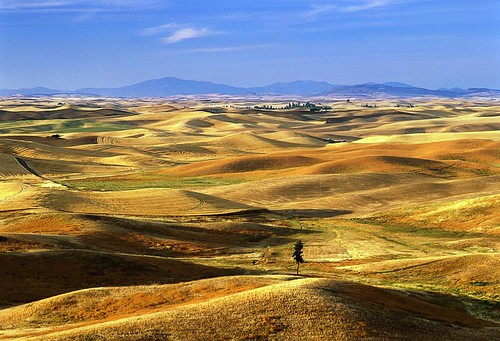
The Palouse

A good shot of the rolling hills and wheat country of the Palouse.

     The Palouse is a region of Southeast Washington State that is defined by lots of wheat fields mixed with steep and rocky cliffed river valleys and patches of forest eyebrows. These eyebrows are basically areas of wheat fields that cannot be tilled and are used by deer in the area to bed down. The river valleys have cliffs and steep edges, with lots of gullies and areas where deer can hide. They are lush areas and can be very interesting to hunt.

     For this trip, I had to buy a bunch of new equipment and square away my rifle. That meant lots of trips to the gun stores and the local Cabelas here in Boise. I had fun doing this, and Boise is definitely a hunter’s town.

     I also rented a 2010 Ford F150 from a rental car place(the flex fuel model), and I abused the crap out of this vehicle. It was used for the trip to the Palouse from Boise and back, and it was used for all the wandering around in the wheat country and river valleys. It was also used to haul out deer, cross rivers, climb steep hills, and even tow a deer off of a cliff edge.

     So after getting my gear, rifle and truck assembled, I headed on out to the town we stay in. I was to link up with my father and uncle there and it was about a 8 hour trip from Boise. I pulled into the town in the afternoon.

     The camp we were to call home was a garage that was converted into a hunting lodge of sorts. Inside was lots of deer horns, a wood stove, power, and enough space for us to set up some tables and chairs to eat at and hang out.

That night we prepared for hunting and talked shop with the local farmers, and the various land owners and farmers/ranchers/hunters of the area that stopped by. It was great fun to touch base with all of these folks, and everyone was excited for opening day the next morning. (a big shout out to Tim for being such a great host and hunting guru)

     The first day we started hunting, I probably hit a record for observing the most amount of deer in one day.  The problem was that our party couldn’t get a shot at anything shootable. The deer have to be three pointers, or have three tines on one horn to include the eye guards. Anything less than a three point and you could be heavily fined.

     Opening day sounds like a war zone. There are gun shots going off all over the place, and guys are slinging large rifle calibers all over the place.  This is why wearing hunter orange vests is required, because you definitely do not want to be accidently shot by any of the dozens of hunters scattered throughout the area. I also thought to myself if a hunter orange plate carrier might have some interest to some folks?  Who knows, and maybe someone is already selling such a thing?
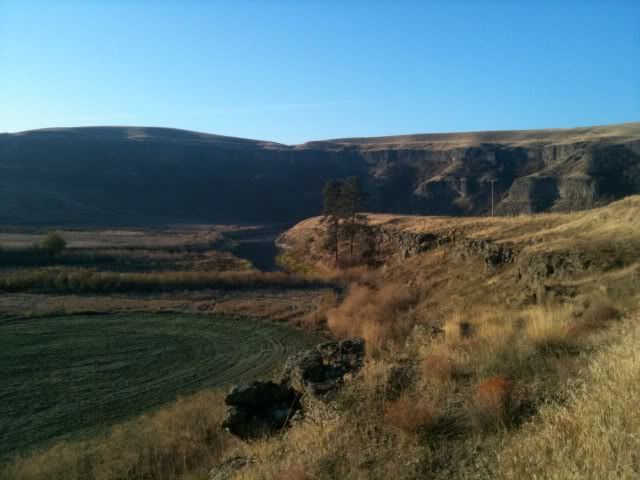
Cliffs

The cliff area I was hunting. 

     The next day is when I got my deer. I was up on cliff edges above the river doing some glassing (using binoculars) and decided to try and get lower on the stepped edges of the cliff. I definitely had to be careful doing this, and find an access point that was safe enough. But these stepped areas of the cliff edges are where the big Whitetail deer like to hang out, and especially the bucks, so it is worth the effort.

     Over the years, our hunting party has taken quite a few bucks in the cliff areas of the Palouse. Most hunters of the area will not go up there because getting a deer there requires a lot of work to get out, and it is just tough hunting. But those cliffs are where the big guys like to hang, to include the one I got.

     How I got him was an interesting story. As I was crawling down, I heard some noise in the bushes below me and a two point buck popped out. I raised the rifle on him and looked at his horns to identify how many he really had. You look for little nubs on the eye guards, or any kind of growth on the horns to give you any indicators for a shot. But nothing on this guy’s horns would indicate a three point, so I had to let him go. I notified my uncle via a small Motorola ‘talk-about’ radio we use, that this deer was heading his way.

     So as I was going down the slope, I was looking for another point to glass from.  I found a good edge and was able to start glassing again.  It was a great spot because it allowed me to look at the cliffs around me with a better angle. It also shortened up my range if I had to shoot into the river valley. I had a Nikon range finder at the time, and most of my shots would have been in the 200 to 300 yd range. Perfect for the rifle I had set up.

     Then while I was glassing and talking with my father on the radio about another doe we spotted, I had heard some noise in the brush from where the two point buck came out of. I brought my rifle up again and had to move closer to it in order to see what it was. To my astonishment, it was another buck that decided to get up. This guy was definitely shootable and big, and was holding tight in his little hiding spot. I had to shoot quick because he was getting ready to bolt, and I popped him dead on in the chest at about 36 yds.(he walked a little from his position, and then was squared up facing me when I shot).
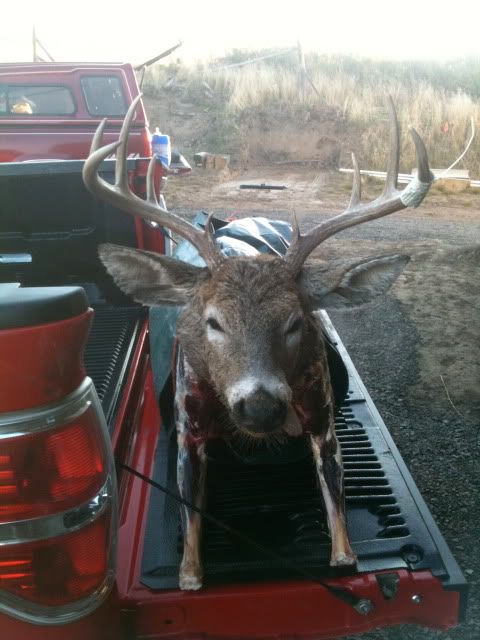
My deer

The five point buck I shot up on the cliffs.

    The shot thwacked him in the chest and he went down immediately. He then rolled down the slope and I put my safety back on the rifle to go after him. Basically, I had to follow him over the cliff edge and through the ravine that he was rolling down. Luckily he was going down a ravine that was passable and I felt I could do it safely.

     As I came up on him, I poked his eyeball to make sure it was dead. You always dead check these things because a wounded animal with horns can certainly hurt you. This guy was dead and it was a good clean shot. The 185 grn. bullet entered the chest and stayed in the body. The bullet did reach the right side tenderloin and was a little screwed up–but not bad.

     From that point on I had to plan on how to get the deer out of there. I unloaded my rifle and slung it on my back and took some clothing off so I did not overheat. I then dragged the animal down the slope with gravity being my friend. The thing felt like it weighed about 190 lbs.

     Once at the bottom of the slope I came across the river that the cliff was overlooking. On the banks of the river, I gutted the deer and washed him out in the river. The river is also what I used to float the deer to a pick up point for my vehicle. (After shooting the deer, I notified my father and uncle to go get the pick up and meet me below to pick up the deer.)

     This next part of the deer hauling process was interesting as well. I had two choices for dragging the deer. Drag it across the river and over land for about 300 yds, or float the body down the river a ways and drag it up the banks to a pick up point for the vehicle, which would make my drag just 30 yds. I chose the ‘Deliverance’ method. (movie reference) lol

     It worked well and I only tripped in the water once.  The water was cold but not that bad, and the animal was floating just fine in the water. Once I got it to the bank on the other side, that is when my hunting party arrived and was able to help me get it up on the road.

     After loading up the deer into the truck, we took it back to camp and hung it on a tractor. Once it was hanged we skinned the thing and parked in a cool dark area of a tractor garage. We then loaded up the truck and went back out to catch a little hunting before dark.

     I was pretty happy. It was an ethical kill meaning it did not suffer, and I did not get hurt hauling it off of the cliffs or through the river. The meat was in one piece and there was tons of fat on this deer. (these deer are basically grain fed animals with all of the wheat and corn in the area, and taste like really lean beef)

     As the week progressed, my uncle shot a deer up on the cliffs as well. We actually had to haul that ‘up the cliff edge’ using my truck as a tow. That was a first for us, and  the potential for falling off the edge was definitely there. My uncle’s deer was a four point. I guess we could have pushed the deer over the ledge, but then that would have damaged the meat and horns.

     Once the week ended I drove back to Boise to drop off my deer at the butcher and rent a meat locker. I asked the butcher to make steaks and hamburger out of it. (and add a little beef to the burger) I will also cut the horns off the head and put it on a mount. I can’t wait to taste the meat, and I already have some recipes that I want to try.

     All and all this was probably my best hunt in this area and I hope to go back again next year. I can’t tell you how many deer we saw, to include shootable bucks. The weather was perfect, the company was excellent, the food was outstanding and all the planning and preparation produced a fantastic experience. The Palouse is a winner! –Matt

Thursday, October 14, 2010

Industry Talk: Aid Workers’ Security Situation Spurs Talks On Afghan Contractor Ban

        What happened to Linda Norgrove was tragic in two ways. First is if she was doing a critical job that put her in harms way, then she should have been given competent security folks who are professionals and capable. And second, the tragedy of her getting kidnapped and the government having to either rescue her or pay a ransom has become a PR nightmare for all involved.

     Of course in this case they felt it necessary to rescue her and that mission was not successful. So what is worse? Using private security or letting your people get kidnapped due to a lack of security? (it reminds me of the piracy debate) Which goes back to what this article is talking about.

     Afghanistan is a far more dangerous place these days and requires ‘true’ security professionals to safely transport crucial civilian specialists from point A to point B. With a shortage of dependable and professional local national security types, as well as a lack of available military escorts, private security contracted through experienced and capable companies are the final and best option in my view.

     Tim Lynch wrote a great post the other day that talked about Linda and the banning of security companies in Afghanistan. It is a good read and be sure to follow his posts as this situation develops.

     We will see how the State Department is able to navigate this one, because if they plan on continuing their missions out there they will need authorization by the Afghan government to continue using their security contractors on the roads. –Matt

——————————————————————

Aid workers’ security situation spurs talks on Afghan contractor ban

October 12, 2010

By Elise Labott

Concerned a ban on security contractors in Afghanistan will curtail the efforts of development workers, the State Department is feverishly negotiating with the Afghan government about a set of conditions that will allow private security details to operate in the country, senior U.S. officials told CNN.

The officials, who spoke on the condition of anonymity because of the sensitivity of the negotiations, said the United States is concerned about a four-month deadline Afghanistan’s president imposed last month to phase out the country’s 52 private security companies by year’s end. If implemented, the move would leave critical aid personnel unprotected and unable to continue their work, a key pillar of the U.S. strategy as it seeks to stabilize Afghanistan.

The U.S. is in intense negotiations with the Afghan interior ministry for a “clarification letter” that would spell out a consistent and uniform set of guidelines by which contractors would be allowed to remain in the country and under what conditions they can operate. The guidelines should be finished within the next week, they said.

(more…)

Wednesday, October 13, 2010

Training: SIA Close Protection Officer Course, Pennsylvania

    Check it out. You can get credits with Bucks New University, some excellent close protection training, and the SIA license–and all in the US. This is a great opportunity for those guys in the US that wanted to get this license via a course like this.

     The other thing to mention though is that I have no clue if the SIA program will be around much longer? My guess is that it will stick around for a bit, and the license will still continue to be required by companies in Europe or in the war zones. A big hat tip to Steven Collins and his crew over at BIS for getting the word out on this. –Matt

——————————————————————

(from Black Ice Security)

S.I.A. Close Protection Officer Course

Description:

BRTC and Globe Risk are offering the only Close Protection training program in North America that is approved by the Security Industry Authority (S.I.A.) in the UK. This program also has the distinction of being accredited by Bucks New University, UK, an internationally recognized academic institution.  The course will end with the S.I.A. licensing examination.

Recognized internationally as the security industry’s benchmark for training in Close Protection, the S.I.A. certification is available to those who successfully complete the training course and pass practical and written exams. The SIA course will also provide 15 points towards a degree in Protective services from Bucks New University.  SIA is the U.K. authority for security specialists and licensing which will likely be necessary for security agents who provide protective services during the 2012 Olympic Games.

Course Content:

(Knowledge and practical skills 150 hours minimum)

–          Role and Responsibilities of the Close Protection Operative

–          Threats and Risk Assessment

–          Surveillance Awareness

–          Operational Planning

–          Law and Legislation

–          Interpersonal Skills

–          Close Protection Teamwork and Briefing

–          Conduct Reconnaissance’s

–          Close Protection Foot Drills

–          Route Selections

–          Close Protection Journey Management

–          Search Procedures

–          Incident Management

–          Venue Security

–          Communication and Conflict Management

–          Final Examination

–          Tactical Medical Care

(more…)

« Newer PostsOlder Posts »

Powered by WordPress