Feral Jundi

Wednesday, September 26, 2012

Funny Stuff: Party Seems Over For Somali Pirates–Prostitutes Lament

Filed under: Funny Stuff,Somalia — Tags: , , , — Matt @ 4:54 PM

There they found pirates who once owned vast villas living in darkened, unfurnished rooms, hiding from their creditors.
Prostitute Faduma Ali longs for the days when her pirate customers had money. As she smoked a hookah in a hot, airless room in Galkayo last week, she sneered as she answered a phone call from a former customer seeking some action on credit.
“Those days are over. Can you pay me $1,000?” she asked. That’s what she once got for a night’s work. “If not, goodbye and leave me alone.”
“Money,” she groaned as she hung up.

Too funny. If you want to know the health of an illicit industry like piracy, then turn to the prostitutes as a way of gauging that. lol

I also love that Faduma Ali pictured below is a prostitute, but still wears what looks like the niqab or veil. I really don’t know how she is viewed upon by Islamic scholars or other muslims there in the city she lives in, and I am surprised the extremists haven’t killed her or made an example of her yet?

But back to the big point here. This is just more proof that the current strategy of getting armed guards on boats–and I mean all vessels going through GOA–is the right path. Congratulations to all involved with the effort, to include the navies of the world and the private armed guards on boats.

On that note, just because the Somali pirate industry is suffering, does not mean that they are out of the picture or that other pirates from around the world won’t do their thing. For example, Nigerian pirates seem to be really upping their game and increasing their use of violence. The truly desperate and dangerous pirates are out there, and they are committing atrocity in order to achieve their goals. It is these wolves, that continue to hunt and seek weakness, that we need to be on guard for.

I would hate to see armed guards on boats get over taken by better armed and highly determined pirates….. But the realist in me just assumes that it will happen, and all we can to is to continue to press for the entire industry stay one step ahead. Both in planning/intelligence and in optimum weapons for that voyage. –Matt


$1000 a night no more: Prostitute Faduma Ali, who longs for the days when her pirate customers had money, chews the stimulant khat and smokes a cigarette at a house in the once-bustling pirate town of Galkayo, Somalia. (AP Photo/Farah Abdi Warsameh) Source: AP

AP IMPACT: Party seems over for Somali pirates
By ABDI GULED
09/25/2012
The empty whiskey bottles and overturned, sand-filled skiffs littering this once-bustling shoreline are signs the heyday of Somali piracy may be over. Most of the prostitutes are gone and the luxury cars repossessed. Pirates while away their hours playing cards or catching lobsters.
“There’s nothing to do here these days,” said Hassan Abdi, a high school graduate who taught English in a private school before turning to piracy in 2009. “The hopes for a revitalized market are not high.”
Armed guards aboard cargo ships and an international naval armada that carries out onshore raids have put a huge dent in piracy and might even be ending the scourge.
While experts say it’s too early to declare victory, the numbers are startling: In 2010, pirates seized 47 vessels. This year they’ve taken five.
For a look at the reality behind those numbers, an Associated Press team from the capital, Mogadishu, traveled to the pirate havens of Galkayo and Hobyo, a coastal town considered too dangerous for Western reporters since the kidnappers have turned to land-based abductions over the last year.
There they found pirates who once owned vast villas living in darkened, unfurnished rooms, hiding from their creditors.
Prostitute Faduma Ali longs for the days when her pirate customers had money. As she smoked a hookah in a hot, airless room in Galkayo last week, she sneered as she answered a phone call from a former customer seeking some action on credit.
(more…)

Tuesday, September 25, 2012

Russia: Private Military Companies May Appear In Russia Says Rogozin

Filed under: Industry Talk,Russia — Tags: , , , , , — Matt @ 4:08 PM

I have seen other mentions in the news about Russia’s interest in PMSC’s, although they have been using them for quite awhile. For a great primer on one aspect of what a Russian type market would look like, is this episode of a documentary that the gaming company EA put together for Army of Two.

In the documentary they focus on the PMSC industry in Transnistria. This break away republic is flush with weapons and out of work soldiers, and this country’s industry has been involved with providing arms and services all over the world. The country is in a grey area of status, and multiple clients have been able to take advantage of this situation.

For Russia, it sounds like they are willing to experiment and copy the west’s use of PMSC’s. Although I doubt they would be totally private, but you never know… –Matt


Private Military Companies May Appear in Russia – Rogozin
19/09/2012
By Dan Peleschuk
The Russian government’s Military Industrial Commission may consider creating private military companies in Russia, Deputy Prime Minister Dmitry Rogozin said Wednesday.
Russia’s significant economic interests abroad often operate in “difficult” conditions, and such companies would facilitate their work, said Rogozin, who oversees Russia’s military-industrial complex.
“We are thinking about whether our money should go toward financing foreign private security [and] military companies, or whether we should consider the feasibility of such companies in Russia itself,” he said.
President Vladimir Putin also declared his support in April for the creation of such companies, currently employed by a slew of Western governments, to provide security for Russian facilities abroad as well as training foreign military units.
Some Russian military analysts, however, are skeptical about Rogozin’s idea. They think the plan could be just one of the charismatic politician’s off-the-cuff statements, such as his claim earlier this month that Russia should plan to build a lunar base to reinvigorate its flagging space program.
Military analyst Alexander Golts says private U.S. security companies, for example, are useful because they allow the U.S. government to dodge the hefty insurance payments in the case of a military-related death – a practice rendered largely pointless in Russia.

(more…)

Monday, September 24, 2012

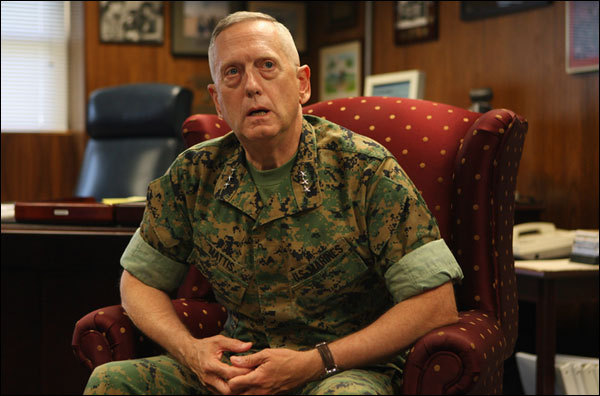
Leadership: General Mattis On ‘Command And Feedback’, And The Use Of ‘Eyes Officers’

From his lead position, Mattis stayed close to the regiments involved in the fiercest fighting and got a good sense for events on the battlefield. The general refused to believe that images on a computer screen in the quiet hum of a command post could tell him what he needed to know about how the battle was progressing and what his subordinates required. Mattis could be ruthless; he would relieve the commander of one of his regiments in the middle of a campaign. In the marines, only performance counts. Mattis picked several officers to act as what he called his “eyes only” representatives. They had no authority but, he said, like “Frederick the Great’s focused telescope or Wellington’s lieutenants in the Peninsula Campaign,” they had the duty of wandering the battlefield to keep him informed of things they thought he needed to know: troops or officers who were exhausted by combat, supplies that were not reaching the front line, and the other human factors that can be crucial in combat. -page 116 and 117 of The Iraq War: A Military History, By Williamson Murray, Robert Scales

The Slate put this out last year, but I just recently stumbled upon it and wanted to share. General Mattis is a Marine’s Marine and he is very much respected. With that said, when I found out that he was implementing some concepts that are familiar here in Jundism and some of my leadership posts, I perked up.

Specifically, the mystery shopper concept or having folks on the inside of your organization to give you some honest feedback about the true health of your company or military unit. With this data, you can actually make adjustments to policy that will better serve the mission or contract.

I also liked the focus on innovation and gaining feedback. Or, command and feedback, which is a play on the phrase command and control. This also led to the best quote in the article below about where that feedback or innovation could come from.

If you are always on the hunt for complacency, argues Mattis, you will reward risk-takers, and people who thrive in uncertainty. “Take the mavericks in your service,” he tells new officers, “the ones that wear rumpled uniforms and look like a bag of mud but whose ideas are so offsetting that they actually upset the people in the bureaucracy. One of your primary jobs is to take the risk and protect these people, because if they are not nurtured in your service, the enemy will bring their contrary ideas to you.”

That is awesome and all companies and military units should learn from this. Leaders should dare to listen and seek feedback from all quarters of their organization, and soldiers/contractors should dare to come forward and disagree, or present the better idea. Any policies and actions within an organization that supports this command and feedback process should be looked at and attempted.

We should constantly be supporting and pushing innovation within the ranks, and constantly seeking feedback and using these innovations in order to continuously improve the organization/mission/contract/war fighting/strategy. Awesome stuff. –Matt


Gen. James Mattis, USMC The general who is fighting a constant battle to keep the military innovating.
By John Dickerson
Aug. 9, 2011
When speaking to rising officers, Marine Gen. James Mattis likes to tell the story of the British Navy. At the turn of the 19th century, it had no rival in the world, but 100 years later it had grown complacent in dominance. Officers amassed rules, ribbons, and rituals that had little to do with the changing nature of war. “They no longer had captains of wars,” he tells them, “but captains of ships.”
As commander of the U.S. Central Command, Mattis oversees the wars in Afghanistan and Iraq, but his career mission has been against complacency. In modern warfare the reliance on better technology and superior firepower deadens the talent for innovation, he argues. This blinds some officers to emerging threats and slows their ability to react to them. The U.S. military, he argues “must avoid becoming dominant and irrelevant.”

(more…)

Jobs: Project Security Team Member, Afghanistan

If you head over to the career page for DynCorp with the link I provided, you will see a bunch of these positions open. What is posted below is all I know about these positions, and if anyone has any inside scoop, please feel free to post below in the comments.

I am not the point of contact for this job, nor am I a recruiter for DynCorp. Follow the links below if you want to apply, and ask the company’s recruiters if you have questions.  Good luck with the job if you apply. –Matt


Project Security Team Member-1206053
Security Clearance: None
Job Summary
The Project Security Team Member provides close, mobile and static security/force protection. Delivers training for expats and cooperating country nationals.  Provides risk consultation, incident management and crisis management.
Principle Accountabilities
• Provides close protection.
• Briefs on mobile security team mission security details.
• Provides static security/ force protection management.
• Provides personal security training for expats.
• Provides professional capacity building and training for Cooperating Country Nationals (CCNs).
• Assesses formal threat, risk and vulnerability.
• Analyses intelligence pertinent to project activities.
• Provides risk consultation, incident management, crisis management.
• Briefs on mobile security team mission security details.
• Develops and refines standard operating procedures (SOPs).

(more…)

Saturday, September 22, 2012

Podcasts: DoD Works To Institutionalize Contracting Lessons From Iraq, Afghanistan

Outstanding little podcast and I am in 100 percent agreement. The military must not lose the lessons learned from this war when it comes to working with and using contractors. So management ‘lessons learned’ must be institutionalized and be part of the military commander’s tool box of how to fight wars. It is also nice to know that contractors are finally getting this kind of attention at that level. Check it out. –Matt


DoD Works To Institutionalize Contracting Lessons From Iraq, Afghanistan
9/13/2012
By Jared Serbu
DoD acquisition officials say they’re working to instill the idea throughout the department that contracting is a military commander’s responsibility. Now, Estavez said, contracting guidance for Afghanistan comes straight from Marine Corps Gen. John Allen, commander of the International Security Assistance Force.
“That’s because it’s part of his effort to win that fight in Afghanistan,” he said. “That needs to go into our military education process and our civilian education process. When our junior officers go through their paces, that has to become part of their process. They need to think, ‘When I deploy, contractors are going to be part of the process. They can help me win the fight or they can impede me. I need to manage them to help me win.’ We’ve been saying this at leadership levels, but we’re all transitory. We need to have that idea inculcated into the workforce for the future.”
Transcript here.

Listen here.


« Newer PostsOlder Posts »

Powered by WordPress