Feral Jundi

Thursday, August 30, 2012

Maritime Security: Piracy Off Africa Has Plunged, With A ‘Great Deal Of Credit’ Towards Armed Guards

Filed under: Maritime Security,Nigeria,Somalia — Tags: , , , , — Matt @ 9:24 AM

The decrease in attacks appears to be a result of increased security measures taken by commercial vessels and of sustained antipiracy patrols by the navies of more than a dozen nations, including the United States.
Admiral Fox said the shipping industry “can take a great deal of credit” for the trend. More commercial vessels are carrying “embarked security teams” of armed guards, he said, and no vessel with such a team on board has been hijacked.

Excellent job to all security teams out there for producing these results. It is proof that ‘armed guards on boats’ is a crucial element of the overall strategy of countering piracy. Now hopefully every company and team out there doesn’t drop their guard, and they only continue to improve upon their operations and effectiveness.

That, and the industry must pay close attention to the changing tactics of the pirates. Off the coast of Nigeria, pirates seem to be more willing to take the chance of a gun fight with security forces in order to accomplish the task of taking a boat or kidnapping folks. The fear here is that other pirate groups will learn from these types of assaults and attempt the same.

Pirate action groups will also experiment and game the armed security systems of vessels. It will either be the  application of lethal surprise, overwhelming fire power, or the use of well coordinated/organized swarms. All of these tactics will be mixed together and combined by hungry and determined criminals willing to take that risk and try new methods. ‘Risk takers’ in that part of the world are not in short supply, and there is no telling how many smart and innovative criminal leaders/entrepreneurs there are. But they are out there, and we must stay one step ahead of them. –Matt 


U.S. Reports That Piracy Off Africa Has Plunged
By THOM SHANKER
August 28, 2012
Acts of piracy in the treacherous waters around the Horn of Africa have fallen sharply in 2012, according to statistics released by the United States Navy. The Navy credits aggressive patrolling by international forces and increased vigilance by the commercial shipping industry for the decrease.
Data released by the Navy last week showed 46 pirate attacks in the area this year, compared with 222 in all of last year and 239 in 2010. Nine of the piracy attempts this year have been successful, according to the data, compared with 34 successful attacks in all of 2011 and 68 in 2010.
Even so, senior Navy officers have been careful not to declare victory.
“The pirates are very adaptable, and they are very flexible,” said Vice Adm. Mark I. Fox, the Navy’s deputy chief for operations, plans and strategy. “We are watching carefully.”

(more…)

Wednesday, August 29, 2012

Maritime Security: Business Innovations–A Company Proposes A Centralized Approach For Protecting Vessels

Filed under: Jundism,Maritime Security — Tags: , , — Matt @ 1:17 PM

US-based company Armed Piracy Defense is proposing a centralised approach to ensure that all ships within high risk areas will have anti piracy security teams on board. These security teams would have common protocols and procedures to provide quality armed security service to ships transiting pirate-infested waters.
From its command centre in South Florida, Armed Piracy Defense gives thousands of shipping companies access to 25 maritime security companies and their available teams. These companies have 125 teams in the High Risk Areas at any given time. The plan is to include as many as 400 security teams that will be stocked by floating armouries, to protect vessels in danger zones. These teams will be able to cover all of the 150 ships on the riskiest routes, moving in and out of the Indian Ocean High Risk Areas each day. -From Defence Web

This is cool and thanks to Christopher over at my Feral Jundi Facebook Page for sending me this one. What APD has proposed is a rather innovative business model that could help to reduce costs to shipping and ensure more ships get access to armed security in high risk transit areas.

What I wanted to do is post what the company is proposing, and allow the readership here to saturate/incubate/illuminate this proposal, and share their thoughts. It also sounds like the company is seeking this input as well, which is awesome. They want feedback and they want to improve upon the idea, which is pure Jundism in my book. So definitely let them know by voicing your opinion here. Bravo to the company for daring to be innovative, and open about their idea. –Matt


From the APD website
Armed Piracy Defense: Securing clients fleet any time, any place in 25 HRA ports, with world TOP 50 leading Marsec companies
Armed Piracy Defense is offering an innovative new service that will save you money, time and hassle. We operate in Florida, USA, a command and control center for all Maritime security companies world wide, with over 50 1st class selected companies operating between West Africa and Straits of Malacca.
All of the companies are members of SAMI and other 1st class accredited companies. When your voyage plans change to A NEW destination as you set sail or if your timing changes for mechanical reasons or a deviation from the original route plan, you will still need armed guards to protect your vessel.
We are able to match the needs of ship owners in all HRA with Maritime Security companies. These companies provide us with disembark times and the place of their teams 7 to 8 working days before the completion of a voyage so we can put their team with your vessel when a last minute change occurs.
We periodically send information about the availability of ARMED GUARD teams in real time at 25 HRA ports to 10000 selected Ship owners, Charterers, CSO’s, Fleet managers, Active Captains and Operation officers world wide. Our aim is to secure your ship at any time at any place.

(more…)

Military News: New Zealand–A Haka Farewell To The Fallen

Filed under: Military News,New Zealand — Tags: , , , , — Matt @ 11:38 AM

This Haka ceremony in New Zealand will send shivers down your spine. A warrior’s farewell like this is universally inspirational and certainly a unique military tradition.

Thanks to Mike on Facebook for sending me this. Rest in peace to the fallen. –Matt


Tuesday, August 28, 2012

Industry Talk: A Closer Look At The Aid Industry And Their Current And Future Use Of PMSC’s

According to the report, incomplete U.N. data shows a steady rise in the number of security contracts from 2006-2007, with the value increasing from $44 million in 2009 to $76 million in 2010, the latest data available.
The majority of contracts in 2010 – $30 million worth – were for activities by the U.N. Development Program followed by $18.5 million for U.N. peacekeeping operations and $12.2 million for U.N. refugee activities, it said.
The report said the overall value of contracts is likely to be considerably higher because data from some U.N. bodies, like the U.N. children’s agency UNICEF, is not included or incomplete.

In this post I wanted to post some statistics of interest to our industry that will help companies looking for an entry into this market. Or at least it will help companies in their research, and identifying possible niches.

Awhile back I posted a publication that discussed the UN’s increasing reliance on private security. I wanted to expand on that post a little more and identify some key statistics that report did not have, that I was able to grab elsewhere, that will further help to educate companies out there wanting to get into this sector of security.

The first statistic is this one. It came from the report called ‘Aid Worker Security Report: Spotlight on security for national aid workers: Issues and perspectives (August 2011)‘ This report gives a quick run down as to the types of attacks and how many deaths there have been over the years. 2008 was the peak of deaths and was certainly a wake up call for this industry.
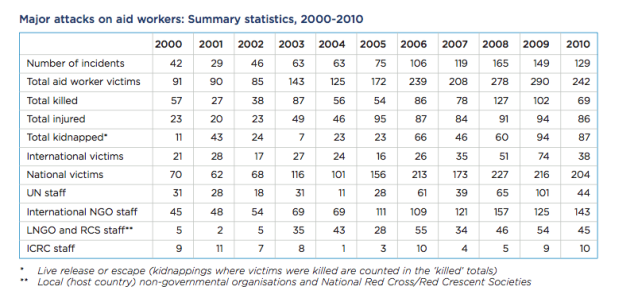
 

But these deaths also show the drive and incentive that these aid groups have when it comes to getting into these troubled spots of the world. That despite these deaths and incidents, they are still getting in there. They are driven by their donors, and if they do not produce results, then they will see a decrease in donations. Competitors in this market will get more donations if they are perceived as being ‘more effective’ in helping people.

We are also talking about millions of dollars worth of donations, and large aid organizations that have tons of folks and facilities to support with those donations. So showing worth and an ability to follow through with aid is vital if they want to continue getting donations.

Plus, groups like Aid Watchers or or Charity Watch help to further gauge the effectiveness of organizations, which help to further guide donations. These donations are also highly dependent on people having the disposable income to actually give to these causes. You can see how finicky this process can be during a downward trend in the economies of countries world wide.

There is also a lot of competition from smaller aid groups or individuals, seeking to fund their projects. In this type of competitive market for your donation, it is easy to understand why they would take the risk of sending folks into harms way to show they are more capable than the other guy.

What is also at issue is the perception of aid groups in these countries. As this applies to our industry, there is the perception that using armed security sends a negative image to the local populations. In the eyes of these clients, the security industry has an image problem.

Which brings up the next statistic that I thought was interesting. What types of security services are these aid groups willing to contract, and who are they contracting with? Well, here is one graph I found from Providing Aid in Insecure Environments: Trends in violence against aid workers and the operational response (2009 Update) HPG Policy Briefs 34, April 2009.
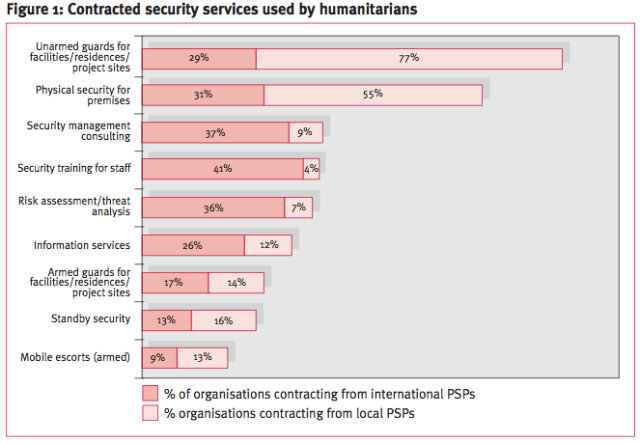
 

With this graph you can see this high dependency on ‘unarmed local guards’.  Which is a nice idea, but realistically in a war zone or troubled spot, unarmed guards is a horrible idea. And yet aid groups continue to depend upon this type of protection.

But for training/consulting/managing/risk assessment, international PMSC’s are still king. Which is not surprising, and I only think this will increase as aid groups continue to look at entering or holding their position in these hot zones.

Finally, I wanted to go back to the UN’s use of private security and it’s significance. The UN is a business of sorts as well. They have to show to the member countries that they are effective. If they are not able to operate in these countries and keep the peace, then they will not be able justify it’s cost and existence. So for operations that are not direct peace keeping missions, but still place staff in war zones or troubled spots, they must do all they can to hold in place and not be chased out because of incidents.

There has also been a change in philosophy at the UN, which was mentioned in this report I posted.

Change of Security Philosophy (at the UN)
During the past decade, the UN has redefined its security strategy, recognizing that the organization could no lon- ger rely on its own reputation to secure it from harm. As one high official put it, the UN can no longer count on the “strong assumption that the UN flag would protect people, protect the mission.” At the same time, the UN decided to keep a presence in dangerous conflict situations where it previously would have withdrawn. This new dual posture led the organization to rely increasingly on forceful protection measures.
The Secretary General spoke of this new approach in his 2010 report on the Safety and Security of UN Personnel. He noted that the UN was going through a “fundamental shift in mindset.” Henceforth, the organization would not be thinking about “when to leave,” but rather about “how to stay.” The UN now proposes to stay in the field even when insecurity reaches a very dangerous threshold. The Secretary General’s report, reflecting the UN’s general posture, focuses on how to “mitigate” risk, rather than considering the broader context, such as why the UN flag no longer protects and whether the UN should be present in a politically controversial role in high-risk conflict zones.
Risk outsourcing is a rarely acknowledged aspect of this security philosophy. Private contractors reduce the profile of UN-related casualties and limit the legal responsibility for damages that security operations may cause. This is similar to the posture of governments, which lessen wartime casualties among their own forces through the use of PMSCs, and thus avoid critical public pressure on the waging of war. UN officials have acknowledged in private that in situations where casualties cannot be avoided, it is better to hire contractors than to put UN staff in danger. As is the case for governments, UN use of PMSCs serves as a means to prevent public criticism of larger security policies.

Hiring the services of a PMSC can be easier as well, and can have better results than depending upon poorly trained local forces and security markets. This industry has gained experience and capability, and especially after ten plus years of war time contracting.

I also believe that the UN’s use of PMSC’s will only help private aid groups to ‘see the light’ when it comes to using security to accomplish their goals. Much like with the whole ‘armed guards on boats’ theme that I keep pounding away at in maritime security posts, I think a similar theme could be promoted for aid groups. Especially if you can associate armed security with a reduction in deaths and kidnappings, and an increase in effectiveness for all aid groups. Or if the perception of the security industry can be changed, and the image of this industry better fits into what these aid groups need.

Also, you could compare this to a ‘dance’ between our two industries. This is like a dance between two new partners with two different ideas of what good dancing is all about. As we work together in these dangerous troubled spots in the world, I believe the partnerships will only improve and get synchronized. But that only happens if our group and their groups strive to understand one another, and apply kaizen to that relationship. So hopefully this post has contributed to that understanding.

It’s a dangerous world out there, and the security industry is ready and willing to meet those challenges. –Matt


Private funding in humanitarian aid: is this trend here to stay?
By Velina Stoianova

13 April 2012.
Major humanitarian crises in the past decade have prompted unprecedented amounts of private donations: the tsunami that caused widespread devastation across the Indian Ocean in December 2004 saw US$3.9 billion raised in private aid; the response to the January 2010 earthquake in Haiti generated at least US$1.2 billion in contributions from the general public; US$450 million was channelled in response to the 2010 floods in Pakistan; and at least US$578 million went to Japan following the March 2011 earthquake and tsunami. While global private support to specific large-scale emergencies is relatively easy to gauge, it remains unclear how much private money overall is out there in any given year.

(more…)

Industry Talk: Turkey’s Private Security Officers Outnumber Armies Of Six Countries In Europe

Filed under: Industry Talk,Turkey — Tags: , , , , , — Matt @ 9:13 AM

Turkey has roughly 217,000 private security guards who are employed in public offices and private companies, a figure that outnumbers the soldiers in the armies of six countries in Europe — Austria, Belgium, Portugal, the Netherlands, Norway and the Czech Republic…Currently there are 1,430 security firms in Turkey, and 737 training centers for private security officers, according to the Security Headquarters’ Private Security Department’s figures.
Candidates receive non-armed certifications after 90 hours of training, but an armed certification requires a further 30 hours…

Every now and then I will come across statistics from other countries about their PMSC industry. These two stories below go into the statistics of Turkey’s market and I thought it would be cool to archive them here.

One statement below brought up an interesting point about loans. Getting a loan in some countries is not as difficult as it is in others, and it looks like Turkey has an industry that is yearning for more capital to expand and grow. From building training facilities to buying all the equipment and weapons necessary to maintain a growing security business, they need it.

“We want the government to support our sector. In a country that is capable of providing loans to the IMF, we want to be able to receive long-term low-interest loans from state banks, as well as support from the Social Security Institution and the Finance Ministry. With this support, our sector will be able to develop even more,” he said.

The other point to bring up is that 9/11 has had a world wide impact on this sector, and not just in the west.  Security services are in high demand all over because of the threat of terrorism or crime, and this industry is in high demand in countries where police forces have been cut. In countries where austerity measures have reduced the number of police, you will see this market of force expand and private security is filling that vacuum.

Of course the final big picture comment is summed up in this statement.

Perut also added that the private security services sector is valued at up to $6 billion for the entire world.

I guess Perut did not have access to the Small Arms Survey done last year that actually put the value of this market much higher. Although he could be referring to just one aspect of PMSC’s, so who knows where he got it from. Here is the quote:

The private security sector has been booming since the mid-1980s and continues to grow steadily (van Dijk, 2008,
p. 217). Recent estimates show that the security market is worth about USD 100–165 billion per year, and that it has
been growing at an annual rate of 7–8 per cent. –2011 Small Arms Survey, Ch. 4

Interesting stuff and if you guys have anything add to this data, let me know. This post will also be filed under Turkey in the categories below if you need it. –Matt


Private security officers in Turkey now their own ‘army’
08/28/2012
The 217,000 private security guards in Turkey outnumber armies of many many nations, according to Bülent Perut, chairman of a sector organization. Rapid urbanization is increasing the number, he says.
The number of Turkish private security officers has reached 217,000, greater than the combined military forces of Austria, Belgium, Portugal, Holland, Norway and the Czech Republic, according to data from a sector organization.
“Even though there aren’t specific figures as to the size of the sector’s economy, we believe that in general it ranges between $3-6 billion,” Private Security Associations Federation President Bülent Perut told Anatolia news agency in an interview published Aug. 28.
In Turkey, 886,000 people hold private security certificates, confirming that one has received appropriate education and training in the field. Some 604,000 of these people also hold a security ID, the state authorization to work as a guard.
Perut told Hürriyet Daily News in a phone interview yesterday that many security guards preferred other jobs when they are available, because of the low wages and
poor level of social rights in the security sector.

(more…)

« Newer PostsOlder Posts »

Powered by WordPress