Feral Jundi

Thursday, May 24, 2012

Call To Action: Instructions For How To Submit A Contractor Casualty For The Defense Of Freedom Medal

This is an important post, and in the past I have discussed the Defense of Freedom Medal before, but never discussed the process of getting a killed or wounded contractor their medal.  This medal is the equivalent to the Purple Heart that the military gives to wounded or killed soldiers. It is my intent with this post to empower companies and contractors with the information necessary on how to submit a casualty for this medal.

I will also put a link to this post on my Contractor Casualty Statistics page so it will be easy to find for those who want to come back to it. The links below, highlighted in blue, are also important to read.  These are the memos that detail how this works, and what is required. Please forward this information on to the companies if you are a friend or family member of a contractor that was killed or wounded, and they have not been recognized for their sacrifice. If the company in question is no longer in existence, then I would recommend contacting the Army Incentive Awards Board directly with the email below.

One other possibility is to get a DBA focused law firm to help out in the process. Here is a link to one law firm that has commented on the particulars of this medal.

Also, there is no record of every recipient from what I can gather. Wikipedia had an entry dedicated to contractors that received this medal, but it only lists four.  I know there are more out there, and I will keep an eye out for a source that tracks this. Good luck out there and let’s make it happen! –Matt


Secretary of Defense Medal for the Defense of Freedom

1. Purpose: The Secretary of Defense Medal for the Defense of Freedom (DFM) is established to acknowledge civilian employees of the Department of Defense (DoD) who are killed or wounded in the line of duty. The medal symbolizes the extraordinary fidelity and essential service of the Department’s civilian workforce who are an integral part of DoD and who contribute to the preservation of national security.

2. Description: The Army’s Institute of Heraldry developed the medal.
      a. Medal: The eagle and shield exemplify the principles of freedom and the defense of these freedoms on which our country is founded. The laurel is emblematic of honor and high achievement.
      b. Ribbon: Red, white, and blue are our National colors. The red stripes commemorate valor and sacrifice. The wide blue stripe represents strength. The white stripes symbolize liberty as represented in our national flag. The number of red stripes represents the four terrorist attacks using hijacked airplanes, and the single blue stripe represents the terrorist attack on the pentagon on September 11, 2001. This day, more than ever, united this country and brought to the forefront our heroic civilians.

3. Certificate: A DA Form 7499 will accompany the medal.

4. Eligibility: The medal shall be awarded to any DoD civilian employee meeting the definition of ’employee’ under title 5 United States Code, Section 2105, and who is eligible for an award under DoD 1400.25-M, Subchapter 451, ‘Awards,’ including employees of non-appropriated fund activities, when killed or wounded by hostile action while serving under any competent authority of the Department under conditions for which a military member would be eligible for receipt of the Purple Heart. Additionally, the Secretary of Defense has discretionary authority to award this medal to non-Defense personnel who are otherwise qualified to be awarded the medal based on their involvement in DoD activities.

5. Criteria: Eligibility criteria for the medal are aligned as closely as possible to those for the Purple Heart for members of the Armed Forces; this medal differs from other medals in that it is not ‘recommended.’ The employee is ‘entitled’ to the medal if the employee is eligible under Section 4 and if the conditions or criteria in this paragraph are present. Hostile action may involve, but is not limited to, the use of conventional or nuclear weapons, chemical or biological agents, explosives, or missiles. The medal shall be awarded to employees who are killed or who sustain injury due to hostile action against the United States of America, or killed or wounded while rescuing or attempting to rescue any other employee or individual subjected to injuries sustained under such conditions. The wound for which the award is made must have required treatment by a medical officer, and records of medical treatment for wounds or injuries received in action must have been made a matter of official record.

6. Limitations on Awarding Medal: The medal is authorized for the incident of death or the first wound suffered under the conditions indicated above. The medal itself may be awarded only once; however, for subsequent events that would require the award of the medal, a device will be awarded to attach to the ribbon of the medal.

7. Posthumous Awards: The medal may be awarded posthumously and, when so awarded, may be presented to a representative of the deceased member’s family.

8. Responsibility and Approval: The approval authority for the DFM is delegated as specified in the Assistant Secretary of the Army (Manpower and Reserve Affairs) memorandum dated March 24, 2009, subject: Delegation of Authority Secretary of Defense Medal for the Defense of Freedom.

9. Nomination Format: Forward a memorandum, along with a DA Form 1256, containing the following:

     a. General personal information: For government employees: provide name, SSN, title, series, grade, organization and location.

     b. Specific information regarding injury/death: Description of the situation causing the injury/death in detail to include the date, time, place, and scene of the incident, and official medical documentation of the employee’s injuries and treatment. The description must be well documented, including the names of witnesses and point of contact (POC) for additional medical information, if needed.

10. Army Contractor Nominations: The Secretary of Defense will consider nominations of contractor employees for this medal. Nominations for contractor employees will consist of the attached form, completed and submitted to the Executive Secretary, Army Incentive Awards Board, along with a report from a medical treatment facility or professional and a signed release to permit discussion of medical information by those who review the award nomination. Submit one copy of the memorandum and supporting justification to:

ag1cpaiabsecretary@conus.army.mil.

Secretary of Defense Medal for the Defense of Freedom
Consideration of Eligibility
for Contractor Personnel

1. Name of individual (first, middle initial, last.) Mr. John Doe
2. Position title. Senior Project Engineer
3. Name of contractor company and name/phone number of POC. ABC, 1234 Main Street, Anytown, Virginia 22222. Mr. Harold Barnes (888) 555-4748.
4. Title of Component office for which contractor worked and name/phone number of Component POC or project manager. Headquarters, Department of the Army, IMCEN. Mr. Sam Jones (877) 555-4410.
5. Date and location of the event, which caused the death or injury. September 11, 2001; Pentagon. Mr. Joe Smith, Acting Director, Information Management Center, certifies that this employee was in a duty status on September 11, 2001.
6. Describe the circumstances of the individual’s death or injury, e.g., the event that caused the death or injury and how it occurred. Mr. Doe was working in the Pentagon, Room 1C543, when terrorists crashed a commercial aircraft into the Pentagon. He was hit on the head by falling debris from the ceiling and walls of his office.
7. For injuries only (1) describe the nature of the injury and the treatment protocol (treated and released, number of days hospitalized); (2) identify where treatment occurred (treated at medical facility or by private doctor and provide name of facility/ physician and phone number if available); (3) describe extent of immediate care, (treated with aspirin, x-rays taken, etc.), and (4) describe extent of continued care if considered necessary (outpatient care, physical therapy, etc.) Mr. Doe sustained blunt force trauma to his head and was admitted to Polaris Hospital Emergency Room where he was taken to the operating room and received fourteen stitches to close the wound in his head. He received medical treatment at the hospital until September 18, 2001. He had physical therapy appointments once a week for several months.
8. CERTIFICATION STATEMENT: MG Thomas Smith, Commanding General, U.S. Army XXXXXX, signed memorandum recommending approval.

Content last reviewed: 5/22/2009-ALV
References
Memo, May 20, 2009 – DFM Reporting Instructions
Wednesday, May 23, 2012

Iraq: Exxon Mobil Leads The Charge North, As The Shine Of The South Wears Off

Filed under: Industry Talk,Iraq — Tags: , , , , , — Matt @ 1:49 PM

Iraq has ambitious plans to develop its huge southern oilfields – potentially the world’s biggest source of new oil over the next few years – and few oil firms dare risk being barred from such a bonanza by angering Baghdad.
But increasingly, some executives say, Kurdistan’s potential is also coming up in boardroom discussions, as sluggish output, red tape and infrastructure bottlenecks in the south take some of the shine off the central government’s oil program.
Oil majors are now waiting on the sidelines, watching the outcome of Exxon’s balancing act between Baghdad and Arbil, the northern capital. France’s Total is the latest company to provoke Baghdad’s ire by acknowledging interest in Kurdistan.
“What companies are trying to do is get to the point where they are investing in the north and the south,” said one industry source working in Iraq……Firms have experienced problems getting visas for contractors and security staff, delays in bringing in armored vehicles and holdups securing operating licenses. Such hassles make Kurdistan’s offerings look more tempting by comparison.

“Every delay we face cuts off a significant part of the internal rate of return,” said one oil company source. “Sometimes I wonder if we picked the wrong region.”

This is some interesting business going on in Iraq. Oil companies are playing a risky game in Iraq, and yet they are the actors that will more than likely drive Iraq to ‘pull it together’. It also looks like Exxon Mobil is leading the charge in this game as well.

I say this, because the divisions in Iraqi parliament/central government, along with corruption, is causing oil companies to seek safer and more stable leadership/relationships to do business with in order to keep extracting and shipping oil. For example, Exxon has signed contracts both in the North and the South, and it looks like they are starting to lean more towards moving north with the hopes that this will send a message to parliament. Of course parliament reacted by saying they cannot bid on any more contracts in the south.

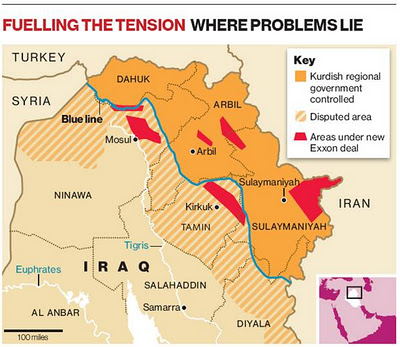
The other area of interest with this, are the contracts signed in the disputed areas. Specifically the area near Mosul, which is the second largest city in Iraq.  I could see Exxon having all sorts of problems in that region unless some serious deals were made, and I was curious as to what the motivation was?  Perhaps the clues are in the state of affairs within the city itself. Check this quote from an interview with Mosul’s governor?

Mosul is an agricultural and oil region. However, it cannot properly and sufficiently use Iraq’s oil revenues. Mosul is also uncomfortable with the recent agreements between foreign oil companies and Arbil to extract oil from Mosul’s soil. For instance, Exxon-Mobil signed a contract with the KRG despite the fact that the site it will explore for oil is in Mosul. Nujaifi is holding talks with Exxon-Mobil and the KRG to resolve this problem. In addition, under the Iraqi constitution, Mosul should get 11 percent of Iraq’s oil revenue. However, it receives only 2 percent. According to Nujaifi, if the oil bill is not adopted and the oil revenues are not distributed evenly by the provinces, a political crisis will erupt. The poverty rate in Mosul is 23 percent, whereas it is 3 percent in the KRG. Nujaifi notes that the rising tension along the borders of Mosul is creating tension for them as well. As the KRG becomes more popular, it is impossible to explain the recent state of backwardness in Mosul.

I highlighted the key parts in this quote, and I think that is most significant. With poverty as high as it is, and a neighbor like KRG enjoying the good life, who do you think Mosul will want to do business with?  Especially if Iraq is only giving Mosul 2 % of Iraq’s oil revenue.  They are definitely getting the short end stick in this deal, and either the South pays up, or Mosul will probably join the Exxon party.

Also, the news of Kurdistan signing a deal with Turkey for a new pipeline that would completely shut out Baghdad is definitely some news to talk about here. That would mean they would have a way to capitalize on oil extraction without paying Baghdad. They could possibly bring cities like Mosul into the mix with this pipeline, and especially if Mosul can capture a better deal.

On Sunday, Iraqi Kurdistan unveiled an agreement to sell oil through Turkey into the international markets, thereby leaving Baghdad completely out of the loop. The Kurdish oil minister Ashti Hawrami said Iraqi Kurdistan will construct a huge 1 million barrel per day pipeline over the next 12 months through which oil and gas will be carried through Turkey.
“We envisage the building of a new pipeline taking Kurdistan’s oil, particularly the heavier component part to Cihan,” Hawrami said at a conference with Taner Yildez, the Turkish energy minister.
Baghdad believes such an arrangement contravenes Iraqi laws, while Kurds assert they can sign any contract regarding their natural resources according to the terms of the constitution.

Oil fields like this also provide jobs to the locals and infuse money into the local economy. Security will be crucial–which means local security companies will be a huge player in this. (although if you look at how MEND operates in Nigeria, you could see the same thing happening in Mosul with insurgents) The question here is would Baghdad send the troops to protect these oil fields? lol Probably not, unless they are included in the oil deal. That is where this get’s interesting, and I am sure criminal groups and insurgents are looking at how they could use this to their advantage.

The other thing to look at is if Exxon and other oil companies have another pipeline they can use, that is being managed by a government that knows what it is doing and is stable, then I could totally see how this would be a better bet for those companies.  This is also another signal to Baghdad that ‘hey guys, if you come together and square away your house, then you too can enjoy the same prosperity as the Kurds’.

Or, the Iraqi government can try to exert influence or pull some military moves up north, but good luck there. lol The Peshmerga and terrain will dictate otherwise.

So we will see how it goes. My guess is that Exxon and others will continue to play the North against South in order to keep extracting. They will keep these two players of the country competing for these companies and their capability. That back and forth interaction, might be the kind of business that will force the country to square itself away in order to finally realize their oil extraction goals. The alternative is to be driven apart.

There is a lot of money in the ground, and if Iraq wants it, it will have to do business with the companies that know how to get it out and into the market. That takes compromise and leadership, and a divided parliament and corrupt government in the south will only force companies to take the path of least resistance. –Matt


Analysis: In Iraq, oil majors play north versus south
By Patrick Markey and Peg Mackey
Thu Apr 5, 2012
In the weeks before Iraqi Kurdistan revealed that Exxon Mobil had signed up to explore for oil there, executives at rival Shell faced a dilemma over whether or not to join the U.S. oil major in its foray north and risk angering Baghdad.
The fields in the autonomous region offered rich potential, an easier working environment, better security and attractive contracts. That seemed a winning combination for smaller oil companies already working there, such as Norway’s DNO, even though they struggled to collect profits.
But at the 11th hour, industry sources say, Royal Dutch Shell backed out and decided to focus on a $17 billion gas deal in the south rather than sign exploration contracts with the Kurdish Regional Government, which the central government could dismiss as illegal and could prompt reprisals.
Shell’s caution, Exxon’s silence on its deals and this week’s renewed dispute between Baghdad and Kurdistan over export payments reveal how delicate is the balance companies must manage between a central government and a Kurdish authority locked in a struggle over who controls Iraq’s vast oil wealth.
The dispute over oil is at the heart of a wider disagreement between Iraq’s central government in Baghdad and the Kurdish region, which are also increasingly at odds over regional autonomy, land and political influence.
Iraq has ambitious plans to develop its huge southern oilfields – potentially the world’s biggest source of new oil over the next few years – and few oil firms dare risk being barred from such a bonanza by angering Baghdad.

(more…)

Tuesday, May 22, 2012

Cool Stuff: The Historic Launch Of Falcon 9–Private Industry Enters The Space Race!

Filed under: Cool Stuff,Space — Tags: , , , , — Matt @ 11:27 AM

Today, though, “Falcon flew perfectly!!,” SpaceX CEO Elon Musk wrote on Twitter moments after the launch. “Feels like a giant weight just came off my back :).”
At a press conference held after the launch, Musk said that “every bit of adrenalin in my body released at that point,” and that the elation he felt was like “winning the Super Bowl.”
“I would really count today as a success no matter what happens for the rest of the mission.”-National Geographic

This is awesome news and congrats to Elon Musk and the team at SpaceX. The company had to delay the launch by a couple of days due to some issues, but the second time was a charm. Now it will link up with the International Space Station and hopefully that will go without a hitch.

My latest thoughts on the private space industry and security, is that government is now relinquishing it’s monopoly on space. And space, strategically, is the ultimate high ground. My concerns in this case, would be the protection of space property like satellites from those wishing to destroy or hack that stuff. Or state and non-state actors exploiting cyber weaknesses of these systems that control this space hardware. Or worse yet, actually causing crashes or glitches in space launches, as a way to take out the competition in the space market.

Can you imagine a terrorist group, taking control of a rocket like Falcon 9 and crashing that into the ISS?  Or plowing it into some key satellite that is vital to national security? Or causing a rocket to fail on launch, and crashing that thing purposely into a population center?

Also, if you look at how much money each launch costs, then you can see how this industry might fire up some serious corporate competition/sabotage.  Especially between private companies and countries.  If one country is dependent on a private company, and then another country with a state sponsored commercial space program attacks the systems of that private company, all so folks have no where else to go for space launches but that state sponsored commercial program, then you can see how this can play out.  This is not to say we will see Russia or China attack SpaceX, but it is definitely something to keep in mind. Especially with cyber attacks.

With that said, I certainly hope SpaceX and others are serious about security, both physical and cyber, because it doesn’t take much to ruin a business plan and mission.-Matt


Monday, May 21, 2012

Letter Of Marque: Title 33, Chapter 7 Of The US Code–Regulations For The Suppression Of Piracy

Yep, this exists, along with Article 1, Section 8, Paragraph 11 of the US Constitution. I thought this was pretty cool, because we definitely have laws on the books for getting private industry involved with the suppression of piracy.

I also liked these laws, because they defined captures. That the US can authorize private industry for capture of pirates. This is important to note, because at this time, there is only a Defense Industry in place for the suppression of piracy. Meaning, companies are only providing guards to defend vessels with the possible use of force. No one has the authority to arrest or capture pirates.  So basically we have a system in place that only allows for the ‘killing’ of pirates in the course of the defense, but god help us if private industry actually arrested folks?

By arresting pirates, we can find out information about pirate operations and we can keep these thugs out of the business of piracy by letting them rot in a prison. It would also give companies some authority for when pirates surrender. An effective Offense Industry could profit from the capture (or killing if pirates fail to surrender and become violent), and thus removing those threats from the seas. I should also note that the US congress used to pay privateers for the capture of British sailors and seamen during the War of 1812 using a bounty system. In other words, companies must be compensated if you want them to actually arrest and detain pirates. Without incentive and and well defined legal authority, ship owners and security guards on these boats will want nothing to do with capturing anyone.

Or we can continue to promote this current Defense Industry where companies either kill or wound pirates in fire fights and then allow pirates to escape–so they can go attack some other vessel. Hell, why would companies be compelled to kill pirates in the first place with such a system?  Killing pirates or arresting them, would eliminate the sweet deal ‘Defense Industry’ we have that benefits from having active pirates.  Something to think about when talking about when dealing with today’s piracy issues. –Matt


Title 33, Chapter 7 Of The US Code– Regulations For The Suppression Of Piracy

Honduras: The US Drug War Ramps Up, And Honduras Is Still Looking For A Charter City Sponsor

Honduras is the latest focal point in America’s drug war. As Mexico puts the squeeze on narcotics barons using its territory as a transit hub, more than 90 percent of the cocaine from Colombia and Venezuela bound for the United States passes through Central America. More than a third of those narcotics make their way through Honduras, a country with vast ungoverned areas — and one of the highest per capita homicide rates in the world.

The drug war is definitely heating up in Honduras. The strategy seems pretty simple, and that as you can see with the quote up top, Honduras is a main smuggling route on land and the US plans on helping to stop that. Also, the amount of land to cover is smaller and you could consider Honduras a choke point that US and Honduran forces plan on blocking. Or at least trying to.

Below I have posted two stories in regards to the efforts in Honduras. The first is about DEA’s FAST teams working with the Hondurans on operations, and the second is a story about the US applying lessons learned in Iraq towards operating bases in Honduras.

What is cool is the whole ‘outpost’ concept that is being applied to the effort. To get folks closer to the smuggling routes, as opposed to making long trips back and forth.  You can also stay closer to the cities next to smuggling routes, and do more patrols that way as well. In comparison to Afghanistan–this is moving the guys off the FOBs and out into outposts so they are closer to their AO’s.

In past drug operations, helicopters ferrying Honduran and American antinarcotics squads took off from the capital, Tegucigalpa, whenever an intelligence task force identified radar tracks of a smuggler’s aircraft. The three-hour flights required to reach cartel rendezvous points did not leave much idle time to spot airplanes as they unloaded tons of cocaine to dugout canoes, which then paddled downriver beneath the jungle canopy to meet fast boats and submersibles at the coast for the trip north.
In creating the new outposts — patterned on the forward bases in Iraq and Afghanistan that gave troops a small, secure home on insurgent turf — spartan but comfortable barracks were built. Giant tanks hold 4,500 gallons of helicopter fuel. Solar panels augment generators. Each site supports two-week rotations for 55 people, all no more than 30 to 45 minutes’ flying time from most smuggling handoff points.

No word if any contractors are helping to set up these outposts or do work in the outposts, and I will be keeping my eye open for any jobs related to Honduras.

Another note about Honduras, which is equally interesting to me, is the concept of charter cities there. Paul Romer has been working with the government to establish a charter city called the RED.  The reason for this, is all based on the hope for elevating the prosperity of the country–something like what Hong Kong did for China.

They are currently looking for a country that would sponsor this charter city, and so far no one has taken a bite. But if someone were to sponsor it, then that city would provide work for the region. The hope would be to bring immigrants south, and they would work in the RED to make a life, instead of them running to places like the US and Canada illegally.

That kind of dynamic would not bode well for the drug cartels either, just because they depend upon immigrants delivering their drugs up into the US. Or at least taking advantage of the massive flow of people crossing the border every year–because it overwhelms law enforcement. A charter city like the RED would also require excellent law enforcement/security in order to keep drugs and crime out.

Now one idea for Honduras is to let the US know that if they want to operate in Honduras for the drug war, that they should help out with the Charter City concept. Either the US could become that sponsor, or the US could help apply some leverage to get a country to jump on board? I would think that if both Canada and the US is wanting to clamp down on illegal immigration, that providing an alternative like this charter city, would be an option to help alleviate that problem. Especially if Honduras is willing to do this, and businesses are drawn to the RED because it is such a good deal.

Interesting stuff, and lots of things going on in Honduras right now. –Matt


D.E.A.’s Agents Join Counternarcotics Efforts in Honduras
By Charlie Savage and Thom Shanker
May 16, 2012
A commando-style squad of Drug Enforcement Administration agents accompanied the Honduran counternarcotics police during two firefights with cocaine smugglers in the jungles of the Central American country this month, according to officials in both countries who were briefed on the matter. One of the fights, which occurred last week, left as many as four people dead and has set off a backlash against the American presence there.
It remains unclear whether the D.E.A. agents took part in the shooting during either episode, the first in the early hours of May 6 and the second early last Friday. In an initial account of the second episode, the Honduran government told local reporters that two drug traffickers had been killed and a large shipment of cocaine seized; he did not mention any American involvement. Several American officials said the D.E.A. agents did not return fire during the encounter.

(more…)

« Newer PostsOlder Posts »

Powered by WordPress