Feral Jundi

Sunday, May 13, 2012

Publications: Contractor Support Of USCENTCOM AOR, 2nd Quarter FY 2012

Check it out. Contractor use has only increased in Afghanistan, and in Iraq we have seen a draw down from the last report. I thought what was equally interesting was the increase of contractor use in ‘other’ locations. 14,618 ‘other location’ contractors last quarter versus 24,765 for this quarter. It would be cool if they actually broke down these other locations? All said, the total amount of contractors are just a little more than last quarter, but not by much.(151,995 last quarter versus 152,959 this quarter)

What is also curious is the decrease in the use of local nationals from the last report, and the increase in the use of American and partner contractors in Afghanistan. I am wondering if that is a direct result of all of these incidents of green on blue attacks, or because of poor quality services performed by local Afghans?  Who knows, and it is hard to say what is happening with the numbers there.

As to security contractors, we have seen a huge increase in use for Afghanistan. Last quarter we were at 20,375 folks, and now we are at 26,612. So we must be doing something right.

Although Iraq has seen a pretty sharp decline in security contractor use. Last quarter we were at 8,995 and this quarter we are at 3,577. But that is still a significant security contractor presence presence in post war Iraq.  This might stabilize as well, after all of the ‘right size’ initiatives that DoS was working towards. But who knows and it might go lower.

The other cool deal in this publication was the mention of the new ANSI standard for security companies. Under Sec 833 of the FY2011 NDAA, the US government will use third party accreditation services to see what companies meet the ANSI standard.  So it will help the government in picking companies for contracts that at least meet ANSI. And if companies want to play, they will have to live up the ANSI standard. Or that is the theory, and we will see how all of this translates out in the field.

This is still a great deal, and in this report they mentioned the concept of ‘best value’ and how this ANSI standard can help them find the best value companies out there. But hopefully this will not be the only metric.  Reputation, and how they treat their contractors should be other areas of concern, as examples of how they should pick.

It was funny though that they threw in that other term ‘technically acceptable’.  It sounds like some in government are still hanging on to LPTA as the way to go for contracts, and that is just dumb. Lowest Priced, Technically Acceptable contracting is how you get these ‘race to the bottom’ gigs like TWISS, and it is just a dumb tool for security contracts. LPTA might work for finding a contractor to mow your lawn and no one really cares if they screw up.  No lives will be lost and the lawn will be cut regardless.

But for security, you want the best value for the dollar–just like you would choose a doctor or a lawyer.  Because with these types of contracts, lives ‘are’ on the line…-Matt


Contractor Support Of USCENTCOM AOR, 2nd Quarter FY 2012

Friday, May 11, 2012

Afghanistan: EU To Spend €50mn On Private Security In Afghanistan For The Next 4 Years

Filed under: Afghanistan,Industry Talk — Tags: , , , , , — Matt @ 2:22 PM

Now this is some interesting news with the EU and their EEAS.  I posted earlier this year about another contract they were flying for security, and this one is targeted towards Afghanistan.

Hopefully they can navigate this whole APPF and Decree 62 deal, because they could easily kiss their beloved Page Group security partner (or whomever wins the contract) goodbye if Karzai has his way. Maybe the EU has made some deals to allow them to keep their own security?

I also thought it was interesting that they have narrowed down what companies qualify. Here is the quote:

It is aiming to sign up a big company with prior experience in Afghanistan – the winning bidder must have an annual turnover of at least €20 million and 400 staff. Five companies are eligible to compete – the Hungarian-based Argus, Canada’s Gardaworld, British firms G4S and Page Group, and French company Geos – after getting on an EEAS private security shortlist last year.

My one heartache about this is why aren’t American companies qualified to bid? (like US companies with offices in Europe) I know the US is not a member of the EU, but that doesn’t mean it’s companies are not capable. Because I can think of several who fit the the bill of having ‘annual turnover of at least €20 million and 400 staff‘. The EU is really missing out in my opinion by not contracting with US companies, and it’s not like the US hasn’t contracted with European PMSC’s for DoD or DoS related contracts in the war.

Aegis comes to mind as one current example, and they are actually being contracted to replace AGNA on the KESF contract! lol Either way, we will see how the bidding goes and how they navigate the complexities of Afghanistan security contracting. –Matt


EU to spend €50mn on private security in Afghanistan
05/11/2012
By Andrew Rettman
The EU’s external action service (EEAS) plans to spend up to €50 million on private security guards for its Afghanistan mission over the next four years.
The EEAS unveiled the tender on Thursday (10 May), saying the money would be spent on “protection of staff, their families in the country, visitors from headquarters or other EU institutions, the premises and the goods of the EU delegation in Afghanistan.”
The contract – valued at between €30 million and €50 million plus VAT – is to cover at least 100 security guards, as well as “mobile patrol teams, equipment [and] armoured cars.”
It is aiming to sign up a big company with prior experience in Afghanistan – the winning bidder must have an annual turnover of at least €20 million and 400 staff.

(more…)

Publications: Journal Of International Peace Operations, May-June 2012

These are great publications and in order to read them, just put your cursor over the ‘expand’ button in the center and it will expand the whole thing into a readable format. Definitely play around with it, and check it out. –Matt


Thursday, May 10, 2012

Maritime Security: Ships Slow Down To Save Fuel In Pirate Waters

The shipping companies have switched to relying on guards, rather than speed, for protection because a single day at lower speeds can save $50,000 in fuel at current prices – enough to pay the guards for the whole journey…..Peter Cook, director of the Security Association for the Maritime Industry, said estimates earlier this year had put the total fuel cost to shipping companies of running faster through the high-risk area in 2011 at $2.7bn.

There are a couple of points with this trend that needs to be mentioned. Armed security is giving these ship owners a way to save money. Instead of going as fast as they can and burning up expensive fuel, there are some opting to slow down and depend upon security to protect their vessels.

Which is great, but these shipping companies should be on notice that when you slow down the vessel, pirates will factor that in for their attacks. I mentioned before that pirates will eventually turn to attacking vessels that are armed, just because so many vessels are switching to armed security and the easy prey will soon be gone. The key factor here is that slow vessels will make it easier to board, or swarm. Which leads to my next point, and that is a discussion about the appropriate force size, weapons, and rules for the use of force to meet this demand.

I say this, because there are those in the industry that have different ideas about armed security or that everyone follows the same rule book for armed security. Which is fine, but pirates can pick up on these rules and various differences and exploit them.  For example, the policy for warning shots is something pirates can game.

They can find out at what distances warning shots occur, and then they can assemble attack formations that will account for that. I talked about Uboat tactics awhile back, and as long as pirates do not show weapons and are able to find that distance they can hang out at, they could potentially set up for a swarm attack. One example is that in the Bab el Mandeb Strait, up to 10 skiffs attempted to swarm a vessel in April.

A maritime security alert has been issued for the Bab el Mandeb Strait after 10 skiffs approached a Panama-flagged oil tanker on Sunday, April 29. Four skiffs initially approached, followed by a group of two, then four further skiffs. The suspected pirates abandoned the attack after an onboard security team fired flares and displayed weapons, according to GAC Protective Solutions. Such “swarming” has been previously reported in and around the Bab el Mandeb Strait.

Now imagine if this pirate force actually applied some concentrated firepower and coordination to this type of attack?  Will today’s standard guard force be able to counter that?  If we see more killer PAG’s like what Trident Group was up against, along with slower vessels and less unarmed vessels making transits, then yes, I think we will see an armed vessel taken down by force. I hope it doesn’t happen, and all we can do is to ensure all security forces have the tools and rules necessary to counter such things.

I have talked about weapons in the past, and having a couple of PKM’s or rifles chambered in 7.62 or higher would be good. Optics on weapons would be awesome so that security can observe and shoot if need be, or precisely put rounds where they need them. I am also a fan of the larger caliber weapons, like the M-2 HB .50 cal. A heavy caliber, belt fed machine gun can maintain good stand off distances, or can bring on a decent volume of fire as vessels make the charge. Especially for swarms.

M-240’s and PKM’s would be good for this as well. Having the ability to shoot an engine at distance would be excellent, and a large caliber sniper rifle would work for that. Something like a Barrett M-82 is what I am thinking of. And with the small size of guard forces on vessels, giving them weapons that would increase their lethality and range would be a force multiplier. In other words, an armed guard force must have weapons that out match the enemy’s weapons–in range, accuracy and lethality. That’s if you want your guard to force to have advantage? Your force already has the high ground, but don’t skimp on the weapons, and especially if you are only contracting a small force. (of course this is just my opinion, and everyone has their own ideas of what works out there)

Also, having a smart defensive plan and plenty of obstacles set up on the ship is key. It was mentioned on prior posts that concertina wire is selling like hotcakes out there.  Security should also apply Kaizen to their plan, and always look for advantage or ways to deal with all and any types of scenarios. Also, make sure you have sound communications, and other key support equipment to do the job. Especially night equipment, like NVG’s or thermals, or binoculars and spotting scopes for the day time.

Finally, and this is pointed towards ship owners. If slowing down to save money is something you want to do, then you have to know that you are giving pirates an advantage. As they take this advantage and attack vessels, you must also realize that armed security will be more important than ever before. They will engage in combat with pirates, and shipping companies should not be surprised or shocked if this happens. If anything, these companies should be highly supportive and thankful that men and women like this are willing to put themselves at risk to do this job. That is what you pay them to do, and if all other preventative measures fail then combat will occur.

By taking away speed, you are taking away a pretty effective measure and only increasing the odds of confrontation. So definitely make sure you have properly armed professional security if slowing down to save money is your goal.-Matt
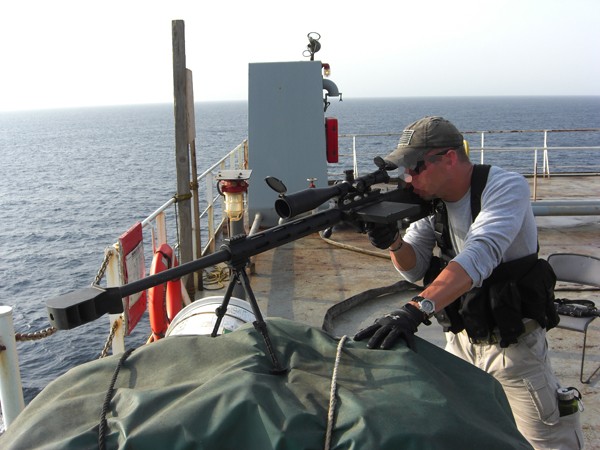
 

Image: Nexus Consulting


Ships Slow Down to Save Fuel in Pirate Waters
Tuesday, 8 May 2012
By Robert Wright
Violent confrontations between Somali pirates and merchant ships’ armed guards could become more common as some shipping companies have reduced ship speeds through the highest-risk area to save on fuel, maritime experts have warned.
The shipping companies have switched to relying on guards, rather than speed, for protection because a single day at lower speeds can save $50,000 in fuel at current prices – enough to pay the guards for the whole journey.
The speed reductions contravene published advice that ships should use their maximum speed in the highest-risk areas. Pirates have never managed to board a vessel traveling at 18 knots or more and container ships and other faster vessels have traditionally crossed the high risk area up to 1,500 miles off Somalia’s coast at up to 24 knots.
Ron Widdows, chief executive of Germany’s Rickmers Holding, a major shipowner, said several maritime security companies had suggested his company employ their guards and slow ships down. Rickmers’ current security company opposed reducing speeds because pirates were more likely to attack slow ships, Mr Widdows added.

(more…)
Wednesday, May 9, 2012

Quotes: Trident’s Tom Rothrauff On The ‘Killer’ Pirates His Men Stopped–Twice In 72 Hours!

Filed under: Maritime Security,Quotes — Tags: , , — Matt @ 12:21 PM

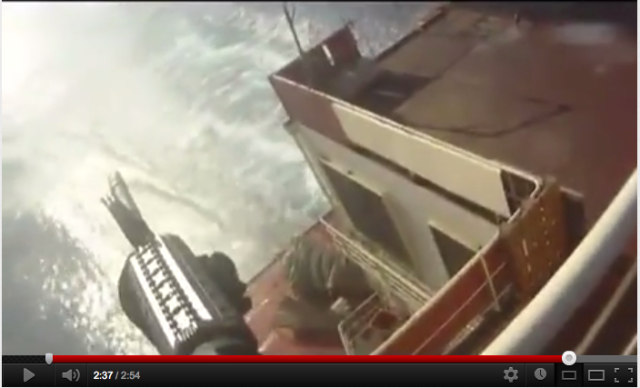
This is significant because this quote below gives the back story on the video that was posted awhile back of the actions of an armed security detail on a vessel. Of course many folks speculated about what happened, and came to all sorts of ridiculous conclusions. Some called for investigations and questioned the tactics used by this security company, while others showed support and cheered them on. My position on the matter was to hold judgement, because I wasn’t there.

Now that that a better picture of what happened has come out, I am floored. These guys were up against a determined foe armed with RPG’s and AK-47’s, that tried to attack them twice in 72 hours! So under the circumstance, the video and the actions of these men makes total sense.

It is also a warning to other companies, that eventually pirates will test the waters on how to take down vessels that are armed. That the low hanging fruit called ‘vessels without armed guards’ is going away, and pirates are re-tooling and gaming this new reality. And like the quote below stated, this armed security team fought off this killer PAG not once, but twice in 72 hours….’twice’. Bravo to Trident Group for stopping them. –Matt


Armed guards of Trident Group, stop the killer pirates!

In an emailed statement to Lloyd’s List, Trident president Tom Rothrauff said:

“This action came 72 hours following another attack by this exact same pirate action group against this very same vessel. Further, the same PAG had attacked a tanker in the week prior, so this was a killer PAG. Our team acted with poise, and used every rule for the use of force as prescribed by the US Coast Guard in PSA 3-09.

“The skiff was identified as carrying RPG’s and AK 47’s. The team was compelled to wait before they initiated warning shots until the master gave permission to the team to release repelling force. When the warning shots were fired, it just so happened that the skiff opened up on our team at the exact same time.”

« Newer PostsOlder Posts »

Powered by WordPress