Feral Jundi

Wednesday, April 11, 2012

Syria: In Syria, Send In The Mercenaries, By J. Michael Barrett

This perked me up, just because Syria is the new ‘Libya’ when it comes to any kind of western involvement. But involvement is a lot more precarious in this case, and the folks we would be supporting are questionable. And like the piece below mentioned, we tend to arm and train folks that end up turning against us down the line. So the author below presents the alternative, or using mercenaries, as opposed to arming rebels and forever losing control of the weapons we throw at the problem.

What makes this article so interesting to me, is the author. This guy is not some yahoo. He is the CEO of Diligent Innovations and a former ‘Director of Strategy for the White House Homeland Security Council(Feb.-Oct., 2007) , Intelligence Officer for the Office of the Secretary of Defense, and Senior Analyst for the Chairman of the Joint Chiefs of Staff‘ . You might also recognize him from all of the interviews he has done on the various cable news shows.

Not only that, but he is a Wikistrat expert. Wikistrat has quite the pool of experts and to be one of them, you have to have some game in the beltway. Some of his fellow Wikistrat experts include such names as John Robb of Global Guerrillas, Dr. Ann Marie-Slaughter (R2P), Dr. Thomas PM Barnett (Sys Admin), Professor Allison Stanger, and the list goes on….

So back to this deal in Syria. I would be curious if this concept of using mercenaries instead of arming folks has been mulled around at Wikistrat?  Or if Michael has actually given this some serious thought on how this would work?

Or it could be just a piece that raises an idea for those to either support or strike down based on it’s merits. From a technical point of view, I guess a company could be called upon to perform offensive operations.  MPRI definitely helped in the planning and strategy for Croatia during the Balkans crisis. Executive Outcomes was contracted to fight and win wars both in Sierra Leone and Angola. So technically, a company or companies could provide this service. (the author mentioned The Flying Tigers, and he gets kudos for that!)

In Libya, contractors and mercenaries were used on both sides of the conflict, and they are still there. Hell, contractors were calling in targets for the air campaign and individuals were joining the rebel army. Here is a quote from Simon Mann about Libya.

In the Libyan revolution further lines of demarcation – between government forces and PMC forces – became more blurred. From Tripoli it has been reported that UK ex-Special Forces were used, in some places, instead of regular troops. This came about because of the uncontrolled and the ‘everywhere’ presence of war correspondents, accredited and otherwise. Their prying eyes made the covert deployment of SAS and SBS troops difficult.

Even so, the need for trained laser designator operators to bring in air dropped laser bombs, with as much precision as possible, had to be met. Therefore designator kits were supplied to ex- UK SF contractors. These were men whose salaries were being paid for by the oil companies, for oil field site security. They were already in country, already on contract.

Even for Syria, there have been reports of contractor involvement. During the whole STRATFOR data breach deal, emails detailed that SCG International has been involved with helping the opposition in Syria.

So I guess my point is that the waters are being tested for how best to approach Syria. Do we do nothing and allow a brutal regime to murder their own people? Do we arm and train the opposition, with the possibility that some day those weapons and training might be used against the west?  Or do we send in mercenaries because sending troops is something a war weary west is not that interested in or willing to pay for?  Or maybe we do nothing at all, and watch a massacre take place. Not a lot of easy answers.

One thing is for sure. If Syria falls, then jihadists would be able to capitalize on the situation.  If weapons and munitions are captured or liberated during the course of the revolution (much like what happened in Libya), they will find their way into other wars and terrorist operations.

Jihadists will also find their way into the politics of Syria, much like how the Muslim Brotherhood gained political market share in Egypt. So basically we would see extremists replace a dictator. The question here is can the west win over a rebel group and gain influence by assisting them, or will we be demonized despite our actions and contributions, just because of the islamic extremist influence within that revolution?  Can we compete in that kind of environment and should we be involved?

Might I also add that Saudi Arabia and GCC nations are getting involved and adding money to the pot. Upper level leadership in the US are getting involved and pushing to do something in Syria. Of course Russia is sending folks to support Assad, and China is showing their support for Assad as well. So things are happening and who knows how this will turn out.

It is also important to bring up this responsibility to protect deal as well. If the west feels it has an obligation to intervene–to stop a massacre, then something more than talk needs to happen. It takes action and the will to make it happen, and it also requires a realistic look at what we want to accomplish strategically in the region. Sending troops is a bridge too far for a war weary, cash strapped, and politically paranoid/sensitive west, and maybe contractors paid by GCC donors is the ticket? I will keep a look out for further industry involvement in Syria and this one will be interesting to follow. –Matt


In Syria, send in the mercenaries
J. Michael Barrett
April 10, 2012
The world community, including the United States, is at a crossroads about the right steps to forcefully prevent the further slaughter of civilians in Syria. There are many good reasons to intervene — to stop the death, detention and probable torture of any number of innocents; to support the democratic right of people to consent to rule by a freely elected government; and to avoid a repeat of the U.S. inaction that allowed Iran’s dictatorship to prevail in 2009.
There are just as many reasons not to intervene — the sovereignty of nations; the moral hazard of providing U.S. troops where our national interest does not dictate; and the uncertainty about those we would be helping take power. All the while, do-nothing diplomatic talks and easily ignored cease-fires continue to fail because the talking doesn’t change the facts on the ground.
But is there another way — something more effective than merely clamoring for calm, but less direct than intervening militarily or arming and training the rebels?
In fact, there is. Throughout the ages, the answer to such situations has been to raise an army for hire and send in the mercenaries. This was done throughout the great power struggles of the first and second millennia across the globe, and in more recent decades across Africa. Libya’s Gadhafi tried to use mercenaries to defend his regime just last year. We also placed many guns-for-hire in Iraq and Afghanistan, provided by the likes of Triple Canopy and the company formerly known as Blackwater.
Perhaps the most relevant example here is the World War II American Volunteers Group, better known as the “Flying Tigers.” Prior to Pearl Harbor, when America was not yet party to World War II, these combat pilots’ actions were known but not officially endorsed by the White House under President Franklin Roosevelt. They were pure mercenaries, pilots who resigned their U.S. military commissions to serve in a foreign air force for high pay — some received $600 a month in 1941 dollars and with the promise of $500 more for every Japanese plane they shot down.
The pay-for-service model suited the needs of the day. It allowed skilled fighters to side-step the moral and legal hazard of sending uniformed U.S. troops, whose duty is to uphold the Constitution by fighting our enemies, not to intervene in missions that lack a direct national security rationale.
One potential roadblock of note is the Neutrality Act of 1794, a centuries-old congressional effort to ensure the then-fledgling U.S. was not dragged into wars by citizens acting as mercenaries in conflicts where the United States was not engaged. However, this law, rarely enforced, reflects outdated thinking about the modality and nature of declarations of war. It also treats violations as a misdemeanor. If the imperative to save lives is so strong, Congress or President Obama could surely find a path around it, including a waiver or other injunction. Beyond that, the government’s only role would be to work behind the scenes to have Saudi Arabia and other interested nations pick up the tab, much as they did during the process of countering the Soviet invasion in Afghanistan in the 1980s.
Given the perceived imperative to intervene in Syria, but the countervailing duty to respect state sovereignty and the lack of United Nations sanction (due to perpetual vetoes by China and Russia), mercenaries might well be the best prescription, Neutrality Act or no. They would allow the U.S. to avoid arming the locals directly, about whose character and intent we know little.
This would not resolve the underlying question of who comes to power after the regime falls, but it would allow for a humane defense of the Syrian population without committing America officially or putting American soldiers, sailors, airmen and Marines at risk.
J. Michael Barrett, the CEO of Diligent Innovations, is a former Director of Strategy for the White House Homeland Security Council and a former Naval Intelligence Officer.
Link to post here.
—————————————————————-
J.Michael Barrett
Mike is a national security expert and noted author with an extensive background in defense policy, military intelligence, and support to US counter-terrorism operations. His extensive national security credentials include serving as the Director of Strategy for the White House Homeland Security Council, Intelligence Officer for the Office of the Secretary of Defense, and Senior Analyst for the Chairman of the Joint Chiefs of Staff (Feb.-Oct., 2007).
Mike has been interviewed on television and radio by ABC, The Canadian Broadcast Company, Fox News, FRONTLINE, MSNBC, NBC, NPR, The New York Metro News, New York Sun, and The Washington Post. He also is the co-author of two books on security and counter-terrorism (including a New York Times Best Seller) and has authored more than a dozen journal and opinion-editorial articles.

(more…)

Law Enforcement: Greece Offers ‘Cop-For-Hire’ Service To Raise Cash

Filed under: Greece,Law Enforcement — Tags: , , , — Matt @ 7:59 AM

Next will be the military. lol Greece has definitely had some serious problems financially and when it’s police force has to do extreme measures like this, it makes you wonder.

Now here is the thing. The whole rule of ‘you get what you pay for’ or ‘you pay peanuts, you get monkeys’, definitely applies to this situation.  When you reduce salaries and benefits, what incentive does the police have to do well?  To actually police a community, a community that has decided to lower their salary. It reminds me of places like New Orleans which had some of the lowest paid cops in the country. And when hurricane Katrina hit, a lot of those NOLA cops just left.

Also, if you look at the photo below, those are Greek law enforcement involved with riot control. These guys have been very busy trying to maintain law and order in a very angry country. The last thing that country should do is make their police angry by messing with their pay.

Now on to the ‘cops for hire’ scheme. You see this happen in one form or the other all over the world. It’s just these guys are being very open and business-like about it. Of course Greece has a long history of hoplites for hire and I am sure Xenophon would approve of this modern scheme. lol But I do share the concern that once you get into this game, will they be able to effectively protect and serve the community, or will they become more concerned with protecting paying clients?

On the other hand, that community should take note. If your police are renting their services out, maybe that might be a hint that you are not paying them enough? –Matt


Greece offers “cop-for-hire” service to raise cash
Tue, Apr 10 2012
In a bid to raise cash, Greek police are offering a 30 euro ($39) per hour “cop-for-hire” scheme for private companies or citizens seeking protection at special events.
Police said the service was provided only under special circumstances, such as cases of high-security risk, and that revenues would be used to fund police equipment and boost the state budget. It used to be available for free before a debt crisis hit the country.
“We will provide these services only in exceptional cases and only if we have the available assets and staff. We’ll first make sure that no citizen is deprived of police protection,” police spokesman Thanassis Kokkalakis said on Tuesday.
Hiring a police officer for an hour costs 30 euros, according to the law, which has entered into force. A police vehicle escort, for example for the transfer of art works or other sensitive material, will cost an additional 40 euros per hour and a motorcycle escort 20 euros.

(more…)

Tuesday, April 10, 2012

Libya: Ukraine Seeks Libya ‘Mercenaries’ Release

Filed under: Libya,Ukraine — Tags: , , , — Matt @ 2:17 PM

Very interesting. So are these guys mercenaries or just oil workers? If anyone has anything to add to this story, feel free to do so in the comments. –Matt


Ukraine seeks Libya ‘mercenaries’ release
10 April 2012
Ukraine has said it is doing all it can to secure the extradition from Libya of 19 of its citizens accused of being pro-Gaddafi mercenaries.
The group, which also includes three Belarusians and two Russians, was formally charged on Monday, eight months after they were detained.
The 24 accused insist they were working as oil industry contractors.
One of the Russians has told the BBC that their release could already have been secured through diplomacy.
In a phone interview, Aleksandr Shadrov, 59, told the BBC Russian Service that they had all been in Libya purely to service oil rigging equipment and that a good lawyer would “easily refute the case”.
They deny the charges of preparing land-to-air missile launchers to shoot down planes taking part in the Nato-led mission to protect Libyan civilians.
The Russian embassy in Libya has told the BBC that it is doing all it can to secure the release of its citizens. Belarus says its three citizens had signed contracts to operate civil facilities in Libya and it is co-ordinating its efforts with the Russian and Ukrainian embassies.
The Ukrainian authorities said negotiations between Kiev and the Libyan authorities were already under way. A spokesman for the Ukrainian foreign ministry said a possible extradition of its 19 citizens was on the table, even though the two countries had no formal treaty.

(more…)

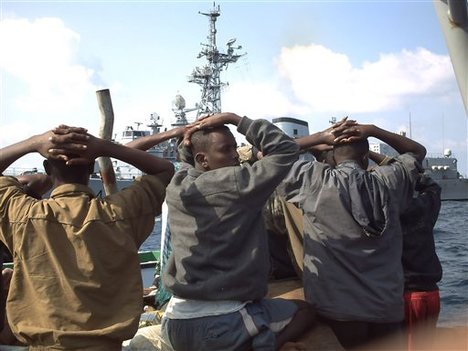
Maritime Security: The Insanity Of ‘Catch And Release’

A EU NAVFOR spokesman was unable to provide Sky News with a figure for how many suspected pirates had been returned to Somalia without charge.
“I don’t have the number for those returned to Somalia – a number of reasons but largely because it was not initially considered important to maintain the number,” the spokesman told Sky News. -Link to quote here.

This is the part of our global anti-piracy campaign that absolutely kills me. It’s as if these navies are sport fishermen, and they are releasing their catch so it can grow bigger, and spawn more fish, so they have more fish to ‘catch and release’ in the future.

Now of course we are dealing with the legal mechanisms, or lack there of, of each country that has laws that deal with piracy.  So when a navy captures a pirate or suspected pirate, those navies are operating under the guidelines of those laws. Because these countries have not implemented sound anti-piracy laws, we unfortunately see pirates captured and then release because of some legal mistake or loophole. Or, those that did the arresting of the pirates did not capture and detain properly, or properly document or obtain witnesses, etc.

So who are the worst offenders of ‘catch and release’?  That is a good question and I tried to do a little search for any comprehensive reports on this problem. Below, I have found a few recent articles on Canada and the UK, and their deficient legal mechanisms in place for prosecuting pirates. Here is a sample for the UK.

Fewer than one in every five suspects picked up around the Horn of Africa over the past four years have been prosecuted for piracy-related offences, the Ministry of Defence has admitted. The figures will fuel growing criticism of Britain’s involvement in the anti-piracy operation.
Official MoD figures obtained by The Independent on Sunday show the Royal Navy has boarded 34 vessels suspected of piracy in the Indian Ocean since volunteering to lead Operation Atalanta, the EU’s first naval mission, in 2008. However, on all but six occasions, the gangs rounded up were taken to the nearest beach and released – despite often being caught with equipment including guns and ladders. A list of boardings since November 2008 shows that the navy has detained a total of 279 likely pirates but allowed 229 of them to go free, some in groups of up to 17 at a time. Fifty more were sent on for prosecution in Kenya, the Seychelles or Italy.

Amazing. This is just insane, and this practice of catch and release must end.  Also, I wanted to mention that all the nations involved have had similar catch and release stories, so the UK or Canada are not the only ones. I have been documenting this for awhile now, and it is very frustrating.

I also wanted to mention that we are missing opportunities of detention by not allowing private security companies to detain and arrest these pirates. Every engagement could turn into an arrest and a removal of these criminals off of the high seas. By issuing Letters of Marque to PSC’s or the captain on these boats, nations could give them the same arresting powers that their navies currently have.

Within the terms of the LoM, you can define exactly how arrests are to be done and the specific rules for detention and transportation of prisoners. A country can also offer bounties for each pirate that was legally detained and prosecuted. We have GPS and video filming capability, and these can all be tools required under the terms of the LoM in these modern times.

As it stands now, security companies are executing the ultimate in extreme justice on the high seas. That would be actually killing pirates during the defense. So the question I have is why is killing pirates more appropriate than detaining them? If anything, a security company should have the option of capturing those pirates instead of just killing them. It would also take a load off of the larger navies who are tasked with anti-piracy.

So why capture them alive? Well, for intelligence purposes, a pirate that is alive and talking, is far better than a dead one. Also, by capturing them, we take them out of the game.  Of course killing them takes them out of the game permanently, but sometimes killing these pirates is not feasible within the course of current rules of engagement.

In one scenario, what if the pirates attacking the ship decided to stop their attack and just give up for whatever reason? Or during their attack, their engine fails and they get within killing range–so they raise their white flag right there. Does an armed guard execute these pirates who are trying to give up, or do they detain them? Or do we just let them go?  And also, if that pirate vessel is no longer sea worthy because armed guards made it so, and now pirates are sinking, is there any obligation at all to save and detain those pirates? These are all questions that could be answered with an effective Letter of Marque regime and bounty program, that makes capturing pirates something of interest to security companies on these vessels.

I mention bounty, because even with a LoM, security companies will not be entirely motivated to detain. An effective bounty or reimbursement program would be necessary to make up for the costs of such an offense industry. You must also incentivize the process in order to create a vibrant offense industry. A company would be risking life and limb to go that extra mile to capture a pirate crew, so companies must have some mechanism in place for compensation.

So those are my thoughts on the whole thing. The laws dealing with piracy need to catch up, and we also must look at legal mechanisms that will help to make the elimination of piracy more efficient and effective. –Matt


Navy frees four out of five suspected Somali pirates
Britain criticised for ‘particularly poor record’ in international crackdown on Indian Ocean piracy
Brian Brady
Sunday, 8 April 2012
Hundreds of suspected pirates arrested by the Royal Navy off the coast of East Africa have been immediately set free – to continue threatening merchant vessels in one of the world’s busiest shipping lanes. Fewer than one in every five suspects picked up around the Horn of Africa over the past four years have been prosecuted for piracy-related offences, the Ministry of Defence has admitted. The figures will fuel growing criticism of Britain’s involvement in the anti-piracy operation.
Official MoD figures obtained by The Independent on Sunday show the Royal Navy has boarded 34 vessels suspected of piracy in the Indian Ocean since volunteering to lead Operation Atalanta, the EU’s first naval mission, in 2008. However, on all but six occasions, the gangs rounded up were taken to the nearest beach and released – despite often being caught with equipment including guns and ladders. A list of boardings since November 2008 shows that the navy has detained a total of 279 likely pirates but allowed 229 of them to go free, some in groups of up to 17 at a time. Fifty more were sent on for prosecution in Kenya, the Seychelles or Italy.
The Government has acknowledged the “catch and release” strategy is often an “unsatisfactory outcome”, although ministers also maintain it helps to disrupt pirate networks.

(more…)

Monday, April 9, 2012

Publications: Journal Of International Peace Operations, March-April 2012

Filed under: Industry Talk,Publications — Tags: , , — Matt @ 11:45 AM

I always like posting these, just because the ISOA puts a lot of effort into making a good product here and the stories are relevant to the industry. –Matt


« Newer PostsOlder Posts »

Powered by WordPress