Feral Jundi

Saturday, March 24, 2012

Bounties: Offense Industry And Black Swan Event–The New Orleans Saints Finds An Edge With Bounties!

First off, who are we kidding?  The NFL is a business and war, and every team/army is doing everything they can to gain advantage and win Super Bowls. Teams pay millions of dollars in salaries to players, and those teams make millions of dollars from ticket sales and the selling of merchandise. It is an insanely popular sport here and it is very much a part of our national culture and heritage. Football in the US is big, big, business.

Not to mention that the teams purposely look for players that hit hard and can deliver results. That is what they are getting paid to do. Sure they wear body armor in the form of a helmet and pads, but their coaches are purely focused on turning that player into a weapon on the football field. They practice for their game, much like gladiators practiced for matches in the arena, or how soldiers train for war.

Why do I know this?  Because I played football when I was younger and hitting hard, targeting players to take them out of the game or to make crucial plays, and enjoying the win was what football was all about. You did not play the game to lose, nor does any player play the game to be ‘ineffective’. It’s a rough game requiring strategy, fitness and aggression, and fans and players wouldn’t have it any other way.

So when I read through this ‘bounty gate’ thing, I just shake my head as to how ridiculous and hypocritical it is. But it is also a Black Swan event in the NFL, because the New Orleans Saints found a scheme that worked and it has created an uproar. They created an offense industry that contributed to a win in the Super Bowl, and it did not require millions of dollars to fire it up. It reminds me of moneyball, another scheme that contributed to wins while saving money. (funny how Executive Outcomes won wars, while doing it on time and under budget too?… And they certainly shocked the world with their effectiveness. lol)

The other thing that is not mentioned enough is that bounties have been a common practice in the NFL for awhile. (please see the first article below) What ticked everyone off about the New Orleans Saint’s bounty program or ‘offense industry’, was that it was successful. That they won a bowl game, not that they were targeting players. All teams play the game violently and to it’s fullest, because if they didn’t, they would lose and they would lose out on money because fans and investors could care less about them. All teams have strategies that target the weakness or the center of gravity of the other team, and they have a very short period of time to win their war.

As to the bounty related rules, I also have to laugh. The teams are more concerned with salary caps so that teams that are well supported by rich owners or highly populated cities, do not have advantage over teams that do not have those resources. In the NFL, they try to make things equal when it comes to pay, just so the game is more interesting and fair. So when someone figures out how to properly implement an offense industry to win a game, and there is money involved with that scheme, then of course the other teams are going to cry. Not because of the safety issue, but because they didn’t think of it first. They also cry because it fits nicely in a morality attack to knock down a winning team. Remember Boyd’s ‘isolate your enemy morally, mentally, and physically, while increasing your moral, mental and physical standing’?

I do realize this is a sporting event and not warfare, so I guess some modicum of fair play should exist. lol But to me, what Gregg Williams did was awesome. This is exactly what ‘offense industry’ is all about, and Gregg used his particular bounty system to motivate his players to win their war. He also did it pretty efficiently by getting the players to add to their own bounty pool program, along with encouraging others to add to that pool. This gets everyone invested into the game. Williams could also focus on the key players of the opposition that would be strategically beneficial to take out of the game or render ineffective. Here is a brief run down of how it worked:

On March 2, 2012, ESPN’s Adam Schefter reported that the NFL had indeed found evidence of a bounty program. Later that day, the NFL announced it had obtained irrefutable proof of a bounty pool dating back to the 2009 season, based on a review of 18,000 documents. It determined that Williams had initiated the fund soon after he arrived in New Orleans in 2009, in hopes of making the defense more aggressive. Between 22 and 27 Saints defensive players were involved. The players and Williams contributed their own cash to the pot, and received cash payments based on their performance in the previous week’s game. For instance, a special teamer who downed a kick returner inside the receiving team’s 20-yard-line earned $100. Players could also be fined for mental mistakes and penalties. Players also received “bounties” for “cart-offs” (plays in which an opponent was removed from the field on a stretcher or cart) and “knockouts” (plays that resulted in a player being unable to return for the rest of the game). Players usually earned $1,000 for “cart-offs” and $1,500 for “knockouts” during the regular season, though they were encouraged to put their winnings back into the pot in order to raise the stakes as the season went on. Payments were known to double or even triple during the playoffs.
The NFL sent a confidential and detailed memo to all 32 teams detailing its findings. It revealed that the Saints had not only targeted Warner and Favre during the 2009 playoffs, but had also targeted Green Bay Packers quarterback Aaron Rodgers and Carolina Panthers quarterback Cam Newton during the 2011 regular season. According to that memo, Saints linebacker Jonathan Vilma offered $10,000 cash to any teammate who knocked Favre out of the NFC Championship Game. Another source told CBSSports.com’s Mike Freeman that Reggie Bush’s agent at the time, Michael Ornstein, was closely involved in the scheme from the beginning. Ornstein contributed $10,000 to the pot in 2009, and an undisclosed amount in 2011.

What is also hypocritical is Senator Dick Durbin’s shock about the whole thing. He will be conducting a Senate hearing on the practice of bounties in the NFL, and in other sports. I actually look forward to what comes out of it, just so I can learn what the various teams of different sports have done. Who knows, maybe the State Department and DARPA could learn from this?  Maybe the State Department can modify their Rewards For Justice program, and have Gregg Williams advise? lol –Matt


Saints took common practice of bounties to new, dangerous level
By Mike Freeman
Monday March 05, 2012?The bounty was $2,000, and the conditions were simple: Knock the starting quarterback out of the game and the cash was yours.
So it was on. The bounty was kept secret from the coaching staff and some of the team. Mostly, only the bounty hunters themselves — players on the defensive line — knew the whole plan. The money was fronted by the participants, and one player held the cash.
The problem was, in the game, no one reached the quarterback, and the bounty went unclaimed. The next week, it was doubled to $4,000. The quarterback survived the game intact. The pot grew to $8,000, and finally the defense had knocked out a quarterback, but there were problems. He was only out a few plays and the player who made the hit wasn’t part of the bounty crew.
The players spent the money on exotic dancers instead.
That’s one story from a player who asked that neither he nor his team be identified. Other players from around the NFL, in interviews, also recounted various bounty tales. The practice is far from isolated. Some players estimated 30 to 40 percent of all NFL players last season participated in a bounty system.
“This ‘bounty’ program happens all around the league,” former NFL lineman Damien Woody tweeted, “not surprising.”
“Bounties, cheap shots, whatever you want to call them, they are part of this game,” former Washington defensive back Matt Bowen wrote. “It is an ugly tradition … you will find it in plenty of NFL cities.”
This, the players seem to agree on. There are many bounty systems in the NFL. They can inspire more energized play, and are usually created by players, not coaches. Players interviewed said bounties are offered for anything from knocking a player out of the game to delivering so-called “remember-me” shots.

(more…)

Friday, March 23, 2012

Building Snowmobiles: The Quadrotor EFP

This is a pretty awesome combination of technologies if you ask me. A quadrotor of the size necessary to carry an EFP, programmed with all the necessary system controls to make it precise and maneuverable, and armed with an EFP that can be aimed at an engine block or the driver of a vehicle.

Plus, an EFP can penetrate armor (40 mm from 25 ft for the SLAM), and with the quadrotor EFP, you could target from multiple angles depending on the amount of munitions you have, the terrain, the weather, the targets and the mission. This is another Drone Archer weapon to look at, and it’s possible uses are many.

So here are some pieces to combine, just to fire up the imagination. These are not the final solutions or pieces to this ‘snowmobile’, but at least you can get the idea of what we are going for here. Please list better devices and pieces if you are interested.

First is the Control Systems or brains of the thing. If you have been watching those incredible quadrotor videos I have posted lately, then this TED describes the ‘how’ for these things. Very impressive.


Next would be the quadrotor itself. The Draganflyer x8 can carry 2.2 pounds and has a gyro stabilized, servo controlled mount for a camera. (or EFP in this case)


And finally, the munitions. I like the SLAM munitions. (which is 2.2 pounds–oh how convenient? lol)


Put them all together and you have the Quadrotor EFP.

As to the ideas of how to use such a device, I will leave that up to the minds and imaginations of the reader. From ambushes on armored columns and motorcades, to anti-material missions, to taking out individuals-there are many uses for such a thing. And because the Quadrotor EFP can be precise, pre-programmed, and remain hidden behind a wall or blocks away on top of some building, it would be very difficult to defend against. Especially if this system was used in a swarm type attack, where the device is used to attack from multiple angles and at erratic moments of the attack. Imagine bees or wasps and how they attack a target.

Or you could use the Quadrotor EFP for very surgical attacks. You could also just park the Quadrotor EFP behind a trash can, and use it like a traditional EFP for an ambush. Maybe it can drop off it’s lethal payload and set the munition. Maybe you want to use for ISR only, and call off your ambush because of whatever reason. Imagine the thing being used at night? Or a swarm at night? Lots of frightening and lethal uses for this weapon….

Now of course with every weapon, there is someone out there thinking of ways to defeat it.  Perhaps a jammer or some device could be used to defeat the Quadrotor EFP. Even counter Quadrotors or some kind of counter-battery system could zap them out of the sky.  Who knows, but these things are a reality and the pieces are all there, so it behooves us to start thinking about this new reality. So with that said, let me know what you think. Do you have a better Quadrotor EFP idea, or do you have ideas on how to defeat this weapon? Maybe you have a radical idea on how to use them for maximum effect? –Matt

Publications: Structuring A Sustainable Letters Of Marque Regime, By Lieutenant Todd Hutchins

A big hat tip to David Isenberg for finding this paper and writing an excellent article about it. Also bravo to the California Law Review for publishing this paper and hopefully between this site and David’s, we can really promote this thing. I am always on the lookout for modern legal interpretations of, and the possible uses for the LoM.

It is also cool that the author of this paper is an officer in the US Navy and a current JAG student. Maybe he can come up and talk a little about any feedback he has received for this paper, and the reason why he chose this particular topic.

Now for a couple of points of interest. Lt. Hutchins is more focused on an international LoM system, as opposed to countries issuing LoM’s. You know, I don’t think this approach would work, just because personally speaking, I would rather answer to the laws and customs of my own country versus answering to an international court. What is to prohibit any biases towards me and my nationality in such a international court?  So personally, I would much rather have a LoM issued by a country whose legal system I trust and would give me the best odds in a trial of my peers–from my country.

I still think companies would seek an internationally issued LoM. Especially if the profit margin was there. If it is not, then the risk will definitely not equal the reward and this industry will not thrive. You really need to make the enemy into the ‘Blufin Tuna’ or ‘Buffalo’ of prizes.

Which brings me to my next point. Offense Industry requires a strong profit motive for the destruction or capture of a declared enemy. The reward must equal or be greater than the risk in this case. I tend to lean towards greater than the risk, just because we want extreme competition for this highly valuable enemy.

So the question with this is if the enemy has enough assets that can be seized and decided upon in a prize court. The guys with the money are on land or hiding out in Dubai or wherever. How will a company be able to seize their assets on the international stage?

Now privateers like Captain Morgan did do land raids to capture enemies and their assets. He was quite successful at it, and if we were to target Somali pirates, then allowing companies to raid wealthy Somali investors in Somalia or elsewhere would be key. But then that would require special agreements with those countries that these investors are hiding in. The LoM would have to be very specific and comprehensive in this regard.

Or, the issuing party could throw in bounties and create a false market out of the whole thing. To artificially attach value to these targets, as well as allow companies to seize assets. That to me would be optimum, just because you really have to sweeten the pot for companies to get involved with this thing. Perhaps the 10 percent that governments would receive via prize courts, would go back into the pot for bounties and costs of running prize courts?  Raising money for bounties is a factor when creating artificial values of targets.

I also applaud the author for identifying how expensive the current Defense Industry is for maritime security. I have mentioned in the past that DI’s are costly, and they do nothing to eliminate the problem. If anything, DI’s profit from the continuation of war or piracy, and it is against the best interest of these participants to remove the very thing that gives them their reason for existence. But DI’s have their place, and I believe that in order to reduce the costs of DI, you need to also implement an offensive capability. You will always need guards to protect that in which you love, but you must also have a force tasked with hunting the bad guys–to keep them off balance and put them on the defense. And ultimately, you would like to make piracy into a very unprofitable game for all parties thinking about getting into that business.

Finally, I would like to add one more deal to this review, just to emphasize the significance of profit and reward in warfare. This quote comes from Sun Tzu.

Now in order to kill the enemy, our men must be roused to anger; that there may be advantage from defeating the enemy, they must have their rewards…Therefore in chariot fighting, when ten or more chariots have been taken, those should be rewarded who took the first. Our own flags should be substituted for those of the enemy, and the chariots mingled and used in conjunction with ours. The captured soldiers should be kindly treated and kept….This is called, using the conquered foe to augment one’s own strength.- Paragraphs 16, 17, 18, Chapter 2, ‘Waging War’.

Even Sun Tzu understood the value of reward in war.  Might I add that the interpretation of ‘rewards’ refers to spoils, and not some ideological reward of just ‘winning’. Although that has it’s place for incentive, but feeling good about a win does not pay the bills as they say. lol

I should also note that Sun Tzu also delved into the concept of the cost of protracted war. It is expensive, and if there is no element of a strategy focused on eliminating an enemy, and industry is only used for defense, then the costs will continue to drain the treasures of those nations and companies with interest in the matter.

There is no instance of a country having benefited from prolonged warfare…It is only one who is thoroughly acquainted with the evils of war that can thoroughly understand the profitable way of carrying it on. –Paragraphs 6,7, Chapter 2, ‘Waging War’.

That pretty much sums up why wars should be fought as quickly as possible, and why there should be thought about creating an industry that profits from ending it, and not ‘carrying it on’. Something to give balance or even counter strong DI’s that come about from prolonged warfare. –Matt


Structuring A Sustainable Letters Of Marque Regime: How Commissioning Privateers Can Defeat the Somali Pira…

Thursday, March 22, 2012

Maritime Security: Piracy Fighters Use Floating Armories

There are between 10 and 12 ships operating as floating armories at any one time. About half a dozen are located in the Red Sea, three off the United Arab Emirates and a couple off the island nation of Madagascar, said Thomas Jakobsson of Sea Marshals Ltd.
“Many companies are too small to be able to comply with regulations. It costs a lot of money,” he said. His company only used floating armories licensed by the Djibouti government and flew the flag of landlocked Mongolia, he said. He believed most of the rest were not operating legally, he said.

This is some interesting reportage on floating armories. It is a reality of maritime security operations out there and it is yet another option–versus buying the weapons and throwing them overboard before coming into port. Or having to deal with the myriad of confusing and conflicting laws of the various ports and countries. Arms on the high seas is a very touchy thing.

My concern with the practice of floating armories is the security of these vessels. Who regulates how this is to be accomplished? We are basically depending upon that vessel and it’s crew of protecting that cache of weapons, and hopefully all parties involved are taking their job seriously? Imagine a pirate force or terrorist group purposely attacking such a vessel in order to take those weapons by force?

On the other hand, it is within the best interest of that floating armory to secure their vessel. They also have plenty of weapons to do such a thing. It is the ultimate ‘armed guards on boats’. lol

As to the legality of such a thing? This would be another great use for the Letter of Marque. Or just call it a license, and the flagged vessel would receive a license from their sponsoring country for this kind of activity. Throw in a bond and some rules/laws to operate by, and now we would have some accountability here.

Another idea is to just use the military for this. If a country assigns specific naval units to assist in this matter, as well as do their anti-piracy thing, then we can have some government control over the distribution of weapons.

These military floating armories would also be contributing greatly to the anti-piracy mission, because they would be ensuring that functioning weapons and ammunition are actually going into the hands of competent guard forces. A naval armory could be used to check licenses, competencies, bonds, etc. before issuing weapons. Hell, a shooting test and zeroing could be done on a military vessel, much like how infantry units do their thing on vessels. They could also hand off crucial intelligence, procedures, or even escorts to these companies, depending upon the routes they take and their mission. It would be an excellent public/private partnership. Something to think about as we navigate this stuff. –Matt


Piracy fighters use floating armories
By Katharine Houreld
March 22, 2012
Private security firms are storing their guns aboard floating armories in international waters so ships that want armed anti-piracy guards for East Africa’s pirate-infested waters can cut costs and circumvent laws limiting the import and export of weapons, industry officials say.
Companies and legal experts say the operation of the armories is a “legal gray area” because few, if any, governments have laws governing the practice. Some security companies have simply not informed the governments of the flag their ship is flying, industry officials said.
Some members of the private security sector are urging governments and industry leaders to impose standards on the unchecked practice of storing weapons offshore to equip anti-pirate forces off Somalia’s coast.
Storing guns on boats offshore really took off as a business last year. Britain — where many of the operators are from — is investigating the legality of the practice, which has received little publicity outside of shipping industry circles.
Floating armories have become a viable business in the wake of increased security practices by the maritime industry, which has struggled for years to combat attacks by Somali pirates. But those in the industry say the standards vary widely.

(more…)

Afghanistan: Government Extends Deadline For APPF Transition

Filed under: Afghanistan,Industry Talk — Tags: , , , , , — Matt @ 11:24 AM

Go figure? The APPF needs more time…. lol I imagine they will need a lot of things in the near future. Like more money, more training, more drugs, more guns and bullets to sell, and more sleep time on post, etc. For those companies signing contracts with them, enjoy your overpriced government security force/Karzai money machine.

The other hypocrisy about this is that it was foreign PSC’s that protected Karzai in his beginning years. So for him to criticize this industry and at the same time basically create another government raised army, is certainly telling. Karzai is purely focused on money, and the APPF is just another money making scheme that he can use to juice these western companies and agencies. Might I add that the APPF is more expensive and with the current arrangement, a western company will have no real buffer force to protect it’s people from any rogue guards or enemy infiltrators. How could any company trust this arrangement?

Of course this is also about money for these western companies as well. They know the situation, and the contractors that work for them know the situation. These companies and contractors are making their bets, and banking on the hope that nothing bad will come out of the arrangement. That the money is more important than their personal safety and security.

I guess you can tell that I am not that impressed by this force and arrangement? lol Yes, I am vocal against it, because you can just look at the arrangement and know how this will turn out. It’s like watching a car heading into a rioting crowd. You know that car is getting damaged or destroyed, and the driver might be killed or hurt in the process, and doom on that driver for making such a poor decision.

My other view on this is that I am a champion of private industry.  I am absolutely biased against government run programs like this, and especially governments that are corrupt and poorly run. And when lives are in the hands of such government programs….look out. This isn’t cutting grass (which government would probably suck at as well), this is the profession of arms and providing security in a war zone. This is not a matter that should be taken lightly. –Matt


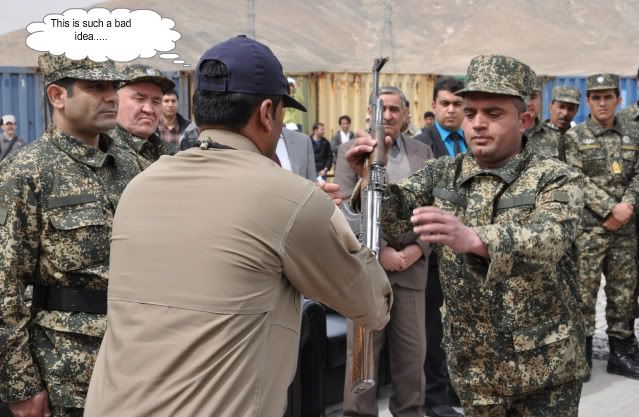
A Blue Hackle security contractor handing over his weapon to an APPF guard during a ceremony.


Afghan government extends deadline for abolishing private security guards
March 18, 2012
The Afghan government is giving companies extensions ranging from a few weeks to 90 days to change from private security guards to a government-run force, officials said Sunday.
The reprieve comes just three days before the March 21 deadline that the Afghan government had set for the majority of companies to start using government-provided security.
Private development companies have said the move is threatening billions in U.S. aid to the country because companies would delay projects or leave altogether because they didn’t feel safe using strictly local security over whose training and procedures they have little control.
President Hamid Karzai has railed for years against the large number of guns-for-hire in Afghanistan, saying private security companies skirt the law and risk becoming militias.
It’s been part of Karzai’s larger push for more control over the way his international allies operate in Afghanistan, as seen most recently in his call for NATO troops to pull back from village outposts and to hand over security responsibilities to Afghans more quickly.

(more…)

« Newer PostsOlder Posts »

Powered by WordPress