Feral Jundi

Wednesday, August 20, 2008

Weapons: The Type 69 40mm Airburst (RPG round), Now in Afghanistan

Filed under: Afghanistan,China,Iraq,Weapons — Tags: , , , , , , — Matt @ 10:35 PM

  Doug sent me this article that he found on Strategy Page.  The round sounds pretty brutal, and the range is pretty amazing as well.  That sucks that they are turning up in Afghanistan now.  I imagine that enough of these munitions launched at the same time, could be a pretty effective tactic to initiate an ambush.  And 1500 meter range makes it an interesting stand-off/indirect weapon as well. Bouncing death, made in China–damn.  –Head Jundi 

——————————————————————

Bouncing Death From China


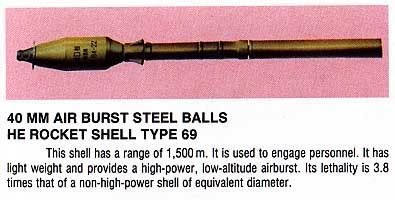
August 20, 2008: Chinese made Airburst anti-personnel RPG rockets have been discovered in Afghanistan, after first being encountered in Iraq, where they were used by Iranian supported Shia rebels. The Chinese made RPG rocket is optimized for anti-personnel effect. To accomplish that, the shell bounces up about six feet, after first hitting the ground. Then the 5.7 pound warhead explodes, releasing hundreds of metal fragments. Casualties can be caused nearly fifty feet away. Because the warhead explodes in the air, and is full of metal fragments, it is more than three times as likely to kill or injure than the usual RPG warhead (which is designed to penetrate armor). The “Airburst Anti-Personnel” rocket also has a longer range (over 1,500 meters, more than twice that for the anti-armor rocket).


Iran buys these rockets from China, or maybe even makes its own copies. Iran denies supplying weapons to the Taliban or al Qaeda (which are violently opposed to the Shia brand of Islam practiced throughout Iran and southern Iraq.) But in the past, Iran has aided al Qaeda, and Iranian gunrunners will sell weapons to anyone who can pay. 

Strategy Page Link

——————————————————————

Type 69 Airburst 

Type 69 40mm Airburst Anti-Personnel High-Explosive (HE) Grenade


This variant was developed specifically for anti-personnel purpose. This round works in a similar way to the bouncing anti-personnel fragmentation mines. On impact, the grenade bounces off the ground to a chest to 2m height then airbursts over the target area, scattering about 800 anti-personnel steel balls over a lethal radius of 15m. The airburst is much more effective than typical blast warheads especially toward entrenched troops.


Sino Defence Link

Thursday, August 7, 2008

Technology: The PCASS Hand-held Lie Detector

Filed under: Afghanistan,News,Technology — Tags: , , , — Matt @ 6:49 PM

     I love stuff like this. Wether or not it delivers the goods, who knows?  But I really think a device like this could make the job of the troops out in the field a little bit easier.  I do have some reservations about totally depending on such a device, but if used in conjunction with other evidence collected, these kinds of technologies can help in separating the bad guys from the good guys.


     This would have been great at the various ECP’s I have had to run.  But contractors being authorized to use such a tool might be a little sticky.  There are certain situations though, where something like this could be nice.  Like screening your guard force for one.  I have been on sites where new guards are streaming into the base on a daily basis.  Things like biometrics and this device could help to keep tabs on screening your guard force.  But yet again, it always boils down to cost, and the various companies out there can be pretty stingy.  


    At this time, I have not heard of any companies using the PCASS.  Although it would not surprise me that there are a few playing around with such a device.  –Head Jundi  


Lie Detector


 The PCASS in action.


New U.S. weapon: Hand-held lie detector  

U.S. troops in Afghanistan first to get new device; ‘red’ means you’re lying

By Bill Dedman

Investigative reporter

updated 3:00 a.m. PT, Wed., April. 9, 2008

FORT JACKSON, S.C. – The Pentagon will issue hand-held lie detectors this month to U.S. Army soldiers in Afghanistan, pushing to the battlefront a century-old debate over the accuracy of the polygraph.

The Defense Department says the portable device isn’t perfect, but is accurate enough to save American lives by screening local police officers, interpreters and allied forces for access to U.S. military bases, and by helping narrow the list of suspects after a roadside bombing. The device has already been tried in Iraq and is expected to be deployed there as well. “We’re not promising perfection — we’ve been very careful in that,” said Donald Krapohl, special assistant to the director at the Defense Academy for Credibility Assessment, the midwife for the new device. “What we are promising is that, if it’s properly used, it will improve over what they are currently doing.”

But the lead author of a national study of the polygraph says that American military men and women will be put at risk by an untested technology. “I don’t understand how anybody could think that this is ready for deployment,” said statistics professor Stephen E. Fienberg, who headed a 2003 study by the National Academy of Sciences that found insufficient scientific evidence to support using polygraphs for national security. “Sending these instruments into the field in Iraq and Afghanistan without serious scientific assessment, and for use by untrained personnel, is a mockery of what we advocated in our report.”

(more…)

Monday, July 28, 2008

News: Soldiers Recount Deadly Attack on Afghanistan Outpost

Filed under: Afghanistan,News — Tags: , , , — Matt @ 8:18 PM

Very interesting account of the battle. –Head Jundi

—————————————————————


Soldiers recount deadly attack on Afghanistan outpost

By Steve Mraz, Stars and Stripes

Mideast edition, Saturday, July 19, 2008

Ben Bloker / Stripes

Spc. Tyler Stafford, 23, a soldier from Company C, 2nd Battalion, 503rd Infantry Regiment (Airborne), recounts the hours-long fight that killed nine of his comrades as he recuperates at Landstuhl Regional Medical Center in Germany.

Ben Bloker / Stripes

Sgt. Jacob Walker, 29, recuperating at Landstuhl Regional Medical Center in Germany, was wounded in Wanat, Afghanistan, when the forward operating base came under attack early Sunday morning.

——————————————————————- 

Everything was on fire. The trucks. The bazaar. The grass.

It looked surreal. It looked like a movie.

That was what Spc. Tyler Stafford remembered thinking as he stepped onto the medical evacuation helicopter. The 23-year-old soldier would have been loaded onto the bird, but the poncho that was hastily employed as his stretcher broke. His body speckled with grenade and RPG shrapnel, the Vicenza, Italy, infantryman walked the last few feet to the waiting Black Hawk.

That was Sunday morning in eastern Afghanistan’s Kunar province. At a forward operating base — maybe as big as a football field — established just a few days prior.

Outnumbered but not outgunned, a platoon-plus element of soldiers with 2nd Platoon, Company C, 2nd Battalion, 503rd Infantry Regiment (Airborne), 173rd Airborne Brigade Combat Team accompanied by Afghan soldiers engaged in a fistfight of a firefight.

After maybe two hours of intense combat, some of the soldiers’ guns seized up because they expelled so many rounds so quickly. Insurgent bullets and dozens of rocket-propelled grenades filled the air. So many RPGs were fired at the soldiers that they wondered how the insurgents had so many.

That was July 13. That was when Stafford was blown out of a fighting position by an RPG, survived a grenade blast and had the tail of an RPG strike his helmet.

That was the day nine Chosen Company soldiers died.

It was just days before the unit was scheduled to leave the base.

———

The first RPG and machine gun fire came at dawn, strategically striking the forward operating base’s mortar pit. The insurgents next sighted their RPGs on the tow truck inside the combat outpost, taking it out. That was around 4:30 a.m.

This was not a haphazard attack. The reportedly 200 insurgents fought from several positions. They aimed to overrun the new base. The U.S. soldiers knew it and fought like hell. They knew their lives were on the line.

“I just hope these guys’ wives and their children understand how courageous their husbands and dads were,” said Sgt. Jacob Walker. “They fought like warriors.”

The next target was the FOB’s observation post, where nine soldiers were positioned on a tiny hill about 50 to 75 meters from the base. Of those nine, five died, and at least three others — Stafford among them — were wounded.

When the attack began, Stafford grabbed his M-240 machine gun off a north-facing sandbag wall and moved it to an east-facing sandbag wall. Moments later, RPGs struck the north-facing wall, knocking Stafford out of the fighting position and wounding another soldier.

Stafford thought he was on fire so he rolled around, regaining his senses. Nearby, Cpl. Gunnar Zwilling, who later died in the fight, had a stunned look on his face.

Immediately, a grenade exploded by Stafford, blowing him down to a lower terrace at the observation post and knocking his helmet off. Stafford put his helmet back on and noticed how badly he was bleeding.

Cpl. Matthew Phillips was close by, so Stafford called to him for help. Phillips was preparing to throw a grenade and shot a look at Stafford that said, “Give me a second. I gotta go kill these guys first.”

This was only about 30 to 60 seconds into the attack.

Kneeling behind a sandbag wall, Phillips pulled the grenade pin, but just after he threw it an RPG exploded at his position. The tail of the RPG smacked Stafford’s helmet. The dust cleared. Phillips was slumped over, his chest on his knees and his hands by his side. Stafford called out to his buddy three or four times, but Phillips never answered or moved.

“When I saw Phillips die, I looked down and was bleeding pretty good, that’s probably the most scared I was at any point,” Stafford said. “Then I kinda had to calm myself down and be like, ‘All right, I gotta go try to do my job.’ “

The soldier from Parker, Colo., loaded his 9 mm handgun, crawled up to their fighting position, stuck the pistol over the sandbags and fired.

Stafford saw Zwilling’s M-4 rifle nearby so he loaded it, put it on top of the sandbag and fired. Another couple RPGs struck the sandbag wall Stafford used as cover. Shrapnel pierced his hands.

Stafford low-crawled to another fighting position where Cpl. Jason Bogar, Sgt. Matthew Gobble and Sgt. Ryan Pitts were located. Stafford told Pitts that the insurgents were within grenade-tossing range. That got Pitts’ attention.

With blood running down his face, Pitts threw a grenade and then crawled to the position from where Stafford had just come. Pitts started hucking more grenades.

The firefight intensified. Bullets cut down tree limbs that fell on the soldiers. RPGs constantly exploded.

Back at Stafford’s position, so many bullets were coming in that the soldiers could not poke their heads over their sandbag wall. Bogar stuck an M-249 machine gun above the wall and squeezed off rounds to keep fire on the insurgents. In about five minutes, Bogar fired about 600 rounds, causing the M-249 to seize up from heat.

At another spot on the observation post, Cpl. Jonathan Ayers laid down continuous fire from an M-240 machine gun, despite drawing small-arms and RPG fire from the enemy. Ayers kept firing until he was shot and killed. Cpl. Pruitt Rainey radioed the FOB with a casualty report, calling for help. Of the nine soldiers at the observation post, Ayers and Phillips were dead, Zwilling was unaccounted for, and three were wounded. Additionally, several of the soldiers’ machine guns couldn’t fire because of damage. And they needed more ammo.

Rainey, Bogar and another soldier jumped out of their fighting position with the third soldier of the group launching a shoulder-fired missile.

All this happened within the first 20 minutes of the fight.

Platoon leader 1st Lt. Jonathan Brostrom and Cpl. Jason Hovater arrived at the observation post to reinforce the soldiers. By that time, the insurgents had breached the perimeter of the observation post. Gunfire rang out, and Rainey shouted, “He’s right behind the sandbag.”

Brostrom could be heard shouting about the insurgent as well.

More gunfire and grenade explosions ensued. Back in the fighting position, Gobble fired a few quick rounds. Gobble then looked to where the soldiers were fighting and told Stafford the soldiers were dead. Of the nine soldiers who died in the battle, at least seven fell in fighting at the observation post.

The insurgents then started chucking rocks at Gobble and Stafford’s fighting position, hoping that the soldiers might think the rocks were grenades, causing them to jump from the safety of their fighting hole. One rock hit a tree behind Stafford and landed directly between his legs. He braced himself for an explosion. He then realized it was a rock.

Stafford didn’t have a weapon, and Gobble was low on ammo. Gobble told Stafford they had to get back to the FOB. They didn’t realize that Pitts was still alive in another fighting position at the observation post. Gobble and Stafford crawled out of their fighting hole. Gobble looked again to where the soldiers had been fighting and reconfirmed to Stafford that Brostrom, Rainey, Bogar and others were dead.

Gobble and Stafford low-crawled and ran back to the FOB. Coming into the FOB, Stafford was asked by a sergeant what was going on at the observation post. Stafford told him all the soldiers there were dead. Stafford lay against a wall, and his fellow soldiers put a tourniquet on him.

From the OP, Pitts got on the radio and told his comrades he was alone. At least three soldiers went to the OP to rescue Pitts, but they suffered wounds after encountering RPG and small-arms fire.

At that time, air support arrived in the form of Apache helicopters, A-10s and F-15s, performing bombing and strafing runs.

When the attack began, Walker was on the FOB. He grabbed an M-249 and started shooting toward a mountain spur where he could see some muzzle flashes. Walker put down 600 to 800 rounds of ammunition.

He got down behind the wall he was shooting from to load more ammo and was told they were taking fire from the southwest. He threw the bipod legs of his machine gun on the hood of a nearby Humvee. A 7.62-millimeter caliber bullet struck Walker’s left wrist, knocking him to the ground. A soldier applied a tourniquet to Walker and bandaged him.

Walker and two other wounded soldiers distributed their ammo and grenades and passed messages.

The whole FOB was covered in dust and smoke, looking like something out of an old Western movie.

“I’ve never seen the enemy do anything like that,” said Walker, who was medically evacuated off the FOB in one of the first helicopters to arrive. “It’s usually three RPGs, some sporadic fire and then they’re gone … I don’t where they got all those RPGs. That was crazy.”

Two hours after the first shots were fired, Stafford made his way — with help — to the medevac helicopter that arrived.

“It was some of the bravest stuff I’ve ever seen in my life, and I will never see it again because those guys,” Stafford said, then paused. “Normal humans wouldn’t do that. You’re not supposed to do that — getting up and firing back when everything around you is popping and whizzing and trees, branches coming down and sandbags exploding and RPGs coming in over your head … It was a fistfight then, and those guys held ’ em off.”

Stafford offered a guess as to why his fellow soldiers fought so hard.

“Just hardcoreness I guess,” he said. “Just guys kicking ass, basically. Just making sure that we look scary enough that you don’t want to come in and try to get us.”

Link to Stars and Stripes Article
Saturday, July 12, 2008

Technology: The Green Machine Brick Maker by TerraBuilt

Filed under: Technology — Tags: , , , , , — Matt @ 4:19 PM

I read about this in this month’s edition of Serviam.  This is an interesting idea and has a ton of potential applications.  In places like Iraq and Afghanistan, building material for the locals is always an issue, and something like this could go a long way in winning some hearts and minds.

That, and the use of this machine at a remote site would help reduce the need for sandbags when building fighting positions and posts.  Something like this, could become the Hesco of building materials in the near future.  Personally, I have not used this machine, so I really do not have an opinion on it.  I have had to fill sandbags before, and nothing sucks like having to rebuild a fighting position after a couple of months, do to deteriorating bags.  We’ll see if this catches on and I would be curious about the feedback on this thing.  –Matt

The Green Machine
The construction industry is faced with depleting resources, heightened environmental concerns, high costs, and deteriorating product quality. The United Nations estimates that worldwide housing shortfall exceeds one billion units and is growing.
The GreenMachine and the associated TerraBuilt Construction System enable construction of high quality, low cost structures made of long lasting materials that save life cycle energy costs, are durable, fire and disaster resistant as well as environmentally sustainable. The cornerstone of the Terrabuilt Construction System is the one-ton hydraulic GreenMachine.

(more…)

Saturday, June 21, 2008

News: The ‘Great Energy Game’ in Afghanistan

Filed under: Afghanistan,News — Tags: , , , , — Matt @ 2:13 PM

    A couple of things about this pipeline.  TAPI has been an ongoing process over the years, but with the recent energy issues and our issues with Iran and Russia and their pipeline project, this will continue to be of concern to our strategic interests in Central Asia.  We want Afghanistan to have a source of ‘country re-building’ revenue, we want a pipeline that will compete with Iran and Russia’s pipeline, and we want to secure another source of energy for the world, so they will not be dependent on Iran and Russia and their whims.  And all of these issues will be overshadowed by the security of this project.  The fundamental question is ‘how do you secure a pipeline, in the heart of enemy territory’?

   Tough question, and Canada seems to be asking this themselves, as we speak.  They are also wondering about commitment.  Do they necessarily want to risk the lives of Canadian troops for a pipeline, so that we can win in this so called Great Energy Game?  These are the questions Canadians, and other countries with forces there will be asking, as the war continues in Afghanistan.

    Furthermore, the Taliban will be getting arms shipments from all sorts of interesting sources, all with the goal of fueling the defeat of this project.(hmmm, I wonder where those munitions will come from?)  So with that scenario, and with the scenario of the continuing strain on international forces in Afghanistan, who will protect this pipeline project?

    Well, this article put some light on to that matter at the end of the article.  Can the Afghanistan government depend on local security and tribes, to protect this delicate project?  I don’t think they have a choice, do to the cost factor and the local need for jobs.  The government will certainly have to make deals with tribes, to get this project going.  

     But you can guarantee that the engineers and employees of these pipeline companies will need protecting.  And with the size of the pipeline, a surveillance system in the form of UAVs will have to be implemented.  And just like the Iraq oil news, there will be a need of individuals that can coordinate these efforts and insure the security plan is being implemented properly.  This is where private security contractors come into play, and we will be an integral part of this project.

     I think in the coming years, you will see this ‘Great Energy Game’ being played out elsewhere, with the involvement of both military forces and contractors.  The issue, is that there just isn’t enough military forces to go around, and invariably the security issues must be dealt with by private means.  This is nothing new.  Throughout the history of Private Security Companies, energy stuff and security contractors have always been hand in hand.  

     What is new now, is the reinforced concern over energy, and it’s perceived limited supplies.(that is if you believe in Peak Oil Theory)  The world needs more energy, it demands more energy, and it will get more energy, and that is what fuels this race.  And any fears that this supply is limited, will only make the stakes higher in this game.  

    If you look at what China has been doing in such places like Africa or Iran’s goal with their pipeline in Central Asia, then this notion of a Great Energy Game becomes even more of a reality.  And in this world, you play to win this game, or we will certainly lose big.  Something to think about, next time you fuel up or get groceries.  –Head Jundi  

—————————————————————— 

TAPI Pipeline 


Pipeline opens new front in Afghan war

Canadian role in Kandahar may heat up as allies agree on U.S.-backed energy route through land-mine zones and Taliban hot spots

SHAWN MCCARTHY

GLOBAL ENERGY REPORTER

June 19, 2008

OTTAWA — Afghanistan and three of its neighbouring countries have agreed to build a $7.6-billion (U.S.) pipeline that would deliver natural gas from Turkmenistan to energy-starved Pakistan and India – a project running right through the volatile Kandahar province – raising questions about what role Canadian Forces may play in defending the project.

To prepare for proposed construction in 2010, the Afghan government has reportedly given assurances it will clear the route of land mines, and make the path free of Taliban influence.

In a report to be released today, energy economist John Foster says the pipeline is part of a wider struggle by the United States to counter the influence of Russia and Iran over energy trade in the region.

The pipeline has strong support from Washington because the U.S. government is eager to block a competing pipeline that would bring gas to Pakistan and India from Iran.

The TAPI pipeline would also diminish Russia’s dominance of Central Asian energy exports.

(more…)

« Newer PostsOlder Posts »

Powered by WordPress