Feral Jundi

Friday, August 20, 2010

Afghanistan: Taliban Attack Afghan Guards In Deadly Raid

     This sucks.  Rest in peace to the fallen and my heart goes out to the families and friends of these Afghan guards. My only comment on this is that I am sure there will be many lessons for this security company, and they will certainly be re-evaluating the defense of their main camps.  But from the sounds of it, the Taliban conducted a classic raid designed to turn a surprised force inside out. These things take guts to perform, and require planning, surprise and violence of action to be effective. It sounds like they had that in this attack. (Running over fleeing unarmed guards with their cars though?)

     The other point to bring up is this whole deal about companies using subcontractors who refuse to use local workers for projects in that locality.  Boy, that is rule number one in a new area you plan on doing construction or other types of work at, and that is always hire local.

     If you hire the locals, they are more likely to protect their cash cow job, and drop some hints that maybe the Taliban (their cousins and uncles) might want to attack that day or night.  Or the work force just doesn’t show up one because their cousins and uncles said not to go to work that day.  Using locals for work projects is the way to go, and the project lead on this should have known better.

     It would also help if the reconstruction team that handed out the money for this road project, also paid attention to what villages might be pissed off if they built a road through their area, and was not included in the project.  Or at least throw in a school or whatever to appease them, while making the case of why a road would be a good thing in their area. It sounds like no one talked these folks, to include the government or the reconstruction team for that area.

     The other option is that maybe these locals did talk with everyone, and because they were Taliban supporters, they will never be happy about anything the government or reconstruction teams tell them. –Matt

—————————————————————-

Taliban Attack Afghan Guards in Deadly Raid

By ALISSA J. RUBIN and SHARIFULLAH SAHAK

August 20, 2010

KABUL, Afghanistan — Taliban fighters in a rural area near the Helmand River staged an audacious nighttime raid early Thursday, swooping down on several hundred sleeping Afghan private security guards who were securing a road construction project, and killing at least 21, according to guards who escaped.

The attack was striking not only for its scale and viciousness but because it took place in the Helmand River Valley, where thousands of British troops have been stationed for the past three years and where now American troops have entered to try to rout the Taliban.

News of the Taliban raid emerged Friday, as Senator John Kerry, Democrat of Massachusetts and the chairman of the Foreign Relations Committee, met with President Hamid Karzai for the second time in four days to discuss corruption among members of the Afghan government, some of whom have been implicated in several major cases. Support for the nine-year war, and for Mr. Karzai, is ebbing in the United States, while Gen. David H. Petraeus, the top American commander in Afghanistan, has signaled that, if anything, the troops would need more time on the ground to accomplish their mission.
(more…)

Wednesday, August 18, 2010

Afghanistan: Anti-Corruption Unit Pressure, Plus Coming Elections Equals ‘Crazy Karzai’!!

     Any chance I can use ‘Crazy Karzai’ in the title of anything, is a good thing. lol Now back to the post.

     Here is the assessment. I really think Karzai thinks this is his ‘Ace in the hole’. Meaning he was planning on pulling this stupid decree out of his funny hat as a means to push back against this pressure we are putting on him about his crap government. Because at face value, not only is this decree silly, but it will probably backfire on him in a dangerous way.

     If let’s say he thought he would get some votes out of this populist move, at the end of the day he still has to deal with the Taliban. He will also have to deal with an entire group of unemployed Afghan security contractors who will probably hop on over to the Taliban out of anger–or just do nothing. He might get some of them to join the army or police. It’s hard to say who goes where, but I do know that this is a big gamble for him politically. And what happens when people get more angry because violence increases due to this massive removal of multiple private security operations across the country?

     I also think that this anti-corruption unit is going to go on the offensive during the elections. Karzai’s competition will have plenty of material for firing up the populace and ripping apart the incumbent. This upcoming election is heavy on his mind, and he knows (thanks to Senator Kerry’s shot across the bow’) that we mean business this time. I for one would love to see him voted out of office. Someone needs to hold that office, that both the Afghans and the Coalition forces fighting in that war can believe in…. and possibly die for, in battle.

     Below I found all the most pertinent stories to help you out in making your own assessments. From some Afghan security company’s responses to the whole thing, to the details of this last diplomatic mission which freaked Karzai out and forced his hand on this. So at this point, it is all about politics. –Matt

Afghan plan to shut private security firms may endanger convoys

If Afghanistan dissolves security firms, guards will join Taliban, some predict

Karzai Plays to the Crowd with Threatened Ouster of Afghan Contractors

U.S. sends warning to Afghanistan, and John Kerry delivers the message

——————————————————————

Afghan plan to shut private security firms may endanger convoys

By DION NISSENBAUM AND HASHIM SHUKOOR

August 16, 2010

KABUL, Afghanistan — Afghan President Hamid Karzai’s office abruptly announced plans on Monday to close all the country’s polarizing private security companies by year’s end, a decision that could create more risk for the U.S.-led military along crucial supply routes into Afghanistan.

In an announcement that appeared to catch NATO officials by surprise, Karzai vowed to shutter the lucrative network of private security firms.

“The government of Afghanistan has decided that the security companies have to go,” Karzai spokesman Waheed Omar said.

If the president follows through with the short timeline, the decision could strip NATO supply routes of the private forces, which have provided protection for convoys that come under constant attack.

It would force diplomatic missions, including the U.S. Embassy in Kabul, to find some other way to protect their compounds.

It also could create a volatile new pool of disaffected militants, some of whom already are suspected of having links with the Taliban and of staging attacks on convoys that are passing through their areas.

“Security will get worse,” warned Matiullah Khan, one of the country’s more influential figures in the murky security convoy business. “The police can’t provide security in the provinces, so how can they escort convoys?”

The private security industry, a complex network of registered international companies and unregulated Afghan militias, employs 26,000 people working on U.S. contracts, according to NATO officials. The vast majority of them – about 19,000 – work on military contracts.

The companies have come under fire from almost every front.

Karzai long has argued that the firms act as a parallel security force that undermines the nation’s police and army.

Many Afghans fear convoy security guards, who have been accused of wildly opening fire and killing civilians while protecting their routes.

Last month, contractors with DynCorp International were involved in a fatal car crash in Kabul that sparked violent anti-American protests and raised fears that the isolated demonstration could devolve into widespread rioting.

Some of the firms have been accused of using their familial ties to the Karzai government to secure millions of dollars in NATO contracts. Two of Karzai’s cousins run one major security company. The defense minister’s son runs another.

U.S. officials also have expressed concerns over long-standing allegations that the security firms use NATO funds for the contracts to pay insurgents not to attack the convoys.

Industry Talk: Karzai’s Decree Regarding PSC’s And The Buzz On The Forums

     This is a translation that I wanted to put up just so folks have something to reference. But what is really cool is all the buzz on the forums about this one.  Lots of opinions all over the place.

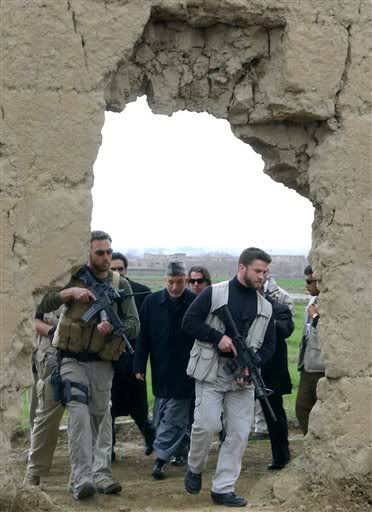
     The photo below is a mystery.  I have no clue if these guys were PSC’s or not.  But what the photo symbolizes is all the years that good men like them spent putting their lives on the line for Karzai. Do you think he even thanked them for their protective services? –Matt

Edit: 08/23/2010 – Tim wrote up a great post on the subject, and has a better translation of the decree.  Check it out here.

—————————————————————–

Karzai

Afghan President Hamid Karzai, center, is surrounded by heavily armed bodyguards as he arrives for a groundbreaking ceremony in Parwan, some 34 miles, 55kms north of Kabul, Monday, March 14, 2005. Karzai was surrounded by dozens of US security personnel as he attended a ceremony of groundbreaking for a road linking the Panjshir Valley to Parwan in the district of Bayan. (AP Photo/Shah Marai, Pool)

—————————————————————–

President Karzai’s decree regarding PSCs in Afghanistan:

For tackling corruption and ensuring security of our citizens and prevention of security irregularities as well as exploitation of arms and military equipment and uniforms by the security companies which has caused some tragic incidents, after some thorough and legal review I am approving the annulment of foreign and national security companies within four months as per the following conditions.

The members of security companies who can meet the military recruitment conditions of provided that they meet the conditions they can join the police forces with or without their registered arms or weapons. And the Interior Ministry is obliged to annul it within four months from today.

For foreign companies who are registered with IM, if they agree, then the IM, Def Min and NDS will buy their weapons and the resident visas of the foreign members will be cancelled. If the companies do not agree to sell their arms their resident visas will be cancelled and they can leave the country with their arms.

Those companies who are not registered with IM their arms will be confiscated.

Embassies or diplomatic offices, NGOs who are operating in Kabul and provinces can still use their own security personnel within their premises. They should not be visible outside their premises. The number and conditions for this will be spelled out by the IM. The MOI’s must take charge of the external security of embassies,NGOs in Kabul and other provinces.

It is the MOI’s task to implement this decree.

——————————————————————

(You must sign up to read a few of these forum discussions)

SOCNET Forum discussion here.

Tactical Forum discussion here.

Lightfighter Forum discussion here.

Secure Aspects Forum discussion here.

Close Protection World Forum discussion here.

Saturday, August 14, 2010

Paracargo: GPS-guided Parachutes May Soon Drop Blood, Medical Supplies To Wounded Troops In Afghanistan

     I like this, but I have to think, what took you guys so long to think it up?  I mean they have already been using these types of paracargo systems for years, and just now the military is thinking about using it for medical resupply?

     What really kills me is that they predict they might be up and running with the project by January? I am sorry, but this is ridiculous and so typical of how government operates.  Put the stuff in a box, and drop it out of the airplane like you would with ammo, food, and water. Surround it with as much cushioning as it takes to insure it lands in one piece, but either way, get it done.

     In the smokejumpers, we have been dropping medical paracargo for a long time.  Stuff like oxygen bottles, IV’s and whatever else the mission required. Which is another point to bring up.  If they are going to drop this kind of bundle in any kind of wooded areas, it might be wise to also have a set of tree climbing equipment that you can toss out of the aircraft as well.  Maybe something that you could drop by GPS chute, and then at a certain altitude the tree climbing box is released with a small drogue keeping it straight but still allowing for speed of the bundle.  That way the thing can plow through the trees to the ground.

     Or if the aircraft can do a low pass, they could toss out the thing as well. In the jumpers, this is how we would do it, and those boxes would plow through the trees just so the guys on the ground could get to it for tree climbing operations.   Because getting medical supplies out of a tree requires the right equipment, and you definitely do not want to keep your patient waiting because of a bundle that is hung up.

    The aircraft could also just drop another medical bundle, but if that one gets hung up in the trees or gets lost in a river or destroyed by enemy fire, it will be equally problematic.  So it pays to have some back up tree climbing equipment just to be prepared.  That is how we did it in the smokejumpers. I realize that most of Afghanistan is not that bad tree-wise, but for those areas that guys are operating in where trees are tall enough, it is something to think about.

    Another idea is to use UAV helicopters for the task. If you want to put medical supplies on the ground and with precision, use something like that.  That’s if it is too dangerous or the conditions suck for manned flight into that spot.

     But going back to the time frame for this.  Imagine how many folks have already died, just because this capability was not in place?  I say do a couple of test runs to figure out the right kind of packaging for the load, and start this program immediately. You could get this done in a week or two, and not wait until January of next year.  Lives could be saved because of it. –Matt

——————————————————————-

GPS-guided parachutes may soon drop blood, medical supplies to wounded troops in Afghanistan

By MARK PATTON

August 11, 2010

WIESBADEN, Germany — GPS-guided parachutes soon could be dropping blood supplies to medics on the battlefield, cutting down the time life-saving medical supplies reach wounded troops.

The military already uses the technology to deliver food, water and ammunition to U.S. forces in remote parts of Afghanistan. Now, the Armed Services Blood Program is working with an Army research center to put blood and other medical supplies under the parachutes instead.

If testing goes as planned, the system could be up and running by January.

Troops needing blood on the battlefield usually have to be evacuated and transported to the nearest medical facility. But evacuation is not always possible when units are under fire or if the weather prevents an emergency vehicle from traveling.

That’s when the Global Position System-guided parachutes can be a lifesaver and allow a wounded servicemember to receive blood during the critical period following an injury, said Air Force Maj. David Lincoln, Armed Services Blood Program deputy director for operations.

(more…)

Friday, August 13, 2010

Industry Talk: NATO Slack Forces US To Send More Soldier And Contractor Trainers To Afghanistan

     This story is interesting for a couple of reasons.  Awhile back I wrote a post that dealt with this type of problem specifically, and how contractors are the ones who will be taking up the ‘slack’.  Matter of fact, that is part of the title of the post. Afghanistan: So As NATO Falters Or Members Leave, Will Contractors Pick Up The Slack?

     One thing that struck me was the numbers mentioned in this story about how many contractor trainers are over there now.  I think that number is much larger than the 2,000 that is mentioned.  I could be wrong, and I only say this because DoD really hasn’t been that accurate with their contractor accounting.  Still, 2,000 contractor trainers is pretty significant.

     The other part that I wanted to mention, was the idea that it takes NATO so long to spin up the required amount of manpower, and yet there was no mention on how fast it takes contractors to be spun up and sent over.  Of course NPR did not want to minimize the capability of the US military, but in all honesty, private industry is the winner for speed of deployment and quantity needed when it comes to training stuff.  Hell, the only thing that slows down contractor deployments, is the lack of government CORs needed to manage the whole contract to ensure it is properly carried out. lol But in this race, we excel.

     The three month training deployment that the 82nd Airborne finished was pretty cool too.  Three month deployments are nice, and private industry is the king of utilizing short deployment contracts like this.  Could we see the military do more of these types of deployments?  I know the troops would probably dig it.

     I also wanted to give a big thanks and pat on the back to all of those contractors out there who are a part of this massive training effort in the war.  You are an essential part of today’s strategy, and today’s war planners and strategists might not appreciate what you do, but I certainly appreciate the hard work you are doing.

     My guess is that there will be more work coming too, so definitely keep up an eye on all the forums and job boards if you are planning to get into the training side of the business. –Matt

——————————————————————

NATO Slack Forces U.S. To Send Afghanistan Trainers

by Tom Bowman

August 13, 2010

American soldiers — and even private contractors — are spearheading the effort to build an Afghan army and police force, so American and NATO troops can one day leave. But Pentagon officials and military officers say NATO nations still aren’t doing enough.

A few weeks ago, hundreds of artillery troops and air defense artillery soldiers from Fort Sill in Oklahoma and Fort Campbell in Kentucky started heading over to Afghanistan. They weren’t part of the so-called surge in combat troops. Instead, Defense Secretary Robert Gates signed orders for them to work as trainers because European nations were too slow in helping out.

“We’re still not getting NATO able to force-generate and deploy forces in the numbers that we need,” says Army Lt. Gen. William Caldwell, who leads the training effort in Afghanistan. “So Gates said, ‘OK then, I’m going to give you another unit.’ “

It was the second time this year Gates said OK to more American trainers because NATO wasn’t picking up the slack. An 800-soldier battalion from the 82nd Airborne Division just got back from Afghanistan on a three-month training mission, designed to serve as a “bridge” to more NATO troops.

But with the NATO troops still not arriving, the troops from Oklahoma and Kentucky were sent — for a year.

That’s annoying some members of Congress.

“NATO members who for whatever reason do not send additional combat troops or who intend to reduce their combat troop presence in the near future should at least be willing to provide trainers who operate away from the heavy fighting,” Sen. Carl Levin, a Michigan Democrat who heads the Armed Services Committee, said at a recent hearing.

NATO is willing — to a point. It has sent about 900 trainers to work with Afghan soldiers and police. The U.S. has sent more than twice that number. American private contractors have sent 2,000.

(more…)

« Newer PostsOlder Posts »

Powered by WordPress