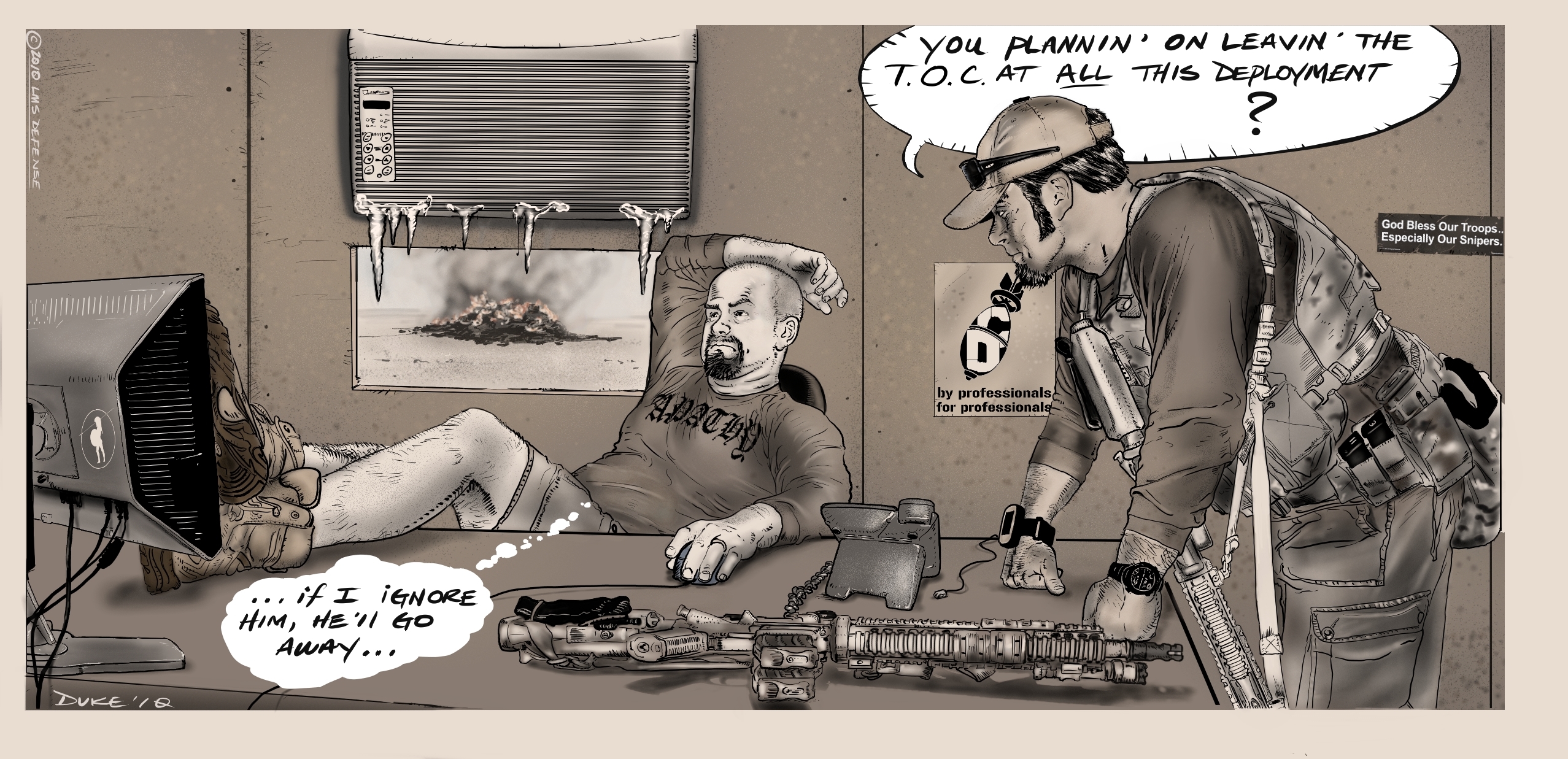
‘That Guy’ by LMS Defense- The Comics. Artwork by Righteous Duke.
‘That Guy’ by LMS Defense- The Comics. Artwork by Righteous Duke.
But executives with international mining firms said in interviews that while they believed that Afghanistan’s mineral deposits held great potential, their businesses were not planning to move into the country until the war was over and the country more stable.
“There are huge deposits there,” said David Beatty, chief executive of Rio-Novo Gold, a mining company based in Toronto. “But as chief executive, would I send a team to Kandahar? And then call a guy’s wife after he gets shot? No.”
*****
I was reading an excellent book the other day called “The End of the Free Market: Who Wins the War Between States and Corporations” by Ian Bremmer, and it was quite the read. Basically, if you track the actions of countries like China in places like Iraq, Africa or Afghanistan, you start to get the idea that something is going on here. That state owned companies have the advantage over private industry in these war ravaged and resource rich countries. That reality is what worries me, and in the larger battle over resources in this world, we need to make some adjustments.
The problem is that private industry just does not want to take the risk of entering these places, because there is just too much liability. Besides, a private company does not have the full weight and support of a country behind it, but a Chinese owned company does. That is a huge advantage.
I have talked about clashes before between free markets and state capitalism in the past, and a prime example was the battle between China and Google. Another example was between Chinese companies and all of the privately owned oil companies going after contracts in Iraq. In both examples, China is able to win contracts or do whatever they want to bend the markets to their advantage, all because they have the full strength of a country behind such endeavors. They can absorb risk, do whatever they want to their people, pay whatever they want, etc., and this hybrid machine called state capitalism is definitely a factor to deal with in the market place.
So how do companies compete against such a thing? That is a question that I am not qualified to answer. The book provides some answers, and I highly suggest folks to check it out. All I can provide in this conversation are some ideas to alleviate concerns about risk in these countries. Private security is what private industry (along with free market supporting governments like the US) uses to protect their investments, and that is what I specialize in. In this war between state capitalism and free markets, security contractors are right there on the front lines.
One thing that can happen to help in our fight against state capitalism, is for capitalist countries to empower private security to do their job. If you make it impossible or difficult for us to be effective, then of course the risk will go up for those investors. This is a fine line to walk, but it is necessary to address if you want to benefit from that free markets that capitalism needs in order to flourish.
Now with Afghanistan, we have a deal where Chinese companies are aggressively pursuing these mineral claims and the rest of the world wants nothing to do with the things. They fear the risk due to the war and politics of the region, and rightly so. With that said, all and effort must be made by the coalition to make that market more attractive to private industry and to allow private industry to do what it needs to do in order to alleviate that risk. Because right now, we are losing that war between state capitalism and free markets in the places where the West has done all of the heavy lifting and dying. –Matt
——————————————————————-
Afghanistan Moves Quickly to Tap Newfound Mineral Reserves
By ALISSA J. RUBIN and MUJIB MASHAL
June 17, 2010
KABUL, Afghanistan — The Ministry of Mines announced Thursday that it would take the first steps toward opening the country’s reserves to international investors at a meeting next week in London even as Afghans expressed a mixture of hope and doubt about the government’s commitment to develop the country’s newly documented mineral wealth.
The focus of the meeting will be the Hajigak area of Bamian Province, which has major iron ore deposits, the Mines Minister, Wahidullah Shahrani, said at a news conference here.
It was Mr. Shahrani’s first public appearance since news that the country had at least $1 trillion in untapped mineral resources became public after an article appeared Monday in The New York Times that detailed findings of the Pentagon and United States Geological Survey. Afghan officials described the $1 trillion estimate conservative and said their estimates suggested the reserves could be worth as much as $3 trillion.
“This good news has the potential of adding a lot of value to the economy of Afghanistan and it will serve the development of Afghanistan,” Mr. Shahrani said.
The previously unknown deposits include huge veins of iron, copper, cobalt, gold and critical industrial metals like lithium. With so many minerals that are essential to modern industry, Afghanistan could be transformed into one of the most important mining centers in the world, according to American officials.
Two hundred mining investors from around the world have been invited to next week’s meeting in London where they will offer suggestions for how to develop the iron ore deposits at Hajigak, said Craig Andrews, the principal mining specialist for Afghanistan for the World Bank.
In Iraq, investigators have opened 67 fraud cases this year, compared with 69 for all of 2009, according to the Special Inspector General for Iraq Reconstruction (SIGIR). In Afghanistan, it’s 42 cases this year vs. four last year.
Stuart Bowen, who heads SIGIR, says more tipsters are coming forward. “Some of these people have come back to the States, so they’re out of the threat zone,” he says. “Perhaps what they saw is gnawing at their conscience.”
*****
To me, this is great news. It indicates to me that there is finally a connection between the guy on the ground and the folks tasked with investigating this stuff. That means guys and gals are talking and sending in tips because ‘they have the courage to do what is right‘ and the IG is acting on it. So bravo to you folks out there that are sticking it to these shady people and companies that think they can get away with this stuff.
It also indicates that there are finally more investigators out there to actually investigate these tips.(contractors have been submitting stuff for awhile now) Although the government and tax payers would have been better served if they would have focused on this in the beginning of the war. Arguably, things would have been less screwed up if they had this manpower in the first place and it is a shame it has gone on this long like it has. The lesson to me, is you must have the necessary manpower and sound leadership in place to expand and contract with the dollars/stuff/people going in and out of war zones. Flexible and scaleable oversight is crucial. This kind of oversight is necessary not only for ensuring the tax payer gets a good value for their money, but that the actions of contractors or military folks does not negatively impact the war time strategy with their actions.
That last part I cannot stress enough. With today’s 24/7 media, the internet, blogs, cameras in smart phones, social media, etc., it is almost impossible to operate out of the public’s view. That means when a company screws up or does something it should not have done, the whole world ends up finding out about it. And then whatever program and strategy that company was a part of in the war, is now threatened by that company who chose the wrong path. That is unacceptable in my view.
Plus, I just love seeing shady companies/managers/individuals who screw over their fellow contractors or the government, get the heat. So keep sending in those tips to the IG, because what you have to say matters. It is an easy way to keep a company honest and on their toes. And maybe, just maybe, companies will actually start listening to their people and taking care of these problems or wrongdoing before they make their way to Youtube or the desk of the IG.
Now one tip that I would like to present to the IG, if any of those guys are listening, is that you should also make an effort to connect with the ‘non-english’ writing, or computer illiterate contractors. An Iraqi or Afghani contractor should have the means of connecting with you, because those folks see all sorts of wrong doings within their companies. The hordes of TCN’s from all over the world who are working on the bases, are in the same boat as well, and there should be an effort to reach out to them. Perhaps a multi-language tip submit program involving anonymous call ins could be implemented there, because speaking a grievance would probably be better than them writing it. Plus they could do it anonymously from the convenience of their phone. Interpreters could then translate the message and investigators can go from there.
Also, there needs to be some pressure on the companies involved with TWISS. I am getting lots of emails from expats and Ugandans about how screwed up that program is. And because this is an LPTA (lowest price, technically acceptable) program, the companies have all been racing to the bottom to out bid the other guy. As a result, you have the lowest paid expats in the industry supervising poorly vetted Ugandans or whatever TCN group, and that dynamic does not promote a well running machine. If anything, expats could care less about doing a good job, and those individuals only look at the job as a stepping stone to go onto something else. Most contractors involved with TWISS that I have talked with couldn’t wait to get out of that contract.
LPTA does not work, it is a race to the bottom, and eventually LPTA is going to hurt the wartime strategy. The vetting of TCN guard forces like Ugandans is poor as well, and I place the blame on companies who are more concerned with cutting costs to outbid the other guy. They will say things like ‘that was the job of the training company we use in Uganda, and we had no part in that’ or ‘well company X in Uganda said they were good to go’. Pffft. Meanwhile they man posts in Iraq with folks who are ill or cannot shoot a weapon or whatever, all because the vetting process is ‘technically acceptable’ and ‘lowest cost’. And why would US companies spend the money on this if they didn’t have to?
It is a ‘race to the bottom’, and the government thinks this is a good idea. Wait until a poorly supervised or poorly vetted Ugandan kills some civilian or soldier, or fails at performing the duties of their post? That is not to say that there are not squared away expats or Ugandans in this program. But it is the program itself and the contracting vehicle that supports it, lends itself to such a screwed up set of circumstances. If the IG wanted a program to investigate, TWISS and the pathetic results of LPTA would be a good one to focus on. –Matt
Edit: 06/21/2010 -Doug Wethington from DCIS just responded in the comments below, and I wanted to put his information in an edit. Here is the important part:
I can also tell you we activity seek “non-English” sources of information for the reasons you site. We know these folks have valuable information and we try diligently to get the word out that we are interested in hearing what they have to say. I welcome any suggestions that will assist us with those efforts. We also welcome email tips, in whatever language, to: icctf@iraq.centcom.mil
Forgot to add, the only phone number we currently have where a recording could be left and tranlation accomplished is the Defense hotline at 800-424-9098. I will take your suggestion and see if we can get a dedicated line with a recorder to receive complaints in country. Thanks for the advise.v/r
Douglas Wethington, Regional Director of Investigations, DCIS
——————————————————————
War zone corruption allegations up sharply
By Aamer Madhani
June 17, 2010
WASHINGTON — The U.S. government, which is pressing Iraqi and Afghan leaders to get tough on internal corruption, is doing the same in its ranks.
Cases of suspected fraud and other wrongdoing by U.S. troops and contractors overseeing reconstruction and relief projects in Iraq and Afghanistan are up dramatically.
James Burch, the Defense Department’s deputy inspector general for investigations, says his agency is investigating 223 cases — 18% more than a year ago.
Investigators have charged an Army officer with pocketing cash meant to pay Iraqi civilian militiamen, contractors offering an Army officer $1 million for the inside track on a road project in Afghanistan, and three contractors for an alleged conspiracy to steal hundreds of thousands of dollars worth of fuel from a U.S. base in Baghdad.
Army Maj. John Cockerham was sentenced in December to 17½ years in prison for accepting $9 million in bribes for contracts to sell water and other supplies to the U.S. military.
In Afghanistan, as in many cultures, a manly embrace is a time-honored tradition for warriors before they go off to face death. Thus, many suicide bombers never even make it out of their training camp or safe house, as the pressure from these group hugs triggers the explosives in suicide vests. According to several sources at the United Nations, as many as six would-be suicide bombers died last July after one such embrace in Paktika.
*****
Bwaaaa ha ha ha ha!!!!! That is too funny. Daniel is absolutely right about how idiotic our enemy can be. And whereas we should never underestimate the enemy, it is also equally important to correctly identify the weakness of the enemy and exploit it. That’s what happens when you strive to ‘know your enemy’ and you find out how dumb these guys can really be.
The ones that get me are the suicide bombers that try to blow up a wall or something, and nothing happens to the wall–FAIL. Or they blow themselves up while planting an IED, because they haven’t a clue on how to do it safely–FAIL. Or they get into a tizzy over a stupid cartoon?
True, there are some dudes floating around who do some damage, and I will give props to those guys. But there are even more nitwits who think they have game and absolutely FAIL. That is why I take every opportunity to show how pathetic or hypocritical they really are. Enjoy and be sure not to drink any soda while reading this truck load of funny. (cola-out-the-nose while laughing kind of sucks…)-Matt
——————————————————————

The Case for Calling Them Nitwits
July/August 2010
By Daniel Byman
They blow each other up by mistake. They bungle even simple schemes. They get intimate with cows and donkeys. Our terrorist enemies trade on the perception that they’re well trained and religiously devout, but in fact, many are fools and perverts who are far less organized and sophisticated than we imagine. Can being more realistic about who our foes actually are help us stop the truly dangerous ones?
*****
IN THE YEARS after 9/11, the images we were shown of terrorists were largely the same: shadowy jihadists who, even when they were foiled, seemed always to have come terrifyingly close to pulling off a horrific attack. We’ve all become familiar by now with the stock footage of Talibs in black shalwar kameezes zipping across monkey bars or, more recently, perfecting kung fu kicks in some secret training camp. Even in the aftermath of the botched Times Square bombing earlier this spring, the perception persists that our enemies are savvy and sophisticated killers. They’re fanatical and highly organized—twin ideas that at once keep us fearful and help them attract new members.
But this view of the jihadist community is wildly off the mark. To be sure, some terrorists are steely and skilled—people like Mohamed Atta, the careful and well-trained head of the 9/11 hijackers. Their leaders and recruiters can be lethally subtle and manipulative, but the quiet truth is that many of the deluded foot soldiers are foolish and untrained, perhaps even untrainable. Acknowledging this fact could help us tailor our counterterrorism priorities—and publicizing it could help us erode the powerful images of strength and piety that terrorists rely on for recruiting and funding.
Nowhere is the gap between sinister stereotype and ridiculous reality more apparent than in Afghanistan, where it’s fair to say that the Taliban employ the world’s worst suicide bombers: one in two manages to kill only himself. And this success rate hasn’t improved at all in the five years they’ve been using suicide bombers, despite the experience of hundreds of attacks—or attempted attacks. In Afghanistan, as in many cultures, a manly embrace is a time-honored tradition for warriors before they go off to face death. Thus, many suicide bombers never even make it out of their training camp or safe house, as the pressure from these group hugs triggers the explosives in suicide vests. According to several sources at the United Nations, as many as six would-be suicide bombers died last July after one such embrace in Paktika.
Pentagon officials said that their initial analysis at one location in Ghazni Province showed the potential for lithium deposits as large of those of Bolivia, which now has the world’s largest known lithium reserves.
For the geologists who are now scouring some of the most remote stretches of Afghanistan to complete the technical studies necessary before the international bidding process is begun, there is a growing sense that they are in the midst of one of the great discoveries of their careers.
“On the ground, it’s very, very, promising,” Mr. Medlin said. “Actually, it’s pretty amazing.”
*****
The “Saudi Arabia of Lithium”? Now that makes Afghanistan interesting. I was aware of the copper deposits, and I have done a little research on gold and gems in Afghanistan, but this is new. This Lithium find is a big deal and if Afghanistan can get it’s business in order, and actually come up with some mining capability, then they could stand to make a lot of money. This could be their ‘oil’. It could also be their curse, but hey, at least it is something.
One other point I wanted to bring up was resource hungry China. These guys are doing all they can to snag as many oil contracts in Iraq, and snag as many mining contracts in Afghanistan(copper). I sure would like to see the West get into the mining game a little more aggressively there, seeing how we are the ones that have invested so much in this war. Interesting news. –Matt
Edit: 6/14/2010 – For a review on how important Lithium is, check out this story. The factors that will be driving Lithium demand, is our political relationship with Bolivia(which is sketchy at best), the Gulf oil spill and resulting energy policy focus on alternative energy, and our competition with China and the rest of the world over the stuff. That is what makes Afghanistan interesting right now.
Edit: 6/15/2010 – The plot thickens. It seems this news came out just before the mining auction for the Hajigak fields. The Asia Times story claims that the Pentagon wanted to drum up more competition for this auction, because China keeps winning mining contracts. Interesting.
Here is the piece of the story to look at:
The Pentagon memo may have been an effort to attract international interest in the mining sector before the auction in the next few weeks of the 1.8 billion-ton iron-ore field in Hajigak, which could be worth $5 billion to $6 billion, according to the British-based Times. The development of the country’s largest known iron deposit has been hampered by the war and weak institutions.
The memo coincided with a visit to India by Wahidullah Shahrani, the new Afghan minister of mines, to solicit bids for Hajigak after a planned tender was canceled last year because of a lack of international interest, the Times reported. Shahrani was appointed with US backing in January after his predecessor was sacked for allegedly taking bribes from a Chinese mining company – a charge he denies.
Afghan and Western officials want more companies to bid for Hajigak and other deposits to prevent China from gaining control over Afghanistan’s natural resources through bids subsidized heavily by Beijing, the Times said. American and European companies have alleged that underhand methods were used by Beijing to get contracts, it said.
——————————————————————
U.S. Identifies Vast Riches of Minerals in Afghanistan
By JAMES RISEN
June 13, 2010
WASHINGTON — The United States has discovered nearly $1 trillion in untapped mineral deposits in Afghanistan, far beyond any previously known reserves and enough to fundamentally alter the Afghan economy and perhaps the Afghan war itself, according to senior American government officials.
The previously unknown deposits — including huge veins of iron, copper, cobalt, gold and critical industrial metals like lithium — are so big and include so many minerals that are essential to modern industry that Afghanistan could eventually be transformed into one of the most important mining centers in the world, the United States officials believe.
An internal Pentagon memo, for example, states that Afghanistan could become the “Saudi Arabia of lithium,” a key raw material in the manufacture of batteries for laptops and Blackberries.
The vast scale of Afghanistan’s mineral wealth was discovered by a small team of Pentagon officials and American geologists. The Afghan government and President Hamid Karzai were recently briefed, American officials said.
While it could take many years to develop a mining industry, the potential is so great that officials and executives in the industry believe it could attract heavy investment even before mines are profitable, providing the possibility of jobs that could distract from generations of war.
Powered by WordPress