Feral Jundi

Sunday, July 26, 2009

Afghanistan: Military Weighs Private Security on Front Lines

   Walter and the rest of the media is a little late to this party, but we can deal with that.  Although it would be nice for the Washington Post to add a little balance to their articles about such things.  Like mentioning a crucial quote that Defense Secretary Gates gave in regards to security contractors.  Here it is, and I posted the story below this one as the source.

     “As recently as February, however, Gates called the use of private security contractors in certain parts of Afghanistan “vital” to supporting U.S. bases. A contract for the work also creates job opportunities for Afghans, he said.”

   Also, the article mentions the dangers of these forward operating bases in Afghanistan, as if that is a new thing or something totally unreasonable for a private security company to handle.  Guess what, we have been protecting bases for awhile now.(TWISS, etc.)  I think what this article was trying to get at is that somehow contractors would not be up to the task of actually doing the job they are contracted to do.  As if somehow Afghanistan is ‘too much for them to handle’.  Pffft.

   And then Michael O’Hanlon enters into the discussion with his thoughts on the matter.

“We don’t want to waste scarce Afghan army and police, so we must be creative,” said Michael E. O’Hanlon, a senior fellow and military expert at the Brookings Institution.

But O’Hanlon also said he is concerned that if contractors were to take over security at forward operating bases, they would be the first to see hostile fire, and they — not soldiers — would have to decide whether to employ weapons against an enemy.

Instead of hiring a private firm, O’Hanlon said, the Americans and Afghans could create a local version of Iraq’s Facilities Protection Service, the modestly trained but government-paid guard force that was pulled together to provide protection for government ministries in Baghdad and the oil fields. “We should create a different branch of the Afghan security forces that has minimal training,” he said.”

(more…)

Monday, July 20, 2009

Funny Stuff: Hair of Death

Anton Chigurh

Anton Chigurh from the Movie No Country for Old Men

A sociopathic assassin hired to recover the drug money. The character was a recurrence of the “Unstoppable Evil” archetype found in the Coen Brothers’ work, though the brothers wanted to avoid one-dimensionality, particularly a comparison to The Terminator. The Coen Brothers sought to cast someone “who could have come from Mars” to avoid a sense of identification. The brothers introduced the character in the beginning of the film in a manner similar to the opening of the 1976 film The Man Who Fell to Earth. Chigurh has been perceived as a “modern equivalent of Death from Ingmar Bergman’s 1957 film The Seventh Seal”. Chigurh’s distinctive look was derived from a 1979 photo from a book supplied by Jones which featured photos of brothel patrons on the Texas-Mexico border. Describing his “extraordinary moptop haircut,” Bardem said, “You don’t have to act the haircut. The haircut acts by itself.” He also reportedly said after seeing himself with the new hairdo for the first time, “Oh no, now I won’t get laid for two months.” Bardem signed on because he had been a Coens fan ever since he saw their debut, Blood Simple.

*****

Johnny Walker Lindh

John Phillip Walker Lindh

Was captured as an enemy combatant during the United States’ 2001 invasion of Afghanistan. An American citizen, he is now serving a 20-year prison sentence in connection with his participation in Afghanistan’s Taliban army. He was captured during the Battle of Qala-i-Jangi, a violent Taliban prison uprising where American CIA officer Johnny “Mike” Spann was killed.

Lindh received training at Al-Farouq, an alleged Al-Qaeda training camp located in Afghanistan. There, he attended a lecture by Osama bin Laden before the September 11, 2001 terror attacks. Lindh had previously received training with Harkat-ul-Mujahideen, an internationally designated terrorist organization based in Pakistan.

Lindh went by Sulayman al-Faris during his time in Afghanistan, but prefers the name Hamza Walker Lindh today.

*****

Taliban Contract Killer (From Free Range International)

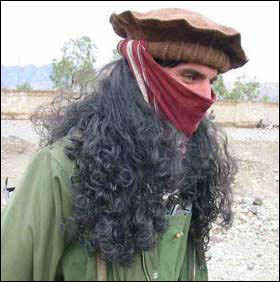
Any Afghan vets recognize this look? If this cat were driving a motorbike in Zabul Province he would be shot on sight. The bob haircut, moustache, dead eyes, and bracelets mark him as Taliban, a contract killer or both. Tim of Panjwayi made him instantly and spent a good 15 minutes trying to chat him up, shake his hand, in short let him know we know and that not all the internationals here are clueless. It pissed our man off; amused the other Afghans who are normally intimidated by guys like this. It is not like us to let a shitbird like this slide by when he shows up wearing colors.

*****

Baitullah 'Hairball' Mehsud

Baitullah ‘Hairball’ Mehsud

Is a leading militant in Waziristan, Pakistan and the leader of the Taliban umbrella group, Tehrik-i-Taliban Pakistan, formed in December 2007.

Sunday, July 19, 2009

Industry Talk: Pentagon Lays Out Detailed Regulations for Security Contractors

Filed under: Industry Talk — Tags: , , , , , — Matt @ 2:48 AM

   Wow, Max Weber eat your heart out. lol Good job to the Defense Department and this is a great step.  Congrats to all those that have been involved with pushing this through and giving the government the guidance necessary to make this a reality.

   Hopefully between now and August, some Kaizen will be applied to this document so it truly is something we can rally around and it will be interesting to hear what the voices in the industry have to say about it.

   As to the next crucial step–have enough regulators to actually enforce this stuff.  I know I am asking for too much, but if you want a quality product, the government is going to have to step up and monitor this stuff.  I do not advocate micro-managing, but I do advocate visiting all the sites out there where contractors are posted or driving at and get involved a little.  Get some shared reality and understand the job at hand for this industry, so you can apply these regulations with a little common sense.  We are not out there to do bad, we are out there because we want to protect the customer and represent the cause. –Matt

—————————————————————–

Pentagon lays out detailed regulations for security contractors

By Elizabeth Newell

July 17, 2009

The Defense Department released an interim final rule Friday laying out policy regarding the use of private security contractors in war zones.

The interim rule, which is effective immediately, modifies the Code of Federal Regulations to include policies and procedures for selecting, training, equipping and overseeing private security contractors.

The Office of the Undersecretary of Defense for Acquisition, Technology and Logistics, which filed the rule, wrote that it is “of critical importance” to address insufficient policy and guidance regulating the actions of security contractors working for Defense and other agencies in war zones.

“It will procedurally close existing gaps in the oversight of private security contractors, ensure compliance with laws and regulations pertaining to inherently governmental functions, and ensure proper performance by armed contractors,” the rule stated.

The rule requires combatant commanders to develop detailed guidance for security contractors operating in their geographic area of responsibility. The guidance must address a range of specific issues, from ensuring private security contractors have the proper training and certification to carry weapons to coordinating communication between PSCs and military forces.

The rule, which is open for comment until Aug. 13, states that private security contractors must document and report incidents involving weapons discharges, attacks, deaths or injuries of PSCs or as a result of action by PSCs, or destruction of property. The contractors must also report any active, nonlethal countermeasures taken in response to a perceived threat if that incident “could significantly affect U.S. objectives with regard to the military mission or international relations.”

In filing the rule, Defense officials said the timing was critical, as the increase of troops in Afghanistan will result in a corresponding rise in the number of private security contractors there.

Doug Brooks, president of the International Peace Operations Association, which represents private security firms, said the rule codifies practices Defense has been implementing for awhile. It makes sense to formalize lessons learned in Iraq so they can apply in Afghanistan, he said. Until now those lessons have been addressed piecemeal through amendments to contracts with security firms.

“A lot of the contractual issues have been largely sorted out in Iraq, but we’re seeing them pop up again in Afghanistan,” Brooks said. “They’re going to have to be sorted out in Afghanistan, which can be a little bit of a painful process, so this is good.”

Erik Quist, general counsel for EOD Technology Inc., a Tennessee-based firm providing security and ordnance disposal services, agreed that most of the rule’s requirements mirror what Defense has been writing into security service contracts.

“It’s not new, it’s not burdensome and the fact that there is now, at this level of government, an official articulation and direction of the process, that’s very important,” Quist said. “If we know what the process should be we don’t have to fret that if something’s absent from our contract, we won’t know what to do. Institutionalizing these requirements under the pending new rule is an important part of the overall effort to protect the taxpayer’s best interests while at the same time establish a process to utilize the very valuable role private security companies can play in supporting the government.”

Story here.


Friday, July 17, 2009

Industry Talk: Wall Street Goes to War

Filed under: Afghanistan,Industry Talk,Iraq — Tags: , , , , , , — Matt @ 5:05 AM

     Well if you want to know the DynCorp story, read this sucker.  As a contractor, we are so removed from the world of the CEO’s, investors and upper level management, and reading this article made that reality very clear.  I wonder if these guys have any ‘shared reality’ with their company?  Do they visit with the guard force in Qatar, or hang out at the mechanics shop at some airbase in Afghanistan or Iraq?  Or how about hang with the police advisors that are all over the world, or drive along during a poppy eradication mission in Afghanistan? Who knows, and for those that have worked for DynCorp, this story is for you. (some reverse shared reality I guess)

   And if any of you bigwigs with DynCorp are reading FJ, all I would like you to know is that your contractors/employees are your best asset out there–take care of them.  You are making a lot of money off of their hard work and sacrifice, and the least you can do is show them some respect and take care of your people.  I understand the concept of free market capitalism, and completely support it.  But that is not everything in life, and please take note, the most respected companies in the world do an excellent job of taking care of their people while still remaining profitable and providing an excellent service/product.

    The goal of any company in the defense industry should be to achieve what Google or Toyota has accomplished, and that is acceptance and respect.  To have your company’s name stand for something good, and not bad, should be your goal.  Be the company that contractors want to work for and customers want to do business with. And because most of DynCorp’s work is US government related, be the company that taxpayers feel is a good value. Be the company that a reporter could write about, and be in awe of it’s operations and total dedication to Kaizen and customer service/satisfaction.  And if you are profitable, there is no reason in the world to not take a little of that and invest the time and money into the little details that could make you the best.

     Maybe Forbes will write an article about a defense company like that some day? Some day….. –Matt

——————————————————————

Wall Street Goes to War

Nathan Vardi

Forbes

For 19 years Robert McKeon and Thomas Campbell were inseparable. They raised money and struck deals together, buying and selling dozens of companies, often in the defense sector–smallish outfits such as Athena Innovative Solutions, Integrated Defense Technologies and Vertex Aerospace. Working 12-hour days out of next-door offices in midtown Manhattan, they could hear each other’s phone conversations and knew the most personal details about each other. They golfed together, went skeet and trap shooting, traveled together for meetings and once shared a hotel room in Mexico. On Fridays they would dine, just the two of them, at Harry Cipriani, the ritzy Manhattan restaurant. “I believe we were pretty close to best friends,” says Campbell.

They also hatched the most lucrative deal of the wars in Iraq and Afghanistan. Their 2005 purchase of DynCorp International, the Falls Church, Va. provider of services to the U.S. military, landed McKeon and Campbell at the center of a booming and controversial business. The leveraged buyout also helped rip apart their relationship. McKeon ended up very rich, personally earning $350 million, or seven times his investment, and in control of a company that has emerged as the biggest winner in the war game. Campbell, forced out of DynCorp, came away with very little and has started over. Today the two former friends are locked in mortal combat–trading accusations of greed and betrayal in protracted litigation and competing for $25 billion a year in battleground services contracts for the U.S. government.

Battlefield contractors have been around for years. But their importance has grown in post-Cold War defense spending. Roughly 240,000 contractor employees, many of them foreign nationals, support U.S. missions in Iraq and Afghanistan, outnumbering the troops they serve. They provide security, military and police training, logistics and air support, reconstruction and every mundane service it takes to feed, clothe and clean fighting forces–collecting some $100 billion of the $830 billion U.S. taxpayers are on the hook for in the two wars. Though they don’t operate under the same rules of engagement as the U.S. military, contractors risk their lives; 1,360 of them have been killed and 20,000 injured in the two war zones.

(more…)

Wednesday, July 15, 2009

Building Snowmobiles: Franklin ‘Chuck’ Spinney Talks about Afghanistan

   This was an interesting article, because Chuck was analyzing the situation much like Boyd would have.  And of course Chuck is a member of Boyd’s Acolytes, so I thought this to be certainly befitting of this category.  Enjoy. –Matt

—————————————————————–

Float Like a Butterfly, Sting Like a Bee

The Taliban Rope-a-Dope

By FRANKLIN SPINNEY

July 14, 2009

On July 7, the Times [UK] carried a remarkable report describing the trials and tribulations of the Welsh Guards, who are now engaged in the ongoing offensive against the Taliban in Helmand Province, Afghanistan. It described in riveting detail how accumulating mental and physical stress are grinding down the bodies and minds of what are clearly highly-motivated, well-trained, and competently-led troops. My aim is to elaborate on the Times report by examining its information from a different perspective. My hope is that this will provide a better appreciation of the Taliban’s game.

With the exception of the last sentence in the penultimate paragraph (i.e., “The Taliban fight not to win but to outlast”), which is silly, the Times provides a graphic description of the pressures on the individual British soldiers, and it is an excellent window into the effects of the Taliban’s military art. The information suggests the Taliban’s strategic aim is to wear down their adversaries by keeping them under continual strain and by working on their psychology, or as the late American strategist John Boyd would say, by getting inside, slowing down, and disorienting their adversary’s Observation – Orientation – Decision – Action (OODA) loops. Moreover, the Taliban’s operational art seems particularly focused on the mental and moral levels of conflict. Outlasting, by running away to fight another day whenever faced with superior forces, is a central part of any winning strategy directed toward achieving this aim. (Interested readers can find a brief introduction to OODA loops in the last section of my remembrance of Boyd in the Proceedings of the Naval Institute, Genghis John.

(more…)

« Newer PostsOlder Posts »

Powered by WordPress