Feral Jundi

Tuesday, November 20, 2012

Industry Talk: Erik Prince Starts Africa Focused Investment Firm With Frontier Resource Group

Prince, who credits the Navy SEALs with bringing out his entrepreneurial spirit, said there were two main risks that perhaps every businessman in Africa must face.
The first one is the political risk in some countries, and the second is the very bad transportation and infrastructure, which means a high cost of doing business there.
“If you can’t get to market cheaply enough, that’s not interesting,” Prince said.
Many foreign investors came to Africa purely for its natural resources, he said, but they forgot that transporting those resources was as important as exploring and producing them.

This is interesting news. As I mentioned before in prior posts, Africa will be a top focus for PMSC’s just because of all the business and resource extraction potential there. A company like Frontier Resource Group can easily be the company that can link the investors with those PMSC’s that could protect and insure those investments in Africa. Or at the least, FRG can help to identify those investments with the highest chance of success based on the risk assessments done by FRG.

The mention of Chinese investors partnering with FRG is key as well. I mentioned in prior posts about an increase in business for South African PMSC’s or consultants from the Chinese, and it would make sense that Prince would want to step in and serve this particular group of investors. –Matt

Website for Frontier Resource Group here.


Into Africa: Ex-navy SEAL sets trail for investors
November 19, 2012
By George Chen
Erik Prince of Blackwater fame has set up a company that will be the ‘search radar’ to help firms manage the risks of investing there
The man who built up Blackwater – the giant private security force that guarded US diplomats in some of the world’s most dangerous places, including Afghanistan and Iraq – sees Africa as his future.
After Erik Prince sold his firm to investors about two years ago, the former officer in the Navy SEALs – the special US military force that killed Osama bin Laden last year – set up a new company called Frontier Resource Group (FRG) early this year.
FRG is an Africa-dedicated investment firm partnered with major Chinese enterprises, including at least one state-owned resource giant that is keen to pour money into the resource-rich continent.
“Africa is so far the most unexplored part of the world, and I think China has seen a lot of promise in Africa,” Prince said during a brief trip to Hong Kong last week to meet potential Chinese investors and partners. “But the problem is if you go alone, you bear the country risk on your own. You have to get support and maintenance there,” Prince, FRG’s managing partner, told the South China Morning Post in an exclusive interview.

(more…)

Sunday, November 18, 2012

Africa: LAPSSET–A Massive Oil Project That Is Gaining The Attention Of PMSC’s

Filed under: Africa,Kenya,Sudan — Tags: , , , , , , , — Matt @ 10:46 PM

G4S said it was looking at oil and gas based prospects in countries like Guinea-Bissau, Nigeria and South Sudan, where a huge oil pipeline could be built through Kenya to a port there in order to bypass bitter disputes with neighbouring Sudan.
High potential mining opportunities are also in countries such as Botswana, Ghana, Namibia and Tanzania.
The company expects to move into Ethiopia, Libya, Somaliland and South Sudan in the next year…-Interview

…To reduce its reliance on Khartoum, the South Sudanese government has announced a 2,000 km pipeline, at a cost of $3bn, through Kenya to its port of Lamu. G4S is one of the companies vying to help secure this vital source of South Sudanese revenue… -separate source–see below

I had picked up on this project through some stories I was reading in regards to the future of this industry. That the companies are looking for business in resource rich Africa, and much of that business revolves around energy related projects.

This particular project grabbed my attention, just because of how ambitious it is and how involved the security for it would be.  Because once this is up and running, all aspects of LAPSSET will be a big target for criminals and terrorists. Especially the 2000 km of pipeline they plan on building.

So this should require the services of multiple PMSC’s to help in all aspects of securing this thing. I also imagine that some kind of oil police apparatus will have to be established, which will then require training facilities with instructors. We will see how it goes, and if any readers have any other details about this massive project, feel free to comment below. –Matt


Lamu Port and Lamu-Southern Sudan-Ethiopia Transport Corridor
The Lamu Port and Lamu Southern Sudan-Ethiopia Transport Corridor (LAPSSET) aka The Lamu corridor is a transport and infrastructure project in Kenya that when complete will be the country’s second transport corridor. Kenya’s other transport corridor is the Mombasa port and Mombasa – Uganda transport corridor that passes through Nairobi and much of the Northern Rift.
The project will involve the following components:
-A port at Manda Bay
-Standard gauge railway line to Juba (capital of South Sudan)
-Road network
-Oil pipelines (Southern Sudan and Ethiopia)
-Oil refinery at Bargoni
-Three Airports
-Three resort cities (Lamu, Isiolo and Lake Turkana shores)
The project was initially conceived in 1975 but never took off due to various reasons. The project was later revived and included in Kenya’s Vision 2030. LAPSSET cost was estimated to cost $ 16 Billion in 2009. Recent estimates arrived after studies now put the cost of the project at between US $ 22 Billion and US $ 23 Billion.
The timeline of the project is not clear including when it started and when it should be finished. Some projects like the Isiolo-Merille projects began in 2007. At the peak of the project, between 2013 and 2018, it is expected that the Kenyan government will be spending about 6% of the country’s Gross Domestic Product or 16% of its annual budget on the project. The project is in turn expected to contribute an additional 3% increase in Kenya’s GDP by 2020.
Key towns in the project are Lamu & Isiolo in Kenya, Juba in Southern Sudan and Addis Ababa in Ethiopia.
Wikipedia for LAPSSET here.
—————————————————————-
Lamu port project launched for South Sudan and Ethiopia

March 02, 2012
There have been protests against the port by some environmentalists and residents of Lamu island
Construction has begun on a $23bn (£14.5bn) port project and oil refinery in south-eastern Kenya’s coastal Lamu region near war-torn Somalia’s border.
An oil pipeline, railway and motorway will also be built linking Lamu to South Sudan and Ethiopia.
Newly independent South Sudan plans to use Lamu as its main oil export outlet.
A BBC reporter says security concerns for the project may explain the presence of Ethiopian and Kenyan troops in Somalia aiming to pacify the region.
‘Biggest African project’
Kenya’s leader Mwai Kibaki launched the project along with his South Sudanese and Ethiopian counterparts, Salva Kiir and Meles Zenawi respectively.
“I have no doubt that this day will go down in history as one of the defining moments – when we made a major stride to connect our people to the many socio-economic opportunities that lie ahead,” AFP news agency quotes Mr Kibaki as saying at the inauguration ceremony.
Known as Lamu Port South Sudan Ethiopia Transport Corridor (Lapsset), it is expected to be completed within four years with initial costs coming from the three governments and plans to attract international investment.
Steven Ikuwa, the administrator in charge of Lapsset, told the BBC the scale of the plans was huge.
“I am proud to say this is one of the biggest projects that we are carrying out in Africa.”
The BBC’s Noel Mwakugu in Lamu says there are worries about the impact of the project on Lamu district, which is one of East Africa’s most beautiful and relatively unspoiled environments along the Indian Ocean and includes a cultural heritage site on Lamu Island.
“Lamu is a living heritage. Already Unesco has declared Lamu a World Heritage Site – as an endangered site,” Mualimu Badi from the Save Lamu group told the BBC.
“If 500,000 people come to work as workers, we stand to lose that status.”
Mr Badi also said local residents fear they would be made homeless by the project as most people in the area are unable to prove their right to live in their homes.
In response to these complaints, Mr Kibaki has announced that residents will be issued with land title deeds and his administration will provide training for 1,000 young people to prepare for future opportunities presented by the port.
Oil export alternatives
Our correspondent says Lamu’s 32-berth port will be five times larger than Kenya’s only other Indian Ocean port, Mombasa – which has been struggling to serve the needs of landlocked countries to the south and west of Kenya.

(more…)

Wednesday, October 31, 2012

Publications: Contractor Support Of USCENTCOM AOR, 4th Quarter FY 2012

The interesting part of this report is that there is very little change from last quarter as far as the overall numbers. In the 3rd quarter, there were 136,901 contractors overall, and in this quarter there are 137,407. So it is an increase, but by a small margin.

The other thing that jumped up at me was that contractor numbers actually increased in Iraq. In the third quarter we saw 7,336 and in this quarter we see 9,000!

We also see some numbers for the APPF force which was supposed to replace contractors in Afghanistan. The statistic that perked me up was the amount of ‘risk management consultants’–220– that was required to watch over the 2,407 APPF folks. These risk management consultants are contractors that represent the companies, and it is just funny that with all of this attention placed on the APPF being the solution, that they still need that many ‘consultants’. lol

The other interesting statistic is the Private Security numbers, or the armed contractors in both Iraq and Afghanistan. In Iraq, there is more use of security contractors from other countries other than the US. The local national use really hasn’t changed that much.

In Afghanistan, you see an increase in US private security use. In the 3rd quarter we saw 480 US security folks, and in the 4th quarter we see an increase to 2,014! Now I am going to speculate that perhaps the reason for this, is the increase in insider attacks and an increase in using Americans to guard FOB’s. The military is wanting to hand over the security of these bases so that it can save some money and use the remaining manpower for training missions or combat support for their other operations out there. –Matt


Contractor Support Of USCENTCOM AOR, 4th Quarter FY 2012

Wednesday, August 31, 2011

Cool Stuff: Feral Jundi Reaches A Key Milestone–One Million Page Views!

Filed under: Blogs,Cool Stuff — Tags: , , , , — Matt @ 2:15 PM

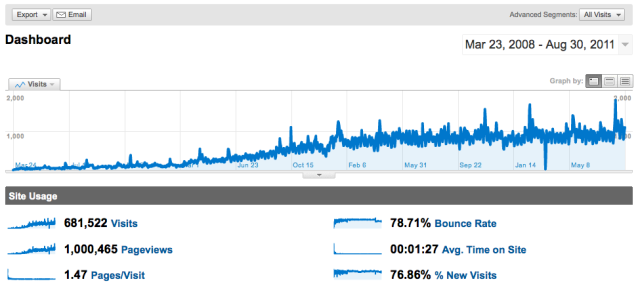
Yep, you heard that correctly. One million page views! This is great milestone for the blog, and I couldn’t have done it without such a fantastic readership.  It also shows how important a brand is, and having the right architecture to support that brand.

I would have to say that the most important lesson learned is focusing in on really good content. Then use the blog’s RSS, Twitter, Facebook, and Linkedin to get it out there so people know the post exists. That is extremely important these days, just because there is a ton of information for the user to access these days, and the reader’s time and attention can be difficult to capture. This blog definitely competes with the media in this regard, but I am grabbing market share or readership.

The future is only looking on the up and up for the blog. I recently did some work to improve upon the mobile version of FJ, and I expect that to pay big dividends. My theory with this is that everyone is carrying smart phones these days, and it is very easy for someone to pull out their device during the little breaks in their life and check out what is going on at the blog. Standing in the line at the supermarket, sitting down at a doctor’s office, taking a break at work, etc., all of these are the times when folks look for something to keep them occupied or are just curious about what is going on in the industry.

What is also interesting is that more and more contractors and soldiers are using these devices out there.  As long as they have access to a wifi point, they can surf the web and check out their favorite spots online. So it is a pleasure and an honor to provide a place for this industry to hang out at and stay informed.

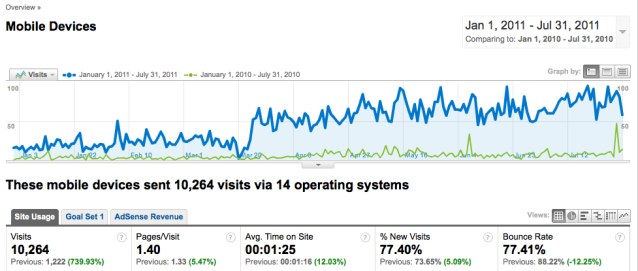
As to the chart below, the one spike downward was when I had to switch to a new theme and upgrade the platform. But as soon as everything was up and running again, the blog did just fine. It was kind of hectic though, and it was the equivalent to doing brain surgery–or so it seemed. lol –Matt


Monday, August 29, 2011

Mobile Apps: Feral Jundi Upgrade For Mobile Viewing

Recently I have been doing some research on the statistics of the blog and stumbled upon a startling figure. Feral Jundi has had a massive increase in traffic from mobile devices like iPhone, Android, Blackberry, or from tablets like iPad. Here is a screen shot of what I am talking about. The key figure here is that the blog went from 1,222 visits from mobile devices in 2010 from Jan to July, to 10,246 visits during the same time period this year. That is a 739 % increase!

The top 5 devices used, and in this order were iPhone, Android, iPad, iPod, and BlackBerry. So with this data, I decided I needed to upgrade and improve upon the mobile version of Feral Jundi.  After doing some research and shopping around, I finally settled upon a company called Brave New Code that makes some software that converts blogs into mobile websites. The set up is called WP Touch Pro, and I am very happy with the final product. I paid $39 for it, and it was a good investment in my view. (disclaimer–I am now an affiliate for WP Touch Pro because I like it so much!)

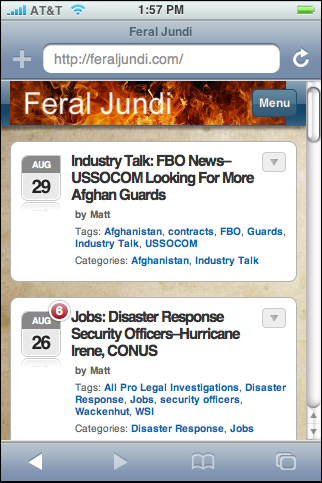
I went with the Pro version, as opposed to the free version, just because it had some features that I really liked. Plus you get access to their support. The only tweaking I had to do to make it work with my blog is to modify my Quick Cache plugin. In their forum, they talk about exactly how to do this, and it was easy to do. Here is a screen shot of the home page as it would look on iPhone.

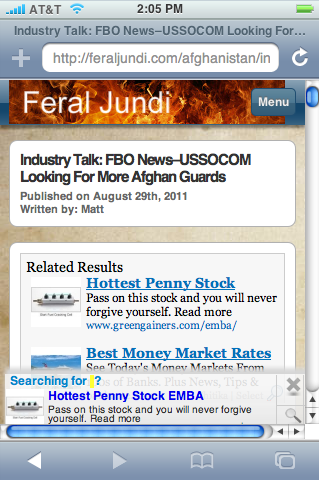
So I figured I would highlight some of the features of this thing. If you want to read a post you can click on the title and the whole thing will pop up. Or you can see just a teaser of the post by clicking that arrow button just to the right of the title. But once you get to the actual post, here is a screen shot of that.

In order to read the post, you will have to touch that right side scroll bar and move it down to check out the post. The Chitika ads are both from the website and the mobile ads. the little Chitika ad in the footer will continue to slide down as you read, or you can remove the ad by pressing that X on the ad.  Or if you want to check out that ad, just tap it and you will be able to check it out. At this time, the blog’s Ad Center is not available for mobile. I might play around with this and see what I can come up with in the future. Just check into the Advertising Page up top to find out any news about that kind of thing, or just contact me.

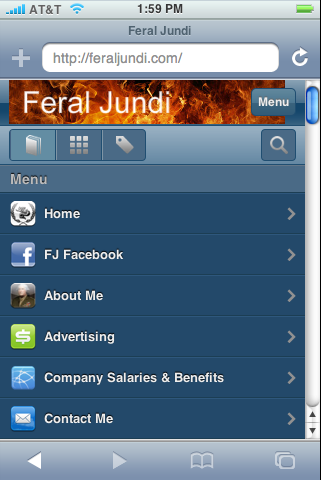
Now the other feature is the Menu, which is a button located in the header at the right side. To check out the Menu, just tap it with your finger and you will get this page.

Pretty self explanatory  here, and I will let the reader explore what they want from here. The book, blocks, and tags graphics are the ‘menu’, categories, and popular tags of the website. So if you want to go back and explore old posts in the archives, that is how you can do it. You can also use the search feature which is a graphic that looks like a magnifying glass.

Some other cool stuff is the comments are indicated by the red dots with numbers in them, indicating how many comments for each post. You can still make comments by following along with the post and scrolling down to the bottom. You also have several means of sharing the post, either by using the ‘share’ button between the post and the comments, or you can click the Twitter, Linkedin, and Facebook buttons at the top of the post.

Finally, and this is a cool little deal that I have been playing around with lately. I have come up with a Seal of Feral Jundi. This is something I can use for publications, icons, favicons, etc. Also, this is the homepage icon for FJ, and this new mobile platform will prompt folks to put it on their phone. This makes it very easy to go right to FJ when you want to read it. (if anyone has the old icon, just delete it and re-do the whole process to get the new icon on your mobile device or tablet. Here is a picture of the icon.

The meaning behind this seal is pretty basic, but unique. The Laurel symbolizes education and victory. The serpent swallowing the person is called the Biscione. It has different meanings to different users of the symbol, but for me, I like the Visconti family history of the symbol. It represents to them a serpent that attacked a village, and the Visconti family destroyed that serpent, and was famous for doing so. So for my purposes, the serpent represents evil or the enemy attacking the innocent, and this blog’s dedication to fighting that. And finally, the crown symbolizes leadership.

I might play around more with the concept, but so far I like it. So enjoy and I appreciate any feedback. The folks on Facebook have visited the site on different mobile platforms, and so far they said it is working. –Matt

« Newer PostsOlder Posts »

Powered by WordPress