Feral Jundi

Wednesday, September 1, 2010

Weapons: Northrop Gets C-RAM Task Order For Afghanistan

     I put this one up because this is kind of surprising. Anyone that has done time on the big FOBs in the war will know what a C-RAM is after hearing the thing go off.  It is a loud and obnoxious automated mini-gun that blasts incoming mortars and rockets out of the air. Bottom line, they save lives.

     What is surprising though, is how involved contractors are in this process. According to this contract, Northrop will be providing personnel to operate these things in Afghanistan.  I would think that there were military folks operating the system along with, but still, that would be a pretty damn cool job to have?  Not to mention the lives you could potentially save as you zap those enemy munitions out of the sky! Here is a video of what I am talking about. –Matt

——————————————————————

Northrop Gets C-RAM Task Order

September 1, 2010,

Los Angeles-based leading shipbuilder and defense contractor Northrop Grumman Corporation has received a $68 million contract from the Scott Air Force Base, Illinois based Defense Information Systems Agency. The company would provide personnel for operating Counter-Rocket, Artillery and Mortar (C-RAM) systems at forward operating bases in Afghanistan supporting Operation Enduring Freedom. The task order has a total potential value of $219 million collectively over a period of three years.

The contract will boost Northrop Grumman’s Defense Systems business part of its Information Systems segment. The segment provides information technology (IT) systems engineering and systems integration solutions for the Department of Defense, national intelligence, federal civilian, state and local agencies, and commercial customers. Products and services are focused on the fields of command, control, communications, computers and intelligence; air and missile defense; airborne reconnaissance; intelligence processing; decision support systems; cybersecurity; information technology; and systems engineering and systems integration.

(more…)

Industry Talk: Policing Foreign Subcontractors And Contractors Is A Problem For NGO’s, PMC’s And The UN

And, sir, we fired him, we fined him, but we as a private organization can’t do any more. We can’t flog him, we can’t incarcerate him. That’s up to the Justice Department. We are not empowered to enforce U.S. law. -Erik Prince Testimony Before Congress, 2007

*****

   This is an excellent little article below, and the quote up top kind of sets the stage for the problem that needs solving. I should note that this is not just a problem for PMC’s in Iraq and Afghanistan, but for NGO’s and the UN as well. So while reading this, understand that the lessons learned here could also apply to those other organizations out there that work in foreign lands and depend upon contractors and their subcontractors to get work done. Governments that depend on the services of these organizations need to figure this stuff out as well, because they stand to lose much if their mission is hindered or threatened by the actions of contractors and subcontractors.

    As you can see with Erik Prince’s famous testimony, that pretty much says it all.  I have yet to work for a company that had it’s own prison or set of laws to abide by. The laws we were to follow were that of our host nation, or the laws applied by whatever nation the customer we worked for belonged to. Each contractor’s country has laws that could also be brought into the mix. But when it comes to actually applying the rule of law to contractors who do wrong, that is when things get all screwed up. It gets really screwed up, when a contracting company uses ‘subcontractors’, because that adds even more confusion.

    So really, like Mr. Prince said, all companies can do is fire that individual, fine that individual, and notify the customer that contracted their services that this happened. Companies in Iraq and Afghanistan also have a difficult choice between wether or not they should tell the police of those countries. Especially during the different phases of the war or if that country is a failed state.

    In the early phases of the wars, most companies would not hand over their employees to weak or failing governments for prosecution.  In a way, that would be a worse crime than whatever that contractor did. It does happen though. An example of that is the corrupt justice system in Afghanistan that is currently holding contractors and giving them punishments that are far more extreme than the supposed crime they committed. Or falsely arresting contractors and extorting them.  With that kind of twisted legal system, why would a company hand over a contractor or subcontractor to such a system? (unless forced to because of some political mess created by the customer a company is serving)

    Which goes back to the customer.  In today’s war, the customer has usually been the US government.  So why haven’t DoD, DoS, or USAID applied any kind of rule of law or punishment to contractors and subcontractors in the course of the war? That is a great question, and I haven’t a clue why the media and critics continue to blame companies for the lack of action on the part of these customers.  It’s as if government has no responsibility in this matter, and the companies continue to be the fall guy. But companies continue to take contracts because no one wants to solve the problem or accept responsibility for any criminal outcomes do to a lack of rules/laws. See how the cycle works? lol

     But of course NGO’s and the UN are in the same boat as PMC’s.  They too operate in foreign lands, and they hire contractors and their subcontractors and have to face the same legal issues as well.  But they are the ‘good guys’ and they get no mention at all by the critics? Pfftt. That is why all parties in this discussion could learn from each other as to the best way forward.

     One solution is for countries to start issuing licenses or letters of marque again. I look at these documents as a connection between the law makers of a country, and the private industry or organizations that want to do work for those countries either locally or abroad. For this to properly work, two licenses would be needed–one from the host nation, and one from the parent nation of that company or organization. If the host nation is a failed state or in the middle of a war, then all that would be required is one license from the country paying the bills. And really, one license is all that is needed, but hey, if the customer wants you to have a license from the other country you are operating in (depending on the state of said country), then so be it.

     For NGO’s, they would be issued licenses by the countries they wish to help.  It would be a similar to a SOFA that is signed between two nations for militaries.  Call it a SONA or status of NGO’s agreement if you will.  I just call it a license to operate in that country, or letter of marque. This license would be a set of rules and laws that an NGO could look to as guidance, and it would also be something they could pass on to their workforce (contractors/subcontractors) as to what the deal is. Of course in this system of operation, all who are involved must know what they are getting themselves into when they sign on as a contractor.  That means the local national, expat, or third country national work force would have to know the rules and laws that apply to them directly. For each type of contractor, the license should also state what applies to them as well. Of course a local national already falls under the laws of that country, but the license can dictate what the company or organization has to do in the case of contractor wrong doing.

     As for the UN, perhaps they could be the issuer of a LoM as well? If they are truly representative of nations throughout the world, then a LoM from this type of organization should come from the blessings of all of these nations. Perhaps the security council would be the issuing authority, and before any contractor could be used by the UN, they must have this license (and a license from the host nation if the council deems necessary)?  Of course within the language of the license would be the outline as to what would be done to a contractor or subcontractor if they committed minor offenses, all the way up to murder or rape?

      The other reason why I like this licensing system, is that this is a direct connection between the law makers of countries, and private industries/organizations. I envision lawyers from both a company/organization and a government going into a room, and hashing out exactly the terms of the license. A logical outcome from that discussion would be a set of laws that would satisfy the requirements of that country and allow companies/organizations to provide a service.

     I would also put expiration dates on a license or mechanisms that would automatically expire the license, just as a means of control.  This was crucial to early usage of privateers when the Letter of Marque was used back in the day. The modern use of such a thing should also have contract limits and other stop gaps so things can be reevaluated and adjusted as conflicts and missions change.

      What is interesting about this system, is that at least some rule of law can be decided upon between two parties and the contractors and subcontractors that are hired under such a system would know exactly what would happen to them if they broke the laws outlined within the license. The license negotiations could also have military lawyers involved as well, so that the strategies used by military planners will not be hindered by the terms of the license.  Get all the legal guys in a room, and get it done.  Millions if not billions of dollars are at stake, the reputation and objectives of all involved are on the line, and the safety and health of all involved could all depend upon the rules and laws laid down by such licenses. Other than that, I don’t know of much else that countries and companies/organizations could agree upon to get the job done and insure some rule of law is applied to the process?

     Another component of the license that would be very important, is verification.  A trust by verify system that ensures companies and organizations are actually abiding by the terms of the license/laws.  That would require monitors, which seems to be what everyone is screaming about for much of today’s contracting issues already. So the party issuing the license, would have it in their best interest to insure monitors are available per contract/subcontract to insure everything is done right.

     Violations of the laws and rules within the license, would also be defined by the license itself. If a contractor or subcontractor wants to work for that NGO, PMC, etc., then they are also falling under the terms of that license. That means you could now be a criminal to whomever issued the license, if you violate the law you in signed on to follow. Letters of Marque are mechanisms that other countries would have to recognize, much like countries recognize each other’s borders or governments, and basically these companies and organizations would be flying the flag of customers, and abiding by the laws/rules set forth in the license. As a contractor, you play under those laws until you are done with the contract. If the license was set up properly, the scenario spelled out by Mr. Prince would then have one more element, and that is the requirement of the company to abide by the license/laws.

     But like I have said before, these issues of the rule of law would be decided upon by the law makers of countries and the lawyers of companies and organizations through meetings and negotiations. Just some food for thought, and I am sure there are other ideas of the way forward as well.

     By the way, it is funny how I continue to go back to this very simplistic licensing system that nations used to use for hundreds of years. I laugh because we are expending so much energy in trying to ‘reinvent the wheel’ when it comes to this stuff, and all we have to do is look to the past for the lessons learned. –Matt

——————————————————–

The Struggle to Police Foreign Subcontractors in Iraq and Afghanistan

Billions at Stake, but U.S. Investigators Stymied by Murky Rules, Enforcement Obstacles

By Nick Schwellenbach and Lagan Sebert

August 29, 2010

To win hearts and minds in Afghanistan and Iraq, military experts want U.S. companies to contract with local firms for a variety of tasks like trucking, feeding troops, and providing security. The U.S. government’s “Afghan First” and “Iraqi First” initiatives increasingly seek to rely on local contractors, often through subcontracts, in part to stimulate their local economies.

(more…)
Friday, August 20, 2010

Industry Talk: Stability Operations Industry–Opportunity And Risk, By Bullet Proof Blog

     I liked this article, and it is a concept that all of the companies need to really wrap their heads around in today’s times.  It is all about crisis communication, and it sounds like Mr. Levick is the guy to talk to about doing this kind of thing.  What is cool is that he has plenty of contractor history to learn from and he is also reaching out to individuals in the industry like Doug to get a feel for what’s what.

     This article also goes well with the interview Mr. Levick did with Doug Brooks, so I recommend watching that if you can.

     Now something I would like to hear from the author is how he would have dealt with the Nisour Square incident differently than how BW and State dealt with it back then?  Most of all, how would his firm handle the crisis management for such an incident if it happened again in the near future? He briefly touched on this contractor army that DoS plans on using in Iraq, but I would have liked to hear some details on how a true crisis management expert would handle the complexities of this industry’s incidents that tend to get so much attention.  We need all the help we can get, because no easy solutions have materialized and companies are still getting sucked into crisis that not only embarrasses them, but embarrasses their clients as well. These incidents also negatively impact the war effort, and it is certainly important for companies to not cause that kind of harm.

     As to an example of current crisis communication, DynCorp actually sent me a company release about the auto accident in Kabul.  But because of the speed of information spread in Kabul and online, and how the negative aspects of the news spread, I just don’t know how you can stop the impact of such a thing?  Or maybe DynCorp did all they could and this was the way to do it? They certainly responded quickly online to those of us trying to cover this stuff, and at least attempted to fill any information gaps that biased media or even the enemy was trying to fill with their own versions of the story.  I wonder how he would rate DynCorp’s crisis management and communications, both in Kabul and online? How would you guys rate it? Interesting stuff. –Matt

—————————————————————–

Stability Operations Industry: Opportunity and Risk

Richard Levick

August 18, 2010

For one not uncontroversial sector of the defense industry, President Obama’s recent reaffirmation of a timetable for Iraqi troop withdrawal means new business opportunity, accompanied by heightened scrutiny — and predictably severe penalties for failure to comply with professionally, as well as politically, dictated operational standards.

The industry in question is called “stability operations,” a broad term that denotes activities by private contractors to support military, peacekeeping missions and disaster relief. To ensure safe and secure environments outside the United States, their multifarious deliverables include protecting vital infrastructure, training indigenous military and non-military forces, responding to emergencies, body-guarding key personnel, overseeing project logistics, assuring medical provisions, demining hazard zones — and so forth.

During the Iraq War, unwanted attention fell on a few such companies amid allegations of fraud and abuse. Now that the West’s role in the war is largely ending, and the role of the industry in Iraq will grow apace, those past mishaps are going to have a strong continuing influence on public perception. Fairly or not, the bigger the future role of the contractors, the more mistrust they can expect to engender.

(more…)

Thursday, August 19, 2010

Legal News: MPRI The Target Of Class Action Lawsuit For Operation Storm

    Interesting case, just because it kind of highlights some history about Operation Storm and the work MPRI was involved with. I wouldn’t mind hitting on this in a future ‘history’ or ‘strategy’ post, because I am sure there are some very intriguing areas to explore when it comes to this operation.  It certainly sounds impressive.

    As to the case, I will not comment too much because I don’t know a lot about either side’s position.-Matt

Edit: 08/20/2010 – David Isenberg has far more to say about this, and the consensus he found is that this is a weak case. David also reported on MPRI back in the day, and interviewed the participants of Operation Storm.  So I tend to think he has this one nailed.

—————————————————————–

U.S. Mercenaries Accused of Abetting Genocide

By ROBERT KAHN

August 18, 2010

     (CN) – A private U.S. defense contractor “trained and equipped the Croatian military for Operation Storm and designed the Operation Storm battle plan,” which killed or displaced more than 200,000 Serbs in 1995, in the largest European land offensive since World War II, the Genocide Victims of Krajina say in Chicago Federal Court. They demand billions of dollars in damages from MPRI, founded by U.S. military officers who were “downsized” at the end of the Cold War, and L-3 Communications, which bought MPRI for $40 million in 2000.”This is a class action brought by ethnic Serbs who resided in the Krajina region of Croatia up to August 1995 and who then became victims of the Croatian military assault known as Operation Storm – an aggressive, systematic military attack and bombardment on a demilitarized civilian population that had been placed under the protection of the United Nations,” the 40-page complaint begins.”Operation Storm was designed to kill or forcibly expel the ethnic Serbian residents of the Krajina region from Croatian territory, just because they were a minority religio-ethnic group. Defendant MPRI, a private military contractor subsequently acquired by Defendant L-3 Communications Inc., trained and equipped the Croatian military for Operation Storm and designed the Operation Storm battle plan. Operation Storm became the largest land offensive in Europe since World War II and resulted in the murder and inhumane treatment of thousands of ethnic Serbs, the forced displacement of approximately 200,000 ethnic Serbs from their ancestral homes in Croatian territory, and the pillaging and destruction of hundreds of millions of dollars worth of Serbian-owned property. The victims of Operation Storm and their heirs and next of kin herein claim that Defendants were complicit in genocide.” (more…)

Wednesday, August 18, 2010

Industry Talk: Karzai’s Decree Regarding PSC’s And The Buzz On The Forums

     This is a translation that I wanted to put up just so folks have something to reference. But what is really cool is all the buzz on the forums about this one.  Lots of opinions all over the place.

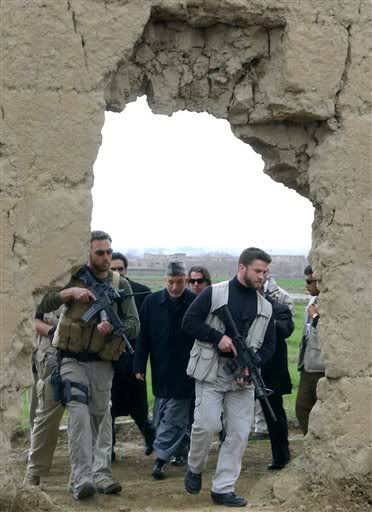
     The photo below is a mystery.  I have no clue if these guys were PSC’s or not.  But what the photo symbolizes is all the years that good men like them spent putting their lives on the line for Karzai. Do you think he even thanked them for their protective services? –Matt

Edit: 08/23/2010 – Tim wrote up a great post on the subject, and has a better translation of the decree.  Check it out here.

—————————————————————–

Karzai

Afghan President Hamid Karzai, center, is surrounded by heavily armed bodyguards as he arrives for a groundbreaking ceremony in Parwan, some 34 miles, 55kms north of Kabul, Monday, March 14, 2005. Karzai was surrounded by dozens of US security personnel as he attended a ceremony of groundbreaking for a road linking the Panjshir Valley to Parwan in the district of Bayan. (AP Photo/Shah Marai, Pool)

—————————————————————–

President Karzai’s decree regarding PSCs in Afghanistan:

For tackling corruption and ensuring security of our citizens and prevention of security irregularities as well as exploitation of arms and military equipment and uniforms by the security companies which has caused some tragic incidents, after some thorough and legal review I am approving the annulment of foreign and national security companies within four months as per the following conditions.

The members of security companies who can meet the military recruitment conditions of provided that they meet the conditions they can join the police forces with or without their registered arms or weapons. And the Interior Ministry is obliged to annul it within four months from today.

For foreign companies who are registered with IM, if they agree, then the IM, Def Min and NDS will buy their weapons and the resident visas of the foreign members will be cancelled. If the companies do not agree to sell their arms their resident visas will be cancelled and they can leave the country with their arms.

Those companies who are not registered with IM their arms will be confiscated.

Embassies or diplomatic offices, NGOs who are operating in Kabul and provinces can still use their own security personnel within their premises. They should not be visible outside their premises. The number and conditions for this will be spelled out by the IM. The MOI’s must take charge of the external security of embassies,NGOs in Kabul and other provinces.

It is the MOI’s task to implement this decree.

——————————————————————

(You must sign up to read a few of these forum discussions)

SOCNET Forum discussion here.

Tactical Forum discussion here.

Lightfighter Forum discussion here.

Secure Aspects Forum discussion here.

Close Protection World Forum discussion here.

« Newer PostsOlder Posts »

Powered by WordPress