Feral Jundi

Tuesday, July 6, 2010

Iraq: The Falcon Club– Paragliding Over Mosul!

Filed under: Funny Stuff,Iraq,Parachuting — Tags: , , , , — Matt @ 7:51 AM

     This looks fun, but what really makes this unique is that this is a paragliding club in Mosul.  I guess you could call this sport, ‘combat paragliding’. lol Either way, I think this is great and I certainly hope this catches on and becomes a popular sport there. –Matt

——————————————————————-

Mosul Paragliders

Holly Pickett for The New York Times Ziad Abdulsattar lifts his feet when taking off with a parachute with Falcon Club near Mosul.

Paragliding Over Mosul – Because Iraq Just Isn’t Dangerous Enough Already

By TIMOTHY WILLIAMS AND ZAID THAKER

July 1, 2010

Holly Pickett for The New York Times Members of the Falcon Club paragliding near Mosul.

MOSUL, Iraq – The risk-averse will tell you that it takes a special sort of foolishness to jump from a mountain with just a paraglider strapped to your back.

So what, then, does that make the members of the Falcon Club, an Iraqi group of daredevils who sail through the air above Mosul, which is perhaps Iraq’s most dangerous city?

Holly Pickett for The New York Times Ahmed Assad prepares his parachute before paragliding with the group.

As if flying flimsy contraptions in a war zone was not enough, the Falcon Club faces the added danger of having been a favorite of Saddam Hussein – whose former friends and allies continue to be hunted down by Shiite militias and others.

Indeed, their recklessness leaves even the club’s members seeking a reasonable explanation.

“Flying is like a disease,” said Saba Yasin Fathi, 43, the club’s leader and a former Iraqi air force pilot who lost his left pinky finger to a propeller last year. “You do it once, you want to do it again and again.”

So the Falcon Club endures the suspicions of Iraqi soldiers at Mosul’s innumerable checkpoints who have never heard of a paraglider, have never seen a hot air balloon outside of an American movie and who believe — reasonably — that Iraq is dangerous enough without courting death.

(more…)

Saturday, June 26, 2010

Jobs: P.S.D. Team Leader And Security Guard Force Site Manager, Iraq

     More opportunities for qualified guys in Iraq.  For these jobs, you will need to sign up on TSI’s Talent Network.  They did provide a contact email for a recruiter below.  Also read the instructions below about what they are looking for (no former Xe guys).

     I am not the POC or recruiter for this and please follow the links below if you would like to apply.  Good luck. –Matt

——————————————————————

Tigerswan

PSD Team Leader

Position Type:  Full-time Employee

Location:  Iraq

Pay Range:  Approximately $139,937

Summary:  TigerSwan’s PSD Team Leaders are responsible for mission planning and operational oversight during PSD operations throughout Iraq.

Qualifications:

· Must be a US citizen

· Must possess DoD Secret clearance

· 3-5 yrs experience in the security arena

· Must have military or security experience in Iraq

(more…)

Sunday, June 20, 2010

War Art: A Man With A Heart For Stone

     “I can’t understand why people do what they do just from looking in their eyes, but when I see what they make I see different creative views,” said Wagner. “Everybody has a different opinion of how life is, and you can see that when someone is given a piece of stone and turns it into a unit crest, a shot glass, or even just a ball.”

*****

     The reasons why I keep coming back to art on this blog is not only do I enjoy the art itself, but I have a profound respect for the process and inspiration needed to make that piece of art.  It requires analysis and synthesis, and it is a great ‘building snowmobiles’ exercise.

     One of my favorite examples of artists/strategists was Myamoto Musashi.  He was a big fan of art and for good reason.  For problem solving or developing unique strategies, you need a brain that can look at situations from different angles and find multiple solutions.  It takes creativity and the ability to really bend and mix the concepts to come up with unique solutions, much like an artist does on a canvas or with marble.

     Of course you need to know yourself and your enemy, but if your enemy has that same mindset, you must have something a little different in your strategy to gain the upper hand. Getting inside his OODA loop is important too, but what if your enemy is aware of OODA as well? The real winner in this fight, is the one that is able to take all strategies and all inputs, and create a winning strategy that is more effective that your enemy’s. It is something to think about when trying to figure out how a ‘John Boyd’ could defeat a ‘John Boyd’. Having a creative mind is just one factor of many that will help you to get there.

     On a side note, it is also interesting to go back to the patterns of battlefield innovation that I keep seeing. (here, and here)  Where the dominate combatant’s strategy is copied by the weaker combatant’s strategy, and then the weaker combatant adds something to that newly adopted strategy to make it even more effective.  A technological advantage could be one addition, or a multitude of little changes, all born from a different point of view, all from a creative mind. Borrowing brilliance seems to be a good way to go, just like artists get inspired by other artists. Interesting stuff and bravo to Charles Wagner for producing some beautiful marble work. –Matt

——————————————————————

Charles Wagner, a native of Rainier, Wash., explains the process of carving the 2nd Infantry Division shield into the emblem of 3rd Stryker Brigade Combat Team, 2nd ID. Wagner worked during his down time for almost a month to create the marble carving, which he will present to the brigade at the end of their deployment.

*****

A Man With a Heart for Stone

Story by Pvt. Zach Zuber

June 19, 2010

DIYALA, Iraq — It all started with grief in 2004-05 timeframe. Three Soldiers lost their lives, and a U.S. civilian contractor, who had befriended them, was left with a loss. Charles Wagner, a mechanic for General Dynamic Land Systems, was working in Mosul, Iraq, at the time and had to find a way to deal with his pain.

In an effort to relieve the pain felt from the passing of his friends, Wagner began shaping marble stones into crests, crosses and hearts. Since that time, he has created many works of art to escape from the stress that comes during deployment.

“This started out as a way to displace myself from what’s going on over here, working during off hours to focus on other things,” said Wagner, a native of Rainier, Wash.

Wagner said he lost three Soldiers on one mission, and he created hearts, crucifixes, and lancers for each of the parents as a way to connect to them.

During that first tour, in 2004-05, he carved a full-size lancer for 1st Stryker Brigade Combat Team, 25th Infantry Division. Then, during the 2006-07 tour with 3rd SBCT, 2nd ID, he created a replica of the Indian-head shield that represents 2nd Infantry Division. When he traveled with the Arrowhead Brigade to Iraq last August, he received the request to make the 3rd Stryker Brigade crest, which includes the 2nd ID shield on top of an arrowhead, with the number three located above the shield.

(more…)

Saturday, June 19, 2010

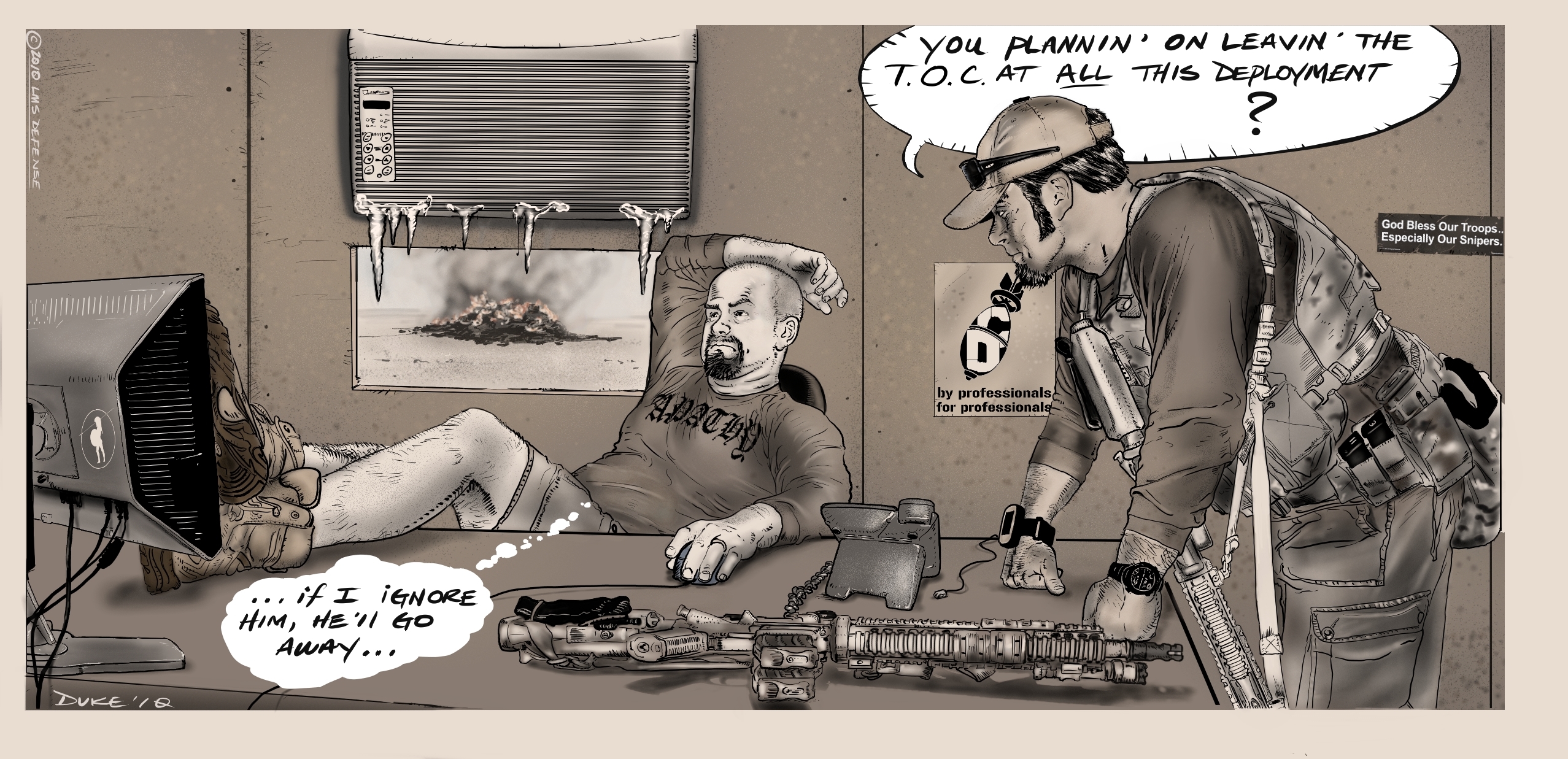
War Art: ‘That Guy’, From LMS Defense-The Comics

That Guy

That Guy’ by LMS Defense- The Comics.  Artwork by Righteous Duke.

Friday, June 18, 2010

Afghanistan: The War Between State Capitalism And Free Markets

     But executives with international mining firms said in interviews that while they believed that Afghanistan’s mineral deposits held great potential, their businesses were not planning to move into the country until the war was over and the country more stable.

     “There are huge deposits there,” said David Beatty, chief executive of Rio-Novo Gold, a mining company based in Toronto. “But as chief executive, would I send a team to Kandahar? And then call a guy’s wife after he gets shot? No.”

*****

     I was reading an excellent book the other day called “The End of the Free Market: Who Wins the War Between States and Corporations” by Ian Bremmer, and it was quite the read.  Basically, if you track the actions of countries like China in places like Iraq, Africa or Afghanistan, you start to get the idea that something is going on here. That state owned companies have the advantage over private industry in these war ravaged and resource rich countries. That reality is what worries me, and in the larger battle over resources in this world, we need to make some adjustments.

     The problem is that private industry just does not want to take the risk of entering these places, because there is just too much liability.  Besides, a private company does not have the full weight and support of a country behind it, but a Chinese owned company does. That is a huge advantage.

    I have talked about clashes before between free markets and state capitalism in the past, and a prime example was the battle between China and Google.  Another example was between Chinese companies and all of the privately owned oil companies going after contracts in Iraq. In both examples, China is able to win contracts or do whatever they want to bend the markets to their advantage, all because they have the full strength of a country behind such endeavors.  They can absorb risk, do whatever they want to their people, pay whatever they want, etc., and this hybrid machine called state capitalism is definitely a factor to deal with in the market place.

     So how do companies compete against such a thing?  That is a question that I am not qualified to answer. The book provides some answers, and I highly suggest folks to check it out. All I can provide in this conversation are some ideas to alleviate concerns about risk in these countries.  Private security is what private industry (along with free market supporting governments like the US) uses to protect their investments, and that is what I specialize in.  In this war between state capitalism and free markets, security contractors are right there on the front lines.

     One thing that can happen to help in our fight against state capitalism, is for capitalist countries to empower private security to do their job. If you make it impossible or difficult for us to be effective, then of course the risk will go up for those investors.  This is a fine line to walk, but it is necessary to address if you want to benefit from that free markets that capitalism needs in order to flourish.

     Now with Afghanistan, we have a deal where Chinese companies are aggressively pursuing these mineral claims and the rest of the world wants nothing to do with the things.  They fear the risk due to the war and politics of the region, and rightly so. With that said, all and effort must be made by the coalition to make that market more attractive to private industry and to allow private industry to do what it needs to do in order to alleviate that risk.  Because right now, we are losing that war between state capitalism and free markets in the places where the West has done all of the heavy lifting and dying. –Matt

——————————————————————-

Afghanistan Moves Quickly to Tap Newfound Mineral Reserves

By ALISSA J. RUBIN and MUJIB MASHAL

June 17, 2010

KABUL, Afghanistan — The Ministry of Mines announced Thursday that it would take the first steps toward opening the country’s reserves to international investors at a meeting next week in London even as Afghans expressed a mixture of hope and doubt about the government’s commitment to develop the country’s newly documented mineral wealth.

The focus of the meeting will be the Hajigak area of Bamian Province, which has major iron ore deposits, the Mines Minister, Wahidullah Shahrani, said at a news conference here.

It was Mr. Shahrani’s first public appearance since news that the country had at least $1 trillion in untapped mineral resources became public after an article appeared Monday in The New York Times that detailed findings of the Pentagon and United States Geological Survey. Afghan officials described the $1 trillion estimate conservative and said their estimates suggested the reserves could be worth as much as $3 trillion.

“This good news has the potential of adding a lot of value to the economy of Afghanistan and it will serve the development of Afghanistan,” Mr. Shahrani said.

The previously unknown deposits include huge veins of iron, copper, cobalt, gold and critical industrial metals like lithium. With so many minerals that are essential to modern industry, Afghanistan could be transformed into one of the most important mining centers in the world, according to American officials.

Two hundred mining investors from around the world have been invited to next week’s meeting in London where they will offer suggestions for how to develop the iron ore deposits at Hajigak, said Craig Andrews, the principal mining specialist for Afghanistan for the World Bank.

(more…)

« Newer PostsOlder Posts »

Powered by WordPress