Feral Jundi

Monday, September 15, 2008

Industry Talk: Mission Critical Psychological Services

Filed under: Industry Talk — Tags: , , , , , — Matt @ 10:45 AM

     For the most part, I am all for these kinds of services. Although I do have some reservations on how these services might be used, and that it would be very easy for a company to just get rid of employees if they had to thin out their contracts do to budget problems.  Instead, a company should remain committed to helping that employee through thick and thin.  And PTSD remains long after the contract, so will a company use these services for that reality of security contracting? 

    I am all for companies providing mental health services for it’s employees, and this is a great step forward to making that happen. We’ll see if the companies use these types of services ethically and for all the right reasons, and I hope to keep them honest here at FJ.  –Head Jundi 

——————————————————————

About Us

Mission CriticalMission Critical Psychological Services (MCPS) is the leading provider of comprehensive psychological support programs for companies employing people in war-torn countries. For over a decade, the psychologists at MCPS have provided support to thousands of civilians working in Iraq, Afghanistan, Sudan, Liberia, East Timor, Bosnia, Kosovo, Macedonia, Israel, Columbia, and Haiti. MCPS psychologists have backgrounds in law enforcement, security, and the U.S. military, and they have lived and worked in hostile environments: they understand the unique challenges of dangerous assignments. All have been trained and mentored in MCPS methodology.

Paul Brand, Ph.D.

Chief Executive Officer

Dr. Brand founded MCPS to build on his decade of experience developing and managing psychological screening and services for people working in war-torn areas. As the President of Medina & Thompson, Inc., he developed psychological fitness programs to support police officers sent to Haiti, Bosnia, Kosovo, Israel, Liberia and East Timor as part of peacekeeping initiatives. Under his direction as the Senior Vice President of Human Resources for DynCorp International, the Department of State’s largest contractor, DynCorp became the first company with comprehensive psychological support for its employees serving in Iraq and Afghanistan. Dr. Brand holds his Ph.D. in Psychology from the Illinois Institute of Technology and has lived and worked in Kosovo, Afghanistan and Iraq as well as the United States.
(more…)

Friday, September 12, 2008

News: US Commander Calls for Operations in Pakistan Tribal Regions

Filed under: Afghanistan,News,Pakistan — Tags: , , , , , , — Matt @ 11:31 PM

     This is interesting, because this is the same pattern of action that was taken with Iraq.  The Joint Chiefs, with the leadership of General Pace, went to town about a new strategy for Iraq.


      The product from these Afghan/Pakistan strategy meetings should be interesting, and will probably revolve around the same kind of themes as the Iraq strategy.  The plan will probably focus on bringing in more troops to hold what property they have taken over there.  


     Of course Pakistan will be a huge deal.  But most importantly, they must find a way to win over the Pashtun and find a moral legitimacy within the people.  That Hamid’s Afghanistan needs to be the people’s Afghanistan, and not looked at as NATO’s Afghanistan.  No army has ever been able to succeed there, without winning over the Pashtun.  The Taliban know this, they know the dynamics of the villages and warlords, and they know how to play the angles.  


     We need to beat the Taliban at their own game, and learn from our experiences there to make that happen.  Our war machine must be a learning organization* if it wants to succeed in Afghanistan.  That is the lesson from Iraq, and that is the lesson of a prior war called Vietnam.  We ‘ll see how this turns out, and  I look forward to the results of the commision.  –Head Jundi


*referencing John Nagl and his COIN book Learning to Eat Soup with a Knife.

——————————————————————- 


U.S. COMMANDER CALLS FOR OPERATIONS IN PAKISTANI TRIBAL REGIONS


9/12/08

By Abubakar Siddique, Ron Synovitz

A EurasiaNet Partner Post from RFE/RL


The chairman of the U.S. Joint Chiefs of Staff, U.S. Admiral Michael Mullen, has announced that he is commissioning a new military strategy that will cover both sides of the Afghan-Pakistan border.


Mullen’s statement came on the eve of the seventh anniversary of the 9/11 terrorist attacks, and said plans include the tribal regions of Pakistan, where Osama bin Laden and other Al-Qaeda leaders are thought to be hiding.


Mullen, the chairman of the U.S. Joint Chiefs of Staff, told a Congressional committee in Washington on September 10 that the new strategy will allow American forces to fight militants in Pakistan’s tribal regions as well as in Afghanistan.


(more…)

Monday, September 1, 2008

News: The Anbar Province is Handed Back Over to the Iraqi Government

Filed under: Iraq,News — Tags: , , — Matt @ 10:36 AM

     This is excellent news.  All of the hard work of the Coalition forces, Army, Marines and Iraqis have paid off.  I am  especially happy for the contractors over there that have assisted in that process.  A large portion of my time in Iraq was spent in the Anbar Province, and some good men in the industry were killed there.  All of the convoy operations and movements up and down those roads in the Anbar were certainly deadly and the industry definitely paid a price there.  And for the sake of the dead, and for the living, I am proud to see this significant victory in Iraq.  –Head Jundi


——————————————————————- 

US hands over former Sunni rebel hotspot to Iraq


RAMADI, Iraq (AFP) — Iraqi forces on Monday took control of the Sunni Anbar province, once the most explosive battlefield in Iraq, from the US military, symbolising the growing security gains in the war-torn country.


The transfer ceremony at the governate building in the provincial capital of Ramadi marked the handover of the 11th of Iraq’s 18 provinces.


Anbar, once a flashpoint of anti-American insurgency and later an Al-Qaeda stronghold, is the first Sunni province to be returned to Baghdad’s Shiite-led government.


“I would like to announce that the (Anbar) transfer from the US to Iraqi forces is done,” said Muwaffaq al-Rubaie, Iraq’s national security advisor, at the handover ceremony.


US President George W. Bush said the transfer of Anbar was a defeat for Al-Qaeda.

(more…)

Friday, August 22, 2008

Building Snowmobiles: Self-sufficiency in a Box

Filed under: Afghanistan,Building Snowmobiles,Iraq — Tags: , , , , , — Matt @ 10:31 AM

     I have written about this before on Feral Jundi, and I always like going back to it.  This concept is definitely ‘building snowmobiles’ material, because it brings together so many interesting concepts and makes sense at so many levels.  I also think we will see these ‘Self-sufficiency in a Box’ concepts continue to expand as technologies and efficiencies of solar, wind and storage devices increase.  


     What gets me about Iraq and Afghanistan, is that they are solar and wind heavens. So systems that take advantage of that are great. And if a Skybuilt unit can generate 5 KW a day, that is pretty cool. (compared to 10 kw a day for a typical generator-just buy two Skybuilt units)


     But the most important concept out of all of this, is the loss of lives because of attacks on convoys. I have had several of my comrades killed in Iraq, in convoy operations. Every military veteran of the conflict there, can say the same thing. IED and EFPs have done their damage, and the targets were usually massive supply convoys that supplied the insurgent’s diet of targets. It just killed me to know that the camp I worked out of, had supply convoys feeding it once and sometimes twice a week. That guys were risking their lives to get fuel and water and food to our camps. We all thanked them for the service, but I often times thought “isn’t there another way?”


     Not to mention the fact that oil is one of the main reasons why we care so much about the middle east in the first place.


     So at these sites, I would have loved to have seen water processing plants and solar/wind farms. And to think, one key mortar impact could easily take out a generator and screw over the entire camp. A power farm with various sources of energy spread out throughout the camp makes way more tactical sense. And why not drill for water at a camp?


     The water issue really gets me, because water was responsible for more convoys than fuel for remote camps. We should be drilling for water, or processing water from local sources. And I even think recycled water should be looked at. And with the hot sun, solar distillers is totally possible in Iraq and Afghanistan. And during the winter, there is the snow in Afghanistan. The point being, convoys for fuel and water should be reduced to a once a month thing, and not a once or twice a week thing. It would save lives and it would make operational sense, both for contractors and for the military.


   The last thing I wanted to mention is that Afghanistan will be the war zone to watch in the coming months and years.  The enemy has switched gears and is focusing on that battlefield. Our relations with Iran and Russia are increasingly strained, and we are pouring more troops into the region that will need more logistical support.  Not to mention the NATO presence, which Russia will no-doubt take an interest in messing with by proxy.  So to sum it up, I am predicting a surge of attacks on supply trains coming in and out of Afghanistan, which could also mean a surge of private security to protect those convoys.  And with that said, we must increase our self-sufficiency out there in order to minimize the logistics tail.  –Head Jundi


————————————


SkyBuilt Power MPS solar/battery system.


Link to Story


Commanders in Iraq Urgently Request Renewable Power Options


27-Jun-2007 06:19 EDT


On July 25, 2006 Al-Anbar commander and U.S. Marine Corps Maj. Gen. Richard Zilmer submitted an MNF-W priority 1 request pointing to the hazards inherent in American supply lines, and noted that the up to many of the supply convoys on Iraq’s roads (up to 70%, by some studies) are carrying fuel. Much of that fuel isn’t even for vehicles – it’s for diesel generators used to generate power at US bases et. al. In response, the document requests alternative energy solutions to power US forward operating bases… and the US military looks like it will act on the request.

(more…)

Wednesday, August 20, 2008

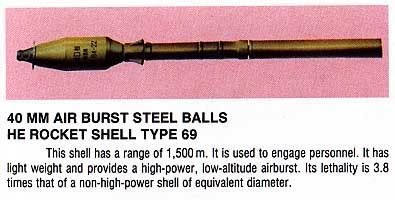
Weapons: The Type 69 40mm Airburst (RPG round), Now in Afghanistan

Filed under: Afghanistan,China,Iraq,Weapons — Tags: , , , , , , — Matt @ 10:35 PM

  Doug sent me this article that he found on Strategy Page.  The round sounds pretty brutal, and the range is pretty amazing as well.  That sucks that they are turning up in Afghanistan now.  I imagine that enough of these munitions launched at the same time, could be a pretty effective tactic to initiate an ambush.  And 1500 meter range makes it an interesting stand-off/indirect weapon as well. Bouncing death, made in China–damn.  –Head Jundi 

——————————————————————

Bouncing Death From China


August 20, 2008: Chinese made Airburst anti-personnel RPG rockets have been discovered in Afghanistan, after first being encountered in Iraq, where they were used by Iranian supported Shia rebels. The Chinese made RPG rocket is optimized for anti-personnel effect. To accomplish that, the shell bounces up about six feet, after first hitting the ground. Then the 5.7 pound warhead explodes, releasing hundreds of metal fragments. Casualties can be caused nearly fifty feet away. Because the warhead explodes in the air, and is full of metal fragments, it is more than three times as likely to kill or injure than the usual RPG warhead (which is designed to penetrate armor). The “Airburst Anti-Personnel” rocket also has a longer range (over 1,500 meters, more than twice that for the anti-armor rocket).


Iran buys these rockets from China, or maybe even makes its own copies. Iran denies supplying weapons to the Taliban or al Qaeda (which are violently opposed to the Shia brand of Islam practiced throughout Iran and southern Iraq.) But in the past, Iran has aided al Qaeda, and Iranian gunrunners will sell weapons to anyone who can pay. 

Strategy Page Link

——————————————————————

Type 69 Airburst 

Type 69 40mm Airburst Anti-Personnel High-Explosive (HE) Grenade


This variant was developed specifically for anti-personnel purpose. This round works in a similar way to the bouncing anti-personnel fragmentation mines. On impact, the grenade bounces off the ground to a chest to 2m height then airbursts over the target area, scattering about 800 anti-personnel steel balls over a lethal radius of 15m. The airburst is much more effective than typical blast warheads especially toward entrenched troops.


Sino Defence Link

« Newer PostsOlder Posts »

Powered by WordPress