Feral Jundi

Thursday, July 10, 2008

News: The IRAM, Flying IED and Barrack Buster

Filed under: Colombia,Iraq,Technology — Tags: , , , , , — Matt @ 10:06 AM

Thanks to Doug for sending me this article.  I posted the Long War Journal article about the ‘flying IED’ a couple of weeks ago and it sounds like it’s use is not a fluke.  So I decided to delve further into the history of these improvised munitions, and it looks like the IRA used to call these things a ‘barrack buster’.  But like the Post article mentions, this weapon is rocket assisted, and not explosively launched like the barrack buster.  I am sure that the IRA and the FARC have fooled around with rockets on these things before.

Now the question I have is where are these 107 mm rocket motors coming from?  Some say from Iran, and some say these engines were taken out of old ammo supply depots littered throughout Iraq.  A lot of these depots were vulnerable to looting back in 2003 after the invasion.  And we also bombed a lot of these depots, which made getting through fences and bunkers a little easier for the locals.  Luckily we have been working hard over the years to secure these sites and clean them up, but it is a massive and ongoing effort.  Or the other idea is that they are making homemade engines out of the tubes of fired 107 mm rockets .

I posted a video of Hezbollah in Gaza building a rocket and it’s engine from scratch.  I do not doubt that technologies and techniques are being passed freely via the internet or otherwise.  Our enemies are very good at building ‘snow mobiles’ , to use a Colonel John Boyd phrase, when it comes to making munitions.

So how do you defeat this?  I have to say that the limiting factor of this system is range.  So patrols should be focusing on the area around bases up to the maximum range.  It looks like they also want to put these things on trucks with open truck beds.  And I say if propane tanks are a common theme in these weapons, then they must be controlled.  Like with a weapon, maybe licenses should be distributed coupled with biometrics ID to track the movement and sales of propane tanks.  If this continues to be a problem, then all and any solutions must be considered.

As for defenses, roofs definitely need to be reinforced.  This is a top down weapon, with IED power.  But it is also very inaccurate.  If you look at it’s deployment, they like using clusters of this weapon.  So another thing that they are trying to achieve is blanketing an area with these things.  So markets or places where a lot of soldiers gather would be the easiest and best targets for these weapons.  So patrols should be focused on IRAMs that are within range of these types of areas.  I have no doubt that the Coalition is formulating a plan for these things, and so are the Private Security Companies tasked with static security at the various bases.  The IRAM is just one more thing to consider. –Matt
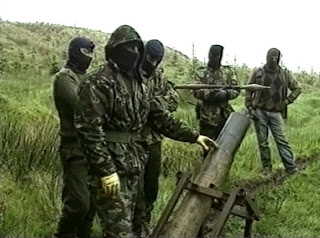
 

IRA with Barracks Buster

An IRA’s ASU (Active Service Unit) displaying a Mark-10 mortar in a propaganda video (1994).


U.S. troops in Iraq face a powerful new weapon
Use of rocket-propelled bombs spreads; at least 21 killed in IRAM attacks
By Ernesto Londoño
July 10, 2008
Suspected Shiite militiamen have begun using powerful rocket-propelled bombs to attack U.S. military outposts in recent months, broadening the array of weapons used against American troops.
U.S. military officials call the devices Improvised Rocket Assisted Munitions, or IRAMs. They are propane tanks packed with hundreds of pounds of explosives and powered by 107mm rockets. They are often fired by remote control from the backs of trucks, sometimes in close succession. Rocket-propelled bombs have killed at least 21 people, including at least three U.S. soldiers, this year.
The latest reported rocket-propelled bomb attack occurred Tuesday at Joint Security Station Ur, a base in northeastern Baghdad shared by U.S. and Iraqi soldiers. One U.S. soldier and an interpreter were wounded in the attack.
U.S. military officials say IRAM attacks, unlike roadside bombings and conventional mortar or rocket attacks, have the potential to kill scores of soldiers at once. IRAMs are fired at close range, unlike most rockets, and create much larger explosions. Most such attacks have occurred in the capital, Baghdad.
‘Flying IEDs’

(more…)

News: Roadside Bomb Kills 3 KBR Workers in Iraq

Filed under: Iraq,News — Tags: , , , , , , — Matt @ 12:50 AM


 I had also heard that the fourth person killed was a Wackenhut employee.  Rest in peace. –Head Jundi

——————————————————————- 

KBR 

Roadside bomb kills 3 KBR workers in Iraq

 July 9, 2008, 6:36PM

By DAVID IVANOVICH

WASHINGTON – Three KBR employees in Iraq were killed and as many as 13 others were injured Monday when an armored passenger bus traveling near Mosul struck a roadside bomb, company officials confirmed today.

The bus, carrying 34 passengers, was traveling between Qayyarah Airfield West and Camp Diamondback in Mosul, when it is believed to have hit a large improvised explosive device, said Heather Browne, a spokeswoman for the Houston-based military contracting giant.

Citing their families’ privacy, KBR would not provide any other details about the victims.

A military spokeswoman for the Multi-National Force Iraq  declined to discuss the incident beyond saying that four people in all were killed and eight were injured. KBR said the fourth fatality was not one of its employees.

The discrepancy in the KBR and military injury counts could not be reconciled Wednesday.

To date, 87 KBR workers have been killed and another 849 wounded by hostile action in Iraq. The company has not said how many were Americans.

Article Link 

Sunday, July 6, 2008

News: US Removes Uranium from Iraq

Filed under: Iraq,News — Tags: , , , , , — Matt @ 2:37 PM

   Boy, I had no idea that those sites were still buried and containing Uranium.  I would have thought that these sites would have been cleaned up, as opposed to just sitting there buried.  And what was the UN thinking?  Sure it is sealed up in containers and buried, but the problem is that Saddam had the stuff.  Now I know back in the eighties, we supported Iraq’s nuclear ambitions, kind of.  But Israel didn’t, and we all know that story.  

     But as soon as Saddam become an enemy of the region and the US in the nineties, then all bets were off.  The UN and the world should have insisted that Saddam take care of this material and hand it over.  We focused so much on the other stuff that Saddam had back then, but I had no idea that this ‘nuclear material’ was still buried and just sitting there.  You learn something new every day.  -Head Jundi 

Nuclear Facilities Iraq 

 Remains of a facility used for Iraq’s clandestine nuclear weapons program. The IAEA (International Atomic Energy Agency) examined the site following the Persian Gulf War (1990–91)

AP Exclusive: US removes uranium from Iraq

Sat, Jul 5, 2008 (11:15 a.m.)

The last major remnant of Saddam Hussein’s nuclear program _ a huge stockpile of concentrated natural uranium _ reached a Canadian port Saturday to complete a secret U.S. operation that included a two-week airlift from Baghdad and a ship voyage crossing two oceans.

The removal of 550 metric tons of “yellowcake” _ the seed material for higher-grade nuclear enrichment _ was a significant step toward closing the books on Saddam’s nuclear legacy. It also brought relief to U.S. and Iraqi authorities who had worried the cache would reach insurgents or smugglers crossing to Iran to aid its nuclear ambitions.

What’s now left is the final and complicated push to clean up the remaining radioactive debris at the former Tuwaitha nuclear complex about 12 miles south of Baghdad _ using teams that include Iraqi experts recently trained in the Chernobyl fallout zone in Ukraine.

“Everyone is very happy to have this safely out of Iraq,” said a senior U.S. official who outlined the nearly three-month operation to The Associated Press. The official spoke on condition of anonymity because of the sensitivity of the subject.

While yellowcake alone is not considered potent enough for a so-called “dirty bomb” _ a conventional explosive that disperses radioactive material _ it could stir widespread panic if incorporated in a blast. Yellowcake also can be enriched for use in reactors and, at higher levels, nuclear weapons using sophisticated equipment.

The Iraqi government sold the yellowcake to a Canadian uranium producer, Cameco Corp., in a transaction the official described as worth “tens of millions of dollars.” A Cameco spokesman, Lyle Krahn, declined to discuss the price, but said the yellowcake will be processed at facilities in Ontario for use in energy-producing reactors.

“We are pleased … that we have taken (the yellowcake) from a volatile region into a stable area to produce clean electricity,” he said.

(more…)

Tuesday, July 1, 2008

Industry Talk: Private Contractors and Iraqi Law

Filed under: Industry Talk,Iraq — Tags: , , , — Matt @ 4:26 PM


Private Security Contractors Protecting Ambassador Paul Bremer and Coalition personnel.


     This story is kind of troubling to me.  I know that eventually Iraq will operate on it’s own one day, but I always worry about the transition from war to peace there.  I have no problem with obeying another country’s laws.  But this war is not over by a long shot.  Sure the threat has died down, and the Iraqi government is gaining control of their country, but placing civilian contractors under Iraqi law right now is not a good move.  We are there to defend the very people that are helping to rebuild Iraq, and we already fall under the laws of the DOD(UCMJ).  So if we defend our DOD or DOS client, and save their life during an ambush, but then get charged with murder by an Iraqi court because we actually had to shoot our weapons and eliminate a threat, then how the heck are we supposed to do our job of protecting in the first place?  Why even give us weapons?  

    Now if the only threat in Iraq was typical criminal stuff, then maybe I could see falling under Iraqi law.  But just as long as we have an enemy in Iraq(Al Qaeda and the various militias who are opposed to the Iraqi Government), and the war is still being fought, then they will use this law to their advantage as a tool of warfare.  Of course they will fire on security contractors from populated places, and of course they will do all they can to force us to defend ourselves in heavily populated areas.  It is what I would do if I were in their shoes.  It is just one more way to fight a propaganda war against the US and insure that Iraq fails.

   I also understand the politics of this.  An Iraq that can govern itself, is a victory in the war for the Coalition.  Our enemies want us to fail there, and the more screwed up things are, the better it is for them.  Allowing civilian contractors to fall under Iraqi law, opens up all sorts of potential in the propaganda war being waged.  

    What the State Department and DOD needs to emphasize is that civilian contractors are in Iraq to protect and support the Coalition there, and that we already fall under the Uniform Code of Military Justice.  And because we are a vital asset to the mission in Iraq, any threat to our existence, is in essence a threat to the US mission there.  We are an integral part of the Coalition, and this point should be made very clear to Iraq and the world.  

    The costs would increase too.  The insurance premiums would go up, because of the legalities of working in Iraq and abiding by their laws.  After every incident involving firearms use, a company would be open to Iraqi investigation.  And do we trust that Iraq has been able to purge their system of bad guys?  And what of the Operational and Personal security of the client?  An Iraqi court, would certainly have to bring this information out in the open, in order to prosecute.  So yet again, could we trust this Iraqi legal system with this information?   

   Also, the days of 2006, when contractors were getting kidnapped at ‘supposed’ Iraqi manned checkpoints is still fresh in our minds.  Who is to say that the Iraqi justice system is strong enough to protect itself from infiltrations of the enemy?   Maybe when Iraq has become entirely peaceful, and the Coalitions is no longer needed to assist in the peace and stability operations there, then us contractors might feel a little more comfortable falling under Iraq law.  I guess the question that needs to be asked, is if the Coalition feels comfortable falling under Iraqi law?  

     I say if the Coalition, the DOD, and the State Department employees and soldiers in Iraq think this is a good idea, then maybe they should fall under Iraqi law too?  When I was a Marine back in the day, we called that’ leadership by example’.  We’ll see how it turns out, and hopefully someone speaks up against this, or can explain how this is a good idea.  –Head Jundi   

—————————————————————— 


Iraqi minister: Deal seeks to end security contractors’ immunity

    * Story Highlights

    * Iraq official: Deal with U.S. says security contractors won’t have immunity in Iraq

    * No immediate comment from U.S. State Department

    * Issue was one sticking point in negotiations for U.S.-Iraq security pact

    * Parliament member declines to say whether deal arose from Blackwater shootings

BAGHDAD, Iraq (CNN) — Security contractors working in Iraq will no longer receive immunity from prosecution in that nation under a deal being brokered by Iraqi and U.S. officials, Iraqi Foreign Minister Hoshyar Zebari said.

Zebari said he briefed Iraqi parliament members about the immunity agreement Tuesday during a closed-door meeting. Officials at the U.S. State Department, which is leading the U.S. side of the negotiations, could not be immediately reached for comment.

The immunity issue was one of the sticking points in talks over a long-term security pact that deals with, among other things, the future of the U.S. military presence in Iraq. Negotiations on the pact continue.

The reported immunity agreement comes more than nine months after an incident in which Iraqi officials allege guards with the Blackwater security firm shot and killed 17 people, including women and children, and wounded 27 at Baghdad’s Nusoor Square.

Survivors and victims’ family members allege Blackwater guards started shooting without provocation, but Blackwater said armed insurgents attacked its guards.

Blackwater is one of the contractors providing security services for the State Department in Iraq. Under a provision instituted in the early days of the U.S.-led occupation of Iraq, security contractors have had immunity from Iraqi law.

The shootings prompted a bitter protest from Iraqi officials and placed the operations of Blackwater and other security firms in Iraq under scrutiny.

A U.S. federal grand jury investigating the Blackwater shootings heard testimony from three Iraqi men in March.

Mahmoud Othman, a member of the Iraqi parliament, said that he attended Tuesday’s closed parliamentary session and that the Iraqi representatives were very pleased with the immunity agreement.

“Zebari explained everything to the members of parliament and told us that the negotiations are still ongoing and we didn’t reach the final version yet. Still, Zebari believes that there are some good developments,” Othman said.

Asked if the immunity agreement grew from displeasure over the U.S. handling of the Blackwater incident in September, Zebari declined to answer.

He said he may have more information during a news conference he scheduled for Wednesday.

CNN’s Saad Abedine and Mohammed Tawfeeq contributed to this report.

Story Link 

Thursday, June 19, 2008

News: Deals With Iraq Are Set to Bring Oil Giants Back

Filed under: Iraq,News — Tags: , , , , — Matt @ 11:24 AM

    This is something that I have been following for awhile, and hoping that Iraq can reach the kind of stability needed to bring these companies in.  What is interesting though, is that the recent and future requirements for oil in the world, will fuel the urgency for such oil seeking operations.  

    But the main reason I posted this is security.  Security contractors will be a vital element to the future of these operations.  The security will be mostly dominated by local Iraqi contracts using Iraqis.  But for the protection of engineers and managers, they will seek more specialized companies that can provide those services.  They will also need individuals that can advise on and help manage the security operations at the various oil production sites.  So I predict that Iraq will be providing jobs to the industry, regardless of what president we have, for years to come.

   Also, thanks to Doug for throwing the article my way.  We’ll see how this develops over the months and years to come, but I do believe that the urgency is there, to help propel this along.  –Head Jundi 

——————————————————————- 

 Basra Oil Fields

 Basra Oil FieldPhoto by Moises Saman for The New York Times

June 19, 2008

Deals With Iraq Are Set to Bring Oil Giants Back

By ANDREW E. KRAMER

BAGHDAD — Four Western oil companies are in the final stages of negotiations this month on contracts that will return them to Iraq, 36 years after losing their oil concession to nationalization as Saddam Hussein rose to power.

Exxon Mobil, Shell, Total and BP — the original partners in the Iraq Petroleum Company — along with Chevron and a number of smaller oil companies, are in talks with Iraq’s Oil Ministry for no-bid contracts to service Iraq’s largest fields, according to ministry officials, oil company officials and an American diplomat.

The deals, expected to be announced on June 30, will lay the foundation for the first commercial work for the major companies in Iraq since the American invasion, and open a new and potentially lucrative country for their operations.

The no-bid contracts are unusual for the industry, and the offers prevailed over others by more than 40 companies, including companies in Russia, China and India. The contracts, which would run for one to two years and are relatively small by industry standards, would nonetheless give the companies an advantage in bidding on future contracts in a country that many experts consider to be the best hope for a large-scale increase in oil production.

(more…)

« Newer PostsOlder Posts »

Powered by WordPress