Feral Jundi

Monday, March 15, 2010

Industry Talk: GAO Sides With DynCorp, The Dutch Are Leaving And Afghan Training Time Is Reduced..Hmmm?

   This is funny. If you take a step back and look at all the pieces–Xe, DynCorp and others are fighting for a chunk of a training contract that is vital to the war effort. But then the government decides to cut the already condensed training schedule from 8 weeks to 6 weeks.  All I know, is that for the next review that the IG does of this training program, it should be well documented that the government set up this contract for failure.

    How can they possibly expect a quality product with this kind of training program? All I know is that whatever companies get involved with this contract, they are going to be earning every penny of their contract. And the Coalition in Afghanistan should do a little more to support this industry in the media, seeing how we are ‘coming to the rescue’ it seems. All I know is that I certainly hope the industry can pull this off, and I will be cheering them on.

    Which makes me wonder.  Is this an outcome of the Dutch leaving, and is this an example of contractors ‘picking up the slack‘?  Boy, if it is, I think the Obama Administration, and the war planners, should do a little more to show their thanks to this industry.  Politically and militarily speaking, we are absolutely vital to the war effort right now.  Especially if any other NATO folks decide to bail out last minute. –Matt

—————————————————————–

GAO blocks contract to firm formerly known as Blackwater to train Afghan police

By Joby WarrickTuesday, March 16, 2010

Federal auditors on Monday put a stop to Army plans to award a $1 billion training program for Afghan police officers to the company formerly known as Blackwater, concluding that other companies were unfairly excluded from bidding on the job.

The decision by the Government Accountability Office leaves unclear who will oversee training of the struggling Afghan National Police, a poorly equipped, 90,000-strong paramilitary force that will inherit the task of preserving order in the country after NATO troops depart.

GAO officials upheld a protest by DynCorp International Inc., which currently conducts training for Afghan police under a State Department contract. DynCorp lawyers argued that the company should have been allowed to submit bids when management of the training program passed from State to the Army. Instead, Pentagon officials allowed the training program to be attached to an existing Defense contract that supports counternarcotics efforts in Afghanistan.

Xe Services, the new name of Blackwater, was poised to win one portion of a much larger group of contracts, shared among five corporations, that could earn the companies more than $15 billion over five years.

(more…)

Mexico: The War In Mexico–Drug Slayings Rock U.S. Consulate

   This is just sad and my heart goes out to the families of the deceased. The infant daughter will now grow up without her parents, all because of the brutal acts of cowards.

   Now on to some thoughts with this.  We must do a better job at containing the border, and we must do a better job at protecting folks in Mexico.  This attack is a clear message by the cartels that they are not pleased with the U.S. It is my view that once we said ‘hey, we will help Mexico out’, then we just declared war on the cartels.  So when the cartels actually strike back and kill one of our own, we should now know that this is an act of warfare, and not some random killing.

    Obviously we have been assisting Mexico in their war down south for awhile, and I have talked about that here. The question I have is will this attack result in us ratcheting up our assistance, or backing off? I also expect more demand on the private side of the house, when it comes to protecting companies operating down there. Hell, we might even see an increase of WPPS folks for Mexico. And of course, there is always the idea I floated here on the blog about how to deal with these thugs.  Who knows, and I would like to hear what the readership thinks? –Matt

——————————————————————

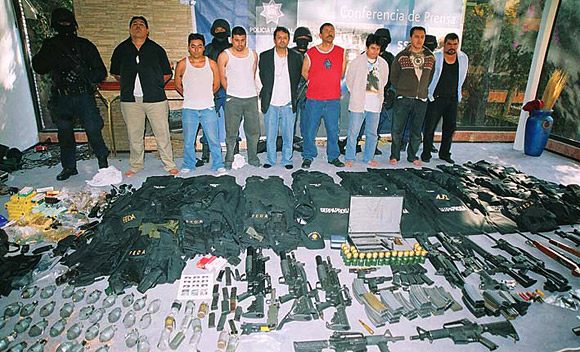
 Drug Cartel Weapons

A captured drug cartel cell and their tools of warfare.

Drug Slayings in Mexico Rock U.S. Consulate

March 15, 2010

By ELISABETH MALKIN and MARC LACEY

CIUDAD JUÁREZ, Mexico — The married couple gunned down Saturday as they drove back from a children’s birthday party with their infant daughter in the back seat were concerned about the violence plaguing this border town, but they never believed they could be its next targets, the husband’s brother said in an interview on Monday.

The couple, Leslie Enriquez, 35, a pregnant American consulate worker, and her husband, Arthur H. Redelfs, 34, an officer at the county jail in El Paso, were within sight of the bridge leading to the United States border crossing when gunmen said to have links to drug traffickers drove up to their car and opened fire, killing them both.

“He was a wonderful man,” said the brother, Reuben Redelfs. “We just regret this as a senseless act of violence.”

Gunmen also killed the husband of another consular employee and wounded his two young children in a near-simultaneous shooting elsewhere in the city, in what appeared to be coordinated assaults on American officials and their families. The killings provoked outrage from Washington and raised new questions about whether employees of the United States and their family members were increasingly at risk of being swept into the cross-fire of Mexico’s bloody drug wars.

The couple had been married for a couple years and lived in El Paso, where they were raising their 7-month-old daughter, who was unharmed in the shooting. Mr. Redelfs said he was now caring for the girl.

Despite concerns about the security in Ciudad Juárez, the couple traveled frequently between Texas and Mexico, where they had friends and Ms. Enriquez worked in the visa section of the American Consulate, Mr. Redelfs said.

“They weren’t worried as targets,” he said.

Asked if he believed the couple were targets because of Ms. Enriquez’s consular job, Mr. Redelfs chose his words cautiously, saying, “I find it more than a coincidence that two separate incidents involving consular employees who were shot and killed occurred on the same day.”

Silvio Gonzalez, a spokesman for the United States Consulate in Ciudad Juárez, said the agency would be closed Tuesday “as we mourn the loss in our community.” The consular office was closed Monday for a holiday.

The killings came during a particularly bloody weekend when nearly 50 people were killed nationwide in drug-gang violence, including attacks in Acapulco as American college students began arriving for spring break.

(more…)

Thursday, March 11, 2010

Kaizen: FPS Using Covert/Overt Inspections For Contractor Security Posts

     FPS officials said in a statement that it has increased both overt and covert inspections of security posts, as well as its oversight of contract guards. 

*****

   Hmmm, I wonder if FPS is reading Feral Jundi. lol Actually this practice of overt and covert inspections is pretty common in a few agencies out there.  The Postal Service even uses mystery shoppers to get a real feel for their customer service and inner workings of offices, so this is nothing new for federal agencies. Mystery shopping is very common in other industries as well, and I have covered that here before.

    But what boggles my mind, is why haven’t more private military companies used this concept?  If you truly care about what is going on with your company, you should be fully involved with collecting intelligence on the inner workings of your company. That means sending folks out to your sites and talking with the contractor on the ground.

    I am not talking about just talking with the managers either. I am talking about getting feedback from the backbone of your company, and that is the contractor doing the work. These are the folks who represent the end result of all of your company policies and training, and a lot depends upon them.  These guys and gals are the ones your customer sees on a daily basis, and makes their judgements about your company based on the actions of these contractors.  The managers are there to lead and to implement company policy and training, and the best gauge for seeing if they did their job, is to study the contractors they are in charge of.

   Also, it is important to note that this is not a witch hunt, or undercover gotcha stuff.  It costs money to fire and hire folks, so ideally, this information is used to tweak policies where it makes it easy for contractors to do the right thing.  It also helps in identifying inefficiencies or identifying key training points that need to be reworked or re-emphasized in order to get a better outcome.  That is what you use this intelligence for.  Of course if you catch criminal activity within your company, you should act upon that information pronto.  But all in all, the idea behind obtaining feedback is to feed your Kaizen machine and make your company a top performer.

   The mystery shopping or covert employee thing is something I have mentioned before, which is just one tool to gain that kind of information about the workings of your company.  It is an extra cost, but it is the kind of investment that will pay for itself handily down the line. Because you can ask folks what is going on with your company, and they might give the straight scoop. Or they might not, partly because they don’t think you will do anything about it or they don’t trust the idea of giving you information that may or may not cause reprisals (thats if your company has a culture that does not support feedback, and if that is the case, you need to fix that by actually acting upon feedback and showing you care).

     You could also use customer or employee feedback software to mine that information gold.  Either way, if you are not doing these things, and actually acting upon that information to make your company better, then you are certainly headed down a road of uncertainty and peril.  You are just gambling at that point, with the hopes that nothing bad will happen to your company and that everything is just rosy with your people. pfffft.

   I guess my point with all of this, is that don’t be the company where the head does not know what the tail is doing.  Seek that feedback gold, and invest in the necessary measures to make that happen.  Start by just asking honestly what the issues are (and be responsive to those issues!!!), and if that doesn’t work, do surprise inspections, use software to gain employee and customer feedback, and finally, use mystery employees and get a solid read on what is really going on with your company. –Matt

Edit: Also check out this article about Best Buy and how they used ’employee feedback’ to their advantage.

—————————————————————–

Use of private security guards at government buildings comes under scrutiny

By Ed O’KeefeThursday, March 11, 2010

There’s a saying among some private security guards in the Washington region: “There’s no security in security.”

Poor job security and the potential dangers that come with protecting government buildings make it a risky line of work, said guards interviewed this week.

Unlike officers with the Pentagon Force Protection Agency who gunned down shooter John Patrick Bedell last week, most security guards at federal buildings in the Washington region are employed by private firms that have contracts with the Federal Protective Service.

The FPS, part of the Department of Homeland Security, provides security at more than 9,000 federal buildings across the country and uses about 15,000 contract security guards to support about 1,200 officers, inspectors and administrative staffers, according to agency officials. A House hearing Tuesday will focus on the FPS’s future and its response to a 2009 Government Accountability Office investigation that exposed security gaps at 10 major federal buildings. The GAO report also faulted the FPS for inconsistent training and poor oversight of private guards.

Next month, Sen. Joseph I. Lieberman (I-Conn.) plans to introduce legislation that addresses the agency’s future and broader threats and security measures at all civilian and military facilities, aides said.

(more…)

Wednesday, March 10, 2010

Afghanistan: So As NATO Falters Or Members Leave, Will Contractors Pick Up The Slack?

   So here is one that you won’t hear discussed out there.  What happens when NATO falters or members leave unexpectedly, as the war drags on?  Each country in NATO has it’s own set of politics back home, and like most countries, they can get into a position where support for operations overseas just diminishes.  Call it the economy, or media/activist groups, unexpected rise in war deaths, natural disasters, Black Swan events, etc.  An example would be the Dutch, and their sudden switch-a-roo/’I am out of here’ move in Afghanistan.  I didn’t see that one coming, but that is exactly what I am talking about.  So who is next in NATO?  And most of all, who will take up their slack, if the war effort depends upon those troops?

   Well for one, my pick is contractors. Mostly because we are the fastest means of filling that vacuum, and we do the least at disrupting the mechanics of the war machine.  Especially if the Dutch were tasked with training or menial/defensive operations.  Or the coalition can play the game where they rob Peter, to pay Paul, and shift forces from one vital mission, to fill another vital mission.  Kind of like with the Georgian conflict with Russia, and how those Georgian troops had to leave Iraq immediately to respond to a crisis in their homeland.  The US military had to scramble to backfill, and problems like this cause vacuums in all sorts of places in the war machine. Especially if contractors are already doing the menial jobs out there–meaning troops are already filling vital positions in the war.  So you take troops from one effort, and move them to another– it has an impact on the machine.

   I also say contractors are a good choice for this ‘vacuum plug’ when it comes to non-offensive operations.  If that member nation was tasked with training, convoy operations, PSD or static security, then contractors could easily be called upon to fill that vacuum so the rest of the war machine continues to function properly.  Hell, I could put a call out on this blog for a small army, have them vetted, tell them to bring their own kit, secure weapons/vehicles/living quarters/ID cards/licenses and deploy them into Afghanistan to fill those PSD/convoy/static positions quicker than you can say ‘Eric Cartman’.  People would be amazed at how quickly security contractors could be spun up, and especially if a company has the resources to do a quick spin up. (and most companies do)

   Of course it would be ideal to use military forces to fill these instant voids, and in most cases they do. But my question is how could they possible act as fast as a private company, or how could this not impact another vital mission they are performing?  Now the military can do stuff like divert troops from one country, to the other, or do an early deployment for a incoming unit, but yet again, this is taking from one vital mission, to fill another.  To me, it makes more sense to not disrupt that harmony of planning, and just contract a company to step in. Especially for the defensive operational stuff. (military replacement is the only option for offensive related ops at this time)

   Using contractors can even buy military planners some time to actually assemble a military team to fill in that hole.  Another way to look at it, is that we are the 50 mph tape for a hole in the fuel line, so that we can get the car back home.  Then at home, we can replace the fuel line.  It does not make sense, to disable the brakes and use a chunk of brake line to repair the fuel line.  Or you could use a vacuum line to repair the fuel line, but yet again, the engine will not run correctly– if at all.

   Now to wrap this up.(pun intended-lol)  The point of it all is that when I hear guys like Senator Levin slam private contractors in one hearing, and then in another quote, he whines about NATO not having enough troops to do the training in Afghanistan, I have to think that politically speaking he is saying one thing, but realistically speaking he has to know that contractors are vital to the war effort.  Because as more NATO folks leave, do to political turmoil, the economy, or some Black Swan event back home, contractors are gonna be as vital to the war machine tool box, as a roll of 50mph tape. –Matt

——————————————————————

50 mph tape

The ever handy roll of 50mph tape. 

More Military Trainers Needed in Afghanistan

Coalition forces pressed to fill gap in trainers needed to help growing Afghan Army and Police forces

Al Pessin

09 March 2010

The U.S. Navy admiral who commands all NATO forces worldwide says he and the alliance secretary general are pressing each member to fulfill a specific part of the shortfall in military trainers in Afghanistan.  The admiral spoke at a U.S. Senate hearing, where senior members from both parties criticized NATO allies for the shortage.Admiral James Stavridis gave the Senate Armed Services Committee specific numbers.  He said the NATO-run command in Afghanistan needed 1,278 trainers for the growing Afghan Army and Police forces, but it has so far received only 541 – a shortfall of 737.”It is absolutely correct to say that NATO has fallen short in providing these vital trainers.  What we are doing about it is taking further steps in terms of contacting each of the nations individually and going one-by-one through the precise requirement for each of the nations in terms of where they could most effectively fill in the trainer mix,” Stavridis said.The shortage of trainers comes at a time when Afghan Army recruiting is sharply up, due in part to a significant salary increase the Kabul government implemented late last year.The committee chairman, Democrat Carl Levin, said the training commander in Afghanistan told him some of the Afghan recruits cannot enter the army immediately due to the lack of trainers.”That is totally unacceptable, almost unbelievable to me, that we can not get NATO allies to carry out that kind of commitment, which is not the most dangerous.  There is obviously danger anywhere, but compared to being in combat it falls well short of that,” Levin said.

(more…)

Sunday, March 7, 2010

Film: So What Does Avatar, District 9, And The Hurtlocker All Have In Common? (Besides Bashing Those Evil Contractors And PMC’s)

   They are the top downloaded films of 2009, and they are all up for best picture at the Oscars.  Wow.

   Well everyone here knows my feelings on all of these movies.  I have had a chance to see all of them, and my opinions really haven’t changed too much.  Probably my favorite out of all of them, if I can put aside the whole ‘PMC’s are evil’ angle, is District 9. It trumps Avatar for a unique story and kick ass sci-fi. Plus they made it for way cheaper than Avatar, and you have to give it up for the little guys who do a lot with a little.

   I think the worse one for bashing the military and contractors, is Avatar. So for that, I wouldn’t mind seeing the Hurt Locker or District 9 beat out Avatar, just to see Cameron’s face in the close ups at the oscars. The Hurt Locker is probably the least offensive out of all of these films, but even in that film, they portrayed contractors (one of which was played by Ralph Fiennes) as murky seedy dudes of the desert, who only care about themselves and money. In other words, they played up the mercenary stereotype to the hilt in their portrayal of contractors in the film, and I was turned off. And in this scene, they act like the military was fearful of contractors in Iraq.  If anything, most of the military guys I came across wanted to be contractors or if they saw a contractor PSD team broken down on the side of the road, they usually pulled over and asked if we need any help.  The movie makes it seem like military and contractors were at odds with each other over there, and that could be the farthest from the truth.  Contractors also helped out the military with medical calls or security support, and I saw way more collaboration and mutual respect over there, than what the film portrayed.

   I have yet to see a company fork over the money and provide a Barrett M 82 .50 Cal for road work either. Not impossible, but highly unlikely, and especially with the weapon restrictions contractors faced in Iraq. If a British contractor would like to pipe in and prove me wrong on this, I am all ears.  I never saw them roll with that kind of weaponry out there, but I could be wrong.

   The funny thing with all of these films, is that I think more films will be made with PMC’s in them.  I am even optimistic enough that eventually someone will make a good movie that will portray this industry in a positive light.  The reason I say that, is because every time Hollywood tries to make political statements in their films, it backfires on them. Apocalypse Now was meant to be an anti-war film, and instead it turned into a cult classic.  Platoon, was meant to be an anti-war film, and made by an extreme left-wing loony tunes veteran named Oliver Stone. Instead, that film has become a cult classic.  Full Metal Jacket is another classic war film, that was meant to repulse the viewer about war and the military, and instead, it has created a following throughout the world. Hell, that movie is what motivated me, and thousands like me, to join the Marines. lol So will Hollywood only motivate others to want to become contractors, with their attempt at making ‘anti-contractor’ films?

   So will this new batch of anti-contractor/anti-PMC films, actually backfire on Hollywood?  Look at the video gaming industry?  Those are easily comparable to film releases and revenue, with multi-million dollar campaigns to sell them and huge start studded release parties, all trying to promote the allure of their shooter PMC related games.  There was even talk of making Army of Two a movie. Wow, I didn’t see that one coming.

   Look at the top downloaded films below, and the free market has definitely made it’s choice about what it wants.  And you know what? What the viewing public wants, it gets.  lol So will we see more films that involve this industry, and will Hollyweird continue to inadvertently elevate this industry through it’s naive attempt at demonizing us? I am getting more and more emails from kids and individuals who never served in the military or police, who want to become contractors or who are just interested in learning about the industry. Interesting cultural developments if you ask me, and that is why I cover this stuff.

   The best thing the film industry could do, if they really don’t like us, is to ignore this industry and keep us out of their scripts. But the temptation is just too strong, and I think we will see more films that have either negative or positive portrayals of contractors in them.  And that portrayal will further thread this industry into the fabric of culture–good or bad. Interesting times, and we will see who wins at the Oscars. –Matt

Edit: And the Hurt Locker wins Best Picture.  -hee hee

—————————————————————–


TorrentFreak’s Top Downloaded Films For 2009

1. District 9 – 12,639,000

2. Avatar – 11,326,000

3. The Hurt Locker – 7,930,000

4. Up – 5,437,000

5. Inglourious Basterds – 5,376,000

6. Precious – 4,922,000

7. Up In The Air – 4,855,000

8. A Serious Man – 3,836,000

9. The Blind Side – 1,845,00010. An Education – 683,000

Link to TorrentFreak blog here.

——————————————————————

Best Motion Picture Nominees of 2009

“Avatar” (20th Century Fox)

A Lightstorm Entertainment Production

es Cameron and Jon Landau, Producers

“The Blind Side” (Warner Bros.)

An Alcon Entertainment Production

Nominees to be determined

“District 9” (Sony Pictures Releasing)

A Block/Hanson Production

Peter Jackson and Carolynne Cunningham, Producers

“An Education” (Sony Pictures Classics)

A Finola Dwyer/Wildgaze Films Production

Finola Dwyer and Amanda Posey, Producers

“The Hurt Locker” (Summit Entertainment)

A Voltage Pictures Production

Nominees to be determined

“Inglourious Basterds” (The Weinstein Company)

A Weinstein Company/Universal Pictures/A Band Apart/Zehnte Babelsberg Production

Lawrence Bender, Producer

“Precious: Based on the Novel ‘Push’ by Sapphire” (Lionsgate)

A Lee Daniels Entertainment/Smokewood Entertainment Production

Lee Daniels, Sarah Siegel-Magness and Gary Magness, Producers

“A Serious Man” (Focus Features)

A Working Title Films Production

Joel Coen and Ethan Coen, Producers

“Up” (Walt Disney)

A Pixar Production

Jonas Rivera, Producer

“Up in the Air” (Paramount in association with Cold Spring Pictures and DW Studios)

A Montecito Picture Company Production

Daniel Dubiecki, Ivan Reitman and Jason Reitman, Producers

Link to the Oscars website here.
« Newer PostsOlder Posts »

Powered by WordPress