Feral Jundi

Friday, August 20, 2010

Industry Talk: Stability Operations Industry–Opportunity And Risk, By Bullet Proof Blog

     I liked this article, and it is a concept that all of the companies need to really wrap their heads around in today’s times.  It is all about crisis communication, and it sounds like Mr. Levick is the guy to talk to about doing this kind of thing.  What is cool is that he has plenty of contractor history to learn from and he is also reaching out to individuals in the industry like Doug to get a feel for what’s what.

     This article also goes well with the interview Mr. Levick did with Doug Brooks, so I recommend watching that if you can.

     Now something I would like to hear from the author is how he would have dealt with the Nisour Square incident differently than how BW and State dealt with it back then?  Most of all, how would his firm handle the crisis management for such an incident if it happened again in the near future? He briefly touched on this contractor army that DoS plans on using in Iraq, but I would have liked to hear some details on how a true crisis management expert would handle the complexities of this industry’s incidents that tend to get so much attention.  We need all the help we can get, because no easy solutions have materialized and companies are still getting sucked into crisis that not only embarrasses them, but embarrasses their clients as well. These incidents also negatively impact the war effort, and it is certainly important for companies to not cause that kind of harm.

     As to an example of current crisis communication, DynCorp actually sent me a company release about the auto accident in Kabul.  But because of the speed of information spread in Kabul and online, and how the negative aspects of the news spread, I just don’t know how you can stop the impact of such a thing?  Or maybe DynCorp did all they could and this was the way to do it? They certainly responded quickly online to those of us trying to cover this stuff, and at least attempted to fill any information gaps that biased media or even the enemy was trying to fill with their own versions of the story.  I wonder how he would rate DynCorp’s crisis management and communications, both in Kabul and online? How would you guys rate it? Interesting stuff. –Matt

—————————————————————–

Stability Operations Industry: Opportunity and Risk

Richard Levick

August 18, 2010

For one not uncontroversial sector of the defense industry, President Obama’s recent reaffirmation of a timetable for Iraqi troop withdrawal means new business opportunity, accompanied by heightened scrutiny — and predictably severe penalties for failure to comply with professionally, as well as politically, dictated operational standards.

The industry in question is called “stability operations,” a broad term that denotes activities by private contractors to support military, peacekeeping missions and disaster relief. To ensure safe and secure environments outside the United States, their multifarious deliverables include protecting vital infrastructure, training indigenous military and non-military forces, responding to emergencies, body-guarding key personnel, overseeing project logistics, assuring medical provisions, demining hazard zones — and so forth.

During the Iraq War, unwanted attention fell on a few such companies amid allegations of fraud and abuse. Now that the West’s role in the war is largely ending, and the role of the industry in Iraq will grow apace, those past mishaps are going to have a strong continuing influence on public perception. Fairly or not, the bigger the future role of the contractors, the more mistrust they can expect to engender.
(more…)

Industry Talk: Bullet Proof Blog Interviews Doug Brooks On Stability Operations Industry

Thursday, August 19, 2010

Iraq: Civilians To Take US Lead After Military Leaves Iraq

One American official said that more than 1,200 specific tasks carried out by the American military in Iraq had been identified to be handed over to the civilians, transferred to the Iraqis or phased out.

To move around Iraq without United States troops, the State Department plans to acquire 60 mine-resistant, ambush-protected vehicles, called MRAPs, from the Pentagon; expand its inventory of armored cars to 1,320; and create a mini-air fleet by buying three planes to add to its lone aircraft. Its helicopter fleet, which will be piloted by contractors, will grow to 29 choppers from 17.

The department’s plans to rely on 6,000 to 7,000 security contractors, who are also expected to form “quick reaction forces” to rescue civilians in trouble, is a sensitive issue, given Iraqi fury about shootings of civilians by American private guards in recent years. Administration officials said that security contractors would have no special immunity and would be required to register with the Iraqi government. In addition, one of the State Department’s regional security officers, agents who oversee security at diplomatic outposts, will be required to approve and accompany every civilian convoy, providing additional oversight.

*****

     I wanted to cut this portion out for the reader to focus in on. Does anyone see the possibility here for some real problems if the insurgents in Iraq wanted to target this ‘civilian leadership’ specifically? There is the potential here for multiple ‘Nisour Square‘ scenarios, because it will be this heavy duty contractor army that will be engaging with insurgents if they atttack. And no doubt, the bad guys will love to start a fight in highly populated areas, much like they did with the Nisour Square ambush.

     What I would like to hear is if State will stand by this ‘contractor army’ they have created, if in fact they had to actually use their weapons? I mean, you guys are arming them and giving them all of this military hardware to use? Because as much as the media, DoS, Iraq and the entire world would like to believe, civilian casualties happen in war zones, or non-permissive environments. (whatever we want to call Iraq now) It is unfortunate, but they happen. No one plans on a tragedy like this happening, except for the enemy.

     Of course no one wakes up one day and says ‘I want to kill civilians’, except for the enemy. When these types of incidents happen, it is extremely damaging to the psyche and to the morale of all involved. It is avoided at all costs, but sometimes this stuff happens. So that is why I continue to ask this question of ‘if you are going to ask these men to protect you in Iraq, and they have to use deadly force, are you going to back them up if they actually kill someone?’. Worse yet, are you guys going to back them up if a stray bullet in that fire fight accidently kills a civilian? Or will you be throwing your heroes into an Iraqi or American prison, for an accident they had no intention of committing?

     Finally, as the combat troops leave, and the ‘civilians’ take over, the realities of this war zone are still there. Only when the enemy has lost the will to fight, can you truly say the war is over. So in my mind, I totally think that Al Qaeda and company or any of the Iranian backed groups will continue to cause problems. Not only for Iraq, but for this civilian leadership and cadre left in Iraq. Contractors will be using military hardware like MRAPs and Blackhawk Helicopters, and taking over the various 1,200 military tasks in the country, but will they get the same treatment and legal protections that the military had when they were in Iraq? Because I certainly would hate to see contractors being thrown under the bus, like what happened with Xe, just for trying to do their job in a war zone. –Matt

—————————————————————-

Civilians to Take U.S. Lead After Military Leaves Iraq

By MICHAEL R. GORDON

August 18, 2010

WASHINGTON — As the United States military prepares to leave Iraq by the end of 2011, the Obama administration is planning a remarkable civilian effort, buttressed by a small army of contractors, to fill the void.

By October 2011, the State Department will assume responsibility for training the Iraqi police, a task that will largely be carried out by contractors. With no American soldiers to defuse sectarian tensions in northern Iraq, it will be up to American diplomats in two new $100 million outposts to head off potential confrontations between the Iraqi Army and Kurdish pesh merga forces.

To protect the civilians in a country that is still home to insurgents with Al Qaeda and Iranian-backed militias, the State Department is planning to more than double its private security guards, up to as many as 7,000, according to administration officials who disclosed new details of the plan. Defending five fortified compounds across the country, the security contractors would operate radars to warn of enemy rocket attacks, search for roadside bombs, fly reconnaissance drones and even staff quick reaction forces to aid civilians in distress, the officials said.

“I don’t think State has ever operated on its own, independent of the U.S. military, in an environment that is quite as threatening on such a large scale,” said James Dobbins, a former ambassador who has seen his share of trouble spots as a special envoy for Afghanistan, Bosnia, Haiti, Kosovo and Somalia. “It is unprecedented in scale.”

White House officials expressed confidence that the transfer to civilians — about 2,400 people who would work at the Baghdad embassy and other diplomatic sites — would be carried out on schedule, and that they could fulfill their mission of helping bring stability to Iraq.

Legal News: MPRI The Target Of Class Action Lawsuit For Operation Storm

    Interesting case, just because it kind of highlights some history about Operation Storm and the work MPRI was involved with. I wouldn’t mind hitting on this in a future ‘history’ or ‘strategy’ post, because I am sure there are some very intriguing areas to explore when it comes to this operation.  It certainly sounds impressive.

    As to the case, I will not comment too much because I don’t know a lot about either side’s position.-Matt

Edit: 08/20/2010 – David Isenberg has far more to say about this, and the consensus he found is that this is a weak case. David also reported on MPRI back in the day, and interviewed the participants of Operation Storm.  So I tend to think he has this one nailed.

—————————————————————–

U.S. Mercenaries Accused of Abetting Genocide

By ROBERT KAHN

August 18, 2010

     (CN) – A private U.S. defense contractor “trained and equipped the Croatian military for Operation Storm and designed the Operation Storm battle plan,” which killed or displaced more than 200,000 Serbs in 1995, in the largest European land offensive since World War II, the Genocide Victims of Krajina say in Chicago Federal Court. They demand billions of dollars in damages from MPRI, founded by U.S. military officers who were “downsized” at the end of the Cold War, and L-3 Communications, which bought MPRI for $40 million in 2000.”This is a class action brought by ethnic Serbs who resided in the Krajina region of Croatia up to August 1995 and who then became victims of the Croatian military assault known as Operation Storm – an aggressive, systematic military attack and bombardment on a demilitarized civilian population that had been placed under the protection of the United Nations,” the 40-page complaint begins.”Operation Storm was designed to kill or forcibly expel the ethnic Serbian residents of the Krajina region from Croatian territory, just because they were a minority religio-ethnic group. Defendant MPRI, a private military contractor subsequently acquired by Defendant L-3 Communications Inc., trained and equipped the Croatian military for Operation Storm and designed the Operation Storm battle plan. Operation Storm became the largest land offensive in Europe since World War II and resulted in the murder and inhumane treatment of thousands of ethnic Serbs, the forced displacement of approximately 200,000 ethnic Serbs from their ancestral homes in Croatian territory, and the pillaging and destruction of hundreds of millions of dollars worth of Serbian-owned property. The victims of Operation Storm and their heirs and next of kin herein claim that Defendants were complicit in genocide.” (more…)

Wednesday, August 18, 2010

Industry Talk: Karzai’s Decree Regarding PSC’s And The Buzz On The Forums

     This is a translation that I wanted to put up just so folks have something to reference. But what is really cool is all the buzz on the forums about this one.  Lots of opinions all over the place.

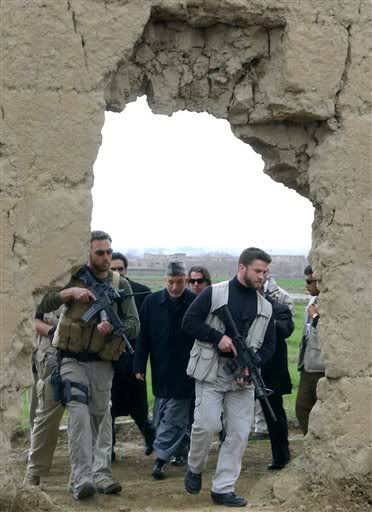
     The photo below is a mystery.  I have no clue if these guys were PSC’s or not.  But what the photo symbolizes is all the years that good men like them spent putting their lives on the line for Karzai. Do you think he even thanked them for their protective services? –Matt

Edit: 08/23/2010 – Tim wrote up a great post on the subject, and has a better translation of the decree.  Check it out here.

—————————————————————–

Karzai

Afghan President Hamid Karzai, center, is surrounded by heavily armed bodyguards as he arrives for a groundbreaking ceremony in Parwan, some 34 miles, 55kms north of Kabul, Monday, March 14, 2005. Karzai was surrounded by dozens of US security personnel as he attended a ceremony of groundbreaking for a road linking the Panjshir Valley to Parwan in the district of Bayan. (AP Photo/Shah Marai, Pool)

—————————————————————–

President Karzai’s decree regarding PSCs in Afghanistan:

For tackling corruption and ensuring security of our citizens and prevention of security irregularities as well as exploitation of arms and military equipment and uniforms by the security companies which has caused some tragic incidents, after some thorough and legal review I am approving the annulment of foreign and national security companies within four months as per the following conditions.

The members of security companies who can meet the military recruitment conditions of provided that they meet the conditions they can join the police forces with or without their registered arms or weapons. And the Interior Ministry is obliged to annul it within four months from today.

For foreign companies who are registered with IM, if they agree, then the IM, Def Min and NDS will buy their weapons and the resident visas of the foreign members will be cancelled. If the companies do not agree to sell their arms their resident visas will be cancelled and they can leave the country with their arms.

Those companies who are not registered with IM their arms will be confiscated.

Embassies or diplomatic offices, NGOs who are operating in Kabul and provinces can still use their own security personnel within their premises. They should not be visible outside their premises. The number and conditions for this will be spelled out by the IM. The MOI’s must take charge of the external security of embassies,NGOs in Kabul and other provinces.

It is the MOI’s task to implement this decree.

——————————————————————

(You must sign up to read a few of these forum discussions)

SOCNET Forum discussion here.

Tactical Forum discussion here.

Lightfighter Forum discussion here.

Secure Aspects Forum discussion here.

Close Protection World Forum discussion here.

« Newer PostsOlder Posts »

Powered by WordPress