Feral Jundi

Tuesday, January 14, 2014

Industry Talk: The Slavonic Corps–A Russian PMSC In Syria

“A large field between Lattakia and Tartous, surrounded by barbed wire. That is where our battalion and the Syrian reservists were stationed. It used to be a racecourse. We were housed in the former stables. By October there were 267 people from the ‘Slavonic Corps’, split into two companies. One company was made up of Kuban Cossacks, the other had people from all over Russia; there were 10 or 12 men from Petersburg. The bosses said that the numbers of the corps in Syria was expected to reach up to 2,000 men.”
In addition to assault rifles, the battalion received machine guns and grenade launchers. They had anti-aircraft guns, 1939 models. The mortars were from 1943. Crews were formed for the four T-72 tanks and some BMP (infantry fighting vehicles). The question of how appropriate the weapons were, for the task of protecting “facilities,” came up quickly, even from the most gullible, and was addressed. “Did you come to fight or to guard? Whoever guards is on eternal kitchen patrol.” Those were the words of the commander’s reply. The manager of the project was Vadim Gusev, known to many as the deputy director of Moran Security Group.

This is a unique story that I wanted to get out there for folks to check out. My post about Assad approving the use of PMSC’s was a record post on FJ, and stories like this are very interesting to the community. I also wanted to put this out so that those who were involved with this contract in Syria can respond. The last couple of weeks I have been asking around on FB and nothing has come up. I suspect that it is mostly a language deal and that Russians have not been hanging on English based FB groups. So hopefully this post will get their attention via Google Search.

Basically, this company was contracted to guard ‘and’ do other things in Syria, for the Assad side. Apparently the contractors recruited by this company were victim to the whole bait and switch game, and as soon as they got on the ground, the company changed the contract to a more kinetic operation . So the company I believe is at fault for not being honest in their recruitment from the get go, and not preparing their people for this kind of contract. As  a result, the Slavonic Corps had a poor showing in Syria, it was poorly led and managed, and the contract signed with the client was poorly written. The result was a company running out of Syria with it’s tale between it’s legs, and creating a bunch of unpaid and pissed off contractors. Here is a quote about recruitment:

This was never understood. “When they spoke to us in Russia, they explained that we were going on a contract with the Syrian government, they convinced us that everything was legal and in order. Like, our government and the FSB were on board and involved in the project. When we arrived there, it turned out that we were sent as gladiators, under a contract with some Syrian or other, who may or may not have a relationship with the government… That meant that we were the private army of a local kingpin. But there was no turning back. As they said, a return ticket costs money, and we’ll work it off, whether we like it or not.” As they told the Slavonic Corps troops, the job came down to maintaining control over the centre of the oil industry, in the town of Deir ez-Zor. In order to be in control of it, we had to reach it. More than 500 kilometres across territory occupied by government troops, by the opposition or by completely unknown forces.

Crazy, but this sounds way too familiar from my experience in contracting. But I am not going to let the contractors that signed up for this off that easy. These guys did not do their due diligence before accepting the contract. It sounded like the recruiters attracted a lot of desperate and naive folks who really wanted to believe this was a good deal. I wonder if the Russians have a forum or Facebook group to go to, so they can ask questions to their community about companies like the Slavonic Corps or the Moran Security Group? Because if they would have had a SOCNET or a Feral Jundi or an Eeben Barlow, they could have gotten some second opinions that would have squared them away.  Here is a great quote from another Russian PMSC called the RSB Group, about the idiocy of this contract:

In the words of the professional: This is a crazy scheme
After asking Vyacheslav Kalashnikov several times to speak on the subject of Syria, and having received no answer, Fontanka turned to the head of Russia’s largest private military company, the “RSB Group,” for comment. Oleg Krinitsyn is certain: the Syrian story of the Slavonic Corps was a crazy scheme from the start.
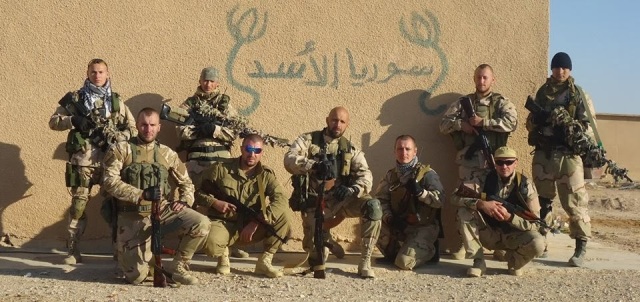
“The widely advertised campaign to recruit mercenaries for Syria initially sounded like a stunt, a kind of PR campaign. Later on, people believed it and were drawn to their dream – to make money. But not all of them understood that this money was dirty, and possibly bloody. Before sending people to a country where there is active fighting, where there is a virtual ‘layer cake’ of the Syrian Army, the opposition fighters, al-Qaeda, al-Nusra etc, it’s essential to prepare them, as well as to understand how to get them out of there. Among those guys, photographed against a backdrop of Syrian equipment, festooned with weapons, I noticed a few of our former employees, who had been dismissed because of their poor moral character. I saw guys with criminal records amongst them. This once again confirms that the aim of the recruiters was not to attract high quality professionals, but just to plug a ‘hole’ with cannon fodder, and fast. And the boys were sent on contracts that resembled contracts for suicide missions. Right away, people signed a contract that included a will to bury their remains in their homeland, or if that proved impossible, in the nation where they died, and then be reburied in Russia. Dreadful.

Luckily for these guys, they were saved by a sand storm. Having experienced these types of storms in the middle east, I can say these things can get pretty dense. Quote:

It could be regarded as a great success that, out of the whole corps, a total of six people were wounded, two of them seriously. It should be pointed out that all of the wounded were removed from the battlefield and returned home with all the others. “We were saved by a sandstorm, we were enveloped by it on our retreat, but it hid us from the local mujahedeen. There was so much sand that you couldn’t see anything. But thanks to that, we are alive.”

These guys also paid the price when after fighting their way out of Syria, they had to deal with authorities when they came back home. The FSB was heavily involved from the sounds of it and this is also an interesting angle to this story. One of the articles I posted below talked about the FSB connection to this company and contract:

For instance, the head of the Slavonic Crops was a commander in the FSB reserve. New York University professor Mark Galeotti has studied the way the Russian security apparatus operates. In an interview for The Interpreter on the topic, he told me that private military contractors would need to clear all such operations with the FSB, which would mean that the FSB has placed Syria on the list of nations where foreign operations were approved. Galeotti went even further. When asked whether he thought there were more Russian mercenaries fighting for the Assad government inside Syria, he said that this was “likely,” and it’s not just mercenaries who are helping Assad:
“I anticipate that ‘mercenary’ is merely a cover story for Russian soldier or spook, just as the “Russian engineers” working on Syrian air defense systems are going to be military.”
There is significant reason to believe that the FSB knew about the mission. But as Thursday’s story in Foreign Policy explains, the Russian government had good reason to clip the mercenaries’ wings:
It’s not hard to surmise why the FSB would have turned on a company it may have given tacit support to send men into Syria. The mercenaries performed poorly in the field, and proof of their illicit activity had been plastered all over the Internet, so not tossing Gusev and Sidorov in the clink might have caused the kind of scandal that even an unembarrassable Kremlin would want to avoid. Moscow has been outspoken in its criticism of U.S. and Arab arms transfers to Syria’s rebels, even as its own state arms export company dispatches more and more sophisticated hardware to Assad, according to the State Department’s Robert Ford, the U.S. ambassador to Syria. The Kremlin is also trying to ensure that the imperiled Geneva II peace conference takes place in December, just in time for the regime to be in a much-strengthened negotiating position after a series of tactical gains on the battlefield.

So with that said, I think the Russians were anticipating that the West was going to make this into an ’embarrassing deal’ by plastering it all over the news. So for them, as soon as the whole thing went bad, they took the side of shock and disgust. Check out how they tried to whitewash this incident when these guys came back.

Despite the fact that, according to the contract, the assignment was supposed to last five months, in the last days of October the personnel were loaded onto two chartered planes and sent to Moscow. They were not expecting such a reception to be awaiting their arrival at Vnuknovo. As they disembarked the aircraft one by one, each fell into the hands of FSB officers. There was a quick inspection, the removal of SIM cards and any other media, and a brief questioning as witnesses. Then followed the removal of their passports, non-disclosure forms, and tickets home. Vadim Gusev, who had flown in business class and left the plane first, remained in the hands of the investigators. As they explained at the Moran Security Group, he and another employee of the company, Evgeny Sidorov, who was responsible for human resources, were arrested in a criminal case brought by the FSB’s metropolitan command under the never-before applied Article 359 of the Criminal Code – mercenary activities.

Did I mention that the contractors involved will not be getting paid the 4,000 dollars they were promised!…. Yikes, what a soup sandwich.

Well, that is about all I have on this one. Just some commentary on what has already been reported. If anyone has any interesting side notes on this story, I would be curious to hear about it. I also posted some links to the companies involved in this story and some good posts about the Slavonic Corps below. –Matt

Foreign Policy story on the Slavonic Corps.

Moran Security Group website here.

The Slavonic Corps website here.

War is Boring post about it here.

Pieter Van Ostaeyan’s blog about it here. (he was able to dig up some interesting stuff)

Youtube video of one of the contractors thought to be dead, that survived and posted this.


The Last Battle of the “Slavonic Corps”
The story of the Russian mercenaries who went to war against Syrian rebels.
By Denis Korotkov
Originally published by Fontanka on November 14, 2013
Translated by Pierre Vaux November 16, 2013
A Syrian rebel group claims that it has ambushed and killed a group of Russian mercenaries who may have been working for a Chinese security contractor. The jihadist fighters from an Al Qaeda affiliate “Islamic State of Iraq and al Sham (ISIS)” claim to have killed the mercenaries in a battle near Homs. At least one of the mercenaries, however, has been videotaped alive and well, and living back in Russia.
The large and well-respected St. Petersburg newspaper, Fontanka, has published an article, translation by The Interpreter, entitled “St. Petersburg Sends Contractors to Syria.” It details the investigation that uncovered the existence of Russian mercenaries defending sensitive installations important to the Assad government in Syria. The contractors appear to have been recruited in St. Petersburg by a company based in Hong Kong.
We also know that the mercenaries appear to have been operating in As-Sukhnah, east of Palmyra, on the road between Deir Ez Zor and Homs. Jihadists have long wanted to capture the town, and nearby Palmyra, because securing this road would link their forces from the east to the west. The Assad regime, on the other hand, has had difficulty sparing the resources to defend the position, as it is far away from the major cities which are heavily embattled. According to the initial investigation by Fontanka, the mission of the mercenaries was to secure key regime assets, away from the front lines, in order for Assad forces to concentrate on removing “bandits” in other areas. However, it appears that the oil fields that the Russians were supposed to be guarding were in rebel control, and the team was really tasked with getting them back.
The following translation is an update from Fontanka. It says that one of the key players in the military contracting company is a reservist officer in the Russian Federal Security Service (FSB), lieutenant colonel Vyacheslav Kalashnikov. The FSB, therefore, were aware on some level that the Moran Security Group was sending Russian mercenaries to Syria to fight for Assad. However, the mercenary group was shut down and several mercenaries were arrested upon their return to Russia. A major Russian contractor says that this was not an FSB mission, but a mission designed to look like an FSB mission. The insinuation is that a pro-rebel group hired the Russians in order to lead them into a trap, kill them, and show their bodies on television.
All of the pictures on the original Fontanka article were also posted in the one we already translated. Instead, these pictures of the Russian mercenaries were posted on a Russian social network (except the one that states it was from Fontanka). – Ed.

(more…)

Saturday, January 4, 2014

Industry Talk: Basra Contracts With Aegis To Help Stop Wave Of Terrorism

Anxious to rid itself of the lawlessness that still plagues Iraq’s southern capital, Basra’s governor has hired a private military company run by a British general who helped capture the city from Saddam Hussein.
Maj Gen Graham Binns, who is the chief executive of Aegis Defence Services, commanded the 7th Armoured Brigade when it led the siege of Basra in 2003.
Four years later he supervised the handover of the city to Iraqi security forces. Now, amid growing concern about a fresh wave of terrorist violence across the country, Basra’s governor has invited Maj Gen Binns’s company back to assist at a “strategic level”.
Aegis will be asked to provide help with setting up specialised CCTV detection and checkpoint systems across the city, establishing a “ring of steel” security system to thwart suicide bombers.
It will also set up an academy to help security forces improve coordination and intelligence-gathering techniques.
As Basra’s economy promises to boom, Britain’s consulate prepares to pull out.

A hat tip to Mark over at facebook for finding and sharing this news. This is a big story because Iraq is turning to private industry to help solve this immense threat that has been growing in their country. Iraq is awash with terror attacks this last year, thanks to the mess that is going on in Syria.

Basically, Syria has turned into a jihadist factory, where Al Qaeda has definitely taken advantage. This violence is also spilling over the borders into places like Lebanon and Iraq. ISIS or Al Qaeda of Iraq and Syria is gaining territory, manpower, and weapons, and they are on the war path. There have also been some significant prison breaks that have certainly helped add to the ranks.

A prime example of what I am talking about is that ISIS has just captured Fallajuh and is working on Ramadi–two places that coalition forces fought really tough fights during the war. Iraq’s military and police are having a hard time competing with this, and they are losing ground. There is also a sectarian element to this. These areas are primarily sunni, the government of Iraq is led by shia, and because of the actions of the jihadists to fuel this animosity between the two, that it is very easy for ISIS to get refuge in sunni areas.

Another point to bring up is that the governor of Basra is contracting Aegis’ services because of Maj Gen Graham Binns background and experience in Iraq. He was the commander of all British forces in Iraq, at the time the British signed over Basra’s security back over to Iraq, December of 2007. This is quite the thing to bring back this General, but as a contractor. Which brings up an interesting thought.

Will General Binns be able to do what he wanted to do in this contract, that he couldn’t do in the military doing the same mission? Will he have more flexibility and be more innovative in the way he accomplishes the mission, or is he a one trick pony as they say? We will see, and if Aegis or General Binns would like to comment on this contract, we look forward to hearing from you. Congrats to the company and good luck to General Binns. Be sure to check out all three articles below, to include one written by General Binns himself. –Matt

Edit: 01/07/14 -Here is an interview that the governor of Basra gave about the the status of his city and why he is contracting services, versus using local. He just took office and it seems corruption is very bad, and security is not dependable.

Al-Monitor: How do you see the security situation in the province?
Nasrawi: The security problem is no different from the contract problems we talked about, for there is a lack of planning in both cases. The mechanisms in place for fighting terrorism are basic, limited and non-innovative. Thus, we decided as an initial step to contract a British security consulting company. I believe that the problem of terrorism cannot be solved via a military leader, but rather through security experts, surveillance technology, and training and developing the capabilities of the intelligence [agencies]. For example, we have a plan to buy sophisticated explosives-detection devices, but who determines the specifications and standards for these devices? Will we make the same mistake as Baghdad, which imported [explosives-detection] devices that didn’t work? Who will choose the weapons and sniffer dogs? To answer these questions, we turned to a global consulting firm that works in the security field.
Al-Monitor: Have you encountered any objections to this contract from the ministries concerned with security or the office of the commander in chief of the armed forces?
Nasrawi: The law allows the province to do this, and the contracts are paid using Basra’s money, not funds from Baghdad.
Al-Monitor: You talk about security as though it’s a purely technical issue, but what about the social problems feeding disorder?
Nasrawi: This is correct. Security cannot be achieved though arrests alone. First, it costs a lot of money to put large numbers of people in prison. Most importantly, however, we must address the motives for crimes and the cultural and social reasons standing behind these crimes — and we must work to address them. A culture of security must spread in society, so that each citizen becomes a part of the ingredients for security in the country and is not afraid or reluctant to report any security breach.
Al-Monitor: What about the malfunction within the security establishment?
Nasrawi: The causes [of this malfunction] are known. There is corruption as well as political and partisan intervention in the work of the security services. Recently, Basra was able to rein in a large gang involved in theft, blackmail and kidnapping, which was led by a senior police officer. We were under pressure not to arrest [members of the gang], but we were determined to bring them to justice. We will not allow for a shuffling of cards in Basra. We will not stray from our path to purify the security services of any breaches.


Maj Gen Graham Binns when he was in the military.


Basra invites British back for security role
Six years after the last British troops left amid a barrage of bombs and mortars, the Iraqi city of Basra is to re-enlist UK military expertise to oversee its security again
By Colin Freeman
03 Jan 2014
Anxious to rid itself of the lawlessness that still plagues Iraq’s southern capital, Basra’s governor has hired a private military company run by a British general who helped capture the city from Saddam Hussein.
Maj Gen Graham Binns, who is the chief executive of Aegis Defence Services, commanded the 7th Armoured Brigade when it led the siege of Basra in 2003.
Four years later he supervised the handover of the city to Iraqi security forces. Now, amid growing concern about a fresh wave of terrorist violence across the country, Basra’s governor has invited Maj Gen Binns’s company back to assist at a “strategic level”.

(more…)

Wednesday, January 1, 2014

Leadership: General Balck On Eating With Your Troops

When General Hermann Balck was commanding 48th Panzer Korps on the Eastern Front with General F.W. von Mellinthin as his I-A, Mellinthin one day reproached Balck for wasting time by going out to eat with the troop units so often. Balck replied, “You think so? OK, tomorrow you come with me.”
The next day, they arrived at a battalion a bit before lunchtime. They had a formal meeting, Balck asked some questions and got some answers. Then, they broke for lunch. During the informal conversation that usually accompanies meals, Balck asked the same questions and got completely different answers. On their way back to the headquarters, Balck turned to Mellinthin and said, “Now you see why I go out so often to eat with the troop units. It’s not for the cuisine.”

In one of my searches on General Hermann Balck, I came across an interesting deal about the value of informal conversation and eating with your troops. As a leader in the PMSC world, to achieve unit cohesion can be challenging. Most gigs are personnel deployment versus unit deployment, so you could be on a gig where you are constantly working with new folks.

So as a leader in such an environment, you have to constantly find ways of connecting with your guys other than just working with them in the day to day. Anything you can do to connect with folks and bring them together as a team, even when that team is constantly changing. The brass ring for any leader is to create unit cohesion so that operationally, you work as a team and not a bunch of individuals. Sitting with your shift, team, detail, company, etc. is one small way of building that unit cohesion.

This sounds like a no-brainer when it comes to leading, but you still have folks out there who want to separate themselves from their team/organization/company. Either for privacy issues, or on the negative side, because they could care less about the very people they lead. That eating with your men is a waste of time, like what was mentioned by Mellinthin up top. The simple act of breaking bread with your brothers in arms can show that you do care about them and actually want to connect with them other than through training or work.

It is also an excellent way to get feedback gold from your people. Or to create an environment where people can open up to what is really going on with the contract/mission or with what is happening with the team. Someone might mention a very useful bit of information about training or operational stuff, that really opens up a conversation within the group at the dinner table. ‘Pass the gravy, and tell me more about how to do this better….. As a leader,  you should have a front seat to this information sharing dinner party.

There was also a mention of Boyd in this article that was interesting. Boyd and Lind were both a part of the group that interviewed Balck and all sorts of cool lessons learned were obtained from these conversations. –Matt


General Hermann Balck in the center, at a table with soldiers.

Conversations
By William S. Lind
March 15, 2007
A curious fact about the American military, and American private industry, in the early 21st century is their insistence on holding formal meetings. The practice is curious because these same institutions spend a great deal of time and effort studying “good management,” which should recognize what most participants in such meetings see, namely that they are a waste of time. Good decisions are far more often a product of informal conversations than of any formal meeting, briefing or process.
History offers a useful illustration. In 1814, the Congress of Vienna, which faced the task of putting Europe back together after the catastrophic French Revolution and almost a quarter-century of subsequent wars, did what aristocrats usually do. It danced, it dined, it stayed up late playing cards for high stakes, it carried on affairs, usually not affairs of state. Through all its aristocratic amusements, it conversed. In the process, it put together a peace that gave Europe almost a century of security, with few wars and those limited.
In contrast, the conference of Versailles in 1919 was all business. Its dreary, interminable meetings (read Harold Nicolson for a devastating description) reflected the bottomless, plodding earnestness of the bourgeois and the Roundhead. Its product, the Treaty of Versailles, was so flawed that it spawned another great European war in just twenty years. As Kaiser Wilhelm II said from exile in Holland, the war to end war yielded a peace to end peace.
The U.S. military has carried the formal meeting’s uselessness to a new height with its unique cultural totem, the Powerpoint brief. Almost all business in the American armed forces is now done through such briefings. An Exalted High Wingwang, usually a general or an admiral, formally leads the brief, playing the role of the pointy-haired boss in Dilbert. Grand Wazoos from various satrapies occupy the first rows of seats. Behind them sit rank upon rank of field-grade horse-holders, flower-strewers and bung-holers, desperately striving to keep their eyelids open through yet another iteration of what they have seen countless times before.
The briefing format was devised to use form to conceal a lack of substance. Powerpoint, by reducing everything to bullets, goes one better. It makes coherent thought impossible. Bulletizing effectively makes every point equal in importance, which prevents any train of logic from developing. Thoughts are presented like so many horse apples, spread randomly on the road. After several hundred Powerpoint slides, the brains of all in attendance are in any case reduced to mush. Those in the back rows quietly pray for a suicide bomber to provide some diversion and end their ordeal.

(more…)

Thursday, December 26, 2013

Publications: Freedonia Report On Global Demand For Security Services

This publication is very expensive, but you can buy bits and pieces of it at your own choosing. I am not getting any kickbacks or anything from this group, and I am only putting this out there as information for the readership to check out.

To go along with my post on crowdfunding, the global demand for security is increasing, and the factors driving the demand are evident in this report.

Factors such as rapid gains in economic activity, rising personal incomes, foreign investment activity, and concern that public safety forces are overburdened, corrupt, or unable to provide sufficient protection will boost gains. Furthermore, increasing regulation and a trend toward greater professionalism in many of these local security service markets will improve public trust in security service businesses, thereby driving gains.

I have seen these trends and talked about them here on the blog. China is blowing up when it comes to security services. Africa will definitely need services, and thanks to the cartels in Mexico, security will continue to be in high demand.  The US continues to be the largest consumer of security services in the world, which is interesting. Also, the progression towards ISO certification for maritime PMSC’s–which will probably carry over to land based PMSC’s in the future, is a sign of this ‘professionalizing’ of the industry. Check it out. –Matt


Global demand for security services is driven by rising urbanization, the real and perceived risks of crime and terrorism, and a belief that public safety measures are insufficient.
World demand to 7.4% annually through 2016
Global demand for private contract security services will increase 7.4 percent annually to $244 billion in 2016. In general, demand for security services is driven by rising urbanization, the real and perceived risks of crime and terrorism, belief that public safety measures are insufficient, and growth of a middle class with assets to protect and the means to pay for supplementary security measures. The security service market will also be supported by an improved economic environment and building construction activity.
Developing areas to see strongest gains in demand

(more…)

Building Snowmobiles: Crowdfunding Private Security

Definition of ‘Crowdfunding’: The use of small amounts of capital from a large number of individuals to finance a new business venture. Crowdfunding makes use of the easy accessibility of vast networks of friends, family and colleagues through social media websites like Facebook, Twitter and LinkedIn to get the word out about a new business and attract investors. Crowdfunding has the potential to increase entrepreneurship by expanding the pool of investors from whom funds can be raised beyond the traditional circle of owners, relatives and venture capitalists.
In the United States, crowdfunding is restricted by regulations on who is allowed to fund a new business and how much they are allowed to contribute. Similar to the restrictions on hedge fund investing, these regulations are supposed to protect unsophisticated and/or non-wealthy investors from putting too much of their savings at risk. Because so many new businesses fail, their investors face a high risk of losing their principal.-Investopedia

One of the exciting things to develop last summer was the advent of crowdfunded security. It is a concept that I wanted to share here on the blog that is really cool and cutting edge. It is a new way of doing business and I wanted to introduce the concept. Who knows, maybe someone will take the ball and run with this.

So here is the concept–create a crowd funding website called Securityfunfr.com or similar, that is completely dedicated to helping countries, states, cities, towns, communities and even individuals in starting crowd funding campaigns for their security. The model is already out there with such places as Idiegogo, Kickstarter, or Crowdtilt.

The idea for this came from a Crowdtilt campaign that was done in Oakland, California by a community in need of security services. Their neighborhood was constantly dealing with criminals, and the police were stretched too thin because of budgetary constraints to deal with that crime. So a member of the neighborhood started a campaign to raise money to contract the services of a local security company.

What happened next is amazing. They were able to raise all of the money needed to fund their own security, and in a very short time. Folks from all over the country could contribute funds to this campaign–and they did.

Now what makes Securityfundr an interesting concept is that it would be a ‘security specific’ niche crowdfunding site. A place to go, to specifically raise funds for whatever security is required. I envision something that a small village in Somalia could take part in, or some town Idaho could get into, or what some female jogger that runs in Central Park, NY could tap into–all to raise money for their security.

You could also raise money to secure websites and protect against hackers. The cyber element of securityfundr could be big, just because the ferocity of attacks that can hack places like Target, could easily be turned on small mom and pop websites–and they do. But small businesses and individuals are limited in their ability to protect their websites, all by how much money they have. Enter crowdfunding and the potential of a site like securityfundr….

I would also create a portal for security companies to advertise their wares on the site. They could receive alerts through the website, for when a funding campaign is started within their area.  A company could sign up, and get alerts for specific types of security work, within a certain distance. The website would have a highly secure and encrypted online interface and mobile interface. Each company would be voted on and rated by the public, kind of like what Yelp or Amazon does, all so folks can voice their opinions on the quality of companies and their services. Like I said before, the models are there, and all it takes is to make a snowmobile out of all of them for the purpose of Securityfundr.

Below I have posted all of the pertinent stories related to the crowdfunded security. If you know of others, by all means let me know and share them in the comments. As to the potential of such a concept? Who knows, maybe a crowdfunding campaign could be started to fund securityfundr?  lol –Matt


Screen Shot 2013-12-26 at 2.37.30 PM


Oakland Neighbors Crowdfunding Private Security
BY Sam Roudman
Friday, October 4 2013

Oakland California’s Rockridge neighborhood has generally been better known for its fresh pasta and pricey Craftsman homes than for brazen daylight robberies. But that changed last month when three men held up a line of drivers waiting at the Rockridge BART station to pick up passengers in order to use the carpool lane on their morning commute.
“The casual carpool line is sort of a sacred thing,” says Rockridge resident Steve, Kirsh, “they robbed 20 people and they kind of freaked out the community.”
What’s a violated yet technologically savvy community to do? In Rockridge, the answer has been to crowdfund private security services, with the aim of compensating for an understaffed police department in the city with the highest robbery rate in America. In the last few weeks three separate campaigns have been started on Crowdtilt in order to fund four months of private security patrols in three different section of Rockridge. Near $35,000 have been raised so far, and two of the three projects have raised enough funds to ensure they will move forward.
The campaigns illustrate the power of crowdfunding tools to propel civic action, but they also point to the potential of crowdfunding to increase urban inequality in the name of a civic virtue like neighborhood safety.

(more…)

« Newer PostsOlder Posts »

Powered by WordPress