Feral Jundi

Wednesday, February 12, 2014

Weapons: Oh, The Weapons Contractors Use…

Filed under: Afghanistan,Iraq,Weapons — Tags: , , , , , , , , , , — Matt @ 2:19 PM

This is a fun one. On Facebook I posted a TOTD or Thought Of The Day on what types of weapons contractors have used in the past on contracts. What I got was an incredible amount of feedback on this and it was really fun to see what popped up. Here is the TOTD I posted:

TOTD: Contractor Weapons. I think this would be a fun one. I would be interested in all the various weapon types that guys have seen issued as contractors, or had to use as part of their contract. Or stuff that you saw or heard other contractors use. Everyone hears about AK’s, M-4/ARs, and Glocks, but what are the other rifles and pistols seen issued. Or even the heavier weapons used for contracts. This should be a fun one and I will probably make a post out of it on the blog.

I have mentioned in the past that Facebook has been incredibly useful for interacting with the contractor community. The amount of feedback and interaction is amazing and very useful. I am also able to share more ideas in a more efficient manner there, which also helps to get more ideas in return.

So back to contractor weapons. Guys posted pictures and everything, and it was cool to see any trends in what we are using out there. Obviously AK -47’s and M-4/AR-15 variants are the top primary weapons. But the various types of other weapons issued and their histories are very interesting. Some are just recaptured weapons that were given to contractors by outgoing military units in the various AO’s, or some are weapons the companies were able to ship into that country. Others were bought in gun markets in the region, and it is fascinating to see what contractors we able to get a hold of.

What I will do below is list every gun mentioned and I recommend going to the post on FB to see the various stories behind these weapons. I did notice that the G-3 was mentioned quite a bit. I got to play around with one in Iraq, but didn’t use it for work. In the photo below, Patrick brought up a heavily modified G 3 that I thought was cool.

The other thing to point out is how many copies of weapons were mentioned. Stuff that was either reproduced by Iraqi factories or stuff that was made in the weapon making villages of Pakistan. Lots of junky weapons that fell apart or barely worked, but were cheap and helped to stand up a contract. It is a huge problem in the industry, and companies continue to outfit contracts with junky weapons and equipment, all because of money or because they do not have the connections to get the good stuff into that war zone. That is the one thing that I continue to see and hear from contractors out there, and I have experienced the same, and that companies are horrible at providing good weapons or equipment. It’s why guys become good at fixing weapons or why folks prefer to bring their own kit–because the companies are horrible at this stuff.

Back to the list. There is also the mention of heavy weapons used, or the use of explosives. Stuff that you would not associate with contracting, but was certainly used at one time or another by contractors in Iraq or Afghanistan. In the early days of Iraq, you saw everything. Now, not so much because regulations and contracts have become very specific as to what can be carried. I saw that change during the 2006 to 2008 time frame, and especially in Iraq. But there are contracts that are out of sight or out of control of the Big Military, and you continue to see the heavy stuff come up on contracts.  So here is the list, and feel free to add in the comments section stuff that you used on contracts. –Matt


9819_10152259363751115_1886790961_n

This is a PDW Patrick McAleer made in 2007, out of an Iranian G3, in Iraq. Photo Credit Patrick McAleer.


Pistols

Glock 19
Glock 17
HS 2000
Caracal F
M 9
SIG P226
Makarov
Turkish Kanuni
Walther P 38
Iraqi Berretta
Browning Hi Power
Walther P 99
CZ 75
.455 Webley
Smith and Wesson Sigma
Norinco NP 22 (Sig 226 copy)
FN P35
CZ 70
Tariq
Zastava EZ9
Ruger P95
.38 Colt Diamondback
Colt 1911
.455 Colt Eley
Tokarov

Rifles
M 16 A2
AK 47
AR 15
M 4
FN FAL
Colt 722
G 3
G 36
Type 56
K 98
Krag
British SMLE
Sturmgewehr 44
SVD
Saiga M 3
Benelli Argo
Remington R 25
Remington 700
Browning BAR
Mosin Nagant
FPK Dragunov
AR 10
Ruger Scout Rifle in .308
AMD 65
HK MR 308
FN FAL para
VZ 58
AR 18
HK 416
East German MPi KM 72
SIG 550

Shotguns

NOR 982
Remington 870
Italian double barrel

Submachine Guns

Swedish K
MP 5
Scorpion
Uzi
Sterling
Krinkov
PPSH 41
Beretta M 12
Beretta PM 12S
Thompson

Machine Guns

MG 42
FN Minimi Para SAW
FN M-249 SAW
M-240/MAG 58
PKM
M 60
RPK
MG 3
RPD
VZ 59

Grenade Launchers

M 79
UBGL 25
HK 69
M 203
M 320/AG 36

Mortars, Grenades and Mines

M 67
RGD 5
M 18 Claymore
Stun
Tear Gas/CS
Improvised Claymores For Defense
Mortars for flares

Rocket Launchers

AT 4
RPG 7

Heavy Machine Guns

M 2
DsHK

Automatic Grenade Launchers

MK 19
AGS 17

Misc.

Crossbows
Regular Archery Bows
Kitchen Knives
ASP baton
Slingshot

Tuesday, February 4, 2014

History: George Washington On Starting His Own PMSC To Combat The British

Mr. President, I am a soldier and believe in being prepared. For that and other reasons, I will give my vote for the resolutions of the gentleman from Hanover. Rather than submit to the present condition of things, I will raise one thousand men, subsist them at my own expense, and march myself at their head to the relief of Boston.– George Washington

This is a cool quote from American history that you don’t hear much about. Obviously Washington did not have to raise an army in this fashion, but it is interesting that he put it out there. That he was willing to finance such an army if no one else was going to act.

What is also interesting is that George Washington was very familiar with concept of privatized warfare from his experience fighting with the Royal American Mercenary Regiment (RAMR) during the French and Indian War. He was also a champion of actually paying soldiers as opposed to asking them to do what they did, purely out of love of country. Washington found out that with a volunteer militia, it’s a little hard to keep guys focused when they can’t be home to make money or grow food to support their family. Paying a salary kept their heads in the game, and helped reduce attrition.

The other area of privatized warfare that Washington was involved with was privateering. He actually owned stock in privateering ventures and was a supporter of issuing the Letter of Marque to privateers to fight wars.

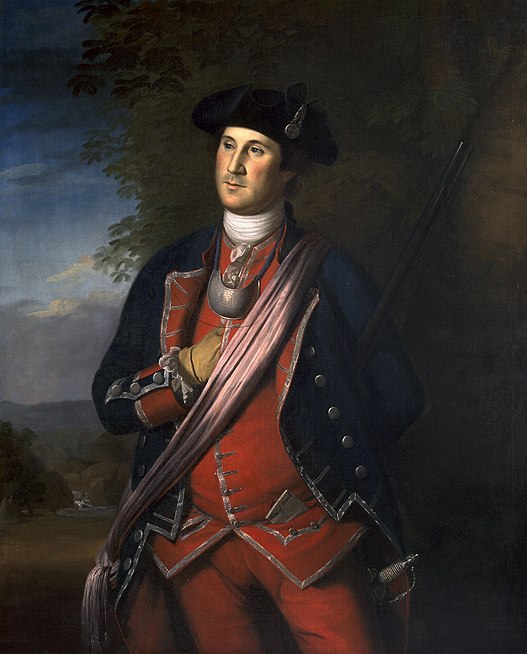
The artwork posted below is also interesting. That would be the uniform he wore during the French and Indian War. I noted in the past that this war was significant because this is where Washington learned how to fight and lead men in combat. He learned from the various mercenaries that came to fight in the RAMR, and he used that knowledge and experience and applied it later on. –Matt


Charles Willson Peale is the Artist. This is the earliest authenticated portrait of George Washington and shows him wearing his colonel’s uniform of the Virginia Regiment from the French and Indian War. The portrait was painted about 12 years after Washington’s service in that war, and several years before he would reenter military service in the American Revolution. 1772


Patrick Henry: “Liberty”

“I have but one lamp by which my feet are guided; and that is the lamp of experience.”

As the British army tightened the noose around Boston, the Virginia Assembly met in an extralegal session to discuss what steps to take in the wake of what was happening up North. The British hoped that by isolating Boston, they could stamp out the revolution. As the speech below demonstrates, the effect was the opposite of what the British desired, for Virginians—and other colonists—realized that “If they can do it to Boston, they can do it to us.”

The words of the debate were later written from memory by William Wirt, and though they may not be the exact words spoken by Patrick Henry and others, the general consensus among historians is that they certainly contain the spirit of Henry’s remarks and are consistent with what we know of his eloquence. He was, in many ways, the voice of the American Revolution. Likewise, the authenticity of the remarks by George Washington has been called into question, but again, they probably accurately reflect his feelings. Loyal almost to the last, he was now thoroughly fed up with the British.

The members address the president of the meeting to gain the floor. The President acknowledges each by the jurisdiction which he represents.

Mr. Pendleton: Mr. President.

The President: The gentleman from Caroline.

Mr. Pendleton: I hope this Convention will proceed slowly before rushing the country into war. Is this a moment to disgust our friends in England who are laboring for the repeal of the unjust taxes which afflict us, to extinguish all the conspiring sympathies which are working in our favor, to turn their friendship into hatred, their pity into revenge? Are we ready for war? Where are our stores—where our arms—where our soldiers—where our money, the sinews of war? They are nowhere to be found in sufficient force or abundance to give us reasonable hope of successful resistance. In truth, we are poor and defenseless, and should strike when it becomes absolutely necessary—not before. And yet the gentlemen in favor of this resolution talk of assuming the front of war, of assuming it, too, against a nation one of the most formidable in the world. A nation ready and armed at all points; her navy riding in triumph in every sea; her armies never marching but to certain victory. For God’s sake, Mr. President, let us be patient—let us allow all reasonable delay, and then if the worse comes to the worst, we will have no feelings of blame. There is no man in this Convention more attached to the liberties of this country than is the man who addresses you. But think before we sacrifice perhaps everything to the spirit of indignation and revenge. Think of the strength and lustre which we derive from our connection with Great Britain—the domestic comforts which we have drawn from the same source—the ties of trade and business—the friends and relatives we have in England. The tyrannies from which we suffer are, after all, the tyrannies of a party in temporary possession of power. Give a little time, take no hostile action, and these tyrants will be overthrown in England and men in sympathy with America will assume authority. Our ills will pass away and the sunshine of the halcyon days of old will come back again. We must arm, you say; but gentlemen must remember that blows are apt to follow the arming, and blood will follow blows, and, sir, when this occurs the dogs of war will be loosed, friends will be converted into enemies, and this flourishing country will be swept with a tornado of death and destruction.

(more…)

Monday, February 3, 2014

Industry Talk: Prince Targets Aviation And Logistics In Africa

So is this Blackwater part 2?
“It’s similar,” Prince replied. “But we’re not here to serve government or defence projects, we’re not there to build their police force, nothing like that. We’re there to move an NGO, an advanced seismic crew or a drilling crew from a mining company, or if an oil operation needs their camp supported and built.”

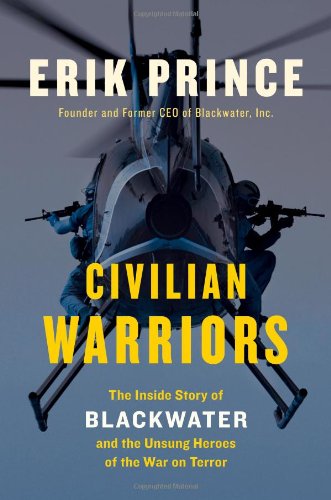
The story of Erik Prince starting Frontier Resource Group and focusing on Africa is not new and I have blogged about that when it first came out. But what was missing were the details, or at least more than what was available at the time I posted that stuff. Thanks to the Civilian Warriors book and all the interviews, Prince has been able to talk a little more about this new venture.

So in the articles below, there are some great little details to pluck out and talk about. The first one that I thought was interesting, was the ‘a ha’ moment for Prince as to what area of business he wanted to get into in Africa.

Prince, who has flown since he was 16, said he realised the potential of operating a safe and reliable air service a year ago when the aircraft which was flying him back from a mine site in Burkina Faso nearly crashed.
“A scary moment but also one of clarity,” he said.

I mentioned in my review of his book that he is an entrepreneur and businessman, and he constantly looks at the world through this lens. His ‘a ha’ moment for the creation of Blackwater came from the realization that he needed to be home with his family, and the SEALs and other groups needed a consolidated, all in one training facility. So he identified a market weakness that he could exploit, and also saw the advantage for his personal well being.

He is also a pilot and has had a love for aircraft since he was younger. In his book, he was very proud of all the aviation ventures that BW got into, so this move towards aviation and logistics in Africa makes sense.

The other tidbit is the quote up top and what was directly asked in regards to security work. He was asked by the WSJ on whether this new venture would include armed security work or not? Here is the quote.

Such high costs also reflect the dangers of piracy and civil conflict, but Mr. Prince plays down his firm’s plans in the security realm. “We are not there to provide military training. We are not there to provide security per se. Most of that security”—say, if an oil pipeline or mining camp needs protection—”would be done by whatever local services are there,” including police and private firms. “We don’t envision setting up a whole bunch of local guard services around the continent.”
So the former Blackwater chief won’t employ guys with guns? Well, he says, “that would be the exception, certainly not the rule.”

I should remind the reader that Prince could easily contract the services of other security firms to help in security.  That would mean using Academi or any of the offshoots of his older company. But like he mentioned in the quote, using local police or security firms is more than likely the path, which is already what most Chinese investors and companies are doing.

Although the problem with this arrangement is if those local forces are dependable? Can they deliver services on time and under budget, or is it even a good service? Can they provide high level PSD services for the engineers and workers for those companies? That is where PMSC’s like Blackwater would come in. Also, someone needs to manage those local forces, or look out for the best interest of the client.

I am quickly reminded of the In Amenas gas plant attack in Algeria and how depending upon incompetent local security forces (provided by the government) was a contributing reason why the attack was so successful. You must have a competent security company watching over the local security force that companies are either forced to use, or use because of cost and choice. I look at it from a concentric rings of security view point, and your outer layer should be your least dependable force and your final ring of security should be your most dependable. Ideally all rings are dependable in a perfect world, but that just does not happen in the real world. Another way to put it, is you need security you can ‘trust’.

But back to the articles below, I think this quote speaks pretty loudly as to why dependable and highly capable services are in such high demand in Africa.

“If you’re drilling in some remote area and your rig goes down and you need a new part for your rig; that’s 10s if not 100s of thousands of dollars a day. How do you get that thing quickly and with no excuses?”

Time is money as they say, and guys like Prince can absolutely organize an effort to get that part or human out there.

This also reminds me of another potential problem for companies. What if their equipment gets caught up in a mess like what the Arab Spring has created in the Middle East? For that, a guy like Prince could organize the effort to secure equipment and people until it can be either flown out or convoyed out of that mess.  Those types of contracts remind me of what helped put Executive Outcomes on the map.

I am talking about the Ranger Oil contract that Executive Outcomes had in Angola. Basically things became unstable there and Heritage Oil and Gas turned to EO to save some equipment caught up in the mess. At the time, they were leasing some drilling equipment that was costing over $20,000 a day, and UNITA would not allow the company to get the equipment out of there. EO was contracted to secure that equipment, which they did.

It is also important to note that the Chinese account for the largest group of people kidnapped in Africa. I have talked about this demand for protective services by the Chinese in the past, and how the South African PMSC market has been filling that niche. Lot’s of money being spent on some risky projects–hence the need for security and folks who know what they are doing.

As long as we are talking about money, it is also interesting to pluck some of the quotes that discuss why Africa is so interesting to Prince. China is investing billions into development and resource extraction there.

Mr. Prince won’t share any revenue projections, but his prospectus notes that “China is Africa’s largest trading partner,” with annual flows of $125 billion. Most estimates put that figure closer to $200 billion, a meteoric increase from $10 billion in 2000 and $1 billion in 1980. The U.S., which was Africa’s top trade partner until 2009, registered $100 billion in annual African exchange at last count. China-Africa trade could reach $385 billion by 2015, according to Standard Chartered Bank.

Not only that, but the US is also delving more and more into Africa with it’s military ventures. So Prince is basically gunning to be the logistics and transportation ‘go to guy’ for Africa. If US strategy includes getting more involved with Africa, it will need companies in place that can provide a need wherever it presents itself.

Although he does have some competition, because there are numerous larger companies  that have already been working that angle in Africa. PMSC’s in Somalia and their support of AMISOM are one example. There is still room though, and investors are looking for folks that they trust can do the job. That is a key point here, because Prince has shown capability in the past by making things happen, and putting his money where his mouth is. He spent over 100 million on new products and services when he owned BW, and much of it never reached fruition. But some did, and really paid off for him. I imagine he will do the same with this company. This quote shows why investors would be drawn to him and what has provoked Prince to get into this market in the first place.

“As I was moving around Asia trying to raise money for this private equity fund, a lot of the big investors said, ‘It’s great that you want to be a fund manager, but what we really need you to do is to build a business like you had before. Not a defence services business, but one that can help us operate in the challenging areas and take away a lot of the uncertainty’.”

Pretty cool and I imagine he will apply the same mindset to this business as he did with BW. Research the region, find services that are lacking or non-existent but are needed, or see a coming need for a product or service, and create that service or product to meed those needs. That is how he built BW, and that is probably how he will build this company.

As to what kinds of aircraft he will purchase and bring to the market, who knows?  If you look at the aircraft that AAR has (former Presidential Airways and BW business unit), you can get an idea as to the kind of aircraft Prince might introduce into the game. Here is a quick run down from wikipedia as to what they have used.

Presidential operates CASA C-212 and CASA CN-235 turboprops. Recent contracts have added de Havilland Canada DHC-8 Dash 8 turboprop aircraft to the fleet. The company also operates turbine powered helicopters including Bell 214ST, Bell 412, MD Helicopters MD-530, Eurocopter/Aerospatiale SA 330J “Puma”, and Sikorsky S-61 rotorcraft.

The key for Prince is to invest in aircraft that can carry a lot, has robust fuel capacity, is durable, and can land on the really crappy air strips throughout Africa. The parts need to be cheap as well. I am sure he will find something that fits the bill. Either way, we will keep on eye on this. –Matt

Edit 04/02/2014: It looks like DVN (or it’s new name Frontier Services Group Limited) has acquired another percentage of an airline that operates out of Wilson Airport. Here is a clip from the news story about it.

News broke yesterday in Nairobi that DVN had apparently acquired a 49 percent stake in Phoenix Aviation which is based at Wilson Airport in Nairobi and engages in aircraft charters and aircraft maintenance, among other aviation services. First it was Kijipwa Aviation, based in Kilifi, a relatively small aviation company, in which DVN acquired a 49 percent stake in late February, then announcing that they were to bring on line as many as two dozen additional aircraft to boost the operational capacity of the firm. However, the acquisition of a similar share in Phoenix may change those plans as suggestions have been floated already among the aviation fraternity at Wilson Airport that the operations of the two local airlines may be consolidated or aligned under one umbrella or at least they will be working under one central command. While DVN reportedly dished out some 1.2 billion Kenya shillings to acquire the 49 percent stake in Phoenix, no confirmed value could be obtained for the acquisition of the Kijipwa shares. Both investments have been linked to the discovery of significant oil deposits in Kenya and the apparent need of international oil exploration companies to contract a range of services from local Kenyan companies, including aviation.

Frontier Resource Group website here.

Frontier Services Group website here.


Beyond Blackwater: Prince looks to resources in Africa
Photo
Sun, Feb 2 2014
By Stephen Eisenhammer
After running one of the world’s biggest and most controversial private military groups, Blackwater founder Erik Prince is starting a new venture providing logistics for oil and mining companies in remote and dangerous parts of Africa.
China is increasingly looking to Africa to meet its ever growing demand for natural resources. Trade between the two reached an estimated $200 billion (121 billion pounds) this year. With 85 percent of Chinese imports from the continent being oil or minerals, Prince sees an opportunity.
He wants to use his experience of getting people and equipment in and out of remote places, where there is little or no infrastructure, to help companies looking to exploit abundant natural resources in places like Sudan or Somalia.
The 44-year-old former U.S. Navy Seal became chairman of Frontier Services Group (FSG) this month, a Hong Kong-listed company of which China’s state-backed investment fund Citic owns 15 percent. Prince himself has share options in the firm that would convert to a 9 percent stake.

(more…)

Friday, January 24, 2014

Books: My Review Of Civilian Warriors

I finally got a chance to read this book and I was not disappointed. Much of the book went over material that I was already familiar with because I have been blogging about this industry for quite awhile now. But it is cool to finally hear Erik Prince’s version of events and his thoughts on the industry.

So what I did with the book is make footnotes on things that I thought were interesting that I was not aware of. Like did you know that the guy that threw a shoe at President Bush during a press meeting, was tackled by a Blackwater guy and not the Secret Service? Or that it was BW that rescued Vice President Joe Biden, Secretary of Defense Chuck Hagel and Secretary of State John Kerry on a snowy mountain top in Afghanistan? That is crazy, and it is stuff like that, that I will bring up in my notes. I will also mention the books that Prince was influenced by or thought important enough to mention in his book.

The first book mentioned by Prince that inspired him for building Blackwater was called Entrepreneurs Are Made, Not Born–By Lloyd Shefsky. Prince read this book while posted on the ship USS America, and the ideas that came from this book helped him to formulate a plan on what he wanted to do when got out of the Navy. He was a businessman/entrepreneur at heart, just like his father, and he wanted to be closer to his family–hence why he wanted out of the Navy. This is where he got the idea for building a world class training facility that could fill a need for the government, and especially his Navy SEALs, whom were constantly on the road for training. What Prince wanted to do was get a centralized training facility in Moyock, North Carolina for multiple government and private clients that would have everything they needed to train. The courage and drive to take the risk to do this, came from the motivation Prince got from reading this book.

As to the name of the company, did you know that the original names being thrown around were the ‘Tidewater Institute for Tactical Shooting’ or the ‘Hampton Roads Tactical Shooting Center’? They went with Blackwater because as they built the ranges on their new property, they were constantly slogging through the peat stained black water mud. It had a better ring and meaning for them at the time I guess.

In the beginning of their business, training was not their big money maker. It was their targets they constructed and they used a tougher steel combined with a pop up mechanism to make targets that folks all over the US wanted. These targets accounted for 50 percent of their revenue in the early days of the company.

He also makes mention of the pride he had in his contractors and employees. One story he mentioned was about a wounded contractor in his company that I did not know about, but thought was really cool. His name is Derrick and his blog is called Small Victories, and it is about the process he has gone through as a severely wounded contractor.

The second book mentioned was Unrestricted Warfare, written by a couple of Chinese colonels back in 1999. This book documented the coming future of terrorism, and it is what woke up defense insiders–to include Prince, as to what was coming. What happened on 9/11 was not surprising to those who foresaw this type of unrestricted warfare or terrorism.

Prince made mention of Frank Gallagher as the first detail leader BW assigned for the task of guarding Bremmer in Iraq. That 36 man detail later grew to a massive operation protecting a multitude of DoS folks in Iraq and later Afghanistan. What is interesting though is that Frank and company were the guys making the innovations on the ground in Iraq when it came to close protection in war zones. (Frank is also coming out with a book)

Frank’s group were so good that their protection schemes would later be adopted by the US Government for protecting it’s highest risk personnel. Not only that, but Osama Bin Laden at the time was extremely frustrated that none of his clowns were able to get a shot at Bremmer. So OBL fired up some offense industry, and put a bounty out on Bremmer and his protective detail. Bremmer was worth 22 pounds of gold, and anyone on the PSD team was worth $30,000 dollars according to the book.

Another interesting aspect of the way Prince did business was in order to show capability, he would build it first with the hopes that clients would see how useful or important it is, and then contract it out. Prince would put his own money down on the venture as well.

A good example of this is Presidential Airways and the advent of using smaller scale paracargo in Afghanistan. In the early days of the war, the Air Force did not have a small scale paracargo capability. They would use large aircraft to drop 600 lb pallets, and do it way too high up in the air. It was Presidential Airways that recognized a deficiency–that the military needed small scale paracargo, and lots of it in order to meet the demand out there. They would go on to do a proof of concept and supply outposts, and then the government later set up a contract to continue using this service. This would later be called LCLA or Low Cost, Low Altitude and I have talked about this on the blog in the past. Thanks to Presidential Airways, I am sure many outposts received life saving ammunition supply drops or food drops. (Cofer Black’s son was actually resupplied by Presidential Airways when he was at an outpost, serving in the military in Afghanistan)

Then there are the other projects that Prince funded that did not get off the ground. Like the armored vehicle called the Grizzly or their blimp. Or the 1700 man peace keeping force called Greystone.

According to Prince, Greystone would have had it’s own air force, helicopters, cargo ships, aerial surveillance, medical supply chain, and combat group. It was Prince’s alternative to the ineffectual UN peacekeepers that we continue to see deployed all over the world. I remember he was wanting to send these guys to Darfur, Sudan if DoS was ok with it. They were not, and this project never got off the ground.

According to the book, Prince spent about 100 million dollars on various BW projects that never went anywhere. He had the attitude of if you build it, they will come. With his creations, he felt eventually someone in the government or in private industry would want this stuff, and he mentioned that if he threw enough darts at the board, they were bound to hit the bull’s eye. He said this is the price of continually innovating. Whatever the government needed, or what they might suddenly realize they needed, Prince would provide it. (kind of reminds me of Steve Jobs with his drive to create products that people didn’t know they wanted, but when made, they absolutely wanted and needed them)

And really, this is at the heart of what he was all about. His father was the same way, and I kind of got the impression that Prince was constantly trying to live up to what his father was all about. His father was very successful and had the same attitude of seeing a need or potential need, and filling it. He is the one that invented lighted mirrors in vehicle sun visors. But his father also had a lot of failures before that lighted mirror took off as a viable concept. Both men were visionaries and risk takers, and that is what you need in order to create something new. To create something that people want, or didn’t know they wanted, but do now.

In the book, Prince also talked about Executive Outcomes and how successful they were. So EO was an inspiration and it is always cool to hear about visionaries getting inspired by other visionaries and their creations.

Prince also made mention of his Libertarian roots and his ideas on contracting and free markets. He was a big fan of fixed cost contracts, versus cost-based or cost-plus. He felt that a contractor should be able to put their money where their mouth is when they say they can deliver something for a certain price. With cost based or cost plus, you are basically giving a contractor an open check to spend whatever they want to get the job done.

You see this theme throughout the book, and that Prince was all about funding a project in order to show proof of concept and viability, or that BW was interested in providing a good value for the tax payer’s dollar.

Speaking of which, BW funded their own rescue operation of folks off of roofs during the Katrina Hurricane disaster back in 2005!  BW also went on to provide effective security in the region after that disaster.

Another business unit that Prince mentioned was Total Intelligence Solutions. TIS was BW’s private intelligence firm that offered services to not only the government, but to private institutions. The Walt Disney Company was mentioned as one of those institutions.

TIS also had Cofer Black in it, and he was very much impressed with the way it operated compared to the government. Black mentioned that ‘every mid-level government official should spend a two-year sabbatical there to learn about efficiency and effectiveness’. My opinion on that is duh, private industry can be very efficient and effective compared to the government.

The third book mentioned was On War by Carl von Clausewitz. Prince’s father was the one that recommended this book to him before he joined the Navy. As to what lessons he learned from this book is hard to say. He mentioned a Clausewitz quote on courage and that is about it.

Moving along through the book, he mentioned stuff about the An Najaf attack. Travis Haley was mentioned multiple times in regards to this attack and it is cool getting some info on what happened during that deal. Travis was brought in by little bird after the attack began, and he was definitely a force multiplier during the fight. The video he and his team posted of the event has received many views over the years. One thing mentioned that I did not know is that his team did receive mortar fire that day. Accurate mortar fire, as we saw with the Benghazzi attack, can be very bad for the defense.

It is also interesting that General Sanchez did not want to acknowledge that Blackwater was so heavily involved with the defense of this facility. The reality is that if it wasn’t for the actions of BW, they would have lost that consulate in An Najaf. It would have been very embarrassing to Sanchez’s command, for it to get out that a contractor did so well, and in his AO.  Or that the US military was not in a position to defend it because it had so many other things going on at the time. This incident was also unique because there were military folks there, but BW was running the show.

It was interesting to find out how much WPS made for BW. Prince quoted well over a billion dollars. At the peak, BW had over a thousand men on the ground in Iraq performing the WPS mission. I am sure Frank Gallagher and others were pretty amazed at how big this thing got.

There was mention of BW’s perfect record of protection, and the most significant injury of a principal at the time was a ruptured ear drum. BW used Mamba armored vehicles in Iraq, which were manufactured in South Africa. An EFP was used by the enemy against one of BW’s Mambas, and everyone survived, to include that principal mentioned. A BW guy lost his arm in the deal as well. I have to say that is some serious luck and EFPs are no joke. I actually drove these same vehicles in Iraq and I can attest to the protective qualities of it–and that is awesome that these guys actually survived an EFP.

Prince also wrote a lot about the CPA’s Order 17, which was the 16 page document that outlined the rules and laws that folks were to follow in Iraq. In absence of a working country, the CPA had to come up with some rules to operate by until Iraq got itself in order. Contractors were often charged with having immunity in Iraq or not having any accountability for their actions because of what was in Order 17. Prince argues just the opposite, and that Order 17 did provide legal accountability.

Many critics of BW pointed to this so called lack of accountability, and because of the non-disclosure agreements BW signed with DoS and other clients, that they could not defend their position or correct the record. So Prince dedicated some space in this book to explaining why they were legally accountable.

The myth of pay rates was also dispelled in the book. You often heard about this $1,000 dollar a day contractor pay that everyone was getting in the company, in various books and articles. But that was not true with this company. According to Prince, the pay ranged from $450 a day to $650 a day, and averaged about $500 per day across the entire contractor force. He also goes on to compare the military’s ‘total military benefit’, which adds up to about $99,000 dollars a year for an enlisted member. The point here was to compare the compensation of soldiers versus contractors, and I have seen the same CBO stuff that he is talking about. Matter of fact, I blogged about it awhile back.

After the Nisour Square deal, Prince had to do a congressional hearing and that thing is floating around on youtube. What is interesting is that according to the book, Prince actually got advice from Oliver North on the whole process. North had to go through 45 hearings back in the day during the Iran Contra deal.

Prince made mention of the company’s process for growth. Gary Jackson was quoted as saying that they were always searching for the 80 percent solution now, as opposed to the 100 percent solution later. This is interesting to me because it is about being faster to market than the other guy. Get it out now and own that business, despite it not being perfect. Then work to continuously improve it later. Or something like that. Jackson was actually named by Harvard Business Review and Fast Company for his leadership and for the growth of the company. The 80/100 solution scheme is part of the reason for that rise.

Finally, at the end of the book Prince talked about the future of the industry, which I really liked. He also talked about another inspirational book that is significant for a number of reasons.

The book’s name is The Machine That Changed The World, By James Womack, Daniel Jones, and Daniel Roos. Prince was very much inspired by this book and he was in awe of Toyota’s managerial system of lean production. He referred to BW as a sort of factory that produced security specialists, much like how factories produced cars. The client requests ‘X’ amount of contractors, and the BW factory provides that amount just in time. Their ability to get the job done and deliver that product–be it a human or weapon or aircraft, to where the client needed it, and on time, was what made them successful.

Which is cool because I too am heavily influenced by Toyota and it’s concepts. I have a category called Kaizen, in honor of the continuous improvement principals that Toyota was so famous for. Kaizen is also mentioned in my Jundism page.

All in all, I really enjoyed the book and highly recommend it. My one take away with this is that Prince was a visionary and had the courage to go forth and make Blackwater happen. It is also a tragic story, because he basically had to let go of that in which he built and loved so much–all because of politics… Check it out and you will find his book in my book store on Amazon here. –Matt

Edit: 04/04/2014- Travis Haley just wrote about his experiences during the Battle of Najaf and you can read this story over at OAF Nation. Pretty cool and it expands upon what was said in Prince’s book. Especially the part about General Sanchez not sending a relief force to help, and how Ambassador Bremmer instructed Frank Gallagher to assemble a relief force to come to the rescue. Here is a quote from Travis’ story.

There was heated discussion between Ambassador Bremmer and General Sanchez, Commander of Coalition Ground Forces in Iraq. In the end, the Army was unwilling to dispatch a relief force to the Najaf compound. Bremmer then instructed Frank, “I am authorizing you, by any means necessary, to get our people out.”  With that, Frank sent me to round up the air team and to start pulling together weapons and munitions to bring on the flight. I hit the ready room and started pulling kit. My M4, magazines and a CS Rifle. The Counter Sniper Rifle was more of a moment of opportunity thing than a plan and Terry, one of our detail’s Counter Snipers, quickly fished through his gear to give me his dope card as I headed down to the air strip where the Little Birds were spooling up.

Edit: 04/07/2014- A blog named CIMSEC did a podcast with Prince that was interesting. Prince mentioned two more books that he has read recently and recommends. The first is Invisible Armies by Max Boot. The other is To Dare And To Conquer by Derek Leebaert.
 

Wednesday, January 22, 2014

Industry Talk: The APPF On Collecting Revenue

Filed under: Afghanistan,Industry Talk — Tags: , , , , , — Matt @ 11:37 AM

So here are the latest numbers from the APPF, straight from their press releases. I wanted to put this out there as to what these guys are actually making and how much of a government racket this is.
For 2013, they made 5.5 Billion Afghani or in US dollars, that is 98.8 Million! Where that money will go is anyone’s guess. I am sure some will go to pay salaries and what not, but most will probably go into Karzai’s pockets.
Now get this, for 2014 they are already pulling in some serious cash from all the contracts that companies are required to sign with the APPF if they want security. Here is the quote from the press release site.

Press: what is the economical level of this directorate and how effective is it in economical growth of Afghanistan?

Tabish: since beginning of the year 1392 we have received more than 3 billion and hundred and two million Afghani revenue and spent one billion and seven hundred twenty four million Afghani in admin expenditures and delivered one billion three hundred seventy eight million Afghani to government account.

Yep, and yet the APPF has no competition when it comes to performing security. So they can do whatever they want, and there will be no one else that companies can turn to for providing services. So what can go wrong in this kind of set up? How about people getting killed because of poor services rendered? With that said, I invite companies and contractors to share what their thoughts are on the APPF.  –Matt


5.5 Billion Afghani revenue of current year
30 December 2013
The Afghan public protection force and security enterprise is profit security organization; it is a pay-for-service Afghan government security service provider underneath the Ministry of Interior that protects people, infrastructure, facilities, construction projects and convoys from these activities brings enormous benefit to state treasury.
In order to understand APPF’s gain and revenue generated this year we have prepared an interview with Hashmatullah Latifi business and finance general director of APPF and draw your attention to it.
Q: First brief us information about personnel and activities of business and finance directorate?
A: business and finance directorate works beneath APPF and has three separated departments in its formations, including finance and accounting, logistics and business departments, these departments perform their affairs in various sectors to prevail for example department of business and accounting plans the budget, revenue and expenses and issue personnel salaries, department of logistics provides APPF’s logistical needs and department of business works in contracts related affair with national and international clients.

(more…)

« Newer PostsOlder Posts »

Powered by WordPress