Feral Jundi

Tuesday, March 23, 2010

Book: Living In The Shadow Of The Iraq Conflict–From A Military Contractor’s Wife, By Linda Johnson

Filed under: Books,Iraq — Tags: , , , , , , — Matt @ 11:43 PM

    I am glad a book like this is out there.  The haunting truth about this industry, is that there is absolutely no support mechanism for the families of contractors.

   With the military, there are all sorts of resources available to the families of soldiers, all with the intent of helping wives or husbands and the families through long and tough deployments.  Or worse yet, helping families during times when their loved one has been hurt in time of war.  With contractors, there is nothing.

   Often times, families just create their own support mechanisms and do what they can to survive.  The one real benefit with contracting is that guys can just go home if things get too rough for the family. That and deployments are usually shorter.

   Another factor of contracting, is the families of third country national contractors.  Often these contractors are in Iraq or Afghanistan for years and not months. They too must create their own family support mechanisms back home, in order to support such long deployments.  Yet again, these contractors could go home to deal with problems, but the jobs they fill are highly competitive and most guys and gals who are contractors fear losing their job more.  Hence why you have folks who work for such long deployments.

   So with that said, I would like to present to the readership a book written from the perspective of the families back home.  Like the military family, the ups and downs and yearning for loved ones far away is just the same for this community. If you have a wife or girlfriend or family who would like to read a book about what to expect as a family member of a contractor serving overseas, this is it.  I have not read the book yet, so I will not give it a thumbs up or down, but I will promote such things, just because there isn’t anything else like this out there. If any of the readership has read the book or has something to say, feel free to share in the comments. –Matt

——————————————————————
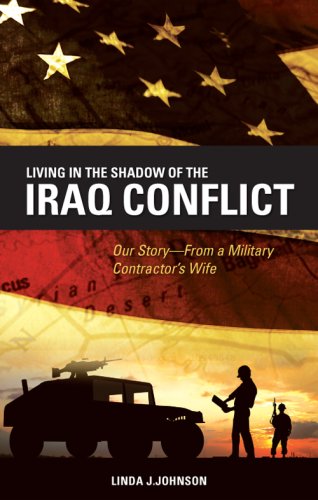
Shadow of Iraq

     This book is being dedicated to all of those brave men and women who have sacrificed home and country to work inside Iraq or Afghanistan during a time of conflict. You have worked alongside our military, and I thank you for your valiant efforts. To the families left behind, I applaud your bravery and selfless dedication as you supported your loved ones in their decision to go. ….I also wrote this for him, he will have a more cohesive and complete picture of what this journey has been like for me …back home with him gone.

Summary

     Many Americans only know military contractors from the little they have read in the media, which hasn’t always portrayed a pleasant picture.

Now, Linda J Johnson is bringing to light the real story behind her family’s sacrificing for their country in this capacity. She believes her story reflects thousands of American families who have been involved in the deployment of a loved one in support of our troops!

Faced with a job shortage on the Island of Kauai; Linda’s husband responded to a recruitment ad for a military contractor and his decision changed their lives forever. Since 2005, Linda began writing a journal to capture what he and their youngest son was seeing out on the battlefield, as well as what she was seeing in the changing of America. That journal became her new book. Through drastic ups and downs, Linda and Richard persevered with faith and pride in his work and in the U.S., constantly battling the negative attitude portrayed by the MSM towards military contractors and the war.

Learn what their lives are like when Living in the Shadow of the Iraq Conflict. Richard returned home in August of 2009 after having served four consecutive years as a military contractor in Baghdad, Iraq.

     About The Author

Linda J Johnson received her doctorate in Christian education in 1999. She also holds certification as a CISD (critical incident stress debriefor) counselor. She is an ordained minister and an internationally endorsed community services chaplain with the Church of God, Cleveland, TN.

Currently, Linda resides in Sioux Falls, South Dakota, where she contributes to the community as a substitute teacher and has headed up the 9/11 project for Awakening America. She has welcomed home her husband of thirty-two years and they are pursuing this project together as they tour and speak and sign books across the country.

Contact Linda J. JohnsonContact Linda J Johnson to book speaking engagements, book signings, or purchase author-signed copies. Leave your contact information in the body of the message.

Book website here.

Buy the book here.

Saturday, March 13, 2010

Iraq: Here Comes China And Their ‘Astonishing’ Oil Demand

   China’s demand for oil jumped by an “astonishing” 28% in January compared with the same month a year earlier, the International Energy Agency (IEA) says. 

*****

   Here is a quick run down on what China is doing in Iraq, and it is all about oil.  I find it interesting that China is getting more involved with really risky resource ventures in places like Iraq or the Congo. And what that means to this industry, is that the Chinese will find a way to secure these ventures and investments.  You will either see Chinese security folks, or they will use local nationals for the work.  But like with most security work, they tend to go with the kind of security they can really trust and depend upon for the most sensitive projects.  Especially to guard oil executives.

   The other thing about this that is frustrating, is that information about Chinese private security companies is very thin.  Maybe there is tons of stuff on Chinese servers?.  Who knows, but it is an area that I would like to learn more about as the fight for resources increases in the coming future. Our industry will only see more involvement in that resource war, and it is important to track this stuff.

   In Iraq, you could very well see a situation where you see Chinese security contractors rolling down the highway in SUVs, or posted at some gate of some oil facility. If any readers have any stories about bumping into Chinese military or contractors in Iraq, please feel free to post away in the comments.  Like I said, there is nothing written about Chinese PMC’s or PSC’s, and I would like to see Feral Jundi’s archives fill up with some more data about that.  I will keep looking, and if anyone finds anything else, let me know. Especially for Africa, because China is really involved there. –Matt

—————————————————————–

Chinese guards at the Ahdab field Thaier Al-Sudan/Reuters 

Red Star Over Iraq

January 21, 2010

China’s ambitions in the Iraqi oil fields could change the landscape

By Stanley Reed and Dexter Roberts

It may be the start of the biggest oil job in the world. Each day, 20 workers from BP and China National Petroleum Corp. (CNPC) buckle down to the task of prepping the Rumaila oil field in southern Iraq for rapid development. In industry lingo, Rumaila is a “supergiant”—a 50-mile-long deposit of sweet crude with estimated reserves of 16 billion barrels, whose output may someday rank second only to Saudi Arabia’s vast Ghawar field. The Saudis, though, have carefully managed their oil assets for decades. In contrast, Rumaila, a lightly inhabited expanse of date groves and Bedouin encampments, has not had a proper upgrade since the 1970s. The Iraqis contracted with BP and CNPC last year (BP) to juice Rumaila’s production from 1.06 million barrels a day to 2.85 million, all in seven years. No one has ever tried such a ramp-up at a field as huge as this one. Putting Rumaila back in full working order will take tens of thousands of workers, 1,000 new wells, and billions in investment.

BP is the largest partner in the venture, but only by a dipstick: It has a 38% stake, while the Chinese hold 37% (the rest is owned by an Iraqi company). The media focus has been on BP’s decision to take up the Rumaila challenge for a low fee of only $2 for every barrel the venture produces. But the more important story could be China’s role. “CNPC’s involvement brings together the country with the most rapid growth in energy demand in history with the country that plans the greatest buildup of production capacity ever,” says Alex Munton, an Iraq specialist at Edinburgh-based oil consultants Wood Mackenzie.

(more…)

Sunday, March 7, 2010

Film: So What Does Avatar, District 9, And The Hurtlocker All Have In Common? (Besides Bashing Those Evil Contractors And PMC’s)

   They are the top downloaded films of 2009, and they are all up for best picture at the Oscars.  Wow.

   Well everyone here knows my feelings on all of these movies.  I have had a chance to see all of them, and my opinions really haven’t changed too much.  Probably my favorite out of all of them, if I can put aside the whole ‘PMC’s are evil’ angle, is District 9. It trumps Avatar for a unique story and kick ass sci-fi. Plus they made it for way cheaper than Avatar, and you have to give it up for the little guys who do a lot with a little.

   I think the worse one for bashing the military and contractors, is Avatar. So for that, I wouldn’t mind seeing the Hurt Locker or District 9 beat out Avatar, just to see Cameron’s face in the close ups at the oscars. The Hurt Locker is probably the least offensive out of all of these films, but even in that film, they portrayed contractors (one of which was played by Ralph Fiennes) as murky seedy dudes of the desert, who only care about themselves and money. In other words, they played up the mercenary stereotype to the hilt in their portrayal of contractors in the film, and I was turned off. And in this scene, they act like the military was fearful of contractors in Iraq.  If anything, most of the military guys I came across wanted to be contractors or if they saw a contractor PSD team broken down on the side of the road, they usually pulled over and asked if we need any help.  The movie makes it seem like military and contractors were at odds with each other over there, and that could be the farthest from the truth.  Contractors also helped out the military with medical calls or security support, and I saw way more collaboration and mutual respect over there, than what the film portrayed.

   I have yet to see a company fork over the money and provide a Barrett M 82 .50 Cal for road work either. Not impossible, but highly unlikely, and especially with the weapon restrictions contractors faced in Iraq. If a British contractor would like to pipe in and prove me wrong on this, I am all ears.  I never saw them roll with that kind of weaponry out there, but I could be wrong.

   The funny thing with all of these films, is that I think more films will be made with PMC’s in them.  I am even optimistic enough that eventually someone will make a good movie that will portray this industry in a positive light.  The reason I say that, is because every time Hollywood tries to make political statements in their films, it backfires on them. Apocalypse Now was meant to be an anti-war film, and instead it turned into a cult classic.  Platoon, was meant to be an anti-war film, and made by an extreme left-wing loony tunes veteran named Oliver Stone. Instead, that film has become a cult classic.  Full Metal Jacket is another classic war film, that was meant to repulse the viewer about war and the military, and instead, it has created a following throughout the world. Hell, that movie is what motivated me, and thousands like me, to join the Marines. lol So will Hollywood only motivate others to want to become contractors, with their attempt at making ‘anti-contractor’ films?

   So will this new batch of anti-contractor/anti-PMC films, actually backfire on Hollywood?  Look at the video gaming industry?  Those are easily comparable to film releases and revenue, with multi-million dollar campaigns to sell them and huge start studded release parties, all trying to promote the allure of their shooter PMC related games.  There was even talk of making Army of Two a movie. Wow, I didn’t see that one coming.

   Look at the top downloaded films below, and the free market has definitely made it’s choice about what it wants.  And you know what? What the viewing public wants, it gets.  lol So will we see more films that involve this industry, and will Hollyweird continue to inadvertently elevate this industry through it’s naive attempt at demonizing us? I am getting more and more emails from kids and individuals who never served in the military or police, who want to become contractors or who are just interested in learning about the industry. Interesting cultural developments if you ask me, and that is why I cover this stuff.

   The best thing the film industry could do, if they really don’t like us, is to ignore this industry and keep us out of their scripts. But the temptation is just too strong, and I think we will see more films that have either negative or positive portrayals of contractors in them.  And that portrayal will further thread this industry into the fabric of culture–good or bad. Interesting times, and we will see who wins at the Oscars. –Matt

Edit: And the Hurt Locker wins Best Picture.  -hee hee

—————————————————————–


TorrentFreak’s Top Downloaded Films For 2009

1. District 9 – 12,639,000

2. Avatar – 11,326,000

3. The Hurt Locker – 7,930,000

4. Up – 5,437,000

5. Inglourious Basterds – 5,376,000

6. Precious – 4,922,000

7. Up In The Air – 4,855,000

8. A Serious Man – 3,836,000

9. The Blind Side – 1,845,00010. An Education – 683,000

Link to TorrentFreak blog here.

——————————————————————

Best Motion Picture Nominees of 2009

“Avatar” (20th Century Fox)

A Lightstorm Entertainment Production

es Cameron and Jon Landau, Producers

“The Blind Side” (Warner Bros.)

An Alcon Entertainment Production

Nominees to be determined

“District 9” (Sony Pictures Releasing)

A Block/Hanson Production

Peter Jackson and Carolynne Cunningham, Producers

“An Education” (Sony Pictures Classics)

A Finola Dwyer/Wildgaze Films Production

Finola Dwyer and Amanda Posey, Producers

“The Hurt Locker” (Summit Entertainment)

A Voltage Pictures Production

Nominees to be determined

“Inglourious Basterds” (The Weinstein Company)

A Weinstein Company/Universal Pictures/A Band Apart/Zehnte Babelsberg Production

Lawrence Bender, Producer

“Precious: Based on the Novel ‘Push’ by Sapphire” (Lionsgate)

A Lee Daniels Entertainment/Smokewood Entertainment Production

Lee Daniels, Sarah Siegel-Magness and Gary Magness, Producers

“A Serious Man” (Focus Features)

A Working Title Films Production

Joel Coen and Ethan Coen, Producers

“Up” (Walt Disney)

A Pixar Production

Jonas Rivera, Producer

“Up in the Air” (Paramount in association with Cold Spring Pictures and DW Studios)

A Montecito Picture Company Production

Daniel Dubiecki, Ivan Reitman and Jason Reitman, Producers

Link to the Oscars website here.

Thursday, March 4, 2010

Industry Talk: TigerSwan Awarded U.S. DoD Iraq Security Contract

   TigerSwan is doing this the smart way. Getting in with local Iraqi security companies and also providing linguists for projects is the way to go, as we slowly transition out of Iraq.  And this company has all the goods to make this contract work because they are all former CAG guys. So businesses should feel at least somewhat comfortable that they have some competent folks in charge.

     Definitely sign up for their news letter and check their career page every now and then, because I am sure we will see more security related jobs pop up in the future. Especially if Iraq plans on capitalizing on their oil fields and increasing their output big time. –Matt 

—————————————————————-

TigerSwan Awarded US Dept of Defense Iraq Security Contract

APEX, NC

March 2, 2010

TigerSwan announced today it has been awarded the contract for Personal Security Detail Services in support of the Task Force for Business and Stability Operations (TFBSO) in Iraq.The Task Force for Business and Stability Operations (TFBSO) is focused on economic stabilization of Iraq, with foreign direct investment, banking and financial systems, industrial capacity revitalization to corporate development, procurement assistance and budget execution, agriculture revitalization, and communications infrastructure. TFBSO also emphasizes the ability of bi-lateral operations between US and Iraq companies. The TFBSO was established in June 2006 to aid in the revitalization and stabilization of Iraq’s economy and to create jobs for the Iraqi people. Since that time, the organization has deployed more than 400 business leaders, engineers, subject-matter experts and accountants to work in partnership with Iraqi business and engineering professionals in every province of the country.Under terms of the $12 million contract, TigerSwan will provide all resources to support the contract, including an experienced multi-disciplined, project management team to ensure the security and safety of TFBSO personnel and sponsored visitors operating throughout all regions of Iraq; experienced, multi-cultured security personnel; analytical intelligence support; and logistics support to include multiple self-sustaining life support camps.

TigerSwan CEO James Reese praised TFBSO for its success in facilitating business (more…)

Publications: GAO Concludes That Contractors Are More Cost Effective Than Employees!

    Well duh. lol You guys don’t have to pay the pensions of contractors when their contract is done and the war is over. Of course the government loves to use this ‘disposable workforce’ called contractors.

     Thanks to David Isenberg who brought this to everyone’s attention through his blog, and you can read his assessment here.

     I do have an issue with the way GAO reworded the one instance that federal employees were more cost effective.  Why training, vetting and recruiting costs were not included in this last one, is interesting.  Is this because politically speaking, they are wanting to promote phasing out security contractors, and the GAO was pressured to write it that way? So instead of adding 240 million with the 162 million dollars to make the ‘grand total cost’ to the government for federal employee security specialists of 402 million dollars, they instead decided to stick with just the 240 million dollar figure? So in order to support their statement that security was not cost effective, they decided to split up the figure…(raised eyebrow) So with my simple math here, I show that private industry is more cost effective than the government for security work.

   Also, I wonder if legal fees and lawsuits were tacked into the costs, because private industry is definitely eating that bill with this war.  Just ask companies like Xe or DynCorp.  And as more legislation is passed, which allows more people to easily sue private industry, and/or makes it more difficult to sue the government, I think this is another area that needs some attention in the accounting process here. A company has to have it’s own costly legal apparatus. The government has a massive legal apparatus already and oodles of laws to protect itself from litigation.

     Just look at the dismal example of how many ‘few successful’ whistleblower cases there have been against government?  Office of Special Counsel should be changed to the Office of Protect the Government. Not to mention all the lawyers assigned to protect the various agencies and departments out there.  The government has a legal shield around it like you can’t believe, and all of it is funded by the tax payer.

   Overall, this is a good publication to show folks as proof that we are more cost effective and we do make sense to the government. So if you are ever in an argument with some dork about the nuts and bolts of contractor efficiency, just pull this sucker up and let the GAO do your talking. –Matt

——————————————————————-

Warfighter Support: A Cost Comparison of Using State Department Employees versus Contractors for Security Services in Iraq

GAO-10-266R March 4, 2010

Full Report (PDF, 20 pages)

Summary

In Process

Our comparison of likely State Department costs versus contractor costs for four task orders and one contract awarded by the State Department for security services in Iraq showed that for three of the task orders and the contract, the cost of using State Department employees would be greater than using contractors, while the State Department’s estimated cost to use federal employees was less for the other task order. For example, using State Department employees to provide static security for the embassy in Baghdad would have cost the department approximately $858 million for 1 year compared to the approximately $78 million charged by the contractor for the same time period. In contrast, our cost comparison of the task order for providing personal security for State Department employees while in the Baghdad region–which required personnel that have security clearances–showed that for this task order, the State Department’s estimated annual cost would have been about $240 million, whereas the contractor charged approximately $380 million for 1 year. However, because the State Department does not currently have a sufficient number of trained personnel to provide security in Iraq, the department would need to recruit, hire, and train additional employees at an additional cost of $162 million. Contract requirements are a major factor in determining whether contractors or government personnel are less expensive–especially factors such as whether personnel need security clearances. However, there are other factors that may play a role in the decision of whether to perform security services with federal employees or enough federal employees than to acquire contractors. Additionally, the government could potentially be faced with incurring some administrative costs from having to take actions to reduce government personnel if they are no longer needed. When using contractors, the department also incurs administrative costs for awarding the task orders and contract and providing oversight; however, the State Department was unable to estimate these costs. Finally, some costs associated with providing Iraq security services using federal employees–such as developing new career fields, providing additional overhead, and building new housing–are difficult to quantify.

Link to publication here.

« Newer PostsOlder Posts »

Powered by WordPress