Feral Jundi

Sunday, December 13, 2009

Iraq: Iraq Hails Second Oil Auction, But Risky Sites Shunned

Filed under: Industry Talk,Iraq — Tags: , , , , , , , , — Matt @ 7:20 AM

Even Gharraf’s winners appeared concerned despite its location in the relatively calm south.

“It depends on the security situation,” Katsuo Suzuki, Japex’s vice president, said when asked when the companies would begin work. “We are in contact with several security companies to discuss the security situations and analyze carefully the situation to decide our program.” 

*****

    “In contact with several security companies?”  Interesting news out of Iraq, and it is only logical that the next step in these deals is to evaluate how to properly secure operations there.  These companies want to succeed in their oil ventures, and you can bet that they will be seeking the best security companies out there that will insure that success.

   That means protecting the fields, the equipment, the employees, and the executives and engineers for these projects.  So you can guarantee that security will be partially coming from Iraqi companies and locals, and with a small contingent of security coming from highly skilled expats.  That is my guess, and it only stands to reason.

   Now one security company that might stand to benefit from this latest deal, is Oryol.  It would make sense that Lukoil would use a Russian security company for protective details.  I have no clue who Japex would use, and maybe some of the oil security pros out there can help to fill in the blanks. Of course there is the Oil Police down south, but companies will also want their own security that they can control and trust.  Either way, good on Iraq for getting this going, and the money earned from these deals will certainly help in the reconstruction of this war torn country. –Matt

Edit: 12/14/2009- I added a newer story on top of the original, in order to add more meat to this post. Check out both of them.

—————————————————————–

Oil executives gird for work in risky Iraq

* Global firms arrive in Baghdad for oil auction

* Security still a major concern for oil work in Iraq

By Missy Ryan

BAGHDAD, Dec 14 (Reuters) – They sped into the Oil Ministry in armoured convoys, flanked by muscled guards and men in dark suits, but oil executives marked a milestone this week when they attended an oil auction outside Baghdad’s fortified Green Zone.

It was a measure of a broad improvement in Iraq’s security that executives from 35 global oil firms came for the ministry’s two-day bid round in downtown Baghdad, where the landscape is scarred by six years of suicide bombs and other bloody attacks.
(more…)

Executive Protection: Corporate Security Officer, California

Filed under: Executive Protection,Jobs — Tags: , , , — Matt @ 6:50 AM

   This is for one of GE’s companies, NBC Universal.  It sounds like they want a retired police officer for this, but they will accept other types of security pros. No word on how much they are paying, and you will have to contact them directly. Good luck. –Matt

—————————————————————–

Job Number: 1122837

Business: NBC Universal

Business Segment: NBC Universal – West Coast Entertainment

About Us : NBC Universal is one of the world’s leading media and entertainment companies. We develop, produce and market entertainment, news and information to a global market. NBC Universal owns and operates a valuable portfolio of news and entertainment networks, a premier motion picture company, significant television production operations, a leading television stations group, and world-renowned theme parks.

Posted Position Title: Corp. Security, Investigator, Investigation & Executive Ops

Career Level: Experienced

Function: Environmental Health & Safety

Function Segment: Health and Safety

Location: United States

U.S. State or China Province: California

City: Universal City

Postal Code: 91608-1002

Relocation Expenses: None

Role Summary/Purpose: To conduct investigations for the Corporate Security Department. This investigative responsibility includes the Universal City Campus, the Burbank campus and related, remote television stations and Universal Studios Hollywood. To coordinate essential investigative activities with the Information Technology Department as appropriate. To coordinate investigations as necessary, with outside private agencies and public sector departments. Provide detailed reports, on the investigative function.

(more…)

Saturday, December 12, 2009

History: Benjamin Church and the Great Swamp Fight

Filed under: History — Tags: , , , , — Matt @ 9:06 AM

John Alderman was a Praying Indian who shot and killed Metacomet (also known as King Philip) in 1676 as part of an expedition led by Captain Benjamin Church.

As a reward, Alderman received King Philip’s head and one hand. The rest of King Philip’s body was quartered and hung on trees. Alderman later sold the severed head to the Fort Plymouth authorities for 30 shillings, a standard rate for Indian heads during King Philip’s War. The head was then placed on a stake in the fort, where it remained for the next 25 years. Reportedly Alderman would exhibit the scarred hand of Philip for a fee.

*****

   Now Benjamin wasn’t a contractor, but he sure did partake in the business of selling heads for 30 shillings a piece. lol  Just another example of how free markets were used back in the early days of this country.  Privateers look pretty tame compared to this practice.

    Could you imagine Church’s Rangers going after today’s Usama Bin Laden and Al Qaeda, and with that kind of a free market warfare mechanism in place?  If they were to kill him, we could put his head under glass and sell tickets to see the thing.  The money made from that, could go towards the families of the victims of this vile organization. That would be cool.

   The sad thing is, that if someone was to kill him and bring back his head to collect that 25 million dollars or whatever it is, more than likely that individual would be thrown in jail and scorned for such a thing.  They probably wouldn’t even pay the hero that did it. –Matt

—————————————————————

Woodcut print of Benjamin Church

Major Benjamin Church (c. 1639-January 17, 1718) was an American carpenter, military officer, and Ranger during America’s Colonial era, and specifically, King Philip’s War.

Biography

Born in Plymouth Colony in about 1639, Church married Alice Southworth on December 26, 1667 in Duxbury, Massachusetts. He resided for a time in Duxbury and later moved to Bristol, Rhode Island.

Church was the principal aide to Governor Josiah Winslow of Plymouth Colony. Holding the rank of captain, he fought during King Philip’s War (1675–1678) on the New England frontier against the Wampanoag, Nipmuck and Podunk tribes of Indians. He is best known for his actions during this time in commanding a company of men independent of the governor’s direct command. Church’s men were the first colonial force successful in raiding the Indians’ camps in forests and swamps. During previous decades, colonists were on the defense against the Natives, although relations were generally peaceful until 1675.

(more…)

Publications: RAND–The Phoenix Program and Contemporary Counterinsurgency

Filed under: Afghanistan,Publications — Tags: , , , , — Matt @ 7:51 AM

   I read these two articles by Mr. Haddick, and I took issue with a few points.  First, a viable COIN/Phoenix program would not only identify the enemy within an area, but it could also collect info on potential leaders to fill the gap once that enemy is removed.  And those leaders, in my view, are the natural tribal leaders that these folks would follow anyway. But really, that would be part of the mission as well, and that is to identify the best replacement leaders in a tribe or village and insure everything is in place before any action is taken.

   Or maybe you don’t take any action at all and just use that information that was collected for some bigger picture stuff. My point is that we need to understand the nodes of influence in these tribes and villages, and use that information to drive the strategies in our war efforts. Kill, capture, or just watch and learn–disrupt, dismantle, or destroy.

     I guess it would be nice if we could say that the government could fill in those vacancies, but in all actuality, a tribal leader would be better suited to watch over his people if some Taliban jackass was taken out of the picture. It would be nice if the government could control all of these tribes and rule over every square inch of their land, but at this time, and within the time frames we are trying to operate under, it is unrealistic.  I say co-op with the tribes, and co-op with the government at the same time, and maybe some day in the future the government can actually apply some rule of law and control in these remote areas. Besides, once the government is something that is appealing to the tribes, and there is actually some benefit, then they will naturally gravitate towards that kind of thing.  But with all the corruption and inability to protect anyone up in the hills, sorry, I don’t see it happening for them.  There are no Lions of Panjshir that I know of in government right now.

   Now the kind of program that I would like to see, is one that works with the types of tribes that support our efforts. The kind of tribes that hate the Taliban and do not want them to come back.  Next is to help these tribes, like with Maj. Gant’s TET concept, to defend themselves so they are strong enough to beat back the Big T.

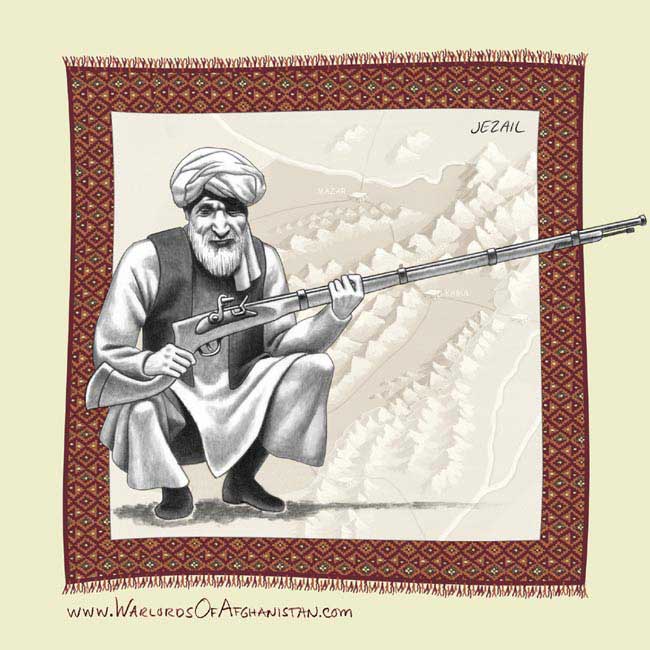
     Then recruit from these tribes to form a crew that has the guts and intelligence to do the kinds of operations that would keep up the pressure on the Taliban and company well into the future. That is where the Jezailchis Scouts would come in.  The JS would be the special forces of that tribe, and these scouts are the types that would be perfect for future Phoenix type programs.  Especially if we wanted to send folks disguised to be Taliban, into regions that are under the Taliban death grip.  You need smart and capable recruits for that kind of duty, much like the Selous Scouts were back in their war, and the Jezailchis Scouts could be the answer.

   The way I envision these scouts, is that they would be fully committed to the concept of killing Taliban and practicing their deadly trade of sniping and tracking. These are the heroes and warriors of the tribes who would pride themselves on how well they shoot and maneuver in the mountains.  These are the real mountain men of the region, and once this is in full swing, we could be tapping into this deadly resource for all types of missions. That is the kind of folks you would need to do really specialized types of operations, like what a Phoenix program would require.  And if we were to look at how the Selous Scouts were able to assemble similar types of teams, then you would see the logic behind this and how lethal it could be.  You could even recruit former Taliban for something like this, and they would be ideal candidates because of their intimate knowledge of the enemy.

   That is my thoughts on the matter, and I would like to hear what you guys think?  Either way, check out this paper on the Phoenix program and see if you can ‘build a snowmobile’ out of it. –Matt

——————————————————————-

Jezailchis

The Jezailchis Scout? 

Does Afghanistan need a Phoenix Program?

By Robert Haddick

July 31, 2009

The Office of the Secretary of Defense hired the RAND Corporation to study the Vietnam-era Phoenix Program and recommend whether some of the program’s controversial techniques might be useful in Afghanistan. RAND’s researchers endorsed a Phoenix-like effort for Afghanistan and in the process, attempted to dispel some of the program’s myths.

What was the Phoenix program? RAND’s relatively brief report summarizes its history: In 1967 the U.S. military command and the CIA created a program — later called Phoenix — that began as an effort to improve intelligence-sharing among a long list of U.S. and South Vietnamese agencies.

(more…)

PMC 2.0: Social Networks as Foreign Policy, The Onion Router, and Humari Awaz

Defense Secretary Robert Gates, who has written about the efficacy of samizdat in undermining the Soviet Union, sees a similar dynamic at work here. “The freedom of communication and the nature of it,” he has said, “is a huge strategic asset for the United States.” 

*****

    These three stories are all inter-related and based on this first one below.  The more I read this, the more I keep thinking that someone is reading Feral Jundi and taking the hint.  lol.  There are all sorts of things we could be doing with these technologies, and it is great to see some innovation in that department.  I especially like the Humari project, because that is flipping cool.  Facebook is already accessible on a mobile platform, but to actually create a social network for mobile for the Pakistani market?  That is neat.

   Why are these stories in PMC 2.0? Because not only is the freedom of communication and the nature of it an excellent strategic asset for the US, it is an excellent strategic asset for companies.  I recommend the reader to go back through all of the PMC 2.0 and social networking related posts that I have made in the past, and evaluate for yourself on the validity of this concept.  The future is coming and everyone will have mobile smart phones and everyone will be using social networking sites.  Is your company ready for that?-Matt

Edit: 12/14/2009- Check out this paper written at the Heritage Foundation about Public Diplomacy 2.0.

————————————————————–

Social Networks as Foreign Policy

12/12/2009

From the 9th Annual Year in Ideas

In August, after the suppression of Iran’s pro-democracy protests, officials in Tehran accused Western governments of using online social networks like Twitter and Facebook to help execute a “soft coup.” The accusation wasn’t entirely off-base. In Iran and elsewhere, this year showed the growing importance of social networks to U.S. foreign policy.

Long before the protests in Iran started, the Broadcasting Board of Governors, which oversees U.S. civilian international broadcasting, had in place software to counter censorship in countries like Iran, so people could better access the blogosphere. And the State Department financially supports agencies that make it easier for Iranians and others to surf the Web. After the protests began, the State Department asked Twitter to reschedule a maintenance outage so the activists could continue to spread the word about their movement.

The United States has long disseminated information to people living under repressive regimes — think of Radio Free Europe. The difference here is that the content of the information isn’t the important thing; the emphasis is on supporting the technical infrastructure and then letting the people decide for themselves what to say. Communication itself erodes despots’ authority. “The very existence of social networks is a net good,” says Alec Ross, a senior adviser on innovation to Secretary of State Hillary Clinton.

(more…)

« Newer PostsOlder Posts »

Powered by WordPress