Thursday, October 29, 2009
Film: Chalk Up Another Crappy Iraq War Movie–‘Green Zone’
Wednesday, October 28, 2009
Weapons Stuff: Rhodesian Cover Shooting or ‘Drake Shooting’
This is a great read, and I highly recommend checking it out. Ian has basically broken down the operations of his unit, and the use of this efficient and lethal shooting technique. –Matt
—————————————————————–
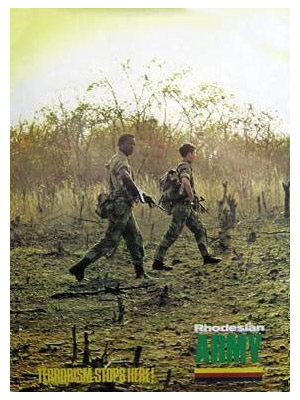
RHODESIAN COVER SHOOTING
By “Ian Rhodes”, 2 Commando, Rhodesian Light Infantry
Prelude
Also known as Drake Shooting, Rhodesian Cover Shooting may be defined as the shooting technique employed to quickly kill concealed insurgents through the various phases of close quarter combat in the African savanna and jesse bush. The method did not replace “fire and movement” procedures, but was rather the primary activity of them. Cover shooting has also been described as a “flushing” action, but this is not strictly accurate. While flushing terrorists from their concealment has obvious advantages, particularly when working with close helicopter support, the first objective of cover shooting was to kill the enemy without the need to see him or locate his exact position first. Likewise the method should not be confused with other foreign practises such as walking suppression fire directed “at the jungle.” Cover shooting was not a random spraying of bullets, but a deliberate and methodical routine designed to elicit maximum effect for the least expenditure of ammunition. After the declaration of U.D.I. in 1965, the Rhodesian war continued for another 15 years and tactics changed greatly as lessons were learned during that time. For this reason experiences may well disagree on opinion and detail. This discussion is also somewhat biased towards the practises of the Rhodesian Light Infantry (RLI) and the combat patrols of the Police Anti-Terrorist Unit (PATU). As such, it cannot be held up as either definitive, or complete. In 1964 the Rhodesian Light Infantry changed roles to that of a Commando Battalion. Deployed in rapid reaction “Fire Force” operations designed to vertically envelop insurgent groups, the cover shooting technique played a significant part in the Battalions overall success. In it`s 19 years of existence, most of those fighting at the very forefront of a bush war, the Rhodesian Light Infantry never lost a battle.
PDF for Rhodesian Cover Shooting or Drake Shooting here.
Afghanistan: Three Contractors Killed in Plane Crash
This kind of missed the news, and adds to the brutal list of air accidents that have happened recently. RIP. –Matt
——————————————————————
3 bodies found in US plane wreckage in Afghanistan
October 27, 2009
KABUL — NATO-led forces have recovered the remains of three American military contractors from the wreckage of a U.S. Army reconnaissance plane that crashed two weeks ago in the rugged mountains of northeastern Afghanistan, the military said Tuesday.
The Army C-12 Huron twin-engine turboprop had been missing since it crashed Oct. 13 while on a routine mission in Nuristan province, a Taliban insurgent stronghold. The plane went down less than two weeks after insurgents overran a coalition outpost the same province, killing eight American troops in one of the war’s deadliest battles for the U.S.
NATO said in a statement that the crash is “under investigation, though hostile action is not believed to be the cause of the crash.”
Thomas Casey, a spokesman for Lockheed Martin Corp., confirmed that the three dead men — a pilot, co-pilot and technician — were American citizens working for Lockheed Martin subcontractors.
They were employed under a Lockheed Martin contract for “counter-narcoterrorism” operations, Casey said.
U.S. forces spokesman Col. Wayne Shanks said the crew were the only ones aboard when the craft went down without giving off any distress signals.
“We just lost contact,” Shanks told The Associated Press.
Nuristan has been the site of the two deadliest battles of the war for U.S. forces, including the Oct. 2 attack in the province’s Kamdesh outpost and a July 2008 raid that killed nine American soldiers at an outpost in Wanat area.
The NATO-led mission is planning to withdraw troops such isolated strongholds to focus on more heavily populated areas as part of a new strategy to protect Afghan civilians.
Shanks said the plane was on a mission for NATO-led forces at the time, but he gave no other details. Casey said only that it was a surveillance mission.
The pilot and co-pilot worked for a company called Avenge Inc., while the technician was employed by a contractor called Sierra Nevada Corp., Casey said.
The military said a UH-60 helicopter traveling to the crash site four days later “experienced a strong downdraft and performed a hard landing” nearby. The helicopter’s crew members were rescued, and the chopper was stripped of sensitive and useable parts and destroyed to keep insurgents from salvaging anything in the wreckage.
Story here.