Feral Jundi

Monday, December 14, 2009

Logistics: For U.S. Troops in Afghanistan, Supplies Are Another Battle

“At this phase, Afghanistan is a logistics war as much as any other kind of war,” said Mr. Carter, whose formal title is under secretary of defense for acquisition, technology and logistics, in a recent interview. 

*****

   Oh yeah, logistics, and not one mention of the contractors that will be responsible for getting those things into Afghanistan.  Maybe August could write a story about that sometime, because I know we are going to be in the thick of it all. I will keep my eye out, but at least this story gave a few indicators of the concerns with logistics. –Matt

—————————————————————–

For U.S. Troops in Afghanistan, Supplies Are Another Battle

December 14, 2009

By August Cole

The White House has settled on sending additional troops to Afghanistan, and now the Pentagon must grapple with another thorny problem: how to support them once they get there.

For Ashton Carter, the top Pentagon official in charge of weapons purchases, that has meant focusing on the concrete — literally. Basic materials for building bases are in short supply or nonexistent in Afghanistan, so U.S. officials must search for staples like concrete next door in Pakistan.

Another priority: Getting thousands of blast-resistant trucks from Oshkosh Corp.’s factory in Oshkosh, Wis., to U.S. forces in the Afghan hinterlands.

“At this phase, Afghanistan is a logistics war as much as any other kind of war,” said Mr. Carter, whose formal title is under secretary of defense for acquisition, technology and logistics, in a recent interview.

Unlike Iraq, Afghanistan has no modern infrastructure. Critical supplies such as fuel must be imported. The country is landlocked and has just three major overland routes. Enormous distances separate bases and outposts. High mountains and valleys, as well as extreme weather, make air travel difficult.
(more…)

Legal News: Omnibus Bill FY 2010–Embassy and Worldwide Security Protection Stuff

     I found this over at Diplopundit, which is a great blog that tracks this stuff.  They basically broke down the bill as to the budget amounts and any new amendments.  I especially clued into the latest budgetary figures, increases in new security positions, and the latest ‘best value’ contracting mechanism that State has. They even mention the Kabul Fiasco specifically, as a reason for the amendment.  Check it out. –Matt

——————————————————————-

From Diplopundit:

Worldwide Security Protection

The conference agreement provides $1,586,214,000 for Worldwide Security Protection, which is $8,787,000 above the House and $8,786,000 below the Senate. The conferees note that $13,375,000 requested for fiscal year 2010 was included in the Supplemental Appropriations Act, 2009 (Public Law 111-32), bringing the total available for Worldwide Security Protection in fiscal year 2010 to $1,599,589,000. Within the amount provided, $221,926,000, and a projected 200 security positions, are to strengthen the Department’s capacity to respond to the growing security challenges at posts around the world, including the requested positions for the second year of the Visa and Passport Security Plan.

Embassy Security Constructions and Maintenance

The conference agreement provides $1,724,150,000 for Embassy Security, Construction, and Maintenance, which is the same as the House and Senate, of which $847,300,000 is for priority worldwide security upgrades, acquisition, and construction and $876,850,000 is for other operations, maintenance and construction.

The following provisions are new, modified from the Omnibus Appropriations Act, 2009 (Public Law 111-8), or further clarified in this joint statement.

Sec. 7006. Local Guard Contracts.

The conference agreement includes a new provision which allows the Secretary of State flexibility to award local guard contracts on the basis of either lowest price that is technically acceptable or the best value cost-technical tradeoff (as defined in the Federal Acquisition Regulation part 15.101) when awarding such contracts in Afghanistan, Iraq and Pakistan.

Current law requires that all local guard contracts must be awarded on the basis of the lowest price that is technically acceptable, and if other factors had been considered, the problems reported earlier this year involving the local guard contract in Kabul, Afghanistan may have been prevented. The conferees understand that providing the Secretary with authority to make awards through the best value approach can enhance the guard force’s effectiveness and justify the additional cost, particularly in countries with dangerous or hostile environments.

Check out Diplopundit here.

Saturday, December 12, 2009

Publications: RAND–The Phoenix Program and Contemporary Counterinsurgency

Filed under: Afghanistan,Publications — Tags: , , , , — Matt @ 7:51 AM

   I read these two articles by Mr. Haddick, and I took issue with a few points.  First, a viable COIN/Phoenix program would not only identify the enemy within an area, but it could also collect info on potential leaders to fill the gap once that enemy is removed.  And those leaders, in my view, are the natural tribal leaders that these folks would follow anyway. But really, that would be part of the mission as well, and that is to identify the best replacement leaders in a tribe or village and insure everything is in place before any action is taken.

   Or maybe you don’t take any action at all and just use that information that was collected for some bigger picture stuff. My point is that we need to understand the nodes of influence in these tribes and villages, and use that information to drive the strategies in our war efforts. Kill, capture, or just watch and learn–disrupt, dismantle, or destroy.

     I guess it would be nice if we could say that the government could fill in those vacancies, but in all actuality, a tribal leader would be better suited to watch over his people if some Taliban jackass was taken out of the picture. It would be nice if the government could control all of these tribes and rule over every square inch of their land, but at this time, and within the time frames we are trying to operate under, it is unrealistic.  I say co-op with the tribes, and co-op with the government at the same time, and maybe some day in the future the government can actually apply some rule of law and control in these remote areas. Besides, once the government is something that is appealing to the tribes, and there is actually some benefit, then they will naturally gravitate towards that kind of thing.  But with all the corruption and inability to protect anyone up in the hills, sorry, I don’t see it happening for them.  There are no Lions of Panjshir that I know of in government right now.

   Now the kind of program that I would like to see, is one that works with the types of tribes that support our efforts. The kind of tribes that hate the Taliban and do not want them to come back.  Next is to help these tribes, like with Maj. Gant’s TET concept, to defend themselves so they are strong enough to beat back the Big T.

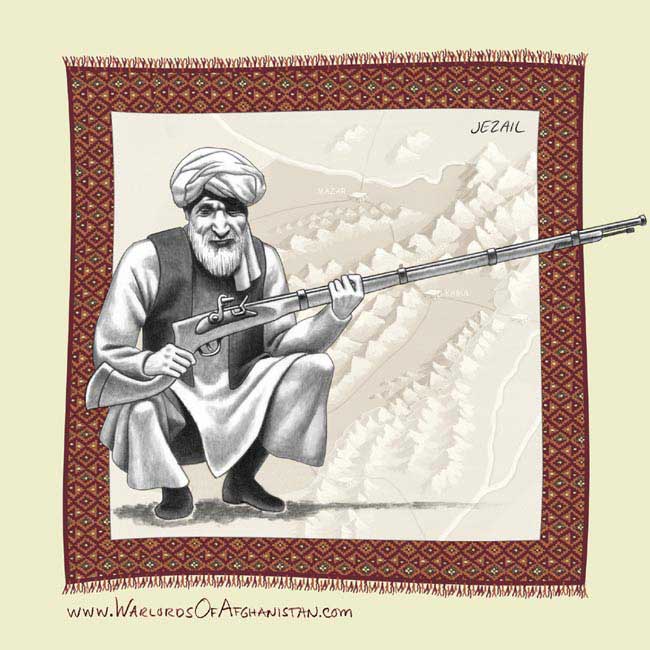
     Then recruit from these tribes to form a crew that has the guts and intelligence to do the kinds of operations that would keep up the pressure on the Taliban and company well into the future. That is where the Jezailchis Scouts would come in.  The JS would be the special forces of that tribe, and these scouts are the types that would be perfect for future Phoenix type programs.  Especially if we wanted to send folks disguised to be Taliban, into regions that are under the Taliban death grip.  You need smart and capable recruits for that kind of duty, much like the Selous Scouts were back in their war, and the Jezailchis Scouts could be the answer.

   The way I envision these scouts, is that they would be fully committed to the concept of killing Taliban and practicing their deadly trade of sniping and tracking. These are the heroes and warriors of the tribes who would pride themselves on how well they shoot and maneuver in the mountains.  These are the real mountain men of the region, and once this is in full swing, we could be tapping into this deadly resource for all types of missions. That is the kind of folks you would need to do really specialized types of operations, like what a Phoenix program would require.  And if we were to look at how the Selous Scouts were able to assemble similar types of teams, then you would see the logic behind this and how lethal it could be.  You could even recruit former Taliban for something like this, and they would be ideal candidates because of their intimate knowledge of the enemy.

   That is my thoughts on the matter, and I would like to hear what you guys think?  Either way, check out this paper on the Phoenix program and see if you can ‘build a snowmobile’ out of it. –Matt

——————————————————————-

Jezailchis

The Jezailchis Scout? 

Does Afghanistan need a Phoenix Program?

By Robert Haddick

July 31, 2009

The Office of the Secretary of Defense hired the RAND Corporation to study the Vietnam-era Phoenix Program and recommend whether some of the program’s controversial techniques might be useful in Afghanistan. RAND’s researchers endorsed a Phoenix-like effort for Afghanistan and in the process, attempted to dispel some of the program’s myths.

What was the Phoenix program? RAND’s relatively brief report summarizes its history: In 1967 the U.S. military command and the CIA created a program — later called Phoenix — that began as an effort to improve intelligence-sharing among a long list of U.S. and South Vietnamese agencies.

(more…)

Thursday, December 10, 2009

Afghanistan: The Taliban Pay More Than The Afghan Army?

Filed under: Afghanistan — Tags: , , , , , — Matt @ 9:43 AM

   I am sorry, but this is unacceptable.  So all along, the Taliban have been paying more for it’s recruits than the Afghan Army has been paying theirs?  Who dropped the ball on this one, because this is huge in my book. For any strategists who would like to learn a quick lesson on war and economics, especially coming from one of us ‘evil security contractors’, the math is simple.  The locals will always go for the best deal possible, and if the Taliban are paying more, then of course they are going to join them.

   It reminds me of the latest GAO report on the State Department’s problem with trying hire enough supervisors to manage the WPPS crew.  If you pay so little for a position like this, what do you expect? Of course contractors are not going to sign up for such a thing.  I love the phrase, ‘pay peanuts and you get monkeys’.  Well in this case, the applicable phrase is that you ‘get what you pay for’.

   Not to mention the fact that every village and tribe out there is hedging their bets right now as to who will be in charge a year from now, five years from now, ten years from now, and etc.  If survival means working for their cousin up in the hills as a ‘little T’ or contract Taliban, and make a little money off the venture, then so be it.  Until the government of Afghanistan can show that it is not corrupt and that it is willing to actually pay their guys a decent salary, then of course these folks are gonna go for the better deal.

     The Afghan Army has to show capability as well, and if they lack motivation or discipline to accomplish the mission of killing the Taliban and company, then why would anyone want to join them? Success breeds success, and everyone likes a winner.

   Glad to see someone woke up and realized that this needed fixing. I think the Army will definitely see an uptick in recruits and in retention, and in turn, less recruits for the Taliban. Duh.

    The other question though is how long can we, I mean the Afghans, pay for these salaries?  Unlike Iraq with it’s oil, Afghanistan really has nothing to pay for anything. –Matt

——————————————————————

Pay increase for Afghan troops boosts interest

APPLICATIONS ARE ON THE RISE

Obama strategy depends on well-trained force

By Glenn KesslerThursday, December 10, 2009

KABUL — A recent pay increase for Afghan troops and police appears to have resulted in a surge of applicants, said the top U.S. military official for Afghan security training.

Lt. Gen. William B. Caldwell IV, citing Afghan statistics, said 2,659 Afghans had applied to join the security forces in the first seven days of this month, about half of the month’s recruiting objective. In the three previous months, recruiting fell short of targets, with only 830 applicants in September, he said.

President Obama’s new strategy for Afghanistan, which calls for 30,000 U.S. reinforcements next year, depends heavily on the rapid development of a well-trained Afghan force that can begin to take over security from U.S. and NATO forces. Afghanistan has about 97,000 troops and 95,000 police officers, but they are poorly trained, have high turnover rates and are prone to corruption.

(more…)

Wednesday, December 9, 2009

Industry Talk: U.S. Seeks New Guards in Kabul

   Finally.  Now lets hope that they will square this stuff away and do what is necessary to prevent this from getting out of hand again in the future.  I would also hope that the State Department would fire a few folks responsible for not doing what was necessary to control this contract and maintain order starting back in 2007.

   Now one thing I hope doesn’t happen, is that the good guys on this contract who didn’t do anything wrong, don’t get shoved onto some black list.  That is stupid.  The folks who are at fault, are the leaders, and those are the ones that should be on a black list.  To put everyone that was ever involved with this contract on some dorkwad list, or who had worked for AGNA at one point or another on a no hire list, is not right.  Identify who the problem children were, and put them on the black list if need be.

    And for those guys who are innocent of any wrong doing or got caught up in this poorly managed mess, I wish you well and I really hope this doesn’t tarnish your chances for future employment.

   The other story on this, is check out David Isenberg’s article at PMH about IPOA and it’s slow progress on the investigation of complaints in regards to Armor Group North America’s performance. Especially after it was brought up at the hearing. –Matt

——————————————————————

U.S. Seeks New Guards in Kabul

December 9, 2009

By AUGUST COLE

The State Department plans to seek new bids to protect the U.S. Embassy in Kabul after the current firm ran into staffing and oversight problems.

The company, ArmorGroup North America, a unit of Wackenhut Services Inc., will be allowed to bid on the new contract, the State Department said.

“The recent allegations of misconduct and various contract compliance deficiencies led us to conclude it was in the best interest of the government to compete a new contract,” said P.J. Crowley, assistant secretary of state for public affairs.

The plan to rebid the contract was earlier disclosed by the Project on Government Oversight, an independent watchdog group that in September released lurid photos and videos of ArmorGroup guards at a party.

(more…)

« Newer PostsOlder Posts »

Powered by WordPress